
BuddhistCatholicContemplativeEvangelicalGeneral ChristianHinduJewishLatter-day SaintMuslimNew VisionsProgressive Christian
Beliefs
- Buddhist
- Catholic
- Contemplative
- Evangelical
- General Christian
- Hindu
- Jewish
- Latter-day Saint
- More Voices
- Muslim
- New Visions
- Pagan
- Progressive Christian
Topics
- Religion News
- Food and Religion
- Sports and Religion
- Religious Art
- Religious Music and Entertainment
- Religious Events
- History and Religion
- Style and Religion
- Politics and Religion
- Women in Religion
- Recreation Outdoors and Religion
- Business Finance and Religion
- Careers Workplace and Religion
- Education and Religion
- Family Parenting and Religion
- Health Fitness and Religion
- Home and Religion
- Relationships and Religion
- Technology and Religion
- Travel and Religion
Columnists
- Buddhist Columnists
- Business Finance and Religion Columnists
- Careers Workplace and Religion Columnists
- Catholic Columnists
- Contemplative Columnists
- Education and Religion Columnists
- Evangelists Columnists
- Family Parenting and Religion Columnists
- General Christian Columnists
- Health Fitness and Religion Columnists
- Hindu Columnists
- History and Religion Columnists
- Home and Religion Columnists
- Jewish Columnists
- More Voices Columnists
- Latter Day Columnists
- Muslim Columnists
- New Visions Columnists
- Nonreligious Columnists
- Pagan Columnists
- Politics and Religion Columnists
- Progressive Columnists
- Recreation Outdoors and Religion Columnists
- Relationships and Religion Columnists
- Religion News Columnists
- Religious Art Columnists
- Religious Events Columnists
- Religious Music and Entertainment Columnists
- Sports and Religion Columnists
- Style and Religion Columnists
- Technology and Religion Columnists
- Travel and Religion Columnists
- Women in Religion Columnists
Resource Library
- 2026 Calendar
- Library of World Religions
- The 100 Most Holy Places on Earth
- Patheos Answers
- Podcasts
- Videos
- Faith Leaders Database
- Anglican Episcopalian
- Bahai
- Baptist
- Buddhism
- Christianity
- Confucianism
- Eastern Orthodoxy
- Hinduism
- Holiness and Pentecostal
- ISKCON
- Islam
- Judaism
- Lutheran
- Methodist
- The Church of Jesus Christ of Latter-day Saints
- New Age
- Paganism
- Presbytarian and Reformed
- Protestantism
- Religion Behind the Scenes
- Roman Catholic
- Scientology
- Shia Islam
- Sikhism
- Sufism
- Sunni Islam
- Taoism
- Zen
- See all religions
Research Tools
 Ad-Free & Subscriber Log-In Subscription Support
Ad-Free & Subscriber Log-In Subscription Support
Follow Patheos 

- Trending:
- Forgiveness
- |
- Marriage
- |
- Consciousness
- |
- Death Penalty
- |
- Election
- |
- Halloween
 Letters from the Edge of Elfland
- Home
- About
- Distributist Resources
- Publications and Presentations
- Support
- Works in Progress
- The Epistolarian Around the Web
- Home
- Catholic
- Pope Francis in Elfland: Reflections on Laudato Si’ Part II
Pope Francis in Elfland: Reflections on Laudato Si’ Part II
Last updated on: September 1, 2016 at 9:35 am by David Russell Mosley
Pope Francis in Elfland: Reflections on Laudato Si’ Part II 2016-09-01T09:35:55-04:00 David Russell Mosley
Patheos Explore the world's faith through different perspectives on religion and spirituality! Patheos has the views of the prevalent religions and spiritualities of the world.
David Russell Mosley
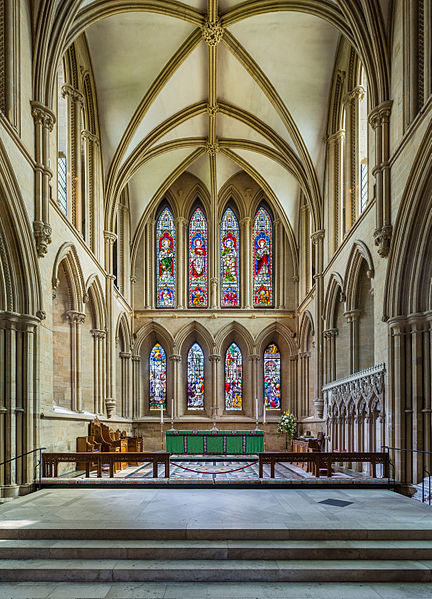
The high altar of Southwell Minster viewed from the sanctuary, in Nottinghamshire, England.
Photo by DAVID ILIFF. License: CC-BY-SA 3.0
Ordinary Time
1 September 2016
The Edge of Elfland
Hudson, New Hampshire
Dear Readers,
The other day I wrote to you concerning some initial reflections on the relationship between Elfland, as I often talk and write about it, and Pope Francis’ understanding of creation in his Encyclical Laudato Si’. In that letter I mentioned that I would turn to the Eucharist in a second letter and so today, I sit down to write you that letter.
In the final chapter of Laudato Si’, which Pope Francis entitles “Ecological Education and Spirituality,” the good pontiff writes about new ways of living in and seeing creation. I touched on many of those in my last letter. After a section on Civic and Political Love, the Pope turns to the sacraments. This is, I believe, a natural turn. As we progress deeper into our understanding of reality and the relations that subsist within it, it is natural that we would turn to and encounter the sacraments.
Pope Francis writes:
“The Sacraments are a privileged way in which nature is taken up by God to become a means of mediating supernatural life. Through our worship of God, we are invited to embrace the world on a different plane. Water, oil, fire and colors are taken up in all their symbolic power and incorporated in our act of praise.”1
I am, perhaps as always, reminded of a line from Tolkien which I quoted in my last letter. I won’t repeat it verbatim now, but in it, Tolkien reminds us that all things can be found in Elfland, trees, rocks, water, bread, wine. These physical realities get bound up with divinity in a particular way when we encounter them in the Sacraments. Water, which we commonly use for bathing, becomes the means by which God cleanses us from sin. A contaminant which normally no amount of water can cleanse from you, in the act of baptism, is washed away and is so in part by the presence of God in the baptismal waters. Oil too, a thing which once was used as a beautifier, and still is for those familiar with things like beard oil or the many uses of essential oils, becomes a means of sealing us with God, of anointing us, setting us apart. “Encountering God,” as Pope Francis writes, “does not mean fleeing from this world, turning our back on nature.”2 Rather, as Pope Francis reminds us:
“For Christians, all creatures of the material universe find their true meaning in the incarnate Word, for the Son of God has incorporated in his person part of the material world, planting in it a seed of definitive transformation.”3
This turn to the Incarnation is quite intentional, for, in this life, after the ascension of Christ and the descent of the Spirit, we now encounter Christ physically in the Eucharist, that, in many ways, preeminent sacrament. It is preeminent both because it is the sacrament in which we meet Jesus in a way in which we do not meet him elsewhere. It is also preeminent in its gratuity for one does not need it for salvation (for that only baptism is required) and yet the Christian life is more difficult without encountering Christ in the Eucharist in some way. For Pope Francis, the Eucharist is the ultimate exaltation of creation. He writes:
“It is in the Eucharist that all that has been created finds its greatest exaltation. Grace, which tends to manifest itself tangibly, found unsurpassable expression when God himself became man and gave himself as food for his creatures..”4
First Christ binds creation to himself by taking on our nature. Now he binds it to himself anew by binding his divine and human natures to bread and wine in the Eucharist. Now from these humble elements, all of creation spins out as if spokes from a center. It is cosmic, says Pope Francis, quoting Pope St. John Paul II:
“Indeed the Eucharist is itself an act of cosmic love: ‘Yes, cosmic! Because even when celebrated on the humble altar of a country church, the Eucharist is always in some way celebrated on the altar of the world” [Encyclical Letter Ecclesia de Eucharistia (17 April 2003), 8: AAS 95 (2003), 438].”5
I love this image. It’s something I loved about going in and wandering about the medieval churches in England in small, rural communities. Here in this church, which survived Henry VIII, the Eucharist is celebrated, sometimes by only a small handful of the faithful. Yet this small act, like the ones in which I participated when my son’s immune system was too compromised for all of us to go to church, involving so few people is not simply being celebrated in that small church, on that humble altar, but is being celebrated cosmically as well as it foretells the future wedding feast of the Lamb. Indeed, in this moment, really in the liturgy in general, time and the eternal, heaven and earth meet and commingle. We are given a foretaste of our deification in those moments. Pope Francis tells us:
“The Eucharist joins heaven and earth; it embraces and penetrates all creation. The world which came forth from God’s hands returns to him in blessed and undivided adoration: in the bread of the Eucharist, ‘creation is projected towards divinization, towards the holy wedding feast, towards unification with the Creator himself’ [Benedict XVI, Homily for the Mass of Corpus Domini (15 June 2006): AAS 98 (2006), 513]. Thus, the Eucharist is also a source of light and motivation for our concerns for the environment, directing us to be stewards of all creation.”6
Because of the cosmic implications of the Eucharist, however humbly celebrated, because the Eucharist entails the joining together of heaven and earth, all creation participates in its celebration. Because of this, we must, therefore, see it as source for our concerns for creation. On the one hand this really ought to be obvious. The more we despoil creation, the fewer fields there will be for wheat and grape vines and thus the elements of the Eucharist will become more scarce, which is not good. It is not good not only because these are the elements necessary for the celebration of the Eucharist, but because, as Thomas Aquinas reminds us, they are things by which men are commonly fed. Bread and wine ought to be at the service of men and women everywhere and their loss on the altar is just as bad as their loss in the hands of the poor.
Again, I am brought back to Elfland. In that perilous realm we can begin to see things for what they truly are. Evil is unveiled and shown in its grotesque and perverse form. Yet beauty too is unveiled. The poor man’s face, as Pope Francis writes, can unfold “mystical meaning.”7 Trees show their kinship to the Tree of Life as well as to the hallowed rood on which Christ was crucified. Bread and wine become flesh and blood.
Pope Francis’ explanation of the place of the sacraments and the Eucharist in particular in creation betrays a kind of sacramental ontology. Creation itself is a sign that signifies and participates in that of which it is a sign, namely the Holy Trinity. We know this in part by virtue of nature itself, but the book of Creation is not enough to tell us about who God is. Thus we have the Eucharist, and the other sacraments. Here heaven and earth reveal their kinship, that heaven upholds earth, that grace perfects nature. So the particular instances of the sacraments show us that creation itself is sacramental. As I said in my last, while Pope Francis makes no reference to Elfland, he clearly walks in its woods.
Sincerely,
David
1 6.235
2 6.235
3 6.235
4 6.236
5 6.236
6 6.236
7 6.233
The Radical Catholic Reimagination of Everything
Previous Post
August 30, 2016
Pope Francis in Elfland: Reflections on Laudato Si' Part I

Browse Our Archives
Select a Category A Secular Age Advent Apologetics Atheism Beauty Being a Catholic Evangelical Being Catholic Being Deified: Poetry and Fantasy on the Path to God Blogging Book Reviews C. S. Lewis Catholic Imagination Catholic Social Teaching Catholicism Christmas Church Calendar Church Fathers Church Life Community Conferences Cosmology Creation Curdled Words Deification Distributism Easter Economics Education Epiphany Essay Extracts Eucharist Faerie Faeriean Metaphysics Fatherhood Films Folk Liturgy Food and Drink G. K. Chesterton Harry Potter J. R. R. Tolkien Jove King Arthur Language Lent Life Literature and Poetry Liturgy Medieval Theology Music My Publications Mythology On the Edges of Elfland Ordinary Time Ordination Parenthood Parish Patristic Theology Pentecost Politics Prayer Racism Radical Orthodoxy Restoration Movement Sacramental Ontology Saints Science Sex and Sexuality Sophiology Stories The Inklings The Radical Catholic Reimagination of Everything Theologians in the Church Theopoetics Thesis Research Uncategorized University of Nottingham What I'm Reading Writing
Select a Month December 2019 November 2019 October 2019 September 2019 August 2019 July 2019 June 2019 May 2019 April 2019 March 2019 February 2019 January 2019 December 2018 November 2018 October 2018 September 2018 August 2018 July 2018 June 2018 May 2018 April 2018 March 2018 February 2018 January 2018 December 2017 November 2017 October 2017 August 2017 July 2017 June 2017 May 2017 April 2017 March 2017 February 2017 January 2017 December 2016 November 2016 October 2016 September 2016 August 2016 July 2016 June 2016 May 2016 April 2016 March 2016 February 2016 January 2016 December 2015 November 2015 October 2015 September 2015 August 2015 July 2015 June 2015 May 2015 April 2015 March 2015 February 2015 January 2015 December 2014 November 2014 October 2014 September 2014 August 2014 July 2014 June 2014 May 2014 April 2014 March 2014 February 2014 January 2014 December 2013 November 2013 October 2013 September 2013 August 2013 July 2013 June 2013 May 2013 April 2013 March 2013 February 2013 January 2013 December 2012 November 2012 October 2012 September 2012 July 2012
Follow Us!
TAKE THE
Religious Wisdom Quiz
How does Isaiah describe the suffering servant's reaction to unjust treatment?
Select your answer to see how you score.
Silent as a sheep Fleeing to Egypt Weeping loudly Roaring like a lion
Related posts from Letters from the Edge of Elfland

William Blake on the Creative Spirit, Beauty, and...
Letters from the Edge of Elfland
The Earth, Our Mother, and the Amazonian Synod
Letters from the Edge of Elfland
Being Deified: Poetry and Fantasy on the Path...
Letters from the Edge of Elfland

“Wherefore stopp’st thou me?” Coleridge’s Creative Message to...
Letters from the Edge of Elfland
TRENDING AT PATHEOS Catholic

Creation, Preservation, and Teleology in Catholic Theology
As I write this, it is very early Monday morning. Like millions...

The Parable Of The Sower And The Word...
One of Christ’s most famous parables is that of the sower who...

Rejecting Doom: Christian Hope And Human Action
Christianity is a religion of hope. We are to have hope and...

Why I Choose the Eucharist Over the Sermon
Choose the Eucharist, Not the Sermon What are we supposed to get...

5 Design Elements Found in Spiritually Rooted Homes
Putting Spirituality Into Home Decor Our homes are more than our living...

Credo: A Story of God Told with the...
About 10 years ago, I began to imagine a personal "Credo" that...
view all Catholic blogs
Ad-Free & Subscriber Log-In Subscription Support
- About Us
- 2026 Calendar
- Videos
- Podcasts
- Library of World Religions
- Faith In Media Tracker
- Advertise With Us
- Write for Us
- Privacy Policy
- Terms of Service
- Do Not Sell My Data
- Contact Us
- Radiant Digital
- Manage Newsletter Subscriptions
- Unsubscribe From Notifications
- Sitemap
Copyright 2008-2026, Patheos. All rights reserved.
Subscription Support Ad-Free & Subscriber Log-In
Follow Patheos