
BuddhistCatholicContemplativeEvangelicalGeneral ChristianHinduJewishLatter-day SaintMuslimNew VisionsProgressive Christian
Beliefs
- Buddhist
- Catholic
- Contemplative
- Evangelical
- General Christian
- Hindu
- Jewish
- Latter-day Saint
- More Voices
- Muslim
- New Visions
- Pagan
- Progressive Christian
Topics
- Religion News
- Food and Religion
- Sports and Religion
- Religious Art
- Religious Music and Entertainment
- Religious Events
- History and Religion
- Style and Religion
- Politics and Religion
- Women in Religion
- Recreation Outdoors and Religion
- Business Finance and Religion
- Careers Workplace and Religion
- Education and Religion
- Family Parenting and Religion
- Health Fitness and Religion
- Home and Religion
- Relationships and Religion
- Technology and Religion
- Travel and Religion
Columnists
- Buddhist Columnists
- Business Finance and Religion Columnists
- Careers Workplace and Religion Columnists
- Catholic Columnists
- Contemplative Columnists
- Education and Religion Columnists
- Evangelists Columnists
- Family Parenting and Religion Columnists
- General Christian Columnists
- Health Fitness and Religion Columnists
- Hindu Columnists
- History and Religion Columnists
- Home and Religion Columnists
- Jewish Columnists
- More Voices Columnists
- Latter Day Columnists
- Muslim Columnists
- New Visions Columnists
- Nonreligious Columnists
- Pagan Columnists
- Politics and Religion Columnists
- Progressive Columnists
- Recreation Outdoors and Religion Columnists
- Relationships and Religion Columnists
- Religion News Columnists
- Religious Art Columnists
- Religious Events Columnists
- Religious Music and Entertainment Columnists
- Sports and Religion Columnists
- Style and Religion Columnists
- Technology and Religion Columnists
- Travel and Religion Columnists
- Women in Religion Columnists
Resource Library
- 2026 Calendar
- Library of World Religions
- The 100 Most Holy Places on Earth
- Patheos Answers
- Podcasts
- Videos
- Faith Leaders Database
- Anglican Episcopalian
- Bahai
- Baptist
- Buddhism
- Christianity
- Confucianism
- Eastern Orthodoxy
- Hinduism
- Holiness and Pentecostal
- ISKCON
- Islam
- Judaism
- Lutheran
- Methodist
- The Church of Jesus Christ of Latter-day Saints
- New Age
- Paganism
- Presbytarian and Reformed
- Protestantism
- Religion Behind the Scenes
- Roman Catholic
- Scientology
- Shia Islam
- Sikhism
- Sufism
- Sunni Islam
- Taoism
- Zen
- See all religions
Research Tools
 Ad-Free & Subscriber Log-In Subscription Support
Ad-Free & Subscriber Log-In Subscription Support
Follow Patheos 

- Trending:
- Forgiveness
- |
- Marriage
- |
- Consciousness
- |
- Death Penalty
- |
- Election
- |
- Halloween
 Letters from the Edge of Elfland
- Home
- About
- Distributist Resources
- Publications and Presentations
- Support
- Works in Progress
- The Epistolarian Around the Web
- Home
- Catholic
- Surrounding Myself with Beauty: Human Life as Art with Pope St. John Paul II and David Jones
Surrounding Myself with Beauty: Human Life as Art with Pope St. John Paul II and David Jones
Last updated on: August 19, 2016 at 10:00 am by David Russell Mosley
Surrounding Myself with Beauty: Human Life as Art with Pope St. John Paul II and David Jones 2016-08-18T21:01:37-04:00 David Russell Mosley
Patheos Explore the world's faith through different perspectives on religion and spirituality! Patheos has the views of the prevalent religions and spiritualities of the world.
David Russell Mosley
Ordinary Time
19 August 2016
The Edge of Elfland
Hudson, New Hampshire
Dear Readers,
As I did a little background reading before my last letter on beauty, I decided it would be good to re-read Pope St. John Paul II’s Letter to Artists. This was only my second reading, my first coming just a months prior as I prepared a paper proposal for an upcoming conference. There are many things from this letter about which I could, and likely will, write. But today, in conjunction with the author David Jones, there is one section to which I would like to pay special attention.
The Pope has just begun the letter by associating the artist with God, one which is actually quite similar to Tolkien’s position in On Fairy-stories. In Tolkien’s text, he calls artists subcreators because what we make is made with materials provided to us whereas God creates ex nihilo. The Pope turns to the Polish language where he compares the Creator, stwórca, to the craftsman twórca, note the subtle difference. However, Pope St. John Paul II wants to be clear that while the artist has a special connection to beauty and creativity, the relationship is not exclusive to artists. He writes:
- Not all are called to be artists in the specific sense of the term. Yet, as Genesis has it, all men and women are entrusted with the task of crafting their own life: in a certain sense, they are to make of it a work of art, a masterpiece.
It is important to recognize the distinction, but also the connection, between these two aspects of human activity. The distinction is clear. It is one thing for human beings to be the authors of their own acts, with responsibility for their moral value; it is another to be an artist, able, that is, to respond to the demands of art and faithfully to accept art’s specific dictates.(2) This is what makes the artist capable of producing objects, but it says nothing as yet of his moral character. We are speaking not of moulding oneself, of forming one’s own personality, but simply of actualizing one’s productive capacities, giving aesthetic form to ideas conceived in the mind.
I will, in another letter, consider the artist’s side, but here I want to focus on the first part. We are all, the Pope tells us, artists in a general sense. We are the twórca of our own lives. My PhD supervisor, Simon Oliver, likes to talk about the hyperangelic human capacity for creating potential future members of the kingdom of God through reproduction, so even something as ultimately common (as in common to all people in general, though not always to all individuals) as sex and procreation are acts of artistic creativity. This brings me to David Jones.
Jones was a twentieth century Roman Catholic poet and artist. In his excellent essay “Art and Sacrament,” Jones argues for the sacramentality of human art. “the art of man,” he writes, “is essentially a sign–making or “sacramental” activity.” Jones gives a curious example for this, a cake baked for Susan. Jones imagines a woman (or girl) named Susan for whom a birthday cake is made. He writes:
For leaving aside the art of cooking and the supererogatory art of icing, in so far as the cake is “made for Susan’s birthday” it is “made over” in some sense. By every possible test it belongs to Ars [Art]. It belonged to Ars, or rather it was pre-ordained to Ars, from the first movement of the cook’s mind to make something that should be significant of Susan’s birth.
Jones’ essay is certain more about the artist in the special sense than the general, but this passage in particular, and others highlighting cricket bowling, argue that even the special sense of being artist is, or ought to be, broad in its definition so as to encompass a large swath of human creativity. For Jones intransitiveness and gratuity are key for something to belong to Ars; everything from bread-baking to cricket as Alison Milbank once said to me.
What this means is twofold, I think. First, it means that when Pope St. John Paul II told us that, “all men and women are entrusted with the task of crafting their own life: in a certain sense, they are to make of it a work of art, a masterpiece,” we can remember that this applies to the everyday making of things, particularly as it participates in some kind of intransitive and gratuitous nature: bread baked for breakfast, a cricket bowl, sex, child bearing, birthday cakes. These acts make you an artist, these are acts of beauty. Second, we are reminded by the Pope that our very lives themselves, in general, are works of art, or ought to be. So by living well, by seeking the Good and the True, we participate in the Beautiful. This is at the heart of so many of my recent letters: Finding Joy in the Kitchen with the Help of Brother Lawrence, The Scene from Harry Potter and the Half-Blood Prince that always Makes Me Cry, Anglophilia: Bake Off, Wallace and Gromit, Shaun the Sheep, River Cottage, and the Local Church, Overcoming Evil with the Common and the Ordinary: Reflections on Harry Potter and G.K. Chesterton, and The Christian Festival of Lammas: Alison Milbank, Bread, and the Church Year. The Common is Art and thus is Beautiful. So I am surrounded by Beauty everyday, if only I open my eyes to see it. That, I think, is one of the key things the artist in the special sense can help us see, but I will have to save that for another letter.
Until then I remain
Sincerely yours,
David
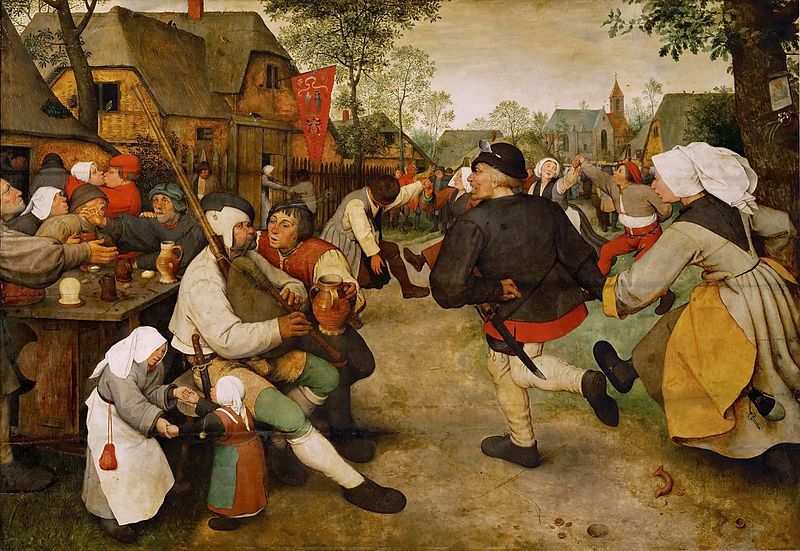
Image Credit: Artist Pieter Brueghel the Elder (1526/1530–1569)
Title The Peasant Dance
Date circa 1568
Source/Photographer
1. The Yorck Project: 10.000 Meisterwerke der Malerei. DVD-ROM, 2002. ISBN 3936122202. Distributed by DIRECTMEDIA Publishing GmbH.
2. GalleriX
(PD 100, 23)
The Radical Catholic Reimagination of Everything

Next Post
August 20, 2016 This Week in Elfland: August 20th Edition
Browse Our Archives
Select a Category A Secular Age Advent Apologetics Atheism Beauty Being a Catholic Evangelical Being Catholic Being Deified: Poetry and Fantasy on the Path to God Blogging Book Reviews C. S. Lewis Catholic Imagination Catholic Social Teaching Catholicism Christmas Church Calendar Church Fathers Church Life Community Conferences Cosmology Creation Curdled Words Deification Distributism Easter Economics Education Epiphany Essay Extracts Eucharist Faerie Faeriean Metaphysics Fatherhood Films Folk Liturgy Food and Drink G. K. Chesterton Harry Potter J. R. R. Tolkien Jove King Arthur Language Lent Life Literature and Poetry Liturgy Medieval Theology Music My Publications Mythology On the Edges of Elfland Ordinary Time Ordination Parenthood Parish Patristic Theology Pentecost Politics Prayer Racism Radical Orthodoxy Restoration Movement Sacramental Ontology Saints Science Sex and Sexuality Sophiology Stories The Inklings The Radical Catholic Reimagination of Everything Theologians in the Church Theopoetics Thesis Research Uncategorized University of Nottingham What I'm Reading Writing
Select a Month December 2019 November 2019 October 2019 September 2019 August 2019 July 2019 June 2019 May 2019 April 2019 March 2019 February 2019 January 2019 December 2018 November 2018 October 2018 September 2018 August 2018 July 2018 June 2018 May 2018 April 2018 March 2018 February 2018 January 2018 December 2017 November 2017 October 2017 August 2017 July 2017 June 2017 May 2017 April 2017 March 2017 February 2017 January 2017 December 2016 November 2016 October 2016 September 2016 August 2016 July 2016 June 2016 May 2016 April 2016 March 2016 February 2016 January 2016 December 2015 November 2015 October 2015 September 2015 August 2015 July 2015 June 2015 May 2015 April 2015 March 2015 February 2015 January 2015 December 2014 November 2014 October 2014 September 2014 August 2014 July 2014 June 2014 May 2014 April 2014 March 2014 February 2014 January 2014 December 2013 November 2013 October 2013 September 2013 August 2013 July 2013 June 2013 May 2013 April 2013 March 2013 February 2013 January 2013 December 2012 November 2012 October 2012 September 2012 July 2012
Follow Us!
TAKE THE
Religious Wisdom Quiz
True or False: Joshua made the sun stand still over Gibeon to give Israel more time to defeat their enemies.
Select your answer to see how you score.
FALSE TRUE
Related posts from Letters from the Edge of Elfland

Poetry, Podcasts, and More: Some Updates on Other...
Letters from the Edge of Elfland

Working on a Book of Poetry: An Apology...
Letters from the Edge of Elfland

Poetry Shapes the World around Us: Reflecting on...
Letters from the Edge of Elfland

William Blake on the Creative Spirit, Beauty, and...
Letters from the Edge of Elfland
TRENDING AT PATHEOS Catholic

Creation, Preservation, and Teleology in Catholic Theology
As I write this, it is very early Monday morning. Like millions...

The Parable Of The Sower And The Word...
One of Christ’s most famous parables is that of the sower who...

Rejecting Doom: Christian Hope And Human Action
Christianity is a religion of hope. We are to have hope and...

Why I Choose the Eucharist Over the Sermon
Choose the Eucharist, Not the Sermon What are we supposed to get...

5 Design Elements Found in Spiritually Rooted Homes
Putting Spirituality Into Home Decor Our homes are more than our living...

Credo: A Story of God Told with the...
About 10 years ago, I began to imagine a personal "Credo" that...
view all Catholic blogs
Ad-Free & Subscriber Log-In Subscription Support
- About Us
- 2026 Calendar
- Videos
- Podcasts
- Library of World Religions
- Faith In Media Tracker
- Advertise With Us
- Write for Us
- Privacy Policy
- Terms of Service
- Do Not Sell My Data
- Contact Us
- Radiant Digital
- Manage Newsletter Subscriptions
- Unsubscribe From Notifications
- Sitemap
Copyright 2008-2026, Patheos. All rights reserved.
Subscription Support Ad-Free & Subscriber Log-In
Follow Patheos