
BuddhistCatholicContemplativeEvangelicalGeneral ChristianHinduJewishLatter-day SaintMuslimNew VisionsProgressive Christian
Beliefs
- Buddhist
- Catholic
- Contemplative
- Evangelical
- General Christian
- Hindu
- Jewish
- Latter-day Saint
- More Voices
- Muslim
- New Visions
- Pagan
- Progressive Christian
Topics
- Religion News
- Food and Religion
- Sports and Religion
- Religious Art
- Religious Music and Entertainment
- Religious Events
- History and Religion
- Style and Religion
- Politics and Religion
- Women in Religion
- Recreation Outdoors and Religion
- Business Finance and Religion
- Careers Workplace and Religion
- Education and Religion
- Family Parenting and Religion
- Health Fitness and Religion
- Home and Religion
- Relationships and Religion
- Technology and Religion
- Travel and Religion
Columnists
- Buddhist Columnists
- Business Finance and Religion Columnists
- Careers Workplace and Religion Columnists
- Catholic Columnists
- Contemplative Columnists
- Education and Religion Columnists
- Evangelists Columnists
- Family Parenting and Religion Columnists
- General Christian Columnists
- Health Fitness and Religion Columnists
- Hindu Columnists
- History and Religion Columnists
- Home and Religion Columnists
- Jewish Columnists
- More Voices Columnists
- Latter Day Columnists
- Muslim Columnists
- New Visions Columnists
- Nonreligious Columnists
- Pagan Columnists
- Politics and Religion Columnists
- Progressive Columnists
- Recreation Outdoors and Religion Columnists
- Relationships and Religion Columnists
- Religion News Columnists
- Religious Art Columnists
- Religious Events Columnists
- Religious Music and Entertainment Columnists
- Sports and Religion Columnists
- Style and Religion Columnists
- Technology and Religion Columnists
- Travel and Religion Columnists
- Women in Religion Columnists
Resource Library
- 2026 Calendar
- Library of World Religions
- The 100 Most Holy Places on Earth
- Patheos Answers
- Podcasts
- Videos
- Faith Leaders Database
- Anglican Episcopalian
- Bahai
- Baptist
- Buddhism
- Christianity
- Confucianism
- Eastern Orthodoxy
- Hinduism
- Holiness and Pentecostal
- ISKCON
- Islam
- Judaism
- Lutheran
- Methodist
- The Church of Jesus Christ of Latter-day Saints
- New Age
- Paganism
- Presbytarian and Reformed
- Protestantism
- Religion Behind the Scenes
- Roman Catholic
- Scientology
- Shia Islam
- Sikhism
- Sufism
- Sunni Islam
- Taoism
- Zen
- See all religions
Research Tools
 Ad-Free & Subscriber Log-In Subscription Support
Ad-Free & Subscriber Log-In Subscription Support
Follow Patheos 

- Trending:
- Forgiveness
- |
- Marriage
- |
- Consciousness
- |
- Death Penalty
- |
- Election
- |
- Halloween
 Letters from the Edge of Elfland
- Home
- About
- Distributist Resources
- Publications and Presentations
- Support
- Works in Progress
- The Epistolarian Around the Web
- Home
- Catholic
- How the Midwest Formed My Imagination: A Reflection on My First Visit to My Hometown in Five Years
How the Midwest Formed My Imagination: A Reflection on My First Visit to My Hometown in Five Years
Last updated on: July 24, 2016 at 3:02 pm by David Russell Mosley
How the Midwest Formed My Imagination: A Reflection on My First Visit to My Hometown in Five Years 2016-07-24T15:02:11-04:00 David Russell Mosley
Patheos Explore the world's faith through different perspectives on religion and spirituality! Patheos has the views of the prevalent religions and spiritualities of the world.
David Russell Mosley
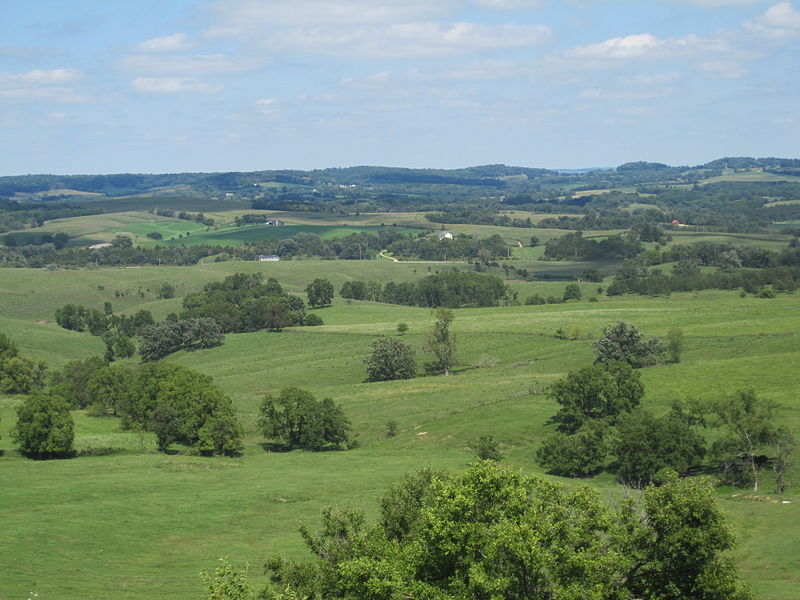
The rolling hills of northwestern Illinois
Date 24 August 2009, 14:07:39 (according to Exif data); August 2009
Source Own work
Author User: (WT-shared) Ethajek at wts wikivoyage
Ordinary Time
Seventeenth Sunday in Ordinary Time
The Edge of Elfland
Hudson, New Hampshire
Dear Readers,
Last week my family got a chance to do something we haven’t done in five years. We visited my home state of Illinois. While travelling with twin two year olds might really warrant its own letter, I want to focus instead on how living in the Midwest helped form my imagination.
As my dad drove us down from Chicago to my hometown of Jacksonville (sadly not while listening to Sufjan Stevens’ excellent album, “Come on and Feel the Illinois”), I was struck by just how beautiful the state of Illinois really is. Having lived on the edge of the Peak District in England and now living in the Granite State, I had grown accustomed to trees and mountains obscuring my view of the horizon. This, of course, has its own beauty. Yet, as we traveled down 355, the sky went on forever and I realized that I had missed an obstructed view of the sky. It was beautiful, stunning, sublime. One day when we were driving around I started pointing out what all the clouds looked like to Lauren (she usually agreed with me). I had forgotten how much I loved looking for shapes in the sky. Sure this is possible just about everywhere, but in the Midwest, where the sky is seemingly infinite, it is certainly easier.
The sky continued on and so I turned my attention to the small copses and large hills (which are really just regular hills, but they seem large in flat Illinois) off in the distance. As I watched them go by I was reminded of something C. S. Lewis wrote in his Surprised by Joy. Lewis remembered being able to see far off mountains and how now, as an adult, he was grateful that his family did not own a car. In this way those mountains remained remote and ripe for Lewis’ childhood imagination. Since he couldn’t visit the mountains he could imagine them however he wanted. This, for me, was the small copses that sped by as my family drove in the car. Sure, I suppose we could have visited them, but since most were likely on private property, that would have been a bad idea. So, they became ripe for my own imagination. To this day, when I imagine a forest, it is often just a larger version of these small copses I saw as a child.
Of course, I couldn’t drive through half the state of Illinois without noticing the farms. Here, I must admit, my feelings became conflicted. On the one hand, these large corn or soybean fields have their own unending beauty. Like the sky, they seem to go on forever and this conveys a sense of beauty, especially the tall stalks of corn. However, I must admit that here I wished I could see something different. Rather than fields of unending corn or soy with only one house on the land, I wish I could have seen small, biodiverse farms and many families farming them. Something tells me that by so doing Illinois would be able to grow most if not all of its own produce and still have plenty to sell out of state.
So the sky, the copses, and the farms, these three, and more I’m sure, helped form my imagination. But I had forgotten. I needed to travel and then return home to remember. There’s an excellent essay by G.K. Chesterton called “The Riddle of the Ivy.” In it Chesterton relates a conversation he had with a friend while he prepared for a holiday:
“One day, as I was leaving London for a holiday, a friend walked into my flat in Battersea and found me surrounded with half-packed luggage.
“‘You seem to be off on your travels,’ he said. ‘Where are you going?’
With a strap between my teeth I replied, ‘To Battersea.’
‘The wit of your remark,’ he said, ‘wholly escapes me.’
‘I am going to Battersea,’ I repeated, ‘to Battersea viâ Paris, Belfort, Heidelberg, and Frankfort….’
‘I suppose it is unnecessary to tell you,’ said my friend with an air of intellectual compassion, ‘that this is Battersea?’
‘It is quite unnecessary,’ I said, ‘and quite spiritually untrue. I cannot see any Battersea here; I cannot see any London or any England. I cannot see that door. I cannot see that chair: because a cloud of sleep and custom has come across my eyes. The only way to get back to them is to go somewhere else; and that is the real object of travel and the real pleasure of holidays…. I am seeking Battersea. The whole object of travel is not to set foot on foreign lands; it is at last to set foot in one’s own country as a foreign land'” (G. K. Chesterton, ‘The Riddle of the Ivy,’ Tremendous Trifles (London: Methuen & Co. LTD., 1920), 203-4.).
Chesterton, notes that life can cause us not to see or know the things around us anymore. Travel can help us see the familiar as if we were seeing it for the first time. I have argued before, and elsewhere, that this is what poetry and fantasy (really all creative, fictive art) can do for us. When I went home for the first time in five years I got to see it as if I were a foreigner and for that I am grateful. I got to see how home had formed my imagination just as much as the books I had read. I got to see the beauty inherent to the Midwest that I feel so many miss. I also got to see what I believe to be the evils of the Midwest. This is what being away from home for five years was able to do for me. While I don’t recommend being gone from home that long, it certainly was beneficial. Even though I love England and New England; mountains and oceans and forests; I will always love the Midwest, it is written into my bones.
Sincerely,
David
The Radical Catholic Reimagination of Everything

Next Post
July 26, 2016 On Being Adopted: The Joys and Pains of One Man's Ongoing Experience
Browse Our Archives
Select a Category A Secular Age Advent Apologetics Atheism Beauty Being a Catholic Evangelical Being Catholic Being Deified: Poetry and Fantasy on the Path to God Blogging Book Reviews C. S. Lewis Catholic Imagination Catholic Social Teaching Catholicism Christmas Church Calendar Church Fathers Church Life Community Conferences Cosmology Creation Curdled Words Deification Distributism Easter Economics Education Epiphany Essay Extracts Eucharist Faerie Faeriean Metaphysics Fatherhood Films Folk Liturgy Food and Drink G. K. Chesterton Harry Potter J. R. R. Tolkien Jove King Arthur Language Lent Life Literature and Poetry Liturgy Medieval Theology Music My Publications Mythology On the Edges of Elfland Ordinary Time Ordination Parenthood Parish Patristic Theology Pentecost Politics Prayer Racism Radical Orthodoxy Restoration Movement Sacramental Ontology Saints Science Sex and Sexuality Sophiology Stories The Inklings The Radical Catholic Reimagination of Everything Theologians in the Church Theopoetics Thesis Research Uncategorized University of Nottingham What I'm Reading Writing
Select a Month December 2019 November 2019 October 2019 September 2019 August 2019 July 2019 June 2019 May 2019 April 2019 March 2019 February 2019 January 2019 December 2018 November 2018 October 2018 September 2018 August 2018 July 2018 June 2018 May 2018 April 2018 March 2018 February 2018 January 2018 December 2017 November 2017 October 2017 August 2017 July 2017 June 2017 May 2017 April 2017 March 2017 February 2017 January 2017 December 2016 November 2016 October 2016 September 2016 August 2016 July 2016 June 2016 May 2016 April 2016 March 2016 February 2016 January 2016 December 2015 November 2015 October 2015 September 2015 August 2015 July 2015 June 2015 May 2015 April 2015 March 2015 February 2015 January 2015 December 2014 November 2014 October 2014 September 2014 August 2014 July 2014 June 2014 May 2014 April 2014 March 2014 February 2014 January 2014 December 2013 November 2013 October 2013 September 2013 August 2013 July 2013 June 2013 May 2013 April 2013 March 2013 February 2013 January 2013 December 2012 November 2012 October 2012 September 2012 July 2012
Follow Us!
TAKE THE
Religious Wisdom Quiz
What was the name of the first murderer in the Bible?
Select your answer to see how you score.
Esau Ishmael Cain Lamech
Related posts from Letters from the Edge of Elfland
Enduring the Valleys of Life: My Struggle with...
Letters from the Edge of Elfland

William Blake on the Creative Spirit, Beauty, and...
Letters from the Edge of Elfland
Can You Imagine? Beginning a Definition of the...
Letters from the Edge of Elfland

“Wherefore stopp’st thou me?” Coleridge’s Creative Message to...
Letters from the Edge of Elfland
TRENDING AT PATHEOS Catholic

Creation, Preservation, and Teleology in Catholic Theology
As I write this, it is very early Monday morning. Like millions...

The Parable Of The Sower And The Word...
One of Christ’s most famous parables is that of the sower who...

Rejecting Doom: Christian Hope And Human Action
Christianity is a religion of hope. We are to have hope and...

Why I Choose the Eucharist Over the Sermon
Choose the Eucharist, Not the Sermon What are we supposed to get...

5 Design Elements Found in Spiritually Rooted Homes
Putting Spirituality Into Home Decor Our homes are more than our living...

Credo: A Story of God Told with the...
About 10 years ago, I began to imagine a personal "Credo" that...
view all Catholic blogs
Ad-Free & Subscriber Log-In Subscription Support
- About Us
- 2026 Calendar
- Videos
- Podcasts
- Library of World Religions
- Faith In Media Tracker
- Advertise With Us
- Write for Us
- Privacy Policy
- Terms of Service
- Do Not Sell My Data
- Contact Us
- Radiant Digital
- Manage Newsletter Subscriptions
- Unsubscribe From Notifications
- Sitemap
Copyright 2008-2026, Patheos. All rights reserved.
Subscription Support Ad-Free & Subscriber Log-In
Follow Patheos