
BuddhistCatholicContemplativeEvangelicalGeneral ChristianHinduJewishLatter-day SaintMuslimNew VisionsProgressive Christian
Beliefs
- Buddhist
- Catholic
- Contemplative
- Evangelical
- General Christian
- Hindu
- Jewish
- Latter-day Saint
- More Voices
- Muslim
- New Visions
- Pagan
- Progressive Christian
Topics
- Religion News
- Food and Religion
- Sports and Religion
- Religious Art
- Religious Music and Entertainment
- Religious Events
- History and Religion
- Style and Religion
- Politics and Religion
- Women in Religion
- Recreation Outdoors and Religion
- Business Finance and Religion
- Careers Workplace and Religion
- Education and Religion
- Family Parenting and Religion
- Health Fitness and Religion
- Home and Religion
- Relationships and Religion
- Technology and Religion
- Travel and Religion
Columnists
- Buddhist Columnists
- Business Finance and Religion Columnists
- Careers Workplace and Religion Columnists
- Catholic Columnists
- Contemplative Columnists
- Education and Religion Columnists
- Evangelists Columnists
- Family Parenting and Religion Columnists
- General Christian Columnists
- Health Fitness and Religion Columnists
- Hindu Columnists
- History and Religion Columnists
- Home and Religion Columnists
- Jewish Columnists
- More Voices Columnists
- Latter Day Columnists
- Muslim Columnists
- New Visions Columnists
- Nonreligious Columnists
- Pagan Columnists
- Politics and Religion Columnists
- Progressive Columnists
- Recreation Outdoors and Religion Columnists
- Relationships and Religion Columnists
- Religion News Columnists
- Religious Art Columnists
- Religious Events Columnists
- Religious Music and Entertainment Columnists
- Sports and Religion Columnists
- Style and Religion Columnists
- Technology and Religion Columnists
- Travel and Religion Columnists
- Women in Religion Columnists
Resource Library
- 2026 Calendar
- Library of World Religions
- The 100 Most Holy Places on Earth
- Patheos Answers
- Podcasts
- Videos
- Faith Leaders Database
- Anglican Episcopalian
- Bahai
- Baptist
- Buddhism
- Christianity
- Confucianism
- Eastern Orthodoxy
- Hinduism
- Holiness and Pentecostal
- ISKCON
- Islam
- Judaism
- Lutheran
- Methodist
- The Church of Jesus Christ of Latter-day Saints
- New Age
- Paganism
- Presbytarian and Reformed
- Protestantism
- Religion Behind the Scenes
- Roman Catholic
- Scientology
- Shia Islam
- Sikhism
- Sufism
- Sunni Islam
- Taoism
- Zen
- See all religions
Research Tools
 Ad-Free & Subscriber Log-In Subscription Support
Ad-Free & Subscriber Log-In Subscription Support
Follow Patheos 

- Trending:
- Forgiveness
- |
- Marriage
- |
- Consciousness
- |
- Death Penalty
- |
- Election
- |
- Halloween
 Letters from the Edge of Elfland
- Home
- About
- Distributist Resources
- Publications and Presentations
- Support
- Works in Progress
- The Epistolarian Around the Web
- Home
- Catholic
- Hillbilly Liturgy: Reflections on the Country Bumpkin, the Eucharist, and Thomas Aquinas
Hillbilly Liturgy: Reflections on the Country Bumpkin, the Eucharist, and Thomas Aquinas
Last updated on: May 6, 2017 at 12:17 pm by David Russell Mosley
Hillbilly Liturgy: Reflections on the Country Bumpkin, the Eucharist, and Thomas Aquinas 2017-05-06T12:17:39-04:00 David Russell Mosley
Patheos Explore the world's faith through different perspectives on religion and spirituality! Patheos has the views of the prevalent religions and spiritualities of the world.
David Russell Mosley
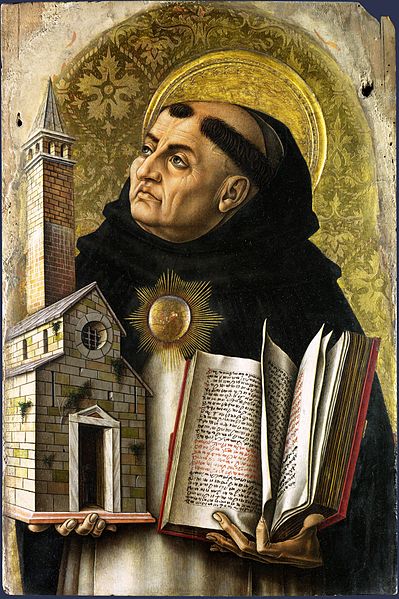
Carlo Crivelli (circa 1435–circa 1495)
Saint Thomas Aquinas (PD-1923)
Ordinary Time
Feast of St. Ethelreda
The Edge of Elfland
Hudson, New Hampshire
Dear Readers,
A few days ago the University of Nottingham put out another video in its A-Z of Theology series entitled K is for Kitchen. In the video one of my former PhD supervisors, Dr. Tom O’Loughlin talks about how there are often two ways of looking at religion. There is the religion of the study––its theology, philosophy, laws, etc.––and there is the religion of the kitchen.
Now O’Loughlin goes on to discuss things like dietary laws, with a passing mention of feasts, but the video got me thinking about a project I’ve been doing some light work on recently. Specifically, I’ve been thinking about what one might call folk liturgy or rustic liturgy or even hillbilly liturgy.
Flannery O’Connor once wrote in a letter that she feared many people believed her to be a hillbilly nihilist when she’d prefer they think of her as a hillbilly thomist. Since then the term has taken moderate flight amongst academics and others. It has become, in many ways, a catch all for those who seek to attain the heights without leaving behind the lows. Noted Aquinas scholar Frederick Christian Bauerschmidt who has aligned himself on more than one occasion with hillbilly thomism. I must admit to rather loving the term and am currently in the process of searching for uses of the word rusticus (which could be translated as rustic, hillbilly, and even country bumpkin) in the works of Thomas Aquinas. In truth, the instances I’ve found so far certainly don’t paint the hillbilly in very positive light (at one point he’s digging up a grave). But there is one passage I find intriguing.
In discussing the nature of miracles, Aquinas notes how sometimes an event may appear wonderful to some, particularly those who do not know its source. He writes:
Wherefore a thing is wonderful to one man, and not at all to others: as an eclipse is to a hillbilly, but not to an astronomer. Now a miracle is so called as being full of wonder; as having a cause absolutely hidden from all: and this cause is God. Wherefore those things which God does outside those causes which we know, are called miracles (ST Ia. 105, 7).
Aquinas paints us a picture of an eclipse as it appears to the hillbilly and to the astronomer. The hillbilly is filled with wonder at the eclipse because the cause of the eclipse (the moon passing in front of the sun) is hidden from him, but not to the astronomer. The cause of the hillbilly’s wonder is ignorance at how the even takes place. However, when it comes to miracles, none of us is in the position of the astronomer. None of us is privy to how God brings about a miracle since its very definition is God doing something outside of the causes about which we know something. So in a miracle we are all in the place of the hillbilly. One could take this a step further then and note that in light of the creation, an event about which we have much to say, but about which none of us know how it was caused, we are all made, indefinitely, hillbillies.
Now, to return to the kitchen: I’m currently working on, or more specifically, I have submitted a paper proposal on the use of wine and bread in the Eucharist. Aquinas sees them as the proper matter (materia conveniens) because they are the food with which men are commonly fed (ST IIIa. 74, 1). While Aquinas does not use the term rusticus here, but rather communius, I think there is a connection. Bread and wine and are, or at least were, the common fare for everyone from the lowest hillbilly to the highest nobleman. Now the argument I hope to put forth, should my proposal be accepted for this conference, is that not unlike, though not completely like either, the effect the Incarnation has an all humanity, so too does the Eucharist have an effect on the food we eat. Every little feast we have, every dinner, participates in the Eucharist. This means the very rhythms of our lives are, or ought to be, bound up in the greater liturgies (of the day, the week, and the year). The rhythms of rustic life, of home life, participate in the heart of the liturgy: the encounter with Christ in the Eucharist. Our lives, when rightly attuned, therefore can become a kind of hillbilly liturgy wherein our waking up and lying down, our getting dressed, our work, and our meals form a kind of folk liturgy, a popular piety.
So, I believe Dr. O’Loughlin is quite right; there is a religion of the kitchen. For the dinner table is, in so many ways, the altar, the table of the Lord’s Supper in our homes.
Sincerely,
David
P.S. Also, check out this video of two Dominican friars who have (or at least had) a band called Hillbilly Thomists:
Previous Post
June 22, 2016
Are the Elves in C. S. Lewis?
Next Post
June 25, 2016 Peter Kreeft and Atheists: A Response to Hemant Mehta
Browse Our Archives
Select a Category A Secular Age Advent Apologetics Atheism Beauty Being a Catholic Evangelical Being Catholic Being Deified: Poetry and Fantasy on the Path to God Blogging Book Reviews C. S. Lewis Catholic Imagination Catholic Social Teaching Catholicism Christmas Church Calendar Church Fathers Church Life Community Conferences Cosmology Creation Curdled Words Deification Distributism Easter Economics Education Epiphany Essay Extracts Eucharist Faerie Faeriean Metaphysics Fatherhood Films Folk Liturgy Food and Drink G. K. Chesterton Harry Potter J. R. R. Tolkien Jove King Arthur Language Lent Life Literature and Poetry Liturgy Medieval Theology Music My Publications Mythology On the Edges of Elfland Ordinary Time Ordination Parenthood Parish Patristic Theology Pentecost Politics Prayer Racism Radical Orthodoxy Restoration Movement Sacramental Ontology Saints Science Sex and Sexuality Sophiology Stories The Inklings The Radical Catholic Reimagination of Everything Theologians in the Church Theopoetics Thesis Research Uncategorized University of Nottingham What I'm Reading Writing
Select a Month December 2019 November 2019 October 2019 September 2019 August 2019 July 2019 June 2019 May 2019 April 2019 March 2019 February 2019 January 2019 December 2018 November 2018 October 2018 September 2018 August 2018 July 2018 June 2018 May 2018 April 2018 March 2018 February 2018 January 2018 December 2017 November 2017 October 2017 August 2017 July 2017 June 2017 May 2017 April 2017 March 2017 February 2017 January 2017 December 2016 November 2016 October 2016 September 2016 August 2016 July 2016 June 2016 May 2016 April 2016 March 2016 February 2016 January 2016 December 2015 November 2015 October 2015 September 2015 August 2015 July 2015 June 2015 May 2015 April 2015 March 2015 February 2015 January 2015 December 2014 November 2014 October 2014 September 2014 August 2014 July 2014 June 2014 May 2014 April 2014 March 2014 February 2014 January 2014 December 2013 November 2013 October 2013 September 2013 August 2013 July 2013 June 2013 May 2013 April 2013 March 2013 February 2013 January 2013 December 2012 November 2012 October 2012 September 2012 July 2012
Follow Us!
TAKE THE
Religious Wisdom Quiz
"______ is the same yesterday and today and forever."
Select your answer to see how you score.
Jesus Christ The Universe God's Plan Our Calling
Related posts from Letters from the Edge of Elfland

To the Full English Breakfast: An Exhortation and...
Letters from the Edge of Elfland

On Teaching Francis' "Canticle of Brother Sun"
Letters from the Edge of Elfland

On the First Day of Advent: Taking Twin...
Letters from the Edge of Elfland

Return to the Sources: On Reading Old Books
Letters from the Edge of Elfland
TRENDING AT PATHEOS Catholic

Creation, Preservation, and Teleology in Catholic Theology
As I write this, it is very early Monday morning. Like millions...

The Parable Of The Sower And The Word...
One of Christ’s most famous parables is that of the sower who...

Rejecting Doom: Christian Hope And Human Action
Christianity is a religion of hope. We are to have hope and...

Why I Choose the Eucharist Over the Sermon
Choose the Eucharist, Not the Sermon What are we supposed to get...

5 Design Elements Found in Spiritually Rooted Homes
Putting Spirituality Into Home Decor Our homes are more than our living...

Credo: A Story of God Told with the...
About 10 years ago, I began to imagine a personal "Credo" that...
view all Catholic blogs
Ad-Free & Subscriber Log-In Subscription Support
- About Us
- 2026 Calendar
- Videos
- Podcasts
- Library of World Religions
- Faith In Media Tracker
- Advertise With Us
- Write for Us
- Privacy Policy
- Terms of Service
- Do Not Sell My Data
- Contact Us
- Radiant Digital
- Manage Newsletter Subscriptions
- Unsubscribe From Notifications
- Sitemap
Copyright 2008-2026, Patheos. All rights reserved.
Subscription Support Ad-Free & Subscriber Log-In
Follow Patheos