
BuddhistCatholicContemplativeEvangelicalGeneral ChristianHinduJewishLatter-day SaintMuslimNew VisionsProgressive Christian
Beliefs
- Buddhist
- Catholic
- Contemplative
- Evangelical
- General Christian
- Hindu
- Jewish
- Latter-day Saint
- More Voices
- Muslim
- New Visions
- Pagan
- Progressive Christian
Topics
- Religion News
- Food and Religion
- Sports and Religion
- Religious Art
- Religious Music and Entertainment
- Religious Events
- History and Religion
- Style and Religion
- Politics and Religion
- Women in Religion
- Recreation Outdoors and Religion
- Business Finance and Religion
- Careers Workplace and Religion
- Education and Religion
- Family Parenting and Religion
- Health Fitness and Religion
- Home and Religion
- Relationships and Religion
- Technology and Religion
- Travel and Religion
Columnists
- Buddhist Columnists
- Business Finance and Religion Columnists
- Careers Workplace and Religion Columnists
- Catholic Columnists
- Contemplative Columnists
- Education and Religion Columnists
- Evangelists Columnists
- Family Parenting and Religion Columnists
- General Christian Columnists
- Health Fitness and Religion Columnists
- Hindu Columnists
- History and Religion Columnists
- Home and Religion Columnists
- Jewish Columnists
- More Voices Columnists
- Latter Day Columnists
- Muslim Columnists
- New Visions Columnists
- Nonreligious Columnists
- Pagan Columnists
- Politics and Religion Columnists
- Progressive Columnists
- Recreation Outdoors and Religion Columnists
- Relationships and Religion Columnists
- Religion News Columnists
- Religious Art Columnists
- Religious Events Columnists
- Religious Music and Entertainment Columnists
- Sports and Religion Columnists
- Style and Religion Columnists
- Technology and Religion Columnists
- Travel and Religion Columnists
- Women in Religion Columnists
Resource Library
- 2026 Calendar
- Library of World Religions
- The 100 Most Holy Places on Earth
- Patheos Answers
- Podcasts
- Videos
- Faith Leaders Database
- Anglican Episcopalian
- Bahai
- Baptist
- Buddhism
- Christianity
- Confucianism
- Eastern Orthodoxy
- Hinduism
- Holiness and Pentecostal
- ISKCON
- Islam
- Judaism
- Lutheran
- Methodist
- The Church of Jesus Christ of Latter-day Saints
- New Age
- Paganism
- Presbytarian and Reformed
- Protestantism
- Religion Behind the Scenes
- Roman Catholic
- Scientology
- Shia Islam
- Sikhism
- Sufism
- Sunni Islam
- Taoism
- Zen
- See all religions
Research Tools
 Ad-Free & Subscriber Log-In Subscription Support
Ad-Free & Subscriber Log-In Subscription Support
Follow Patheos 

- Trending:
- Forgiveness
- |
- Marriage
- |
- Consciousness
- |
- Death Penalty
- |
- Election
- |
- Halloween
 Letters from the Edge of Elfland
- Home
- About
- Distributist Resources
- Publications and Presentations
- Support
- Works in Progress
- The Epistolarian Around the Web
- Home
- Catholic
- Porous and Buffered: Reading A Secular Age
Porous and Buffered: Reading A Secular Age
Last updated on: March 31, 2016 at 10:55 am by David Russell Mosley
Porous and Buffered: Reading A Secular Age 2016-03-31T10:55:44-04:00 David Russell Mosley
Patheos Explore the world's faith through different perspectives on religion and spirituality! Patheos has the views of the prevalent religions and spiritualities of the world.
David Russell Mosley
Eastertide
31 March 2016
The Edge of Elfland
Hudson, New Hampshire
Dear Friends and Family,
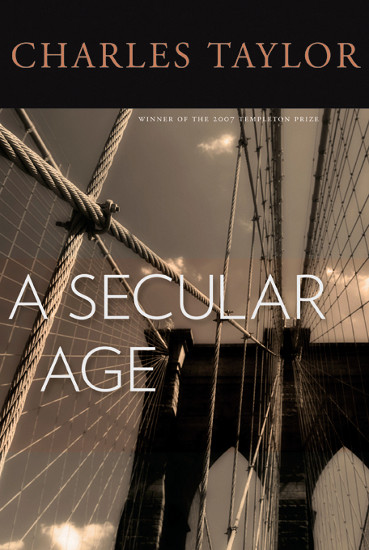
So I’ve recently taken the plunge and started reading Charles Taylor’s A Secular Age. For those unfamiliar with Taylor and/or this work, Taylor is a Canadian philosopher and is professor emeritus at McGill University. He has written numerous works on political philosophy, history of philosophy, intellectual history and more. A Secular Age is Taylor’s attempt at putting a narrative to the transition that happens between, essentially, pre- and post-Enlightenment thinking and living. Specifically, Taylor wants to answer, narratively, “why as it virtually impossible not to believe in God in, say, 1500 in our Western society, while in 2000 many of us find this not only easy, but even inescapable?”1 This book fits, to a certain extent, within the same realm as John Milbank’s Theology and Social Theory or Catherine Pickstock’s After Writing, and other such intellectual histories that seek to describe how we arrived at our modern understandings of reality and society. Taylor’s book is massive and to help me engage more fully with it, I’ve decided to blog my way through it. I intend to take it a chapter at a time and so this first post will cover, to an extent, the Introduction and Chapter 1. However, I want to be clear, I am more giving my thoughts on this book as I work my way through it rather than reviewing or intentionally critiquing it. My plan is just to highlight what I found interesting or problematic about the book as I move through it, so take my opinions with a grain of salt. If you’ve read the book, feel free to correct me when I’m wrong. If you haven’t, feel free to take it up with me and comment as you read the sections on which I am commenting. Now, to the thing!
In the Introduction, Taylor is laying out what he intends to do in this book, specifically, to describe how we moved from a porous self in an enchanted cosmos to a buffered self in a secular age. I’ll tackle porous/enchanted and buffered in a moment, but first, I want to address Taylor’s understanding of secular. Taylor describes three different kinds of secularity but wants to focus on the third kind, “which [he] could perhaps encapsulate in this way: the change I want to define and trace is one which takes us from a society in which it was virtually impossible not to believe in God, to one in which faith, even for the staunchest believer, is one human possibility among others.”2 This third sense of “secular” is in essence where religious belief becomes one option among others and no longer the guiding principle by which life is lived. Taylor, however, does make it clear that religion is tied to all three kinds of secularity, ” as that which is retreating in public space (1), or as a type of belief and practice which is or is not in regression (2), and as a certain kind of belief or commitment whose conditions in this age are being examined (3).”3 This is interesting because Taylor is here arguing that secularity in general cannot cut its ties with religion, it cannot escape transcendence. It can only define itself in contradistinction from religion. Nevertheless, what Taylor wants to do is understand and narrate how we moved from what he will call the porous self to the buffered.
In Chapter 1, then, titled “The Bulwarks of Belief,” Taylor begins to define his terms, particularly porous/enchanted and buffered/disenchanted or secular. The enchanted world (which term Taylor takes up as the antonym to Weber’s disenchantment) is the world in which our pre-modern ancestors lived. For Taylor, “The enchanted world in this sense is the world of spirits, demons, and moral forces which our ancestors lived in.”4 I’m really quite intrigued by Taylor’s use of enchantment and his understanding of the premodern self. For readers of these letters, you’ll know I have an intense interest in enchantment (which I often equate with sacramental and liturgical). It seems to me that Taylor means something similar, however, he is far less interested than I am, for instance, in developing a theology of enchantment or premodern understanding. This is largely because Taylor is offering a narrative and not explicitly arguing for one position over another (or at least not yet).
Taylor understands the person living in the enchanted cosmos as porous, that is open to these spirits, demons, and moral forces not as two minds (or more) that can work together or against one another, but as porous, capable of being internally affected by them. For the porous self, meaning is not primarily in the mind as they are for the buffered self. Taylor describes the buffered understanding of meaning this way,
“On the former view meanings are “in the mind” in the sense that things only the meaning they do in that they awaken a certain response in us, and this has to do with our nature as creatures who are thus capable of such responses, which means creatures with feelings, with desires, aversions, i.e. beings endowed with minds, in the broader sense.”5
An object only has meaning insofar as I, as a being with intellect, imbue it with such. A tree is beautiful or menacing precisely because I feel it to be so, not because the tree itself has beauty or menace. But for our porous ancestors this was not the case. Meaning existed in things. Taylor describes this through the cult of the saints:
“But seeing things this way understates the strangeness of the enchanted world. Thus precisely in this cult of the saints, we can see how the forces here were not all agents, subjectivities, who could decide to confer a favour. But power also resided in things. For the curative actions of saints was often linked to centres where their relics resided; either some piece of their body (supposedly), or some object which had been connected with them in life, like (in the case of Christ) pieces of the true Cross, or the sweat-cloth which Saint Veronica had used to wipe his face, and which was on display on certain occasions in Rome. And we can add to this other objects which had been endowed with sacramental power, like the Host, or candles which had been blessed at Candlemas, and the like. These objects were loci of spiritual power; which is why they had to be treated with care, and if abused could wreak terrible damage.”6
Taylor gets more precise and notes that these meaningful (in the true sense of that word) objects relate on a cosmic level, “So in the pre-modern world, meanings are not only in minds, but can reside in things, or in various kinds of extra-human but intra-cosmic subjects. We can bring out the contrast with today in to dimensions, by looking at two kinds of peers that these things/subjects posses.”7 I am reminded here of John Milbank’s article “Fictioning Things” where writes that the objects in fairy-tales often function as the movers of the plot:
“Fairy-tale yields up a symmetrically opposite paradox: the circulation of objects in the basic plot is shadowed by the operations at a meta-narrative level of misty personages––senders and helpers, preternaturally “other” fairy figures and giants or else legendary human persons. Moreover, though the human heroes and heroines of the main plot are ciphers, who simply receive gifts as well as performing impossible tasks, etc. these ciphers, unlike the more strongly characterized gods or heroes, do in the end triumph, thanks to the mediations of the magical objects and a series of exchanges at the meta-narrative level with the “other” fairy realms.”8
What Milbank describes, it seems to me, is the same kind of relationship between the saint and the relic as described by Taylor. These meaningful objects filled with power and thus cause an affect whether one intends them to or not (one might think of Uzzah and the ark, the One Ring in The Lord of the Rings, or other similar examples). Taylor describes the good objects as capable of good or ill depending on how one uses them, though he never describes whether or not an object imbued with evil power could be used for good if used inappropriately. What Taylor is missing here, so far as I can see, is an extra level of connectivity. The relic of a saint is imbued with power from the saint, but the saint herself is imbued with power from God. Thus the grace mediated through a physical object ultimately receives its power from God. So while meaning is not simply in the mind, that is in the human or even angelic mind, it is ultimately founded in the mind of God. Why Taylor does not, in this chapter at least, make this point, I cannot say.
Another key to the porous self and the “charged” objects is that the effects of the charged object often function on multiple levels. When describing the healing that is given by such an object, Taylor notes that this healing is often not limited to the physical:
“That is, the same force that healed you could also make a better, or more holy person; and that in one act, so to speak. For the two disabilities were often seen as not really distinct. This shows that in, for instance, the healing at and by shrines, relics, sacred objects, etc., we are dealing with something different from modern medicine, even where the analogy seems closest.”9
Without being explicit, Taylor recalls two, almost contrary ideas. On the one hand, I, at least, am reminded of the healings effected by Jesus. Often is the physical healing accompanied by a forgiveness of sin. However, and here is where either Taylor himself, or, possibly, our premodern ancestors, could (or did) go wrong, which is to suggest that there is a direct connection between the physical ailment and particular unholiness. Christ himself denounces this when asked by his disciples who sinned in the case of the man born blind. However, it is clear that there is a connection (from Genesis 3 onward) between our physical ailments (that we die) and our sinfulness.
Taylor’s description of the enchanted cosmos is one that is inherently social. “But living in the enchanted, porous world of our ancestors was inherently living socially. It was not just that the spiritual forces which impinged on me often emanated from people around me, e.g., the spell cast by my enemy, or the protection afforded by a candle which has been blessed in the parish church. Much more fundamental, these forces often impinged on us as a society, and were defended against by us as a society.”10
The buffered self, it would seem, though Taylor has not made this argument explicit as of yet, is one that not only puts up boundaries between me and creation (whether spiritual or physical) but also between me and other selves. If the porous self is inherently social, the buffered self is inherently individual.
Taylor is clearly not, at present, arguing for a return to the porous or enchanted. I’m not sure he believes this possible. Problematic for me is that Taylor does not seem even to be interested to ask whether or not it is true. I understand that his purpose is to narrate, to describe, and he is doing that. So I cannot fault him for doing what he set out to do; I just wish he were doing something a little different, but that’s my problem, not his.
Well thanks for enduring this long post, if you have. If you’ve read this book, let me know if I’m wrong (or right) and what I might have missed.
Sincerely,
David
1 Charles Taylor, A Secular Age (Cambridge: Belknap Press, 2007), 25.
2 Charles Taylor, A Secular Age (Cambridge: Belknap Press, 2007), 3.
3 Charles Taylor, A Secular Age (Cambridge: Belknap Press, 2007), 15.
4 Charles Taylor, A Secular Age (Cambridge: Belknap Press, 2007), 26.
5 Charles Taylor, A Secular Age (Cambridge: Belknap Press, 2007), 31.
6 Charles Taylor, A Secular Age (Cambridge: Belknap Press, 2007), 32.
7 Charles Taylor, A Secular Age (Cambridge: Belknap Press, 2007), 33.
8 John Milbank, ‘Fictioning Things: Gift and Narrative,’ Religion and Literature, 37:3 (Autumn 2005): 15.
9 Charles Taylor, A Secular Age (Cambridge: Belknap Press, 2007), 39.
10 Charles Taylor, A Secular Age (Cambridge: Belknap Press, 2007), 42.
Previous Post

March 10, 2016
An Inklings Walking Tour
Browse Our Archives
Select a Category A Secular Age Advent Apologetics Atheism Beauty Being a Catholic Evangelical Being Catholic Being Deified: Poetry and Fantasy on the Path to God Blogging Book Reviews C. S. Lewis Catholic Imagination Catholic Social Teaching Catholicism Christmas Church Calendar Church Fathers Church Life Community Conferences Cosmology Creation Curdled Words Deification Distributism Easter Economics Education Epiphany Essay Extracts Eucharist Faerie Faeriean Metaphysics Fatherhood Films Folk Liturgy Food and Drink G. K. Chesterton Harry Potter J. R. R. Tolkien Jove King Arthur Language Lent Life Literature and Poetry Liturgy Medieval Theology Music My Publications Mythology On the Edges of Elfland Ordinary Time Ordination Parenthood Parish Patristic Theology Pentecost Politics Prayer Racism Radical Orthodoxy Restoration Movement Sacramental Ontology Saints Science Sex and Sexuality Sophiology Stories The Inklings The Radical Catholic Reimagination of Everything Theologians in the Church Theopoetics Thesis Research Uncategorized University of Nottingham What I'm Reading Writing
Select a Month December 2019 November 2019 October 2019 September 2019 August 2019 July 2019 June 2019 May 2019 April 2019 March 2019 February 2019 January 2019 December 2018 November 2018 October 2018 September 2018 August 2018 July 2018 June 2018 May 2018 April 2018 March 2018 February 2018 January 2018 December 2017 November 2017 October 2017 August 2017 July 2017 June 2017 May 2017 April 2017 March 2017 February 2017 January 2017 December 2016 November 2016 October 2016 September 2016 August 2016 July 2016 June 2016 May 2016 April 2016 March 2016 February 2016 January 2016 December 2015 November 2015 October 2015 September 2015 August 2015 July 2015 June 2015 May 2015 April 2015 March 2015 February 2015 January 2015 December 2014 November 2014 October 2014 September 2014 August 2014 July 2014 June 2014 May 2014 April 2014 March 2014 February 2014 January 2014 December 2013 November 2013 October 2013 September 2013 August 2013 July 2013 June 2013 May 2013 April 2013 March 2013 February 2013 January 2013 December 2012 November 2012 October 2012 September 2012 July 2012
Follow Us!
TAKE THE
Religious Wisdom Quiz
Who saw a vision of a ladder reaching heaven?
Select your answer to see how you score.
Isaac Joseph Jacob Adam
Related posts from Letters from the Edge of Elfland

William Blake on the Creative Spirit, Beauty, and...
Letters from the Edge of Elfland

“Wherefore stopp’st thou me?” Coleridge’s Creative Message to...
Letters from the Edge of Elfland
Stop, Christian Passer-by: A Spiritual Review of Mariner...
Letters from the Edge of Elfland

Good Morning, Mr. Magpie: On Folklore and Science
Letters from the Edge of Elfland
TRENDING AT PATHEOS Catholic

Rejecting Doom: Christian Hope And Human Action
Christianity is a religion of hope. We are to have hope and...

It’s What Comes From Within Which Matters
One of the most difficult things for us to understand is why...

Why I Choose the Eucharist Over the Sermon
Choose the Eucharist, Not the Sermon What are we supposed to get...

5 Design Elements Found in Spiritually Rooted Homes
Putting Spirituality Into Home Decor Our homes are more than our living...

Credo: A Story of God Told with the...
About 10 years ago, I began to imagine a personal "Credo" that...

The Anatomy of Divine Revelation in Catholic Thought
The claim that God has made Himself known to human beings is...
view all Catholic blogs
Ad-Free & Subscriber Log-In Subscription Support
- About Us
- 2026 Calendar
- Videos
- Podcasts
- Library of World Religions
- Faith In Media Tracker
- Advertise With Us
- Write for Us
- Privacy Policy
- Terms of Service
- Do Not Sell My Data
- Contact Us
- Radiant Digital
- Manage Newsletter Subscriptions
- Unsubscribe From Notifications
- Sitemap
Copyright 2008-2026, Patheos. All rights reserved.
Subscription Support Ad-Free & Subscriber Log-In
Follow Patheos