
BuddhistCatholicContemplativeEvangelicalGeneral ChristianHinduJewishLatter-day SaintMuslimNew VisionsProgressive Christian
Beliefs
- Buddhist
- Catholic
- Contemplative
- Evangelical
- General Christian
- Hindu
- Jewish
- Latter-day Saint
- More Voices
- Muslim
- New Visions
- Pagan
- Progressive Christian
Topics
- Religion News
- Food and Religion
- Sports and Religion
- Religious Art
- Religious Music and Entertainment
- Religious Events
- History and Religion
- Style and Religion
- Politics and Religion
- Women in Religion
- Recreation Outdoors and Religion
- Business Finance and Religion
- Careers Workplace and Religion
- Education and Religion
- Family Parenting and Religion
- Health Fitness and Religion
- Home and Religion
- Relationships and Religion
- Technology and Religion
- Travel and Religion
Columnists
- Buddhist Columnists
- Business Finance and Religion Columnists
- Careers Workplace and Religion Columnists
- Catholic Columnists
- Contemplative Columnists
- Education and Religion Columnists
- Evangelists Columnists
- Family Parenting and Religion Columnists
- General Christian Columnists
- Health Fitness and Religion Columnists
- Hindu Columnists
- History and Religion Columnists
- Home and Religion Columnists
- Jewish Columnists
- More Voices Columnists
- Latter Day Columnists
- Muslim Columnists
- New Visions Columnists
- Nonreligious Columnists
- Pagan Columnists
- Politics and Religion Columnists
- Progressive Columnists
- Recreation Outdoors and Religion Columnists
- Relationships and Religion Columnists
- Religion News Columnists
- Religious Art Columnists
- Religious Events Columnists
- Religious Music and Entertainment Columnists
- Sports and Religion Columnists
- Style and Religion Columnists
- Technology and Religion Columnists
- Travel and Religion Columnists
- Women in Religion Columnists
Resource Library
- 2026 Calendar
- Library of World Religions
- The 100 Most Holy Places on Earth
- Patheos Answers
- Podcasts
- Videos
- Faith Leaders Database
- Anglican Episcopalian
- Bahai
- Baptist
- Buddhism
- Christianity
- Confucianism
- Eastern Orthodoxy
- Hinduism
- Holiness and Pentecostal
- ISKCON
- Islam
- Judaism
- Lutheran
- Methodist
- The Church of Jesus Christ of Latter-day Saints
- New Age
- Paganism
- Presbytarian and Reformed
- Protestantism
- Religion Behind the Scenes
- Roman Catholic
- Scientology
- Shia Islam
- Sikhism
- Sufism
- Sunni Islam
- Taoism
- Zen
- See all religions
Research Tools
 Ad-Free & Subscriber Log-In Subscription Support
Ad-Free & Subscriber Log-In Subscription Support
Follow Patheos 

- Trending:
- Forgiveness
- |
- Marriage
- |
- Consciousness
- |
- Death Penalty
- |
- Election
- |
- Halloween
 Letters from the Edge of Elfland
- Home
- About
- Distributist Resources
- Publications and Presentations
- Support
- Works in Progress
- The Epistolarian Around the Web
- Home
- Catholic
- On Food: Growing and Eating and Hobbits
On Food: Growing and Eating and Hobbits
Last updated on: May 6, 2017 at 12:18 pm by David Russell Mosley
On Food: Growing and Eating and Hobbits 2017-05-06T12:18:08-04:00 David Russell Mosley
Patheos Explore the world's faith through different perspectives on religion and spirituality! Patheos has the views of the prevalent religions and spiritualities of the world.
David Russell Mosley
Lent
25 February 2016
The Edge of Elfland
Hudson, New Hampshire
Dear Friends and Family,
Writing to you about food, and not about fasting, feels a bit odd during this Lenten season. However, it is always important to remember that Christianity is primarily a feasting religion which fasts to remind us that we depend on God, not food, for our existence. Nevertheless, today I have read two excellent articles on food that I thought I would share with you, with a little commentary.
The first article I read today came from The American Conservative, an excellent news and opinion source, in my personal opinion. Here author Gracy Olmstead writes an article entitled “Why Cooking Matters.” Olmstead is looking primarily at the work of author Michael Pollan––author of such works as The Omnivores Dilemma and Cooked––to see what importance cooking, even spending much of our time in the cultivation (or hunting) and preparation of the food we eat. For Pollan it is not only good but necessary that we begin to return to older methods of food cultivation and preparation. Failure to do so will result in loss of traditions which will in turn lead to loss of a proper connection to the land.
There are are critics of Pollan, however. Olmstead notes that of New York Times’s Neil Genzlinger who argues that Pollan’s views are too gentrified, unavailable to poor. Olmstead responds that the problem has less to do with this not being available to the poor for financial reasons “but, rather, because we’ve largely lost the skills associated with this work.” Now here I do think Olmstead and Pollan are overlooking the fact that much of this may not be available to those who have to work three full-time jobs just to make ends meet. Rather than the handwringing of Genzlinger, however, I would argue that this is reason enough to fight for political changes to make it easier for the poor among us to have access to good, healthy food and the means to cultivate and prepare it. This may also require re-education and new habits to be formed. We have been so habituated to the processed that for many the organic tastes bad. It took me a long time to love the flavor of organic vegetables or even grass fed beef. Nevertheless, I think these things worth our time.
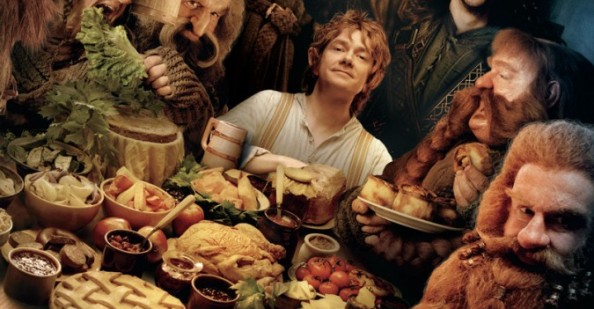
The second article I read was an older article from The Distributist Review by Robert Hutchinson entitled, “How to Eat like a Hobbit.” Hutchinson begins by reminding us of the importance of food in Tolkien’s work. Hutchinson notes, that, “there is more eating than fighting in The Lord of the Rings.” And many are often either driven mad, or to laughter, by how often Bilbo is pining after bacon and his larder in The Hobbit. Hutchinson notes that unlike our industrialized farming of today, hobbits and the other free folk of Middle-earth benefit from what can only be called organic small farms (albeit there were no pesticides in the third age so to call the farms organic is certainly anachronistic on my part). Not everyone was a farmer, but what farmers there were were the primary source of food in the local economies. This Hutchinson sees as a good, and I agree.
Hutchinson then transitions his article from hobbits to our own situation. He notes that even when we see numerous brands on the grocery store shelves many, if not all, of them come from the same farms, are packaged in the same factories, and are distributed by the same distributors. “[B]y some estimates,” Hutchinson writes, “just four companies now produce 90% of the food consumed in the United States: Cargill, Tyson Foods, General Mills and Kraft.” This is not a good, says Hutchinson. This leads to bad growing practices, to a desire for uniformity which causes sellers and growers to use artificial means to keep their food “looking nice” when they hit grocery store shelves. Hutchinson, however, is not content simply to detail the woes, but offers real solutions we can take as individuals, families, and local communities. I will reproduce those in full here:
“1. Go organic. Whenever possible, begin buying organic food, especially when it comes to meat and dairy products. Organic products are more expensive so every family and individual has to adjust their purchases for their own economic situation. Many people believe that, for health reasons, switching to organic, free-range meats and dairy is more important than organic vegetables because of the use of growth hormones and antibiotics in meat and dairy.
2. Buy local only. Almost every town and city in North America and Europe hosts farmer’s markets where the few remaining family and small farms come to sell locally grown produce. There are now also hundreds of websites where you can quickly and easily identify stores in your area that sell locally grown produce.
3. Eat in season. This is the hardest step of all to take. That’s because globalization means that consumers in prosperous nations have gotten used to eating whatever they want, whenever they want it, regardless of the season. But again, convenience comes at a high cost: the fruits you buy in January are picked unripe and artificially ripened with ethylene gas or calcium carbide (yum, yum!). Buying foods in season, however, has the effect of encouraging a far more diverse diet than would otherwise be the case: apricots in April, cherries in May, blueberries and raspberries in June.
4. Start your own garden. One reason to start your own garden is because it sensitizes you to what you’re missing by eating only mass-produced industrial food. Anyone who has ever tasted a homegrown heirloom tomato grown on the vine has trouble going back to the tasteless, “pre-ripened,” dyed-red globules sold in most supermarkets. Even if you only have a few green pepper plants sprouting on your balcony in your high-rise apartment, it is a vivid reminder of the Shire and why you should go out of your way to find “Hobbit-grown” foods whenever you can.
5. Join the Urban Chicken movement. Thousands of families in urban and suburban settings have set up small chicken coops in their back yards, sometimes disguised as children’s playhouses. The fun of growing chickens is heightened by getting dozens of “farm fresh,” organically produced, nutritious eggs.
6. Eat less meat. Hobbits are not vegetarians and neither are most human beings. Yet their favourite foods are grown in the wild, particularly mushrooms. Many people are finding that a return to the so-called “paleolithic diet,” the diet of our hunter-gather ancestors, can result in surprising health benefits and even weight loss. This is a diet made up primarily of fruits and vegetables with occasional lean meat dishes.
7. Lobby for labeling. The industrial food lobby, aided by most national governments, has fought tooth and nail against food labelling requirements. The Big Food lobby has been especially fierce in its opposition to labels for Genetically Modified (GM) foods since so many consumer food products today now contain genetically altered plants, such as corn. It is also opposed to mandatory labelling for products that contain growth hormones, antibiotics, pesticides and so on. That’s because the food industry does not want consumers “voting with their pocketbooks” and choosing organic foods that do not contain these chemical additives.”
While not every individual or family will be able to do all of these at once, I do want to encourage you to do what you can. I said at the beginning that writing about food during Lent felt odd. However, there is at least one upside to writing about this at the tail end of February. For many of us these suggestions will be easier to follow as Spring inches nearer. My wife and I are already planning out our allotment for this season, so we can grow at least some of the food we eat. We are also fortunate to live in an area with many small or at least non-industrialized farms nearby so that as the season begins we can buy fresh, local, and often organic produce, we can even pick our own and jam and can. What is important, however, is that these things are good to do. They are good because they are often healthier options; they are often more economically and environmentally viable options. More importantly, however, they are more Christian options. We are called to be stewards of Creation. What is more, we act as priests for the rest of physical creation at least (I think also for angelic, but that’s another subject for another day). It is our job to offer back our gratitude and our very selves to God as priests offering sacrifices. For this reason we must find more just ways to cultivate and consume our food. The two articles above, if we read them and take them to heart, can help us do precisely that. Cheers.
Sincerely,
David
Previous Post

February 24, 2016
My Lenten Journey with Dante, Augustine, and Samwise
Next Post
March 10, 2016 An Inklings Walking Tour
Browse Our Archives
Select a Category A Secular Age Advent Apologetics Atheism Beauty Being a Catholic Evangelical Being Catholic Being Deified: Poetry and Fantasy on the Path to God Blogging Book Reviews C. S. Lewis Catholic Imagination Catholic Social Teaching Catholicism Christmas Church Calendar Church Fathers Church Life Community Conferences Cosmology Creation Curdled Words Deification Distributism Easter Economics Education Epiphany Essay Extracts Eucharist Faerie Faeriean Metaphysics Fatherhood Films Folk Liturgy Food and Drink G. K. Chesterton Harry Potter J. R. R. Tolkien Jove King Arthur Language Lent Life Literature and Poetry Liturgy Medieval Theology Music My Publications Mythology On the Edges of Elfland Ordinary Time Ordination Parenthood Parish Patristic Theology Pentecost Politics Prayer Racism Radical Orthodoxy Restoration Movement Sacramental Ontology Saints Science Sex and Sexuality Sophiology Stories The Inklings The Radical Catholic Reimagination of Everything Theologians in the Church Theopoetics Thesis Research Uncategorized University of Nottingham What I'm Reading Writing
Select a Month December 2019 November 2019 October 2019 September 2019 August 2019 July 2019 June 2019 May 2019 April 2019 March 2019 February 2019 January 2019 December 2018 November 2018 October 2018 September 2018 August 2018 July 2018 June 2018 May 2018 April 2018 March 2018 February 2018 January 2018 December 2017 November 2017 October 2017 August 2017 July 2017 June 2017 May 2017 April 2017 March 2017 February 2017 January 2017 December 2016 November 2016 October 2016 September 2016 August 2016 July 2016 June 2016 May 2016 April 2016 March 2016 February 2016 January 2016 December 2015 November 2015 October 2015 September 2015 August 2015 July 2015 June 2015 May 2015 April 2015 March 2015 February 2015 January 2015 December 2014 November 2014 October 2014 September 2014 August 2014 July 2014 June 2014 May 2014 April 2014 March 2014 February 2014 January 2014 December 2013 November 2013 October 2013 September 2013 August 2013 July 2013 June 2013 May 2013 April 2013 March 2013 February 2013 January 2013 December 2012 November 2012 October 2012 September 2012 July 2012
Follow Us!
TAKE THE
Religious Wisdom Quiz
"______ is the same yesterday and today and forever."
Select your answer to see how you score.
The Universe Jesus Christ Our Calling God's Plan
Related posts from Letters from the Edge of Elfland

Friendship, Love, and the Arts: A Belated Review...
Letters from the Edge of Elfland

The Earth, Our Mother, and the Amazonian Synod
Letters from the Edge of Elfland

“Wherefore stopp’st thou me?” Coleridge’s Creative Message to...
Letters from the Edge of Elfland

Good Morning, Mr. Magpie: On Folklore and Science
Letters from the Edge of Elfland
TRENDING AT PATHEOS Catholic

Rejecting Doom: Christian Hope And Human Action
Christianity is a religion of hope. We are to have hope and...

It’s What Comes From Within Which Matters
One of the most difficult things for us to understand is why...

Why I Choose the Eucharist Over the Sermon
Choose the Eucharist, Not the Sermon What are we supposed to get...

5 Design Elements Found in Spiritually Rooted Homes
Putting Spirituality Into Home Decor Our homes are more than our living...

Credo: A Story of God Told with the...
About 10 years ago, I began to imagine a personal "Credo" that...

The Anatomy of Divine Revelation in Catholic Thought
The claim that God has made Himself known to human beings is...
view all Catholic blogs
Ad-Free & Subscriber Log-In Subscription Support
- About Us
- 2026 Calendar
- Videos
- Podcasts
- Library of World Religions
- Faith In Media Tracker
- Advertise With Us
- Write for Us
- Privacy Policy
- Terms of Service
- Do Not Sell My Data
- Contact Us
- Radiant Digital
- Manage Newsletter Subscriptions
- Unsubscribe From Notifications
- Sitemap
Copyright 2008-2026, Patheos. All rights reserved.
Subscription Support Ad-Free & Subscriber Log-In
Follow Patheos