
BuddhistCatholicContemplativeEvangelicalGeneral ChristianHinduJewishLatter-day SaintMuslimNew VisionsProgressive Christian
Beliefs
- Buddhist
- Catholic
- Contemplative
- Evangelical
- General Christian
- Hindu
- Jewish
- Latter-day Saint
- More Voices
- Muslim
- New Visions
- Pagan
- Progressive Christian
Topics
- Religion News
- Food and Religion
- Sports and Religion
- Religious Art
- Religious Music and Entertainment
- Religious Events
- History and Religion
- Style and Religion
- Politics and Religion
- Women in Religion
- Recreation Outdoors and Religion
- Business Finance and Religion
- Careers Workplace and Religion
- Education and Religion
- Family Parenting and Religion
- Health Fitness and Religion
- Home and Religion
- Relationships and Religion
- Technology and Religion
- Travel and Religion
Columnists
- Buddhist Columnists
- Business Finance and Religion Columnists
- Careers Workplace and Religion Columnists
- Catholic Columnists
- Contemplative Columnists
- Education and Religion Columnists
- Evangelists Columnists
- Family Parenting and Religion Columnists
- General Christian Columnists
- Health Fitness and Religion Columnists
- Hindu Columnists
- History and Religion Columnists
- Home and Religion Columnists
- Jewish Columnists
- More Voices Columnists
- Latter Day Columnists
- Muslim Columnists
- New Visions Columnists
- Nonreligious Columnists
- Pagan Columnists
- Politics and Religion Columnists
- Progressive Columnists
- Recreation Outdoors and Religion Columnists
- Relationships and Religion Columnists
- Religion News Columnists
- Religious Art Columnists
- Religious Events Columnists
- Religious Music and Entertainment Columnists
- Sports and Religion Columnists
- Style and Religion Columnists
- Technology and Religion Columnists
- Travel and Religion Columnists
- Women in Religion Columnists
Resource Library
- 2026 Calendar
- Library of World Religions
- The 100 Most Holy Places on Earth
- Patheos Answers
- Podcasts
- Videos
- Faith Leaders Database
- Anglican Episcopalian
- Bahai
- Baptist
- Buddhism
- Christianity
- Confucianism
- Eastern Orthodoxy
- Hinduism
- Holiness and Pentecostal
- ISKCON
- Islam
- Judaism
- Lutheran
- Methodist
- The Church of Jesus Christ of Latter-day Saints
- New Age
- Paganism
- Presbytarian and Reformed
- Protestantism
- Religion Behind the Scenes
- Roman Catholic
- Scientology
- Shia Islam
- Sikhism
- Sufism
- Sunni Islam
- Taoism
- Zen
- See all religions
Research Tools
 Ad-Free & Subscriber Log-In Subscription Support
Ad-Free & Subscriber Log-In Subscription Support
Follow Patheos 

- Trending:
- Forgiveness
- |
- Marriage
- |
- Consciousness
- |
- Death Penalty
- |
- Election
- |
- Halloween
 Letters from the Edge of Elfland
- Home
- About
- Distributist Resources
- Publications and Presentations
- Support
- Works in Progress
- The Epistolarian Around the Web
- Home
- Catholic
- Beginning a Path toward Distributism: A Brief Definition
Beginning a Path toward Distributism: A Brief Definition
Last updated on: June 13, 2016 at 2:42 pm by David Russell Mosley
Beginning a Path toward Distributism: A Brief Definition 2016-06-13T14:42:37-04:00 David Russell Mosley
Patheos Explore the world's faith through different perspectives on religion and spirituality! Patheos has the views of the prevalent religions and spiritualities of the world.
David Russell Mosley
https://upload.wikimedia.org/wikipedia/commons/c/c0/Three_acres_and_a_cow.JPG
Eastertide
Ascension Day
The Edge of Elfland
City, State/County
Dear Friends and Family,
As various previous letters of mine have indicated, I am increasingly becoming swayed by the arguments of distributism. However, so many of you my friends and family don’t quite know what I mean when I say distributism. Now, it should be stated upfront that there is often not one definition of distributism, it has different expressions and slightly different emphases with different people or groups. Yet they all share a core and an origin and it is that I want to share with you now. Hopefully, I will do it justice and perhaps convince some of you to at least spend more time reading distributists as I have been doing when taking much needed mental breaks from my thesis (like right now).
Distributism, as the name would suggest, is about distribution, but distribution of what you might ask? Well, I’ll tell you, the distribution of property and by property, I mean land primarily. Distributism holds as its seminal text the papal encyclical Rerum novarum written by Pope Leo XIII on 15 May 1891. The Pope Leo, in this text, is writing concerning the woes of both capitalism and socialism. His concern is primarily with the working classes desiring justice for them as he writes: ‘Among the many and grave duties of rulers who would do their best for the people, the first and chief is to act with strict justice––with that justice which is called distributive––toward each and every class alike.’1 The pope was concerned with the working man’s ability to own land. It is worth quoting him at length:
‘It is surely undeniable that, when a man engages in remunerative labor, the impelling reason and motive of his work is to obtain property, and thereafter to hold it as his very own. If one man hires out to another his strength or skill, he does so for the purpose of receiving in return what is necessary for the satisfaction of his needs; he therefore expressly intends to acquire a right full and real, not only to the remuneration, but also to the disposal of such remuneration, just as he pleases. Thus, if he lives sparingly, saves money, and for greater security, invests his savings in land, the land, in such case, is only his wages under another form; and consequently, a working man’s little estate thus purchased should be as completely at his full disposal as are the wages he receives for his labor.’2
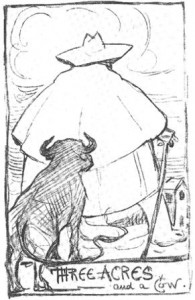
While the pope doesn’t specify to what end this land should be used in this passage, he has in mind that it is to be used toward self-sufficiency by the growing of fruits and vegetables and the raising of some little livestock (chickens, a few pigs, and/or a cow).3 For the pope, the right to possess property is a natural right (one can perhaps see some Locke behind this, the right to life, liberty, and the pursuit of property, which the Declaration of Independence altered to happiness, but I’m not sure the pope is following a Lockean line of thinking; I’ll need to study this more myself).4 Much of the pope’s understanding here is based in the family as the foundation stone for society.5 Society begins in the family and moves out from there, this gives the individual family a State-like status. Again to quote him at length:
‘A family, no less than a State, is, as We have said, a true society, governed by an authority peculiar to itself, that is to say, by the authority of the father. Provided, therefore, the limits which are prescribed by the very purposes for which it exists be not transgressed, the family has at least equal rights with the State in the choice and pursuit of the things needful to its preservation and its just liberty. We say, “at least equal rights”; for, inasmuch as the domestic household is antecedent, as well in idea as in fact, to the gathering of men into a community, the family must necessarily have rights and duties which are prior to those of the community, and founded more immediately in nature. If the citizens, if the families on entering into association and fellowship, were to experience hindrance in a commonwealth instead of help, and were to find their rights attacked instead of being upheld, society would rightly be an object of detestation rather than of desire.’6
So society exists in order to help safeguard against this mistreatment of the working class, of the family, and to help ensure that as many people as possible can become landowners. There’s much more to Rerum novarum, but you’ll just have to read it and the other documents that make up Catholic Social Teaching for yourselves (I have a group on Facebook which is doing just that, so feel free to join us). This is where the distributists come in.
G. K. Chesterton and Hilaire Belloc are the two names that come up most often when one searches out information concerning distributism. These British men and Christians, along with others sought to put the pope’s ideas into practice in turn of the century England (and elsewhere, the Catholic Workers Movement in America founded by Dorothy Day is an American example of these same ideals). Through various writings and periodicals, many of which can be found at the currently dormant Distributist Review, these men and others sought to spread the sensibility of distributism. At the end of the day, this is what distributism is: a sensibility. It is not a political party nor even, strictly speaking, an economic system since it is more about a way of living. Chesterton believed that you could not impose distributism on people, you could only encourage them to live it. How does one begin to live it, though?
I think the answer to this must be incrementally. One must begin with the family. I don’t think it can truly begin at any smaller stage, individuals can do much, but this is an inherently social sensibility (Artur Rosman has written convincingly on the idea that the Church ought to replace the Family; and so one could suggest that the church, locally speaking, would also be a valid starting point). The family, and/or the church, ought to strive to live locally, to support local businesses, local farmers, and help local families get land on which to grow food. My wife and I, for instance, since we don’t even rent our own home but are living with family while I finish my PhD, have rented a 300sqft plot of land on which to grow our own fruits and vegetables. It’s our first time with a plot this large and we may very well fail, but beginning is almost more important than succeeding, at first anyway. From the family level one perhaps should move to the local community, your town or county encouraging locally owned businesses to come in and thrive, in general to encourage local-mindedness. Where it goes from there? I don’t know. But we must take the first steps.
If you have any interest in distributism, please do get in touch (especially if you happen to live near me in the greater Nashua area in New Hampshire) and in the mean time check out some of these online resources. I’ll likely be posting about this again as I will be having several discussions with friends and strangers who have an interest in or are even already proponents of distributism (to those for whom this will mean something, I will be meeting with Dr William Edmund Fahey, president of Thomas More College of Liberal Arts here in NH soon to discuss Chesterton and distributism).
Distributist Links
From Letters to the Edge of Elfland
The Enchantment of Creation Or, I Do Believe in Faerie
On The Economics of Elfland: In Honour of J. R. R. Tolkien’s Birthday
Cottage Economy: A Mini Book Review
From People Who Know More than I Do:
Distributism on Ethika Politika
Sincerely yours,
David
1 Pope Leo XIII,Rerum novarum [Encyclical on Capital and Labor], Vatican Website, May 15 1891, 33, accessed 14 May 2015, http://w2.vatican.va/content/leo-xiii/en/encyclicals/documents/hf_l-xiii_enc_15051891_rerum-novarum.html.
2 Pope Leo XIII,Rerum novarum [Encyclical on Capital and Labor], Vatican Website, May 15 1891, 5, accessed 14 May 2015, http://w2.vatican.va/content/leo-xiii/en/encyclicals/documents/hf_l-xiii_enc_15051891_rerum-novarum.html.
3 Pope Leo XIII,Rerum novarum [Encyclical on Capital and Labor], Vatican Website, May 15 1891, 9, accessed 14 May 2015, http://w2.vatican.va/content/leo-xiii/en/encyclicals/documents/hf_l-xiii_enc_15051891_rerum-novarum.html.
4 Pope Leo XIII,Rerum novarum [Encyclical on Capital and Labor], Vatican Website, May 15 1891, 6, accessed 14 May 2015, http://w2.vatican.va/content/leo-xiii/en/encyclicals/documents/hf_l-xiii_enc_15051891_rerum-novarum.html.
5 Pope Leo XIII,Rerum novarum [Encyclical on Capital and Labor], Vatican Website, May 15 1891, 12, accessed 14 May 2015, http://w2.vatican.va/content/leo-xiii/en/encyclicals/documents/hf_l-xiii_enc_15051891_rerum-novarum.html.
6 Pope Leo XIII,Rerum novarum [Encyclical on Capital and Labor], Vatican Website, May 15 1891, 13, accessed 14 May 2015, http://w2.vatican.va/content/leo-xiii/en/encyclicals/documents/hf_l-xiii_enc_15051891_rerum-novarum.html.
Previous Post

May 5, 2015
The Beauty of Rosie Cotton Is in Her Eyes
Next Post
May 30, 2015 Tetelestai, for now
Browse Our Archives
Select a Category A Secular Age Advent Apologetics Atheism Beauty Being a Catholic Evangelical Being Catholic Being Deified: Poetry and Fantasy on the Path to God Blogging Book Reviews C. S. Lewis Catholic Imagination Catholic Social Teaching Catholicism Christmas Church Calendar Church Fathers Church Life Community Conferences Cosmology Creation Curdled Words Deification Distributism Easter Economics Education Epiphany Essay Extracts Eucharist Faerie Faeriean Metaphysics Fatherhood Films Folk Liturgy Food and Drink G. K. Chesterton Harry Potter J. R. R. Tolkien Jove King Arthur Language Lent Life Literature and Poetry Liturgy Medieval Theology Music My Publications Mythology On the Edges of Elfland Ordinary Time Ordination Parenthood Parish Patristic Theology Pentecost Politics Prayer Racism Radical Orthodoxy Restoration Movement Sacramental Ontology Saints Science Sex and Sexuality Sophiology Stories The Inklings The Radical Catholic Reimagination of Everything Theologians in the Church Theopoetics Thesis Research Uncategorized University of Nottingham What I'm Reading Writing
Select a Month December 2019 November 2019 October 2019 September 2019 August 2019 July 2019 June 2019 May 2019 April 2019 March 2019 February 2019 January 2019 December 2018 November 2018 October 2018 September 2018 August 2018 July 2018 June 2018 May 2018 April 2018 March 2018 February 2018 January 2018 December 2017 November 2017 October 2017 August 2017 July 2017 June 2017 May 2017 April 2017 March 2017 February 2017 January 2017 December 2016 November 2016 October 2016 September 2016 August 2016 July 2016 June 2016 May 2016 April 2016 March 2016 February 2016 January 2016 December 2015 November 2015 October 2015 September 2015 August 2015 July 2015 June 2015 May 2015 April 2015 March 2015 February 2015 January 2015 December 2014 November 2014 October 2014 September 2014 August 2014 July 2014 June 2014 May 2014 April 2014 March 2014 February 2014 January 2014 December 2013 November 2013 October 2013 September 2013 August 2013 July 2013 June 2013 May 2013 April 2013 March 2013 February 2013 January 2013 December 2012 November 2012 October 2012 September 2012 July 2012
Follow Us!
TAKE THE
Religious Wisdom Quiz
How many people were saved from Sodom?
Select your answer to see how you score.
4 5 3 6
Related posts from Letters from the Edge of Elfland
Patheos Catholic's Pagan Problem, or Is Patheos Catholic...
Letters from the Edge of Elfland
The Catholic Church Has a Geography Problem: Reflections...
Letters from the Edge of Elfland
Camping on the Edge of Elfland: Pat Noone...
Letters from the Edge of Elfland

Chesterton, Dragons, and Cancer: A Reflection on this...
Letters from the Edge of Elfland
TRENDING AT PATHEOS Catholic

Rejecting Doom: Christian Hope And Human Action
Christianity is a religion of hope. We are to have hope and...

It’s What Comes From Within Which Matters
One of the most difficult things for us to understand is why...

Why I Choose the Eucharist Over the Sermon
Choose the Eucharist, Not the Sermon What are we supposed to get...

5 Design Elements Found in Spiritually Rooted Homes
Putting Spirituality Into Home Decor Our homes are more than our living...

Credo: A Story of God Told with the...
About 10 years ago, I began to imagine a personal "Credo" that...

The Anatomy of Divine Revelation in Catholic Thought
The claim that God has made Himself known to human beings is...
view all Catholic blogs
Ad-Free & Subscriber Log-In Subscription Support
- About Us
- 2026 Calendar
- Videos
- Podcasts
- Library of World Religions
- Faith In Media Tracker
- Advertise With Us
- Write for Us
- Privacy Policy
- Terms of Service
- Do Not Sell My Data
- Contact Us
- Radiant Digital
- Manage Newsletter Subscriptions
- Unsubscribe From Notifications
- Sitemap
Copyright 2008-2026, Patheos. All rights reserved.
Subscription Support Ad-Free & Subscriber Log-In
Follow Patheos