
BuddhistCatholicContemplativeEvangelicalGeneral ChristianHinduJewishLatter-day SaintMuslimNew VisionsProgressive Christian
Beliefs
- Buddhist
- Catholic
- Contemplative
- Evangelical
- General Christian
- Hindu
- Jewish
- Latter-day Saint
- More Voices
- Muslim
- New Visions
- Pagan
- Progressive Christian
Topics
- Religion News
- Food and Religion
- Sports and Religion
- Religious Art
- Religious Music and Entertainment
- Religious Events
- History and Religion
- Style and Religion
- Politics and Religion
- Women in Religion
- Recreation Outdoors and Religion
- Business Finance and Religion
- Careers Workplace and Religion
- Education and Religion
- Family Parenting and Religion
- Health Fitness and Religion
- Home and Religion
- Relationships and Religion
- Technology and Religion
- Travel and Religion
Columnists
- Buddhist Columnists
- Business Finance and Religion Columnists
- Careers Workplace and Religion Columnists
- Catholic Columnists
- Contemplative Columnists
- Education and Religion Columnists
- Evangelists Columnists
- Family Parenting and Religion Columnists
- General Christian Columnists
- Health Fitness and Religion Columnists
- Hindu Columnists
- History and Religion Columnists
- Home and Religion Columnists
- Jewish Columnists
- More Voices Columnists
- Latter Day Columnists
- Muslim Columnists
- New Visions Columnists
- Nonreligious Columnists
- Pagan Columnists
- Politics and Religion Columnists
- Progressive Columnists
- Recreation Outdoors and Religion Columnists
- Relationships and Religion Columnists
- Religion News Columnists
- Religious Art Columnists
- Religious Events Columnists
- Religious Music and Entertainment Columnists
- Sports and Religion Columnists
- Style and Religion Columnists
- Technology and Religion Columnists
- Travel and Religion Columnists
- Women in Religion Columnists
Resource Library
- 2026 Calendar
- Library of World Religions
- The 100 Most Holy Places on Earth
- Patheos Answers
- Podcasts
- Videos
- Faith Leaders Database
- Anglican Episcopalian
- Bahai
- Baptist
- Buddhism
- Christianity
- Confucianism
- Eastern Orthodoxy
- Hinduism
- Holiness and Pentecostal
- ISKCON
- Islam
- Judaism
- Lutheran
- Methodist
- The Church of Jesus Christ of Latter-day Saints
- New Age
- Paganism
- Presbytarian and Reformed
- Protestantism
- Religion Behind the Scenes
- Roman Catholic
- Scientology
- Shia Islam
- Sikhism
- Sufism
- Sunni Islam
- Taoism
- Zen
- See all religions
Research Tools
 Ad-Free & Subscriber Log-In Subscription Support
Ad-Free & Subscriber Log-In Subscription Support
Follow Patheos 

- Trending:
- Forgiveness
- |
- Marriage
- |
- Consciousness
- |
- Death Penalty
- |
- Election
- |
- Halloween
 Letters from the Edge of Elfland
- Home
- About
- Distributist Resources
- Publications and Presentations
- Support
- Works in Progress
- The Epistolarian Around the Web
- Home
- Catholic
- Meandering Reflections on and Questions about the Harry Potter Series
Meandering Reflections on and Questions about the Harry Potter Series
Last updated on: March 9, 2015 at 1:35 pm by David Russell Mosley
Meandering Reflections on and Questions about the Harry Potter Series 2015-03-09T13:35:10-04:00 David Russell Mosley
Patheos Explore the world's faith through different perspectives on religion and spirituality! Patheos has the views of the prevalent religions and spiritualities of the world.
David Russell Mosley
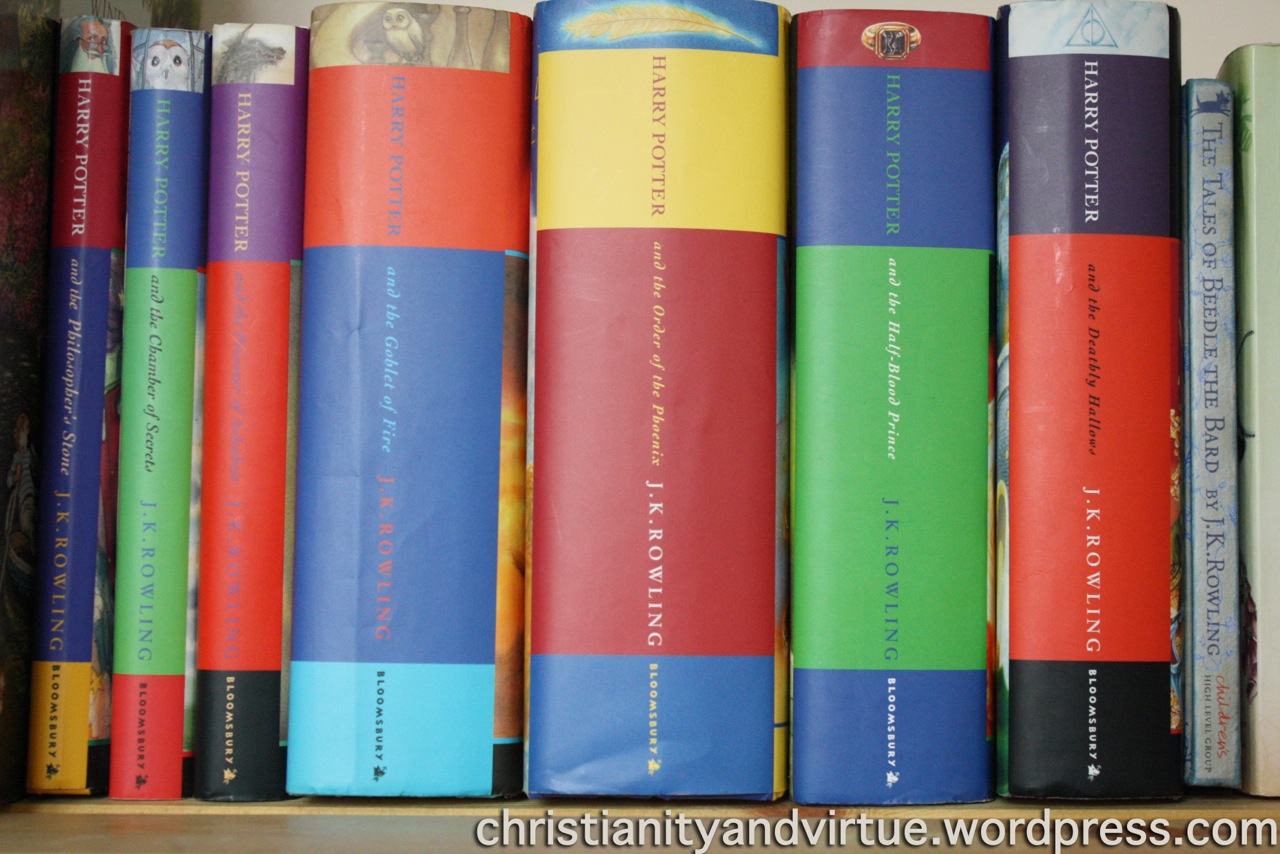
The Harry Potter Series: British Editions
Lent
9 March 2015
The Edge of Elfland
City, State/County
Dear Friends and Family,
Yesterday I finished, yet again, the Harry Potter Series. I love returning to these stories at least once a year. They aren’t perfect, but nevertheless, I still love them. Below are some unorganised thoughts and reflections on the Harry Potter Series. Perhaps some day I’ll organise them or write more fully on some of them, but for now take these little digests for what they: meanderings.
Body and Soul
Perhaps the most problematic part of the Harry Potter Series for me is Rowling’s understandings of body, mind, and soul. In Harry Potter and the Prisoner of Azkaban, we get introduced to Dementors, fear sucking creatures that somehow also possess the ability to suck out one’s soul if given the opportunity to kiss you. First, of course, we might question this association of fear and happiness (the thing that drives away Dementors when formed into a Patronus) and the soul. Why are these two emotions the ones connected with the soul? Sirius, for instance, is able to mentally combat them by thinking first about his innocence (justice) and then his revenge (vengeance). What’s more bothersome, however, is Rowling’s relatively Cartesian understanding of the human person. Hermione tells Ron and Harry that your body can exist (live) without your soul. It serves, apparently, as the source of personality and consciousness, but not motion. It is the ghost driving the machine. So much so, that Rowling invents the Horcrux. Voldemort is able to split his soul putting pieces of it into both inanimate and animate objects. The inanimate objects are able to manifest themselves as Voldemort the person, but not, initially anyway, Voldemort the body. However, Rowling confuses this both when she creates a mind/soul dichotomy in Harry Potter and the Deathly Hallows when we learn the Voldemort put a part of his soul in Harry (by accident) causing a confusion of mind and soul, thus requiring Harry to learn occlumency. But this causes me to ask, if the soul and mind are not the same, what is the soul and what purpose does it serve? Hermione tells us we should care about our souls, but Rowling provides no real reason as to why, since there seems confusion over the difference between soul and mind.
The Invisibility Cloak
In Harry Potter and the Deathly Hallows we learn that Harry’s cloak is one of those hallows, a true cloak of invisibility that is supposed to be spell-proof as regards being seen through. However, in Harry Potter and the Goblet of Fire we learn that Moody’s magical eye is capable of seeing through it. This just doesn’t jive.
Muggle-borns
It seems to me that Rowling undermines everything she sets up about muggle-born wizards in The Tales of Beedle the Bard. In the story of ‘Babbity Rabbity and Her Cackling Stump’ there is a footnote from Dumbledore informing us that while one must be born magical, but that this can come about from muggle parentage, that most research suggests that there is wizarding blood somewhere in that person’s ancestry. This takes away, somewhat, both from my Calvinist/Predestinarian reading of wizardkind, but also takes away from the importance of muggle-wizard relations. One could easily make the argument that if all muggle-borns do in fact have wizard ancestry then they are no longer muggle-borns, they’re just the one person in their family to be born with the wizard genes activated. This would mean that standing up for muggle-borns is no longer related to standing up for muggles qua muggles.
The Importance of Christmas
Christmas plays a really fascinating role in the Harry Potter Series. In each book it seems to serve as a means of furthering the plot (Harry and Co. learn something that helps move them to the climax and its resolution) and/or as a means of giving Harry a family. Some examples will suffice: In Harry Potter and the Philosopher’s Stone its on Christmas that Harry receives his father’s invisibility cloak, giving him his first real connection to his family. That night, Harry finds the Mirror of Erised and sees his parents, and extended family, for the very first time. The cloak also serves as a major plot point throughout the series, being given its ultimate significance as the greatest of the Hallows. In Chamber of Secrets, Christmas is when Harry, Ron, and Hermione take polyjuice potion and the first two question Malfoy and learn more about the Chamber’s more recent history. In Deathly Hallows the period from Christmas Eve to St Stephen’s Day is the period over which Harry and Hermione go to his hometown, his parent’s grave, and his destroyed home; are attacked by Nagini; find the sword of Gryffindor; Ron returns; and Ron destroys a horcrux. Christmas thus serves a profoundly important place in Rowling’s work, which I think may suggest an even greater connection between Harry and Christ.
What Happened to Ron the Strategist?
In Harry Potter and the Philosopher’s Stone we are introduced to wizard’s chess, which is just normal chess with animated, semi-sentient chess pieces. Ron, we learn, is a proficient. Not only does Ron trounce Harry, but he also beats McGongall’s life-size wizard’s chess set. Chess is a highly complex game, requiring proficients to think rapidly and to think and plan ahead. Where is this Ron when it comes to doing homework, or searching for horcruxes (alright, she does emphasise his leadership after he returns and the group learn about the Deathly Hallows), or really any other time planning is involved? It seems to me Ron would be right useful in planning battle strategies, which would have been great in the battle of Hogwarts. His chess skills seemed so important, like Hermione’s logic or Harry’s leadership and broom-flying abilities which all show up with greater importance throughout the series. Instead, Ron seems to get a little dumber.
Aberforth and Goats
Seriously, what’s the deal?
Hagrid’s mum and dad?
How did that work, and why was his dad sad when she left?
Firenze
What role did he play in the battle of Hogwarts? Also, why didn’t he see anything worth saying about the death of Dumbledore?
Voldemort: Love potion baby
I can’t corroborate this, but I have read somewhere that Rowling has said the reason Voldemort cannot love is because he was conceived under the effects of a love potion. This seems to literally make him irredeemable which Harry Potter and the Half-Blood Prince seemed not to indicate. Harry, upon meeting boy Voldemort sees what could have been himself. Even in Order of the Phoenix we learn that the difference between Harry and Voldemort, the ability to love, is often based in Harry’s choices: Harry chose Gryffindor over Slytherin; He chose to befriend Ron and not Draco. If Voldemort lacked the ability to make these choices due to his mother’s unintended wickedness, then Voldemort had no choice and cannot rightly be condemned for his actions because he could not have chosen otherwise, because his mother chose for him.
Anyway, these are just some of my thoughts and reflections. Let me know if you have answers or solutions to some of the problems I’ve noted, or if you simply disagree, or if you have reflections of your own.
Sincerely yours,
David
Previous Post

March 4, 2015
Links and videos I Normally Would Have Posted on Facebook: III
Next Post
March 19, 2015 Truth, Beauty: Why I Teach Beautiful Poetry
Browse Our Archives
Select a Category A Secular Age Advent Apologetics Atheism Beauty Being a Catholic Evangelical Being Catholic Being Deified: Poetry and Fantasy on the Path to God Blogging Book Reviews C. S. Lewis Catholic Imagination Catholic Social Teaching Catholicism Christmas Church Calendar Church Fathers Church Life Community Conferences Cosmology Creation Curdled Words Deification Distributism Easter Economics Education Epiphany Essay Extracts Eucharist Faerie Faeriean Metaphysics Fatherhood Films Folk Liturgy Food and Drink G. K. Chesterton Harry Potter J. R. R. Tolkien Jove King Arthur Language Lent Life Literature and Poetry Liturgy Medieval Theology Music My Publications Mythology On the Edges of Elfland Ordinary Time Ordination Parenthood Parish Patristic Theology Pentecost Politics Prayer Racism Radical Orthodoxy Restoration Movement Sacramental Ontology Saints Science Sex and Sexuality Sophiology Stories The Inklings The Radical Catholic Reimagination of Everything Theologians in the Church Theopoetics Thesis Research Uncategorized University of Nottingham What I'm Reading Writing
Select a Month December 2019 November 2019 October 2019 September 2019 August 2019 July 2019 June 2019 May 2019 April 2019 March 2019 February 2019 January 2019 December 2018 November 2018 October 2018 September 2018 August 2018 July 2018 June 2018 May 2018 April 2018 March 2018 February 2018 January 2018 December 2017 November 2017 October 2017 August 2017 July 2017 June 2017 May 2017 April 2017 March 2017 February 2017 January 2017 December 2016 November 2016 October 2016 September 2016 August 2016 July 2016 June 2016 May 2016 April 2016 March 2016 February 2016 January 2016 December 2015 November 2015 October 2015 September 2015 August 2015 July 2015 June 2015 May 2015 April 2015 March 2015 February 2015 January 2015 December 2014 November 2014 October 2014 September 2014 August 2014 July 2014 June 2014 May 2014 April 2014 March 2014 February 2014 January 2014 December 2013 November 2013 October 2013 September 2013 August 2013 July 2013 June 2013 May 2013 April 2013 March 2013 February 2013 January 2013 December 2012 November 2012 October 2012 September 2012 July 2012
Follow Us!
TAKE THE
Religious Wisdom Quiz
What did Stephen see as he was being stoned?
Select your answer to see how you score.
Angels descending The face of God A bright light from heaven Heaven opened and Jesus standing at the right hand of God
Related posts from Letters from the Edge of Elfland

Poetry, Podcasts, and More: Some Updates on Other...
Letters from the Edge of Elfland

Working on a Book of Poetry: An Apology...
Letters from the Edge of Elfland

Poetry Shapes the World around Us: Reflecting on...
Letters from the Edge of Elfland
Harry Potter, Demons, and Exorcists: A Follow Up...
Letters from the Edge of Elfland
TRENDING AT PATHEOS Catholic

Rejecting Doom: Christian Hope And Human Action
Christianity is a religion of hope. We are to have hope and...

It’s What Comes From Within Which Matters
One of the most difficult things for us to understand is why...

Why I Choose the Eucharist Over the Sermon
Choose the Eucharist, Not the Sermon What are we supposed to get...

5 Design Elements Found in Spiritually Rooted Homes
Putting Spirituality Into Home Decor Our homes are more than our living...

Credo: A Story of God Told with the...
About 10 years ago, I began to imagine a personal "Credo" that...

The Anatomy of Divine Revelation in Catholic Thought
The claim that God has made Himself known to human beings is...
view all Catholic blogs
Ad-Free & Subscriber Log-In Subscription Support
- About Us
- 2026 Calendar
- Videos
- Podcasts
- Library of World Religions
- Faith In Media Tracker
- Advertise With Us
- Write for Us
- Privacy Policy
- Terms of Service
- Do Not Sell My Data
- Contact Us
- Radiant Digital
- Manage Newsletter Subscriptions
- Unsubscribe From Notifications
- Sitemap
Copyright 2008-2026, Patheos. All rights reserved.
Subscription Support Ad-Free & Subscriber Log-In
Follow Patheos