
BuddhistCatholicContemplativeEvangelicalGeneral ChristianHinduJewishLatter-day SaintMuslimNew VisionsProgressive Christian
Beliefs
- Buddhist
- Catholic
- Contemplative
- Evangelical
- General Christian
- Hindu
- Jewish
- Latter-day Saint
- More Voices
- Muslim
- New Visions
- Pagan
- Progressive Christian
Topics
- Religion News
- Food and Religion
- Sports and Religion
- Religious Art
- Religious Music and Entertainment
- Religious Events
- History and Religion
- Style and Religion
- Politics and Religion
- Women in Religion
- Recreation Outdoors and Religion
- Business Finance and Religion
- Careers Workplace and Religion
- Education and Religion
- Family Parenting and Religion
- Health Fitness and Religion
- Home and Religion
- Relationships and Religion
- Technology and Religion
- Travel and Religion
Columnists
- Buddhist Columnists
- Business Finance and Religion Columnists
- Careers Workplace and Religion Columnists
- Catholic Columnists
- Contemplative Columnists
- Education and Religion Columnists
- Evangelists Columnists
- Family Parenting and Religion Columnists
- General Christian Columnists
- Health Fitness and Religion Columnists
- Hindu Columnists
- History and Religion Columnists
- Home and Religion Columnists
- Jewish Columnists
- More Voices Columnists
- Latter Day Columnists
- Muslim Columnists
- New Visions Columnists
- Nonreligious Columnists
- Pagan Columnists
- Politics and Religion Columnists
- Progressive Columnists
- Recreation Outdoors and Religion Columnists
- Relationships and Religion Columnists
- Religion News Columnists
- Religious Art Columnists
- Religious Events Columnists
- Religious Music and Entertainment Columnists
- Sports and Religion Columnists
- Style and Religion Columnists
- Technology and Religion Columnists
- Travel and Religion Columnists
- Women in Religion Columnists
Resource Library
- 2026 Calendar
- Library of World Religions
- The 100 Most Holy Places on Earth
- Patheos Answers
- Podcasts
- Videos
- Faith Leaders Database
- Anglican Episcopalian
- Bahai
- Baptist
- Buddhism
- Christianity
- Confucianism
- Eastern Orthodoxy
- Hinduism
- Holiness and Pentecostal
- ISKCON
- Islam
- Judaism
- Lutheran
- Methodist
- The Church of Jesus Christ of Latter-day Saints
- New Age
- Paganism
- Presbytarian and Reformed
- Protestantism
- Religion Behind the Scenes
- Roman Catholic
- Scientology
- Shia Islam
- Sikhism
- Sufism
- Sunni Islam
- Taoism
- Zen
- See all religions
Research Tools
 Ad-Free & Subscriber Log-In Subscription Support
Ad-Free & Subscriber Log-In Subscription Support
Follow Patheos 

- Trending:
- Forgiveness
- |
- Marriage
- |
- Consciousness
- |
- Death Penalty
- |
- Election
- |
- Halloween
 Letters from the Edge of Elfland
- Home
- About
- Distributist Resources
- Publications and Presentations
- Support
- Works in Progress
- The Epistolarian Around the Web
- Home
- Catholic
- How I Pray: A Reflection
How I Pray: A Reflection
Last updated on: February 11, 2015 at 3:32 pm by David Russell Mosley
How I Pray: A Reflection 2015-02-11T15:32:42-04:00 David Russell Mosley
Patheos Explore the world's faith through different perspectives on religion and spirituality! Patheos has the views of the prevalent religions and spiritualities of the world.
David Russell Mosley
Ordinary Time
11 February 2015
The Edge of Elfland
Hudson, New Hampshire
Dear Friends and Family,
On Monday I posted a list of questions stolen from God and the Machine’s series: How I pray. Today, I want to take this opportunity to answer those questions as best I can. As I said on Monday, I do not offer these as an example of how you ought to pray. I do not think so highly of myself as that. If there is anything I do that you ought to also, it is only because men and women much holier than I have been doing it for much longer. I had considered altering some of the questions to make them perhaps a bit more Protestant friendly. But in an effort to live out consistently and honestly my “Catholic-Evangelicalism”, I am letting them stand and giving my honest answers to them, whomever they may shock or surprise.
Who are you?
While this question was perhaps more intended to explain to readers who this new person is, I do find it a startling and necessary place to begin. Who am I? Am I a father? A husband? A theologian? A poet? A man? An American? I am all of these things and more. Some are accidental to me, not constituting who I am substantially, but constituting the person you encounter whether through these letters or in person. Substantially, I am a Christian, a child of God, adopted into Christ’s sonship and like the pilgrim in The Divine Comedy working my way, by way of my guides, toward the end for which God has made me: the Beatific Vision and deification (which are ultimately synonymous for our vision of the Triune God can be nought else but deifying). I am also a father and a husband (and therefore a man) substantially. These three (or four) things you cannot change about me without changing who I am at my core. Whether other aspects of me, namely being a theologian or poet, are substantial or accidental, I admit to not yet knowing.
What is your vocation?
This is something I’m still discerning. I am, by training, a theologian. Yet, as I have written to you before, I was in the beginning process of becoming an Anglican priest. I don’t yet know to what vocation I am being called, and what my training and inclinations have to do with that, but I am doing my best to listen.
What is your prayer routine for an average day?
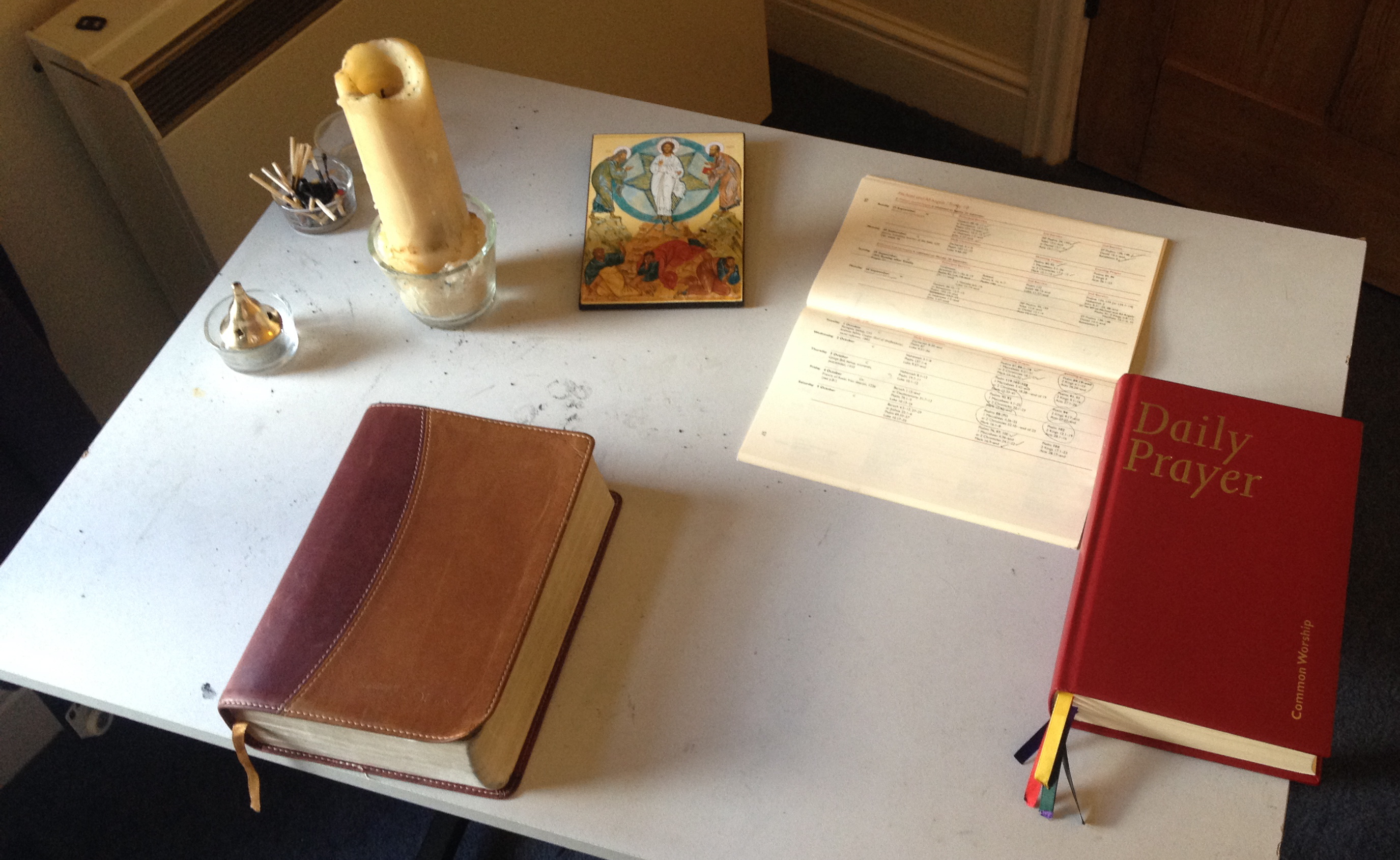
In the mornings, I get up between 3:30 and 6, feed my son, Theodore, go downstairs, and say Morning Prayer. I try, but often fail, at saying Evening prayer between 2:00 and 7:00. I follow the Anglican tradition of keeping Morning and Evening Prayer (based on a shortened form of the Benedictine practice of the Divine Office), using Daily Prayer from the Common Worship. This was the first prayerbook I ever had and like using it to keep up with the Church Calendar. It also adds a level of asceticism to my life that I find I need. Throughout the day I try to pray. I often journal after saying Morning Prayer and this usually includes several prayers, typically for forgiveness. Otherwise, I say prayers when I feel led to or when I need to. I would like to have some more form to my prayer life and am working on it.
How well do you achieve it, and how do you handle those moments when you don’t?
It is difficult for me to achieve this every day. What with twins, living with my Grandmother-in-law in a small condo, and making excuses like the proceeding two, I often fail. I try not to be too hard on myself about it, not disparaging myself, but reminding myself to the standard to which I am holding myself.
Do you have a devotion that is particularly important to you or effective?
In difficult times I often turn to a prayer I learned when reading the works of John Cassian. “Make haste, O God, to deliver me!
O Lord, make haste to help me!” It is from Psalm 70. This prayer when prayed repetitively has been a help in fighting temptation, though I do not turn to it as often as I like.
Do you have a place, habit, or way of praying?
While I hope to someday have a prayer corner filled with icons and religious imagery, for now, in the space we share, I have to settle for something a bit less. I tend to pray Morning Prayer, the one I can ensure I do without others around, in the recliner in my Grandmother-in-law’s living room. I intend also to begin kneeling while doing more formal prayers and perhaps trying other positions for the less formal, like prostration. The body is just as important in the act of prayer as the soul. Our posture, our position can aid or hinder our prayer. Equally, the soul lifts the body to new heights, and depths, in prayer.
Do you use any tools or sacramentals?
I have a few icons that I use, when I’m in the same room as them. Though considering it now, perhaps I will begin bringing them down with me so as to have them for my prayer time.
What is your relationship with the Rosary?
If icons didn’t turn off or confuse some of my Protestant correspondents (for I think of you all, whoever to you all are, as correspondents and not readers), then perhaps my answer to this question will. I have previously written a reflection about praying to departed Christians, the Saints. It stands to reason, therefore, that if I think calling on them for prayer is permissible, so too is calling on the Mother of God. That being said, my prayers to Mary have been limited up to this point by asking her to watch over my sons as she watched over her own son who is Christ our Lord. I have, however, recently acquired a Rosary and have begun to use it at least once daily. In my early days as a Christian, which were not so long ago, I would have thought this if not totally, then at least partially idolatrous. However, I have found my use of the Rosary in prayer to be of profound aid and edification.
Some of you may balk still, but when one looks at the actual prayer, it is mostly Scripture:
Hail Mary, full of grace.
Our Lord is with thee.
Blessed art thou among women [Lk 1.28],
and blessed is the fruit of thy womb [Lk 1.42],
Jesus.
Holy Mary, Mother of God,
pray for us sinners,
now and at the hour of our death.
Amen.
The rest, as you can see, is simply asking for Mary to pray for us. There is nothing, in my opinion too scandalous about this. I have also been influenced by Stratford Caldecott in his book All Things Made New which tells us that the Rosary is entirely about Christ, through the eyes of Mary. I hope to write about that book more soon.
Is there one particular book or spiritual work that has been particularly important to your devotional life?
This is a difficult question for me to answer. On the one hand, the Institutes and Conferences of John Cassian are the primary books that led me down the path of liturgy and asceticism, in fixed hour prayers. However, since then the works of Gregory of Nazianzus, Augustine of Hippo, Thomas Aquinas, and others have been my guides in my devotional life.
What is your current spiritual or devotional reading?
I recently finished reading the Ambigua of Maximus the Confessor and began reading the works of Anselm in this capacity. However, that reading has strayed out of the devotional and may need to be replaced by something else, or at least a reconfiguring of how I read it.
Are there saints or other figures who inspire your prayer life or act as patrons?
St Thomas Aquinas has been a recent inspiration for my prayer life. His prayers and hymns, which I have only recently begun to read and pray myself, are ones I often turn to throughout the day. C. S. Lewis has also been a guide when it comes to prayer, especially his Letters to Malcolm which I hope to re-read soon. I’m sure this list will grow. St Benedict, St Patrick, and St Augustine are also frequent sources of inspiration in prayer. Another I hope to interact with more is my, unintentional, namesake, St David of Wales, patron saint of poets.
What is one prayer you find particularly powerful or effective?
Aquinas’s Prayer for the Attainment of Heaven is one I find particularly powerful. It helps me keep the cosmic as well as individual scope of the life in Christ. I have written about it here.
Have you had any unusual or even miraculous experiences in your prayer life?
There have been times in the past, but none of them can I really remember. The most recent happened while we were still living in the United Kingdom during the intercessions at a Spoken Eucharist service at the parish church in Beeston. I have written about it here. Dreams, visions, and miracles are things I think we are meant to court, but warily. The devil can also show us pictures as he did to Christ in the desert. Nevertheless, there is an inherently visionary aspect to our faith. God is the God who gives dreams and visions and we his people ought to be open and prepared to receive them.
I’d like to see _______YOU_______________ answer these questions.
Sincerely yours,
David
Previous Post

February 9, 2015
How I Pray: Introduction
Browse Our Archives
Select a Category A Secular Age Advent Apologetics Atheism Beauty Being a Catholic Evangelical Being Catholic Being Deified: Poetry and Fantasy on the Path to God Blogging Book Reviews C. S. Lewis Catholic Imagination Catholic Social Teaching Catholicism Christmas Church Calendar Church Fathers Church Life Community Conferences Cosmology Creation Curdled Words Deification Distributism Easter Economics Education Epiphany Essay Extracts Eucharist Faerie Faeriean Metaphysics Fatherhood Films Folk Liturgy Food and Drink G. K. Chesterton Harry Potter J. R. R. Tolkien Jove King Arthur Language Lent Life Literature and Poetry Liturgy Medieval Theology Music My Publications Mythology On the Edges of Elfland Ordinary Time Ordination Parenthood Parish Patristic Theology Pentecost Politics Prayer Racism Radical Orthodoxy Restoration Movement Sacramental Ontology Saints Science Sex and Sexuality Sophiology Stories The Inklings The Radical Catholic Reimagination of Everything Theologians in the Church Theopoetics Thesis Research Uncategorized University of Nottingham What I'm Reading Writing
Select a Month December 2019 November 2019 October 2019 September 2019 August 2019 July 2019 June 2019 May 2019 April 2019 March 2019 February 2019 January 2019 December 2018 November 2018 October 2018 September 2018 August 2018 July 2018 June 2018 May 2018 April 2018 March 2018 February 2018 January 2018 December 2017 November 2017 October 2017 August 2017 July 2017 June 2017 May 2017 April 2017 March 2017 February 2017 January 2017 December 2016 November 2016 October 2016 September 2016 August 2016 July 2016 June 2016 May 2016 April 2016 March 2016 February 2016 January 2016 December 2015 November 2015 October 2015 September 2015 August 2015 July 2015 June 2015 May 2015 April 2015 March 2015 February 2015 January 2015 December 2014 November 2014 October 2014 September 2014 August 2014 July 2014 June 2014 May 2014 April 2014 March 2014 February 2014 January 2014 December 2013 November 2013 October 2013 September 2013 August 2013 July 2013 June 2013 May 2013 April 2013 March 2013 February 2013 January 2013 December 2012 November 2012 October 2012 September 2012 July 2012
Follow Us!
TAKE THE
Religious Wisdom Quiz
What is the correct order for putting off the old self and putting on the new self as described in Colossians?
Select your answer to see how you score.
Rid yourself of anger, take off the old self, put to death earthly nature, put on the new self Clothe yourself with compassion, put on the new self, put to death earthly nature, rid yourself of anger Put to death earthly nature, rid yourself of anger/rage/malice, take off the old self, put on the new self, clothe yourself with compassion Put on the new self, put to death earthly nature, clothe yourself with compassion, rid yourself of anger
Related posts from Letters from the Edge of Elfland
Curdled Words: George Herbert, The Milky Way, and...
Letters from the Edge of Elfland
Chesterton, Dragons, and Cancer: A Reflection on this...
Letters from the Edge of Elfland
Ethnicity, DNA, White Supremacy, and the Pro-Life Movement
Letters from the Edge of Elfland
Saint-Haunted: How St. Cuthbert Found Me
Letters from the Edge of Elfland
TRENDING AT PATHEOS Catholic

Rejecting Doom: Christian Hope And Human Action
Christianity is a religion of hope. We are to have hope and...

It’s What Comes From Within Which Matters
One of the most difficult things for us to understand is why...

Why I Choose the Eucharist Over the Sermon
Choose the Eucharist, Not the Sermon What are we supposed to get...

5 Design Elements Found in Spiritually Rooted Homes
Putting Spirituality Into Home Decor Our homes are more than our living...

Credo: A Story of God Told with the...
About 10 years ago, I began to imagine a personal "Credo" that...

The Anatomy of Divine Revelation in Catholic Thought
The claim that God has made Himself known to human beings is...
view all Catholic blogs
Ad-Free & Subscriber Log-In Subscription Support
- About Us
- 2026 Calendar
- Videos
- Podcasts
- Library of World Religions
- Faith In Media Tracker
- Advertise With Us
- Write for Us
- Privacy Policy
- Terms of Service
- Do Not Sell My Data
- Contact Us
- Radiant Digital
- Manage Newsletter Subscriptions
- Unsubscribe From Notifications
- Sitemap
Copyright 2008-2026, Patheos. All rights reserved.
Subscription Support Ad-Free & Subscriber Log-In
Follow Patheos