
BuddhistCatholicContemplativeEvangelicalGeneral ChristianHinduJewishLatter-day SaintMuslimNew VisionsProgressive Christian
Beliefs
- Buddhist
- Catholic
- Contemplative
- Evangelical
- General Christian
- Hindu
- Jewish
- Latter-day Saint
- More Voices
- Muslim
- New Visions
- Pagan
- Progressive Christian
Topics
- Religion News
- Food and Religion
- Sports and Religion
- Religious Art
- Religious Music and Entertainment
- Religious Events
- History and Religion
- Style and Religion
- Politics and Religion
- Women in Religion
- Recreation Outdoors and Religion
- Business Finance and Religion
- Careers Workplace and Religion
- Education and Religion
- Family Parenting and Religion
- Health Fitness and Religion
- Home and Religion
- Relationships and Religion
- Technology and Religion
- Travel and Religion
Columnists
- Buddhist Columnists
- Business Finance and Religion Columnists
- Careers Workplace and Religion Columnists
- Catholic Columnists
- Contemplative Columnists
- Education and Religion Columnists
- Evangelists Columnists
- Family Parenting and Religion Columnists
- General Christian Columnists
- Health Fitness and Religion Columnists
- Hindu Columnists
- History and Religion Columnists
- Home and Religion Columnists
- Jewish Columnists
- More Voices Columnists
- Latter Day Columnists
- Muslim Columnists
- New Visions Columnists
- Nonreligious Columnists
- Pagan Columnists
- Politics and Religion Columnists
- Progressive Columnists
- Recreation Outdoors and Religion Columnists
- Relationships and Religion Columnists
- Religion News Columnists
- Religious Art Columnists
- Religious Events Columnists
- Religious Music and Entertainment Columnists
- Sports and Religion Columnists
- Style and Religion Columnists
- Technology and Religion Columnists
- Travel and Religion Columnists
- Women in Religion Columnists
Resource Library
- 2026 Calendar
- Library of World Religions
- The 100 Most Holy Places on Earth
- Patheos Answers
- Podcasts
- Videos
- Faith Leaders Database
- Anglican Episcopalian
- Bahai
- Baptist
- Buddhism
- Christianity
- Confucianism
- Eastern Orthodoxy
- Hinduism
- Holiness and Pentecostal
- ISKCON
- Islam
- Judaism
- Lutheran
- Methodist
- The Church of Jesus Christ of Latter-day Saints
- New Age
- Paganism
- Presbytarian and Reformed
- Protestantism
- Religion Behind the Scenes
- Roman Catholic
- Scientology
- Shia Islam
- Sikhism
- Sufism
- Sunni Islam
- Taoism
- Zen
- See all religions
Research Tools
 Ad-Free & Subscriber Log-In Subscription Support
Ad-Free & Subscriber Log-In Subscription Support
Follow Patheos 

- Trending:
- Forgiveness
- |
- Marriage
- |
- Consciousness
- |
- Death Penalty
- |
- Election
- |
- Halloween
 Letters from the Edge of Elfland
- Home
- About
- Distributist Resources
- Publications and Presentations
- Support
- Works in Progress
- The Epistolarian Around the Web
- Home
- Catholic
- The Sacramental Imagination of Harry Potter
The Sacramental Imagination of Harry Potter
Last updated on: November 10, 2014 at 11:25 am by David Russell Mosley
The Sacramental Imagination of Harry Potter 2014-11-10T11:25:50-04:00 David Russell Mosley
Patheos Explore the world's faith through different perspectives on religion and spirituality! Patheos has the views of the prevalent religions and spiritualities of the world.
David Russell Mosley
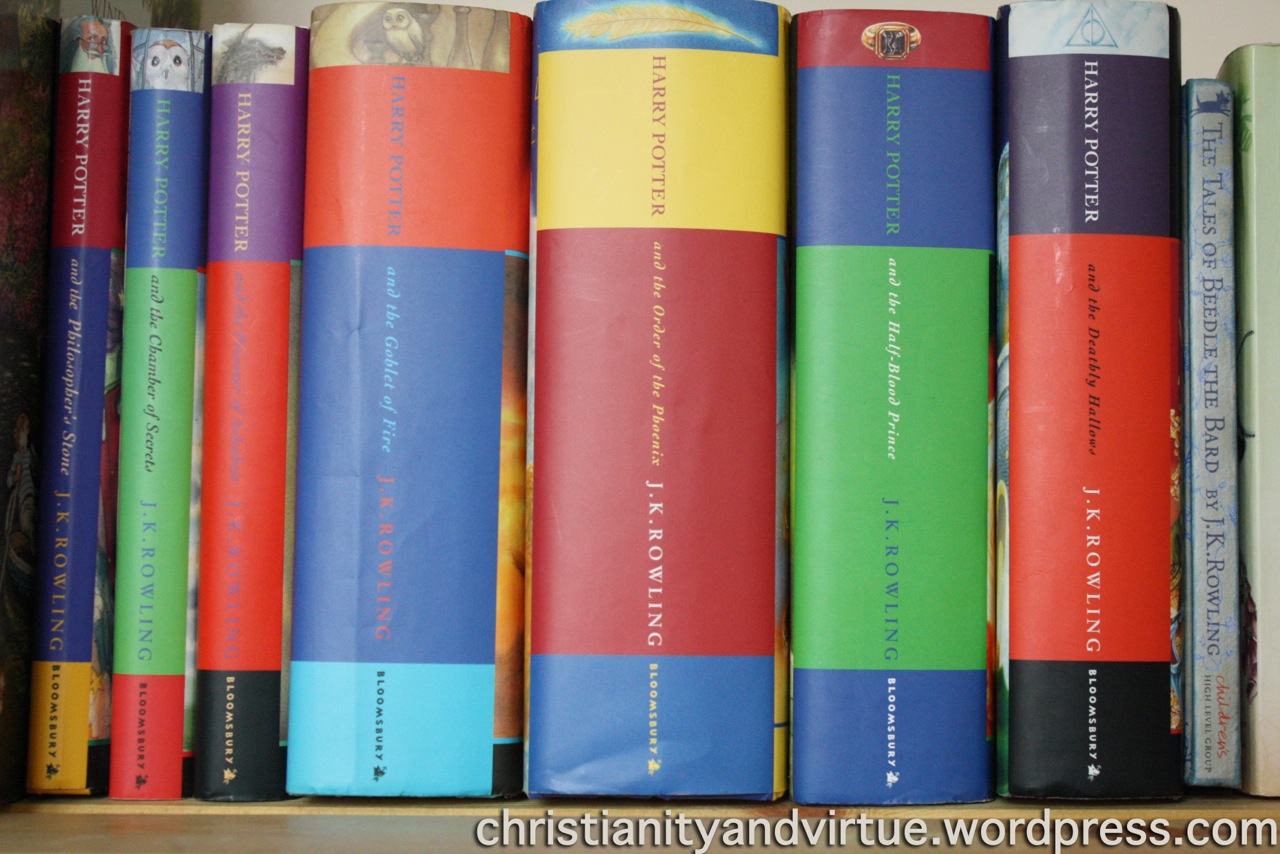
The Harry Potter Series: British Editions
Ordinary Time
Pope St Leo the Great
10 11 2014
The Edge of Elfland
Hudson, New Hampshire
Dear Friends and Family,
The Harry Potter books by J. K. Rowling, are the last books from my childhood that I will be examining in this Sacramental Imagination series. I hope to turn my attention to a few books I read after my childhood, but which are still children’s books, like J. R. R. Tolkien’s Smith of Wooton Major; George MacDonald’s The Princess and the Goblin and The Princess and Curdie, as well as some of his fairy tales; and perhaps others you might recommend.
I have written about the Christian nature of Rowling’s Potter books before, but today I want to spend a little time discussing how they might help children form a sacramental imagination. There are, however, some problems with Ms Rowling’s works that I would like to lay out at the forefront. First is something I have noted before, the almost Calvinistic system of how one becomes a witch or wizard. Following along relatively covenantal reformed lines, one primarily becomes a witch or wizard by being born from parents where at least one of them is a witch or wizard. This is a major plot point for the books commencing with earnest in book 6. However, whether one has wizard parents or not one still must be born a witch or wizard. It is not something one can claim for oneself. Muggles cannot learn magic, nor can squibs. This, therefore, suggests that the preferred way of living presented in the books, as a witch or wizard, is entirely outside of one’s control just as one’s salvation is outside of one’s control in a stringently Calvinist system. There are even those born of wizard ancestry who cannot do magic, who are not part of the community in the same way as everyone else, namely, squibs. This is, for me, a non-Calvinist, fairly problematic, though Rowling does back pedal a little in her The Tales of Beedle the Bard. In a footnote by Albus Dumbledore it is noted that research in the Department of Mysteries up to that point (likely somewhere around the mid-90s in the story’s chronology) that even those with Muggle parents who themselves can do magic likely have a witch or wizard somewhere in their ancestry.
The second problem I have is Rowling’s more or less Cartesian understanding of the human person. In The Prisoner of Azkaban, we learn that Dementors can suck out your soul. Your body would continue to function with your soul gone, but the person would no longer be there. Rowling’s books are based in an essentially Christian cosmos, but it is, in many ways, still a modernistic one, subject to post-Enlightenment thinking.
That being said, there is much that can be gained for children in Rowling’s Potter books. Perhaps the primary thing is how Rowling’s magical world gives us back our own world made strange. Wizards and witches do many of the same things we do: they shop, cook, throw parties, go to school, communicate with one another, and more, but each is rendered strange as we experience the magical world through Harry’s equally unaccustomed eyes. Harry’s first encounter with a magical being is Hagrid, a man too large to be allowed. As we later find out, not only is Hagrid big and a wizard, he’s even half-giant! Harry’s first shopping experience involves an apothecary, a wand shop, getting fitted for late-medieval/Renaissance style robes, and buying a pet owl.
What I find most interesting is how, even with magic, much of what the witches and wizards do would seem to us, slower. They don’t email one another or communicate by telephone, they write letters and send them by owls. It is almost astonishing how ultimately non-magical this is. The letters themselves, in fact nearly all the writing they do, with the exceptions of the newspaper, more recent books, and posters/cards, is done by hand, with a dip pen in the form of a quill. They actually dip a quill in a pot of ink and write, with their hands, on paper. The only magical element is when they send letters, the carriers are owls, but this is almost accidental to the whole process. They might just as well be carried by people. I think this is important. Rowling gives us a world with little technology and even less machining. Magic often takes the place of machines, but in the writing of letters or homework, neither magic nor sophisticated technology is used. Rather, the quill is a tool serving merely as an extension of the person holding it in order to effect a change in the world around them by the generation of something new, namely written words. It is interesting that wands serve the same basic function. They are tools, possessed of little magic themselves. Again, in the same footnote in The Tales of Beedle the Bard (footnote 4 in the notes after ‘Babbity Rabbity and the Cackling Stump), Dumbledore notes that a muggle picking up a magic wand might be able to do a random bit of magic, but only because there is a residual magic left in the wand by its owner. However, in the hand of a witch or wizard, it serves as a conduit for performing magic, magic which comes not from the wand nor any other external source, but from the wielder. Rowling, I think, is teaching children something about words, both that there is something magical, we might even say, sacramental about writing and the use of words (hence the magic spell). There is a relationship between the sign, the word or words, and the thing signified. In writing, the relationship is between the words and their author, with the quill/person as the conduit or sacrament and the letter the effect. In performing magic it is the word or words and their relationship to the change affected in the real world, with the wand/wizard as the sacrament and the magic performed the effect.
There is much more that could be said, particularly about human/animal relationships with the magical animals (like owls), and cosmic/terrestrial relationships (astrology as taught by Firenze the centaur). However, I have waffled on long enough. In the end, despite the flaws, Rowling’s Potter stories can help children see something magical in words, something sacramental in the relationship between words and what they represent, something that isn’t simply accidental. This makes her books immensely helpful in growing a sacramental imagination in children.
Sincerely yours,
David
Previous Post

November 5, 2014
The Sacramental Imagination of Narnia
Next Post

November 13, 2014 The (Not So) Shocking Beliefs of C. S. Lewis
Browse Our Archives
Select a Category A Secular Age Advent Apologetics Atheism Beauty Being a Catholic Evangelical Being Catholic Being Deified: Poetry and Fantasy on the Path to God Blogging Book Reviews C. S. Lewis Catholic Imagination Catholic Social Teaching Catholicism Christmas Church Calendar Church Fathers Church Life Community Conferences Cosmology Creation Curdled Words Deification Distributism Easter Economics Education Epiphany Essay Extracts Eucharist Faerie Faeriean Metaphysics Fatherhood Films Folk Liturgy Food and Drink G. K. Chesterton Harry Potter J. R. R. Tolkien Jove King Arthur Language Lent Life Literature and Poetry Liturgy Medieval Theology Music My Publications Mythology On the Edges of Elfland Ordinary Time Ordination Parenthood Parish Patristic Theology Pentecost Politics Prayer Racism Radical Orthodoxy Restoration Movement Sacramental Ontology Saints Science Sex and Sexuality Sophiology Stories The Inklings The Radical Catholic Reimagination of Everything Theologians in the Church Theopoetics Thesis Research Uncategorized University of Nottingham What I'm Reading Writing
Select a Month December 2019 November 2019 October 2019 September 2019 August 2019 July 2019 June 2019 May 2019 April 2019 March 2019 February 2019 January 2019 December 2018 November 2018 October 2018 September 2018 August 2018 July 2018 June 2018 May 2018 April 2018 March 2018 February 2018 January 2018 December 2017 November 2017 October 2017 August 2017 July 2017 June 2017 May 2017 April 2017 March 2017 February 2017 January 2017 December 2016 November 2016 October 2016 September 2016 August 2016 July 2016 June 2016 May 2016 April 2016 March 2016 February 2016 January 2016 December 2015 November 2015 October 2015 September 2015 August 2015 July 2015 June 2015 May 2015 April 2015 March 2015 February 2015 January 2015 December 2014 November 2014 October 2014 September 2014 August 2014 July 2014 June 2014 May 2014 April 2014 March 2014 February 2014 January 2014 December 2013 November 2013 October 2013 September 2013 August 2013 July 2013 June 2013 May 2013 April 2013 March 2013 February 2013 January 2013 December 2012 November 2012 October 2012 September 2012 July 2012
Follow Us!
TAKE THE
Religious Wisdom Quiz
True or False: Matthew's Gospel begins with a genealogy tracing Jesus' lineage back to King David.
Select your answer to see how you score.
FALSE TRUE
Related posts from Letters from the Edge of Elfland

Working on a Book of Poetry: An Apology...
Letters from the Edge of Elfland
Harry Potter, Demons, and Exorcists: A Follow Up...
Letters from the Edge of Elfland
Catholic School Removes Harry Potter from New Library
Letters from the Edge of Elfland

William Blake on the Creative Spirit, Beauty, and...
Letters from the Edge of Elfland
TRENDING AT PATHEOS Catholic

Creation, Preservation, and Teleology in Catholic Theology
As I write this, it is very early Monday morning. Like millions...

The Parable Of The Sower And The Word...
One of Christ’s most famous parables is that of the sower who...

Rejecting Doom: Christian Hope And Human Action
Christianity is a religion of hope. We are to have hope and...

Why I Choose the Eucharist Over the Sermon
Choose the Eucharist, Not the Sermon What are we supposed to get...

5 Design Elements Found in Spiritually Rooted Homes
Putting Spirituality Into Home Decor Our homes are more than our living...

Credo: A Story of God Told with the...
About 10 years ago, I began to imagine a personal "Credo" that...
view all Catholic blogs
Ad-Free & Subscriber Log-In Subscription Support
- About Us
- 2026 Calendar
- Videos
- Podcasts
- Library of World Religions
- Faith In Media Tracker
- Advertise With Us
- Write for Us
- Privacy Policy
- Terms of Service
- Do Not Sell My Data
- Contact Us
- Radiant Digital
- Manage Newsletter Subscriptions
- Unsubscribe From Notifications
- Sitemap
Copyright 2008-2026, Patheos. All rights reserved.
Subscription Support Ad-Free & Subscriber Log-In
Follow Patheos