
BuddhistCatholicContemplativeEvangelicalGeneral ChristianHinduJewishLatter-day SaintMuslimNew VisionsProgressive Christian
Beliefs
- Buddhist
- Catholic
- Contemplative
- Evangelical
- General Christian
- Hindu
- Jewish
- Latter-day Saint
- More Voices
- Muslim
- New Visions
- Pagan
- Progressive Christian
Topics
- Religion News
- Food and Religion
- Sports and Religion
- Religious Art
- Religious Music and Entertainment
- Religious Events
- History and Religion
- Style and Religion
- Politics and Religion
- Women in Religion
- Recreation Outdoors and Religion
- Business Finance and Religion
- Careers Workplace and Religion
- Education and Religion
- Family Parenting and Religion
- Health Fitness and Religion
- Home and Religion
- Relationships and Religion
- Technology and Religion
- Travel and Religion
Columnists
- Buddhist Columnists
- Business Finance and Religion Columnists
- Careers Workplace and Religion Columnists
- Catholic Columnists
- Contemplative Columnists
- Education and Religion Columnists
- Evangelists Columnists
- Family Parenting and Religion Columnists
- General Christian Columnists
- Health Fitness and Religion Columnists
- Hindu Columnists
- History and Religion Columnists
- Home and Religion Columnists
- Jewish Columnists
- More Voices Columnists
- Latter Day Columnists
- Muslim Columnists
- New Visions Columnists
- Nonreligious Columnists
- Pagan Columnists
- Politics and Religion Columnists
- Progressive Columnists
- Recreation Outdoors and Religion Columnists
- Relationships and Religion Columnists
- Religion News Columnists
- Religious Art Columnists
- Religious Events Columnists
- Religious Music and Entertainment Columnists
- Sports and Religion Columnists
- Style and Religion Columnists
- Technology and Religion Columnists
- Travel and Religion Columnists
- Women in Religion Columnists
Resource Library
- 2026 Calendar
- Library of World Religions
- The 100 Most Holy Places on Earth
- Patheos Answers
- Podcasts
- Videos
- Faith Leaders Database
- Anglican Episcopalian
- Bahai
- Baptist
- Buddhism
- Christianity
- Confucianism
- Eastern Orthodoxy
- Hinduism
- Holiness and Pentecostal
- ISKCON
- Islam
- Judaism
- Lutheran
- Methodist
- The Church of Jesus Christ of Latter-day Saints
- New Age
- Paganism
- Presbytarian and Reformed
- Protestantism
- Religion Behind the Scenes
- Roman Catholic
- Scientology
- Shia Islam
- Sikhism
- Sufism
- Sunni Islam
- Taoism
- Zen
- See all religions
Research Tools
 Ad-Free & Subscriber Log-In Subscription Support
Ad-Free & Subscriber Log-In Subscription Support
Follow Patheos 

- Trending:
- Forgiveness
- |
- Marriage
- |
- Consciousness
- |
- Death Penalty
- |
- Election
- |
- Halloween
 Letters from the Edge of Elfland
- Home
- About
- Distributist Resources
- Publications and Presentations
- Support
- Works in Progress
- The Epistolarian Around the Web
- Home
- Catholic
- My Writing Processes: A Blog Hop
My Writing Processes: A Blog Hop
Last updated on: May 29, 2014 at 12:20 pm by David Russell Mosley
My Writing Processes: A Blog Hop 2014-05-29T12:20:53-04:00 David Russell Mosley
Patheos Explore the world's faith through different perspectives on religion and spirituality! Patheos has the views of the prevalent religions and spiritualities of the world.
David Russell Mosley
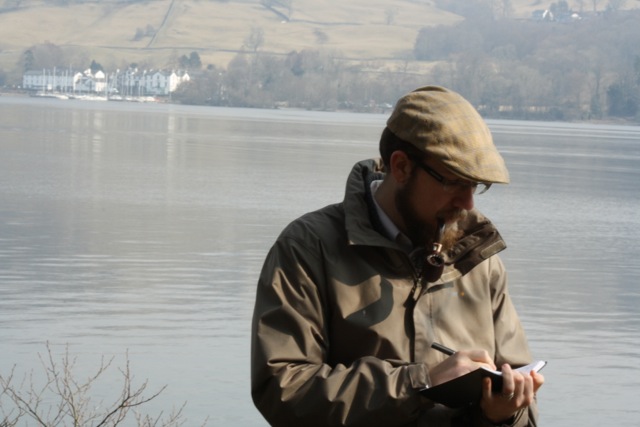
Ascension Day 2014
On the Edge of Elfland
Beeston, Nottinghamshire
Dear Friends and Family,
Michelle over at Soliloquies––an excellent blog that mixes philosophy, life, and writing––has invited to participate in a Writing Process Blog Hop. She has previously invited to a similar ‘event’, though in the previous case it was an award of sorts. I was remiss in not attending to the previous invitation and so willingly and gladly do I participate now. The Writing Process Blog hop invites bloggers to answer four questions about what, how, and why they write. The bloggers are then encouraged to recommend three other bloggers to do the same. With that in mind, here are the questions and my answers.
1. What are you currently working on?
Already this is, in many ways, a question which will perhaps receive an unusual answer. Like my Inviter, I work on both academic and fictive/poetic writings.
On the academic side, I am currently finishing my PhD thesis which is provisionally entitled, Being Deified: Poetry, Theo-Poetry, and Salvation History. In this work I argue that the Christian notion of deification (in Eastern Orthodoxy typically referred to as theosis) is integral to the Christian faith. I show this by arguing for its deep rootedness in Creation, the Fall, the Incarnation, Redemption, and the Age to Come. Alongside this, however, I argue for the importance of human creativity in our deification. I do this primarily through fantasy and poetry or the mythopoeic.
On the fiction front, I have recently finished a draft of what I would call a Faërie Romance which has the provisional title of On the Edge of Elfland. It is a story about a young man called Alfred who grew up believing in Elfland thanks to the stories told to him by a local storyteller called Oliver Alvin. Having returned from university, Alfred has all but forgotten the stories of his youth until one day, searching for mushrooms in the local forest (Fay’s Forest), he stumbles upon a gnome, guardian and shepherd of mushrooms. Alfred will then find out that he is a seer, one who dreams the present and that his fate, as well as the fate of his village and the fate of Elfland are all inextricably linked. He will face against goblins, trolls, dragons, and the goblin king who is, in truth, something far worse. The story is filled with Arthurian references, but is not, precisely, an Arthurian tale. I may post portions of it on here eventually, if there’s any interest.
I am also working on a short story for my twin sons recently born, wherein they find their way into Faërie and have several adventures.
In poetry, I have written several short poems, some of which I have posted here, as well as an attempt at a narrative poem written in alliterative verse about Arthur and his cousin Gawain defeating a lake monster in Lake Windermere.
2. How does your work differ from others in its genre?
In my academic writing, I am, I believe, doing something quite different. I draw from patristic, medieval, and contemporary theologians in order to found my theology. Then, however, I turn to fantasy and poetry in order to further relate the truths of theology. It is my firm opinion that being creative is an essential aspect of being human and of our being deified. Therefore, it is essential that we take into account the great works of human creativity. My own proclivity is for the mythopoeic and so my emphasis lies there.
In my fiction, I am perhaps unusual in that I write, primarily, for an audience of one, myself. My work is not precisely Young Adult, nor is it precisely Fantasy as we often conceive of it. It is, or tries to be, Faërie Romance. If I have an audience beyond myself in mind when I write, it is an audience of the dead. I try to write something I pray my mentors would want to read, if inferior to their own works. In my poetry, I differ only in that I am, at best, a mediocre poet who prefers structure to free verse.
3. Why do you do what you do?
I write (whether it be scholarship, fiction, or poetry) because I could do nothing else. I do not write to gain money or fame (writing, especially academic, is the wrong vocation for those ends). Instead I write because I must. I am not happy if I am not writing. This does not make me successful (whatever that means); nor does it necessitate that I am good at what I do. It only means that I must do it in order to fulfill my vocation.
4. How does your writing process work?
My writing process is different for each kind of writing I do. For blogs and often for poetry, my process is occasional. An idea will strike me because of a place I visited, a sight I have seen, or an article I have read. I then tend to ruminate on it for a few days before I sit down and begin to write it out. When I’m writing poetry, usually a line will present itself to me and I will begin to work around that line forming a structure, a meter, rhyme-scheme, or alliterative pattern.
My academic writing tends to come from the books I have read and my personal reflections on the world around me. For instance, my current work could be said to have two beginnings. The first is in my mother having read The Hobbit to me since I was a little child. This instilled in me a love fantasy and poetry. On the theological side, it began when I took my first class in the history of the Early Church. There I was introduced to the likes of Gregory Nazianzen, John Cassian, Augustine, and others that has led me down the path of deification.
When I set out to write something academic, I tend to write an outline first. My outlines are usually detailed at the beginning and fuzzy at the end. Then I read, take notes, write them into the outline, alter the outline as my research guides me. Then I make another copy of the outline, without the notes, and begin writing. I copy and paste quotations and references in where necessary and write around them. When finished, I usually read what I’ve written aloud, or have my computer do so, and make edits. When the occasion is available, I read my work to others for comments as well.
For fiction, I have only ever worked consistently on one story that underwent such a heavy transition from when I first began it nearly ten years ago, that I re-wrote the entire thing from scratch, occasionally re-incorporating stories I had in the original draft. I am currently waiting until I finish my PhD thesis before I return to this story for the editing phase.
I hope you have found my answers to these questions interesting, possibly even enlightening at least as regards my person. I now nominate three bloggers to do the same:
1. A Pilgrim in Narnia by Brenton Dickieson. Brenton writes primarily about C. S. Lewis, but his blog is truly a revelling in nearly all things Inklings and Fantastical. Brenton, however, does also do fiction writing, so I would personally be interested in his answers to these questions.
2. Mysteries and Manners by Maura. Maura is a Catholic English teacher, which already endears her and her blog to me. Being an English teacher (something I briefly considered myself), I would be interested on her approach to these questions about anything and everything she writes.
3. Having Decided to Stay by Bryana Johnson. Bryana’s blog, like Maura’s, is still new to me. However, after reading her excellent story about ‘The Stag Who Lived Forever’ over at Story Warren, I am intrigued by her as an authoress and curious to know more about her writing processes as well.
Let me know what you think about my writing processes and make sure to check out the blogs I’ve linked to. Ta ta for now.
Sincerely yours,
David Russell Mosley
Previous Post

May 24, 2014
The Importance of Names: What We Named Our Sons
Next Post
June 2, 2014 Arthur Comes to Windermere: A Poem by David Russell Mosley
Browse Our Archives
Select a Category A Secular Age Advent Apologetics Atheism Beauty Being a Catholic Evangelical Being Catholic Being Deified: Poetry and Fantasy on the Path to God Blogging Book Reviews C. S. Lewis Catholic Imagination Catholic Social Teaching Catholicism Christmas Church Calendar Church Fathers Church Life Community Conferences Cosmology Creation Curdled Words Deification Distributism Easter Economics Education Epiphany Essay Extracts Eucharist Faerie Faeriean Metaphysics Fatherhood Films Folk Liturgy Food and Drink G. K. Chesterton Harry Potter J. R. R. Tolkien Jove King Arthur Language Lent Life Literature and Poetry Liturgy Medieval Theology Music My Publications Mythology On the Edges of Elfland Ordinary Time Ordination Parenthood Parish Patristic Theology Pentecost Politics Prayer Racism Radical Orthodoxy Restoration Movement Sacramental Ontology Saints Science Sex and Sexuality Sophiology Stories The Inklings The Radical Catholic Reimagination of Everything Theologians in the Church Theopoetics Thesis Research Uncategorized University of Nottingham What I'm Reading Writing
Select a Month December 2019 November 2019 October 2019 September 2019 August 2019 July 2019 June 2019 May 2019 April 2019 March 2019 February 2019 January 2019 December 2018 November 2018 October 2018 September 2018 August 2018 July 2018 June 2018 May 2018 April 2018 March 2018 February 2018 January 2018 December 2017 November 2017 October 2017 August 2017 July 2017 June 2017 May 2017 April 2017 March 2017 February 2017 January 2017 December 2016 November 2016 October 2016 September 2016 August 2016 July 2016 June 2016 May 2016 April 2016 March 2016 February 2016 January 2016 December 2015 November 2015 October 2015 September 2015 August 2015 July 2015 June 2015 May 2015 April 2015 March 2015 February 2015 January 2015 December 2014 November 2014 October 2014 September 2014 August 2014 July 2014 June 2014 May 2014 April 2014 March 2014 February 2014 January 2014 December 2013 November 2013 October 2013 September 2013 August 2013 July 2013 June 2013 May 2013 April 2013 March 2013 February 2013 January 2013 December 2012 November 2012 October 2012 September 2012 July 2012
Follow Us!
TAKE THE
Religious Wisdom Quiz
According to Jesus, how should we treat our neighbor?
Select your answer to see how you score.
Ignore them As ourselves With suspicion With anger
Related posts from Letters from the Edge of Elfland
Enduring the Valleys of Life: My Struggle with...
Letters from the Edge of Elfland
Letters from the Edge of Elfland
Why I Haven't Been Writing Letters for the...
Letters from the Edge of Elfland
The Dragon Is Dead, Still: A Postlude (of...
Letters from the Edge of Elfland
TRENDING AT PATHEOS Catholic

Creation, Preservation, and Teleology in Catholic Theology
As I write this, it is very early Monday morning. Like millions...

The Parable Of The Sower And The Word...
One of Christ’s most famous parables is that of the sower who...

Rejecting Doom: Christian Hope And Human Action
Christianity is a religion of hope. We are to have hope and...

Why I Choose the Eucharist Over the Sermon
Choose the Eucharist, Not the Sermon What are we supposed to get...

5 Design Elements Found in Spiritually Rooted Homes
Putting Spirituality Into Home Decor Our homes are more than our living...

Credo: A Story of God Told with the...
About 10 years ago, I began to imagine a personal "Credo" that...
view all Catholic blogs
Ad-Free & Subscriber Log-In Subscription Support
- About Us
- 2026 Calendar
- Videos
- Podcasts
- Library of World Religions
- Faith In Media Tracker
- Advertise With Us
- Write for Us
- Privacy Policy
- Terms of Service
- Do Not Sell My Data
- Contact Us
- Radiant Digital
- Manage Newsletter Subscriptions
- Unsubscribe From Notifications
- Sitemap
Copyright 2008-2026, Patheos. All rights reserved.
Subscription Support Ad-Free & Subscriber Log-In
Follow Patheos