
BuddhistCatholicContemplativeEvangelicalGeneral ChristianHinduJewishLatter-day SaintMuslimNew VisionsProgressive Christian
Beliefs
- Buddhist
- Catholic
- Contemplative
- Evangelical
- General Christian
- Hindu
- Jewish
- Latter-day Saint
- More Voices
- Muslim
- New Visions
- Pagan
- Progressive Christian
Topics
- Religion News
- Food and Religion
- Sports and Religion
- Religious Art
- Religious Music and Entertainment
- Religious Events
- History and Religion
- Style and Religion
- Politics and Religion
- Women in Religion
- Recreation Outdoors and Religion
- Business Finance and Religion
- Careers Workplace and Religion
- Education and Religion
- Family Parenting and Religion
- Health Fitness and Religion
- Home and Religion
- Relationships and Religion
- Technology and Religion
- Travel and Religion
Columnists
- Buddhist Columnists
- Business Finance and Religion Columnists
- Careers Workplace and Religion Columnists
- Catholic Columnists
- Contemplative Columnists
- Education and Religion Columnists
- Evangelists Columnists
- Family Parenting and Religion Columnists
- General Christian Columnists
- Health Fitness and Religion Columnists
- Hindu Columnists
- History and Religion Columnists
- Home and Religion Columnists
- Jewish Columnists
- More Voices Columnists
- Latter Day Columnists
- Muslim Columnists
- New Visions Columnists
- Nonreligious Columnists
- Pagan Columnists
- Politics and Religion Columnists
- Progressive Columnists
- Recreation Outdoors and Religion Columnists
- Relationships and Religion Columnists
- Religion News Columnists
- Religious Art Columnists
- Religious Events Columnists
- Religious Music and Entertainment Columnists
- Sports and Religion Columnists
- Style and Religion Columnists
- Technology and Religion Columnists
- Travel and Religion Columnists
- Women in Religion Columnists
Resource Library
- 2026 Calendar
- Library of World Religions
- The 100 Most Holy Places on Earth
- Patheos Answers
- Podcasts
- Videos
- Faith Leaders Database
- Anglican Episcopalian
- Bahai
- Baptist
- Buddhism
- Christianity
- Confucianism
- Eastern Orthodoxy
- Hinduism
- Holiness and Pentecostal
- ISKCON
- Islam
- Judaism
- Lutheran
- Methodist
- The Church of Jesus Christ of Latter-day Saints
- New Age
- Paganism
- Presbytarian and Reformed
- Protestantism
- Religion Behind the Scenes
- Roman Catholic
- Scientology
- Shia Islam
- Sikhism
- Sufism
- Sunni Islam
- Taoism
- Zen
- See all religions
Research Tools
 Ad-Free & Subscriber Log-In Subscription Support
Ad-Free & Subscriber Log-In Subscription Support
Follow Patheos 

- Trending:
- Forgiveness
- |
- Marriage
- |
- Consciousness
- |
- Death Penalty
- |
- Election
- |
- Halloween
 Letters from the Edge of Elfland
- Home
- About
- Distributist Resources
- Publications and Presentations
- Support
- Works in Progress
- The Epistolarian Around the Web
- Home
- Catholic
- The Poetry of Easter: Creation's Hope
The Poetry of Easter: Creation's Hope
Last updated on: April 20, 2014 at 3:36 pm by David Russell Mosley
The Poetry of Easter: Creation's Hope 2014-04-20T15:36:02-04:00 David Russell Mosley
Patheos Explore the world's faith through different perspectives on religion and spirituality! Patheos has the views of the prevalent religions and spiritualities of the world.
David Russell Mosley
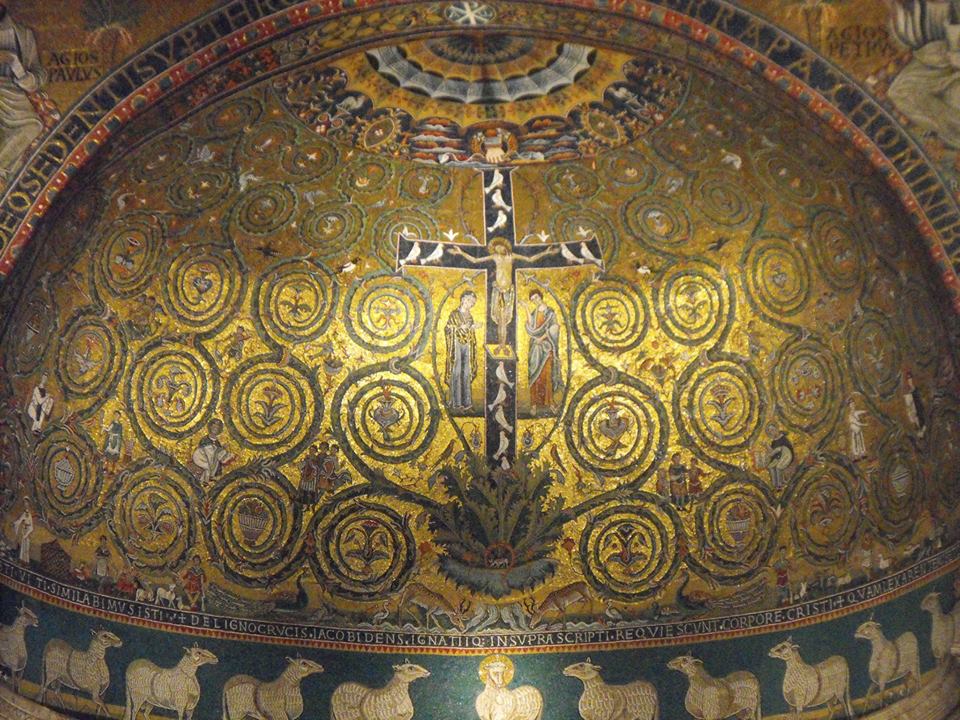
Easter 2014
On the Edge of Elfland
Beeston, Nottinghamshire
Dear Friends and Family,
Advent and Christmas tend to put me in the mood for fairy-stories and fantasies. After all, it is a time of magic, of enchantment, for the God has entered Creation. Easter, however, puts me in mind for poetry. Right now, for instance, I’m attempting to read The Divine Comedy liturgically. The poem begins on the day before Good Friday and ends, apparently, on the Wednesday after Easter. Now, I haven’t reached Paradise yet, but I want to share a passage from there with you.
Dante writes:
“All things, among themselves,
possess an order; and this order is
the form that makes the universe like God.
Here do the higher beings see the imprint
of the Eternal Worth, which is the end
to which the pattern I have mentioned tends.
Within that order, every nature has its bent, according to a different station,
nearer or less near to its origin” (I.103-110)
All of Creation, made by God, is tending toward him. Every inch of Creation has a trace of God within it. In this sense, we can call Creation sacramental because it points toward its origin. It is even, says Dante, tending toward that origin, just as we are. That is, just as we are intended for union with God in the life to come, intended for deification, so too is Creation intended to unite with God, according to its station, according to its place in the Cosmos. This is why, as I wrote over at Theology Think for Palm Sunday, Easter brings hope to Creation and not simply humanity. Let’s remember that as we celebrate the Resurrection of Our Lord today.
I deal with this subject in a few places in my thesis, key to my understanding of Creation’s role in the life to come is Maximus the Confessor who writes:
With us and through us he encompasses the whole creation through its intermediaries and the extremities through its own parts. He binds about himself each with the other, tightly and indissolubly, paradise and the inhabited world, heaven and earth, things sensible and things intelligible, since he possesses like us sense and soul and mind, by which, as parts, he assimilates himself by each of the extremities to what is universally akin to each in the previously mentioned manner. Thus he divinely recapitulates the universe in himself, showing that the whole creation exists as one, like another human being, completed by the gathering together of its parts one with another in itself, and inclined towards itself by the whole of its existence, in accordance with the one, simple undifferentiated and indifferent idea of production from nothing, in accordance with which the whole of creation admits of one and the same undiscriminated logos, as having not been before it is (Amb. 41 1312A-B).
Maximus is arguing several things here, but the key is twofold. First, it is essential to note that Maximus sees humanity as playing a role in God encompassing all creation into himself. God does this, ‘with us and through us’ (Amb. 41 1312A). Humanity, as I argued in the first chapter, has a priestly role to play for the rest of Creation and this is due, in large part, to humanity’s microcosmic nature, that in humanity is there a convergence of all created beings, ‘things sensible and things intellectual’ (Amb. 41 1312A). God encompasses all this in himself in the Incarnation. In this way, using the microcosmic nature of humanity, God unites all created beings to himself.
The second key is that all of creation is included in this. Maximus does not delineate between mineral, vegetable, and animal, some being included, others not. All beings are related to one another and to God, as Maximus writes:
For in their true logos all beings have at least something in common with one another. Amongst the beings after God, which have their being from God through generation, there are no exceptions, neither the greatly honoured and transcendent beings [angels] which have a universal relationship to the One absolutely beyond any relation, nor is the least honoured among beings destitute and bereft since it has by nature a generic relationship to the most honoured beings (Amb. 41 1312B-C).
Here, Maximus goes further than Aquinas, who only seems to see a role in the eschaton for mineral creation, humanity, and the angels. For Maximus, this cannot be, for all created beings are related to one another, even the lowest is related to the highest, by virtue of being a created being. What it more, all beings are held together by God through Jesus Christ.
What this means is that God in Christ and through us is raising up all Creation to himself. We must remember our brothers and sisters outside the human race in the rest of Creation. Remember Christ’s words, ‘”I tell you, if these were silent, the very stones would cry out.”’
Let me leave you with, compared to Dante’s (and many others) some rather base verses of my own:
The flowers all grow towards an end;
Trees and rivers clap for joy.
The mountains on their knees bend;
The birds make a joyful noise.
For water from the holy side
Spilled out, and red blood
Poured onto Creation’s hide.
At last we understood,
Redemption is not for us alone.
If we were silent,
Every rock, and every stone,
Every bird and beast and violet,
Would with one breath
Proclaim the death
Of Jesus Christ, Our Lord.
Sincerely yours,
David Russell Mosley
Previous Post

April 18, 2014
It Is Finished: A Thesis Draft Done on Good Friday
Browse Our Archives
Select a Category A Secular Age Advent Apologetics Atheism Beauty Being a Catholic Evangelical Being Catholic Being Deified: Poetry and Fantasy on the Path to God Blogging Book Reviews C. S. Lewis Catholic Imagination Catholic Social Teaching Catholicism Christmas Church Calendar Church Fathers Church Life Community Conferences Cosmology Creation Curdled Words Deification Distributism Easter Economics Education Epiphany Essay Extracts Eucharist Faerie Faeriean Metaphysics Fatherhood Films Folk Liturgy Food and Drink G. K. Chesterton Harry Potter J. R. R. Tolkien Jove King Arthur Language Lent Life Literature and Poetry Liturgy Medieval Theology Music My Publications Mythology On the Edges of Elfland Ordinary Time Ordination Parenthood Parish Patristic Theology Pentecost Politics Prayer Racism Radical Orthodoxy Restoration Movement Sacramental Ontology Saints Science Sex and Sexuality Sophiology Stories The Inklings The Radical Catholic Reimagination of Everything Theologians in the Church Theopoetics Thesis Research Uncategorized University of Nottingham What I'm Reading Writing
Select a Month December 2019 November 2019 October 2019 September 2019 August 2019 July 2019 June 2019 May 2019 April 2019 March 2019 February 2019 January 2019 December 2018 November 2018 October 2018 September 2018 August 2018 July 2018 June 2018 May 2018 April 2018 March 2018 February 2018 January 2018 December 2017 November 2017 October 2017 August 2017 July 2017 June 2017 May 2017 April 2017 March 2017 February 2017 January 2017 December 2016 November 2016 October 2016 September 2016 August 2016 July 2016 June 2016 May 2016 April 2016 March 2016 February 2016 January 2016 December 2015 November 2015 October 2015 September 2015 August 2015 July 2015 June 2015 May 2015 April 2015 March 2015 February 2015 January 2015 December 2014 November 2014 October 2014 September 2014 August 2014 July 2014 June 2014 May 2014 April 2014 March 2014 February 2014 January 2014 December 2013 November 2013 October 2013 September 2013 August 2013 July 2013 June 2013 May 2013 April 2013 March 2013 February 2013 January 2013 December 2012 November 2012 October 2012 September 2012 July 2012
Follow Us!
TAKE THE
Religious Wisdom Quiz
What does Paul say in Colossians has been nailed to the cross?
Select your answer to see how you score.
Satan's authority Our sins The written code with its regulations The old covenant
Related posts from Letters from the Edge of Elfland

Poetry, Podcasts, and More: Some Updates on Other...
Letters from the Edge of Elfland

Working on a Book of Poetry: An Apology...
Letters from the Edge of Elfland

Poetry Shapes the World around Us: Reflecting on...
Letters from the Edge of Elfland
The Journey Is Almost Over: Reflecting on Six...
Letters from the Edge of Elfland
TRENDING AT PATHEOS Catholic

Creation, Preservation, and Teleology in Catholic Theology
As I write this, it is very early Monday morning. Like millions...

The Parable Of The Sower And The Word...
One of Christ’s most famous parables is that of the sower who...

Rejecting Doom: Christian Hope And Human Action
Christianity is a religion of hope. We are to have hope and...

Why I Choose the Eucharist Over the Sermon
Choose the Eucharist, Not the Sermon What are we supposed to get...

5 Design Elements Found in Spiritually Rooted Homes
Putting Spirituality Into Home Decor Our homes are more than our living...

Credo: A Story of God Told with the...
About 10 years ago, I began to imagine a personal "Credo" that...
view all Catholic blogs
Ad-Free & Subscriber Log-In Subscription Support
- About Us
- 2026 Calendar
- Videos
- Podcasts
- Library of World Religions
- Faith In Media Tracker
- Advertise With Us
- Write for Us
- Privacy Policy
- Terms of Service
- Do Not Sell My Data
- Contact Us
- Radiant Digital
- Manage Newsletter Subscriptions
- Unsubscribe From Notifications
- Sitemap
Copyright 2008-2026, Patheos. All rights reserved.
Subscription Support Ad-Free & Subscriber Log-In
Follow Patheos