
BuddhistCatholicContemplativeEvangelicalGeneral ChristianHinduJewishLatter-day SaintMuslimNew VisionsProgressive Christian
Beliefs
- Buddhist
- Catholic
- Contemplative
- Evangelical
- General Christian
- Hindu
- Jewish
- Latter-day Saint
- More Voices
- Muslim
- New Visions
- Pagan
- Progressive Christian
Topics
- Religion News
- Food and Religion
- Sports and Religion
- Religious Art
- Religious Music and Entertainment
- Religious Events
- History and Religion
- Style and Religion
- Politics and Religion
- Women in Religion
- Recreation Outdoors and Religion
- Business Finance and Religion
- Careers Workplace and Religion
- Education and Religion
- Family Parenting and Religion
- Health Fitness and Religion
- Home and Religion
- Relationships and Religion
- Technology and Religion
- Travel and Religion
Columnists
- Buddhist Columnists
- Business Finance and Religion Columnists
- Careers Workplace and Religion Columnists
- Catholic Columnists
- Contemplative Columnists
- Education and Religion Columnists
- Evangelists Columnists
- Family Parenting and Religion Columnists
- General Christian Columnists
- Health Fitness and Religion Columnists
- Hindu Columnists
- History and Religion Columnists
- Home and Religion Columnists
- Jewish Columnists
- More Voices Columnists
- Latter Day Columnists
- Muslim Columnists
- New Visions Columnists
- Nonreligious Columnists
- Pagan Columnists
- Politics and Religion Columnists
- Progressive Columnists
- Recreation Outdoors and Religion Columnists
- Relationships and Religion Columnists
- Religion News Columnists
- Religious Art Columnists
- Religious Events Columnists
- Religious Music and Entertainment Columnists
- Sports and Religion Columnists
- Style and Religion Columnists
- Technology and Religion Columnists
- Travel and Religion Columnists
- Women in Religion Columnists
Resource Library
- 2026 Calendar
- Library of World Religions
- The 100 Most Holy Places on Earth
- Patheos Answers
- Podcasts
- Videos
- Faith Leaders Database
- Anglican Episcopalian
- Bahai
- Baptist
- Buddhism
- Christianity
- Confucianism
- Eastern Orthodoxy
- Hinduism
- Holiness and Pentecostal
- ISKCON
- Islam
- Judaism
- Lutheran
- Methodist
- The Church of Jesus Christ of Latter-day Saints
- New Age
- Paganism
- Presbytarian and Reformed
- Protestantism
- Religion Behind the Scenes
- Roman Catholic
- Scientology
- Shia Islam
- Sikhism
- Sufism
- Sunni Islam
- Taoism
- Zen
- See all religions
Research Tools
 Ad-Free & Subscriber Log-In Subscription Support
Ad-Free & Subscriber Log-In Subscription Support
Follow Patheos 

- Trending:
- Forgiveness
- |
- Marriage
- |
- Consciousness
- |
- Death Penalty
- |
- Election
- |
- Halloween
 Letters from the Edge of Elfland
- Home
- About
- Distributist Resources
- Publications and Presentations
- Support
- Works in Progress
- The Epistolarian Around the Web
- Home
- Catholic
- Mini-Book Review: Beyond Secular Order by John Milbank
Mini-Book Review: Beyond Secular Order by John Milbank
Last updated on: February 11, 2014 at 1:00 pm by David Russell Mosley
Mini-Book Review: Beyond Secular Order by John Milbank 2014-02-11T13:00:30-04:00 David Russell Mosley
Patheos Explore the world's faith through different perspectives on religion and spirituality! Patheos has the views of the prevalent religions and spiritualities of the world.
David Russell Mosley
11 February 2014
On the Edge of Elfland
Beeston, Nottinghamshire
Dear Friends and Family,
Here is a book review I’ve written for John Milbank’s Beyond Secular Order: The Representation of Being and the Representation of the People. Chichester: Wiley Blackwell, 2013.
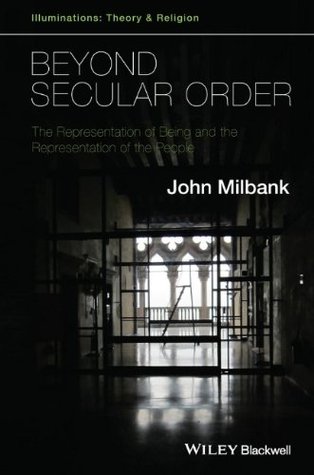
The most recent work from theologian, philosopher, social commentator, and poet, John Milbank, is his book Beyond Secular Order. This book, not unlike others written by Milbank, is in two sequences. The first sequence, On Modern Ontology, is primarily a helpful re-hashing of much of what Milbank has done and said before, here in a smaller, and relatively more easily digested size. Essentially, Milbank is seeking to critique modern philosophy first by evidencing its history in theology (which Milbank traces from late medieval neo-scholasticism, primarily through John Duns Scotus and other, for Milbank primarily Franciscan, neo-scholastic theologians.
This is the portion of the book that is most likely to cause readers to take sides. There are those who will say that Milbank is, knowingly or unknowingly, misrepresenting Scotus and later Scotists (as opposed to Thomas Aquinas and some, though not all, later Thomists); there are those who will say that Milbank’s assessment of Scotus, et al., is correct; and there are those who will say that whether Milbank is right or wrong about the genealogy of modern philosophy he is right (or wrong) in his assessment of modern theology today. This is, perhaps, where I would recommend readers focus their attention, not so much on whether Scotus’ notion of univocity of being is as Milbank portrays it, but whether or not univocity so defined (primarily as saying that God and humanity have the same kind of being but in different quantities, this is admittedly putting it far too glibly), as well as the other three pillars of modern philosophy (Representation, Possibilism, Concurrence) are a correct understanding of the place of modern philosophy/ontology. Milbank develops this theme as well as others, such as a theological critique of modern philosophy. One final note on this sequence, footnote 140 is labeled in the text (pg 79), but not on the note itself causing footnote 141 and every footnote following to be mislabeled by one. Update: I have been informed that the issue is one of typesetting, having taken place after the copyediting and has been corrected for the Kindle edition and the forthcoming reprint.
In the second sequence is where John begins to do something new. Here John begins to outline more systematically than he has anywhere else, to my knowledge, his political ontology. The key points of this seem to be that politics/culture/the arts, etc., are a gift to the human animal from God, they are not natural to us in the sense that we have them by our own power, but they are gifts given to humanity from the beginning. With this as the foundation, Milbank goes on to argue not simply for a theology of politics but that politics is inherently theological (as it is a gift). The implications of this are manifold, but two points which Milbank brings out rather poignantly are these: first, politics, et al., is tied to deification. That is, politics, by virtue of being concerned with the human person, body and soul, and being a gift from God to humanity, is thus immediately related to the telos or end for which God has created humanity. This end Milbank equates, rightly in my opinion, with the theological notion/doctrine of deification or theosis. Second, the further implication for this works in political and church leadership. Milbank argues that since political life (that is culture, the arts, society, etc.) in many ways is a foreshadowing of the resurrection, there is a sense in which we can talk about the politic leader as having a role higher than that of the spiritual (king and priest/Pope in Milbank’s language). This is again because while the priest prepares and cares for the souls of the people, the king foreshadows the reign of Christ in the heavenly Jerusalem by caring for the people’s (or perhaps person’s) ‘spirit’ that resurrected unified whole of body and soul united to the Triune God in deification.
There is so much more I could say about Milbank’s new book (for instance my disagreements with him on the issues of Incarnation without Fall, Milbank sides with Aquinas on this issue, I do not; or his mistreatment of poor John Cassian; or the implications of his understanding of culture/creation as a gift and its relationship to deification). However, my words will pale in comparison with reading the book for yourself. This is something I highly recommend for both Milbank’s critics, detractors, friends, and fans. As Milbank continues to write (he has already mentioned a sequel for this book within the book itself) this book will be the starting place for understanding his thought, both as he critiques modern philosophy and as he understands the theological nature of politics/culture. I highly recommend this book.
Sincerely yours,
David Russell Mosley
Previous Post

February 10, 2014
Mini-Book Review: The Legend of Death by John Milbank
Next Post
February 13, 2014 The Return of Arthur: A Conversation with John Milbank and C. S. Lewis
Browse Our Archives
Select a Category A Secular Age Advent Apologetics Atheism Beauty Being a Catholic Evangelical Being Catholic Being Deified: Poetry and Fantasy on the Path to God Blogging Book Reviews C. S. Lewis Catholic Imagination Catholic Social Teaching Catholicism Christmas Church Calendar Church Fathers Church Life Community Conferences Cosmology Creation Curdled Words Deification Distributism Easter Economics Education Epiphany Essay Extracts Eucharist Faerie Faeriean Metaphysics Fatherhood Films Folk Liturgy Food and Drink G. K. Chesterton Harry Potter J. R. R. Tolkien Jove King Arthur Language Lent Life Literature and Poetry Liturgy Medieval Theology Music My Publications Mythology On the Edges of Elfland Ordinary Time Ordination Parenthood Parish Patristic Theology Pentecost Politics Prayer Racism Radical Orthodoxy Restoration Movement Sacramental Ontology Saints Science Sex and Sexuality Sophiology Stories The Inklings The Radical Catholic Reimagination of Everything Theologians in the Church Theopoetics Thesis Research Uncategorized University of Nottingham What I'm Reading Writing
Select a Month December 2019 November 2019 October 2019 September 2019 August 2019 July 2019 June 2019 May 2019 April 2019 March 2019 February 2019 January 2019 December 2018 November 2018 October 2018 September 2018 August 2018 July 2018 June 2018 May 2018 April 2018 March 2018 February 2018 January 2018 December 2017 November 2017 October 2017 August 2017 July 2017 June 2017 May 2017 April 2017 March 2017 February 2017 January 2017 December 2016 November 2016 October 2016 September 2016 August 2016 July 2016 June 2016 May 2016 April 2016 March 2016 February 2016 January 2016 December 2015 November 2015 October 2015 September 2015 August 2015 July 2015 June 2015 May 2015 April 2015 March 2015 February 2015 January 2015 December 2014 November 2014 October 2014 September 2014 August 2014 July 2014 June 2014 May 2014 April 2014 March 2014 February 2014 January 2014 December 2013 November 2013 October 2013 September 2013 August 2013 July 2013 June 2013 May 2013 April 2013 March 2013 February 2013 January 2013 December 2012 November 2012 October 2012 September 2012 July 2012
Follow Us!
TAKE THE
Religious Wisdom Quiz
Which Christian group is known for its rejection of military service and political involvement?
Select your answer to see how you score.
Methodist Assemblies of God Baptist Amish
Related posts from Letters from the Edge of Elfland
Being Deified: Poetry and Fantasy on the Path...
Letters from the Edge of Elfland
Stop, Christian Passer-by: A Spiritual Review of Mariner...
Letters from the Edge of Elfland

To the Full English Breakfast: An Exhortation and...
Letters from the Edge of Elfland
A Manifesto for the Radical Catholic Reimagination of...
Letters from the Edge of Elfland
TRENDING AT PATHEOS Catholic

Rejecting Doom: Christian Hope And Human Action
Christianity is a religion of hope. We are to have hope and...

It’s What Comes From Within Which Matters
One of the most difficult things for us to understand is why...

Why I Choose the Eucharist Over the Sermon
Choose the Eucharist, Not the Sermon What are we supposed to get...

5 Design Elements Found in Spiritually Rooted Homes
Putting Spirituality Into Home Decor Our homes are more than our living...

Credo: A Story of God Told with the...
About 10 years ago, I began to imagine a personal "Credo" that...

The Anatomy of Divine Revelation in Catholic Thought
The claim that God has made Himself known to human beings is...
view all Catholic blogs
Ad-Free & Subscriber Log-In Subscription Support
- About Us
- 2026 Calendar
- Videos
- Podcasts
- Library of World Religions
- Faith In Media Tracker
- Advertise With Us
- Write for Us
- Privacy Policy
- Terms of Service
- Do Not Sell My Data
- Contact Us
- Radiant Digital
- Manage Newsletter Subscriptions
- Unsubscribe From Notifications
- Sitemap
Copyright 2008-2026, Patheos. All rights reserved.
Subscription Support Ad-Free & Subscriber Log-In
Follow Patheos