
BuddhistCatholicContemplativeEvangelicalGeneral ChristianHinduJewishLatter-day SaintMuslimNew VisionsProgressive Christian
Beliefs
- Buddhist
- Catholic
- Contemplative
- Evangelical
- General Christian
- Hindu
- Jewish
- Latter-day Saint
- More Voices
- Muslim
- New Visions
- Pagan
- Progressive Christian
Topics
- Religion News
- Food and Religion
- Sports and Religion
- Religious Art
- Religious Music and Entertainment
- Religious Events
- History and Religion
- Style and Religion
- Politics and Religion
- Women in Religion
- Recreation Outdoors and Religion
- Business Finance and Religion
- Careers Workplace and Religion
- Education and Religion
- Family Parenting and Religion
- Health Fitness and Religion
- Home and Religion
- Relationships and Religion
- Technology and Religion
- Travel and Religion
Columnists
- Buddhist Columnists
- Business Finance and Religion Columnists
- Careers Workplace and Religion Columnists
- Catholic Columnists
- Contemplative Columnists
- Education and Religion Columnists
- Evangelists Columnists
- Family Parenting and Religion Columnists
- General Christian Columnists
- Health Fitness and Religion Columnists
- Hindu Columnists
- History and Religion Columnists
- Home and Religion Columnists
- Jewish Columnists
- More Voices Columnists
- Latter Day Columnists
- Muslim Columnists
- New Visions Columnists
- Nonreligious Columnists
- Pagan Columnists
- Politics and Religion Columnists
- Progressive Columnists
- Recreation Outdoors and Religion Columnists
- Relationships and Religion Columnists
- Religion News Columnists
- Religious Art Columnists
- Religious Events Columnists
- Religious Music and Entertainment Columnists
- Sports and Religion Columnists
- Style and Religion Columnists
- Technology and Religion Columnists
- Travel and Religion Columnists
- Women in Religion Columnists
Resource Library
- 2026 Calendar
- Library of World Religions
- The 100 Most Holy Places on Earth
- Patheos Answers
- Podcasts
- Videos
- Faith Leaders Database
- Anglican Episcopalian
- Bahai
- Baptist
- Buddhism
- Christianity
- Confucianism
- Eastern Orthodoxy
- Hinduism
- Holiness and Pentecostal
- ISKCON
- Islam
- Judaism
- Lutheran
- Methodist
- The Church of Jesus Christ of Latter-day Saints
- New Age
- Paganism
- Presbytarian and Reformed
- Protestantism
- Religion Behind the Scenes
- Roman Catholic
- Scientology
- Shia Islam
- Sikhism
- Sufism
- Sunni Islam
- Taoism
- Zen
- See all religions
Research Tools
 Ad-Free & Subscriber Log-In Subscription Support
Ad-Free & Subscriber Log-In Subscription Support
Follow Patheos 

- Trending:
- Forgiveness
- |
- Marriage
- |
- Consciousness
- |
- Death Penalty
- |
- Election
- |
- Halloween
 Letters from the Edge of Elfland
- Home
- About
- Distributist Resources
- Publications and Presentations
- Support
- Works in Progress
- The Epistolarian Around the Web
- Home
- Catholic
- My Three Books: Eric Austin Lee Edition
My Three Books: Eric Austin Lee Edition
Last updated on: December 13, 2013 at 1:44 pm by David Russell Mosley
My Three Books: Eric Austin Lee Edition 2013-12-13T13:44:13-04:00 David Russell Mosley
Patheos Explore the world's faith through different perspectives on religion and spirituality! Patheos has the views of the prevalent religions and spiritualities of the world.
Eric Austin Lee
Feast of St Lucy
13 December 2013
On the Edge of Elfland
West Sacramento, California
Dear Friends and Family,
David has kindly sent out a call for our ‘My 3 Books’, in the spirit of Theology Studio‘s tradition of asking its interviewee’s which 3 books have had the most profound affect upon them theologically. Such decisions are always incredibly difficult ones, and I could add at least another ten books to this list, but, if one were to have to choose, I think this is where I would start: 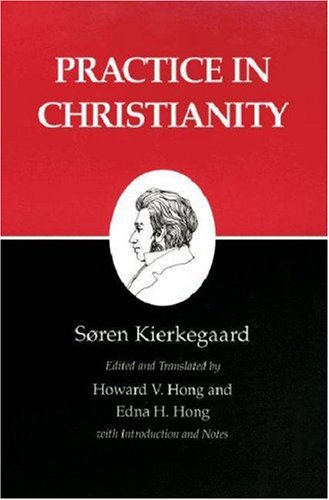 Practice in Christianity, by Anti-Climacus / Soren Kierkegaard, translated and edited by Howard V. Hong and Edna H. Hong (Princeton: Princeton University Press, 1991).
I first read this during my MA at PLNU, under the direction of Professor Mike Lodahl. It was an exhilarating read, not only for its critique of ‘established Christianity’, but also because this book in many ways sums up Kierkegaard’s thought in a pseudonym that is even ‘higher’ than he is able to personally achieve. A later book, Practice in Christianity also combines his critical, pseudonomous style with the ‘upbuilding discourse’-style as the latter part of the book consists of meditations on Scripture, much like those found in Eighteen Upbuilding Discourses and Words of Love (amongst others). One of my favourite meditations on Scripture is his series of discourses on John 12:32. The creativity and inspiration behind these Scriptural meditations are some of the brightest guideposts in the tradition. For me, primarily, the energy and passion about what it means to be a Christian for Anti-Climacus has shaped a great deal of my own journey: Christianity is not meant to be an easy life, for the way of the Cross is a difficult one, and anything which says otherwise “abolishes Christianity!”

Genealogy of Nihilism: Philosophies of Nothing and the Difference of Theology, by Conor Cunningham (London: Routledge, 2002).
I distinctly remember where I was when I finished this book: on my lunch hour at a Mexican food restaurant in San Diego next to the I-5 freeway. It stuck with me because, when I finished this book, I’d never read anything else like it. Yes, I had just finished John Milbank’s wonderful Theology and Social Theory, but, even though it was one of the most difficult books I had ever read at that point, something about this work really struck me. The combination of very dense philosophy on the one hand with beautiful theological prose on the other, alongside such a variety of sources that I wouldn’t have regularly thought was possible. But beyond stylist remarks, it was Cunningham’s vision of proposing a theological alternative to the logic of nihilism that, contrary to most un-nuanced accounts by his detractors, is not simply one that argues that theology is ‘better’ than nihilism; rather, he shows that both nihilism and theology begin with accounts of nothingness: the former cannot stand upon it’s own edifice and ultimately becomes intelligible, while the latter Christian account is primarily one of gift that, out of nothing, God creates. On the one hand, such a logic is simple, but as it is not a ‘simplistic’ one, it is also the kind of account that takes a lifetime — an eternity, even — to understand, needing constant education (to echo Luigi Giussani). Those who know me will know I’m very indebted to Cunningham’s wide-ranging approach and style, not to mention the fact that he was my Doktorvater, so this book will always stay with me. I return to it often, if just for the bibliography alone!
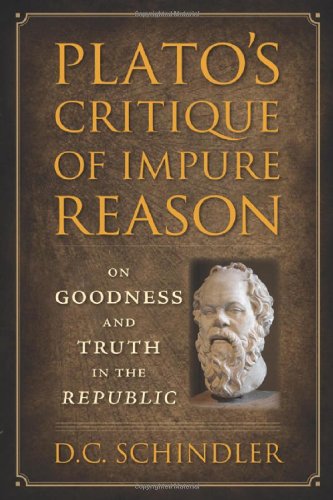 Plato’s Critique of Impure Reason: On Goodness and Truth in the Republic, by D. C. Schindler (Washington, D. C.: Catholic University of America Press, 2008).
It is hard to imagine that a book on Plato like this exists. I’ve read a lot of scholarship on Plato and Socrates, and while some of it is very good and most of it is rather boring, this book stands out like no other. It is the kind of philosophical book where — and not only because I know the author’s theological commitments and indebtedness to Hans Urs von Balthasar — one can see the theological transcendence brimming from every chapter, without even mentioning Christ or Scripture. It takes a mind attuned to the beautiful to be able to read off of philosophical texts (eg, the ‘book of nature’, so to speak) and see a reality resplendent with the light of the Good, all while still maintaining a high standard of scholarship. All of this is prolegomena to say that D. C. Schindler’s work sums up a recent current to extricate Plato from the usual crude ‘dualisms’ with which he is accused. It can be summed up as a kind of ‘third way’ approach, one that argues not through analytic readings of the typical ‘What is F?’ arguments, but through an interpretation which attempts to order Plato’s works toward not just the Republic, but under Plato’s understanding of the Good itself. In this reading, the reader is reminded that Socrates, as the ‘stand-in’ for the Good, always returns to the cave in order to ‘save the appearances’. It is not a gnostic flight from the flesh into the transcendent forms, but an argument for understanding the particular at all, illuminated by the light of the Good.
Sincerely Yours,
Eric
Eric Austin Lee is an independent scholar and web developer currently living in Sacramento, California. After recently receiving his PhD in Theology at the University of Nottingham, he is currently co-editing a collected volume on ‘The Soul’, acting as Managing Editor at the Radical Orthodoxy: Theology, Philosophy, Politics journal, and turning his PhD thesis into a book. His hobbies include playing European-style board games, exploring the world of craft beer, and smoking fine pipe tobacco.
Related articles
-
My 3 Books (or The Post Where I Steal Ideas from The Theology Studio) (elflandletters.wordpress.com)
-
theodramatics.wordpress.com)
Next Post

December 14, 2013 Being a (Non-Roman) Catholic Evangelical: Scripture and Tradition
Browse Our Archives
Select a Category A Secular Age Advent Apologetics Atheism Beauty Being a Catholic Evangelical Being Catholic Being Deified: Poetry and Fantasy on the Path to God Blogging Book Reviews C. S. Lewis Catholic Imagination Catholic Social Teaching Catholicism Christmas Church Calendar Church Fathers Church Life Community Conferences Cosmology Creation Curdled Words Deification Distributism Easter Economics Education Epiphany Essay Extracts Eucharist Faerie Faeriean Metaphysics Fatherhood Films Folk Liturgy Food and Drink G. K. Chesterton Harry Potter J. R. R. Tolkien Jove King Arthur Language Lent Life Literature and Poetry Liturgy Medieval Theology Music My Publications Mythology On the Edges of Elfland Ordinary Time Ordination Parenthood Parish Patristic Theology Pentecost Politics Prayer Racism Radical Orthodoxy Restoration Movement Sacramental Ontology Saints Science Sex and Sexuality Sophiology Stories The Inklings The Radical Catholic Reimagination of Everything Theologians in the Church Theopoetics Thesis Research Uncategorized University of Nottingham What I'm Reading Writing
Select a Month December 2019 November 2019 October 2019 September 2019 August 2019 July 2019 June 2019 May 2019 April 2019 March 2019 February 2019 January 2019 December 2018 November 2018 October 2018 September 2018 August 2018 July 2018 June 2018 May 2018 April 2018 March 2018 February 2018 January 2018 December 2017 November 2017 October 2017 August 2017 July 2017 June 2017 May 2017 April 2017 March 2017 February 2017 January 2017 December 2016 November 2016 October 2016 September 2016 August 2016 July 2016 June 2016 May 2016 April 2016 March 2016 February 2016 January 2016 December 2015 November 2015 October 2015 September 2015 August 2015 July 2015 June 2015 May 2015 April 2015 March 2015 February 2015 January 2015 December 2014 November 2014 October 2014 September 2014 August 2014 July 2014 June 2014 May 2014 April 2014 March 2014 February 2014 January 2014 December 2013 November 2013 October 2013 September 2013 August 2013 July 2013 June 2013 May 2013 April 2013 March 2013 February 2013 January 2013 December 2012 November 2012 October 2012 September 2012 July 2012
Follow Us!
TAKE THE
Religious Wisdom Quiz
How many years did Solomon's temple construction take?
Select your answer to see how you score.
10 years 7 years 6 years 5 years
Related posts from Letters from the Edge of Elfland
Stop, Christian Passer-by: A Spiritual Review of Mariner...
Letters from the Edge of Elfland
A Manifesto for the Radical Catholic Reimagination of...
Letters from the Edge of Elfland
Beauty, Death, Life, and Deification: Reviewing Tell Them...
Letters from the Edge of Elfland
Too Busy for Busy Lives and Restless Souls:...
Letters from the Edge of Elfland
TRENDING AT PATHEOS Catholic

The Parable Of The Sower And The Word...
One of Christ’s most famous parables is that of the sower who...

Rejecting Doom: Christian Hope And Human Action
Christianity is a religion of hope. We are to have hope and...

Why I Choose the Eucharist Over the Sermon
Choose the Eucharist, Not the Sermon What are we supposed to get...

5 Design Elements Found in Spiritually Rooted Homes
Putting Spirituality Into Home Decor Our homes are more than our living...

Credo: A Story of God Told with the...
About 10 years ago, I began to imagine a personal "Credo" that...

The Anatomy of Divine Revelation in Catholic Thought
The claim that God has made Himself known to human beings is...
view all Catholic blogs
Ad-Free & Subscriber Log-In Subscription Support
- About Us
- 2026 Calendar
- Videos
- Podcasts
- Library of World Religions
- Faith In Media Tracker
- Advertise With Us
- Write for Us
- Privacy Policy
- Terms of Service
- Do Not Sell My Data
- Contact Us
- Radiant Digital
- Manage Newsletter Subscriptions
- Unsubscribe From Notifications
- Sitemap
Copyright 2008-2026, Patheos. All rights reserved.
Subscription Support Ad-Free & Subscriber Log-In
Follow Patheos