
BuddhistCatholicContemplativeEvangelicalGeneral ChristianHinduJewishLatter-day SaintMuslimNew VisionsProgressive Christian
Beliefs
- Buddhist
- Catholic
- Contemplative
- Evangelical
- General Christian
- Hindu
- Jewish
- Latter-day Saint
- More Voices
- Muslim
- New Visions
- Pagan
- Progressive Christian
Topics
- Religion News
- Food and Religion
- Sports and Religion
- Religious Art
- Religious Music and Entertainment
- Religious Events
- History and Religion
- Style and Religion
- Politics and Religion
- Women in Religion
- Recreation Outdoors and Religion
- Business Finance and Religion
- Careers Workplace and Religion
- Education and Religion
- Family Parenting and Religion
- Health Fitness and Religion
- Home and Religion
- Relationships and Religion
- Technology and Religion
- Travel and Religion
Columnists
- Buddhist Columnists
- Business Finance and Religion Columnists
- Careers Workplace and Religion Columnists
- Catholic Columnists
- Contemplative Columnists
- Education and Religion Columnists
- Evangelists Columnists
- Family Parenting and Religion Columnists
- General Christian Columnists
- Health Fitness and Religion Columnists
- Hindu Columnists
- History and Religion Columnists
- Home and Religion Columnists
- Jewish Columnists
- More Voices Columnists
- Latter Day Columnists
- Muslim Columnists
- New Visions Columnists
- Nonreligious Columnists
- Pagan Columnists
- Politics and Religion Columnists
- Progressive Columnists
- Recreation Outdoors and Religion Columnists
- Relationships and Religion Columnists
- Religion News Columnists
- Religious Art Columnists
- Religious Events Columnists
- Religious Music and Entertainment Columnists
- Sports and Religion Columnists
- Style and Religion Columnists
- Technology and Religion Columnists
- Travel and Religion Columnists
- Women in Religion Columnists
Resource Library
- 2026 Calendar
- Library of World Religions
- The 100 Most Holy Places on Earth
- Patheos Answers
- Podcasts
- Videos
- Faith Leaders Database
- Anglican Episcopalian
- Bahai
- Baptist
- Buddhism
- Christianity
- Confucianism
- Eastern Orthodoxy
- Hinduism
- Holiness and Pentecostal
- ISKCON
- Islam
- Judaism
- Lutheran
- Methodist
- The Church of Jesus Christ of Latter-day Saints
- New Age
- Paganism
- Presbytarian and Reformed
- Protestantism
- Religion Behind the Scenes
- Roman Catholic
- Scientology
- Shia Islam
- Sikhism
- Sufism
- Sunni Islam
- Taoism
- Zen
- See all religions
Research Tools
 Ad-Free & Subscriber Log-In Subscription Support
Ad-Free & Subscriber Log-In Subscription Support
Follow Patheos 

- Trending:
- Forgiveness
- |
- Marriage
- |
- Consciousness
- |
- Death Penalty
- |
- Election
- |
- Halloween
 Letters from the Edge of Elfland
- Home
- About
- Distributist Resources
- Publications and Presentations
- Support
- Works in Progress
- The Epistolarian Around the Web
- Home
- Catholic
- Thesis Extract: 'The Role of Humanity in Creation'
Thesis Extract: 'The Role of Humanity in Creation'
Last updated on: July 23, 2013 at 10:32 am by David Russell Mosley
Thesis Extract: 'The Role of Humanity in Creation' 2013-07-23T10:32:39-04:00 David Russell Mosley
Patheos Explore the world's faith through different perspectives on religion and spirituality! Patheos has the views of the prevalent religions and spiritualities of the world.
David Russell Mosley
Commemoration of Bridget of Sweden, Abbess of Vadstena, 1373
23 July 2013
Beeston, Nottinghamshire
Dear Friends and Family,
Here is another brief extract from the second chapter of my thesis on Creation and deification. I hope you enjoy.
The Role of Humanity in Creation
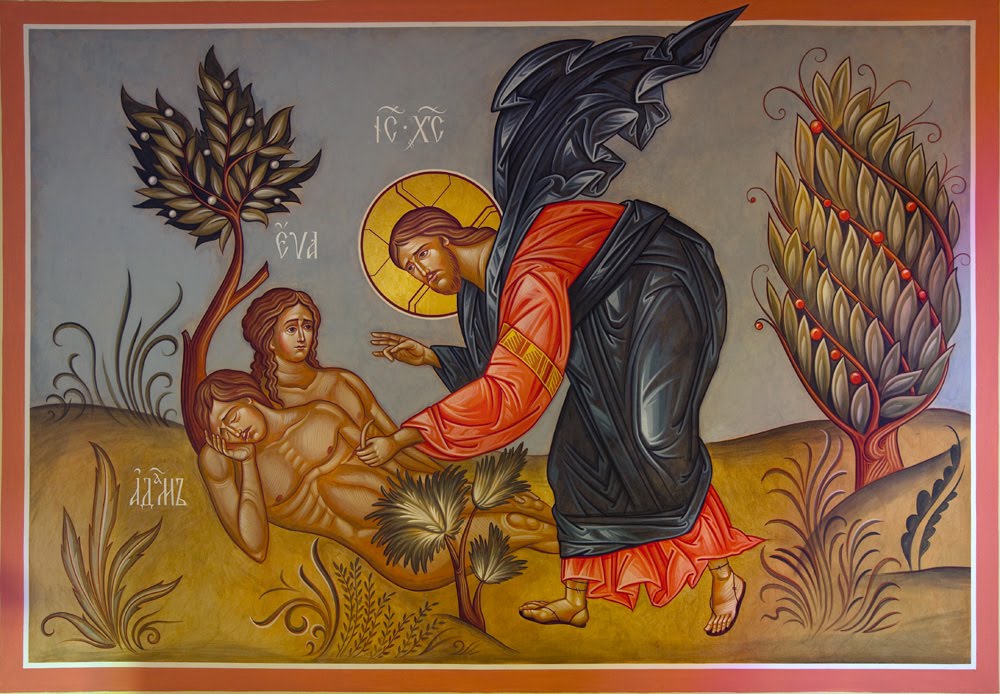
This brings us to role and place of humanity in creation. We will discuss more fully in the section below humanity being made in the image and likeness of God and how nascent humanity was both to serve as priest and to await its deifier. Here, however, we should look at the priestly role of humanity from creation’s point of view. That is, that creation is incomplete without humanity.
John Paul II writes, ‘So the very sacramentality of creation, the sacramentality of the world was revealed in a way, in man created in the image of God.’1 The world is revealed, in a sense to itself, in humanity. Since in creation, only humanity can accept creation as a gift, it is clear that humanity completes, in a qualified sense, creation. If we accept that God creates in order to deify, in order to return all things into himself, as argued above, then we must ask how this is to take place. For Maximus, it takes place through humanity’s interconnectivity and kinship to all creation:
For humanity clearly has this power of naturally uniting at the mean point of each division since it is related to the extremities of each division in its own parts. Through that capacity it can come to be the way of fulfilment of what is divided and be openly instituted in itself as the great mystery of the divine purpose. It proceeds harmoniously to each of the extremities in the things that are, from what is close at hand to what is remote, from what is worse to what is better, lifting up to God and fully accomplishing union. For this reason the human person was introduced last among beings, as a kind of natural bond mediating between the universal poles through their proper parts, and leading into unity in itself those things that are naturally apart from one another by a great interval.(Amb. 41.1305B-C).
What Maximus is arguing is that humans by being both material and spiritual have within them an aspect of every part of creation. This allows humanity to serve as a bridge between the material and the spiritual. A bridge that will unite the two realms, allowing all to return to God. Maximus goes on to say that the way Humanity effects this union by shaking off hindrances (like sexual difference) and seeks union with the undivided God. This unifies heaven and earth in the human person (Amb. 41.1305 C- D). Then, by attaining angelic knowledge humans unite the intellectual and the sensible (Amb. 41.1308A). Finally,
And finally, beyond all these, the human person unites the created nature with the uncreated through love (O the wonder of God’s love for human beings!), showing them to be one and the same through the possession of grace, the whole [creation] wholly interpenetrated by God, and become completely whatever God is, save at the level of being, and receiving to itself the whole of God himself, and acquiring as a kind of prize for its ascent to God the most unique God himself, as the end of movement of everything that moves toward it, and the firm unmoved rest of everything that is carried towards it, being the undetermined and infinite limit and definition of every definition and law and ordinance, of reason and mind and nature (Amb. 41.1308 B-C).
Thus, the human person in one sense deifies creation through its own deification. Just as Christ’s having deified his humanity reached through to all humanity,2 so that deification reaches to all creation, ‘except to the level of being.’ ‘[B]y being divinized, the world is perfected as world.’3 We have begun to encroach on an important aspect here, however, that I will deal with more fully below and in the fourth chapter. For now, however, note that just as creation, if its end is a return to God, cannot effect that end on its own without humanity, so too, humanity cannot affect that change on its own.
1 John Paul II, The Theology of the Body: Human Love in the Divine Plan (Boston: Pauline Books & Media, 1997), 76.
2 Gregory of Nazianzus Theological Oration 30.21.
3 Hans Urs von Balthasar, Cosmic Liturgy: The Universe According to Maximus the Confessor (San Francisco: Ignatius Press, 2003), 257.
Sincerely yours,
David Russell Mosley
Related articles
- Thesis Extract: ‘The Four Aspects of Deification’ (elflandletters.wordpress.com)
- Thesis Extract: ‘Thomas Aquinas’s Five Ways as Evidence of Deification’ (elflandletters.wordpress.com)
Previous Post

July 22, 2013
'Cottage Economy' by William Cobbett: Mini Book Review
Next Post
July 29, 2013 'We Are Being Transformed': Mini Book Review
Browse Our Archives
Select a Category A Secular Age Advent Apologetics Atheism Beauty Being a Catholic Evangelical Being Catholic Being Deified: Poetry and Fantasy on the Path to God Blogging Book Reviews C. S. Lewis Catholic Imagination Catholic Social Teaching Catholicism Christmas Church Calendar Church Fathers Church Life Community Conferences Cosmology Creation Curdled Words Deification Distributism Easter Economics Education Epiphany Essay Extracts Eucharist Faerie Faeriean Metaphysics Fatherhood Films Folk Liturgy Food and Drink G. K. Chesterton Harry Potter J. R. R. Tolkien Jove King Arthur Language Lent Life Literature and Poetry Liturgy Medieval Theology Music My Publications Mythology On the Edges of Elfland Ordinary Time Ordination Parenthood Parish Patristic Theology Pentecost Politics Prayer Racism Radical Orthodoxy Restoration Movement Sacramental Ontology Saints Science Sex and Sexuality Sophiology Stories The Inklings The Radical Catholic Reimagination of Everything Theologians in the Church Theopoetics Thesis Research Uncategorized University of Nottingham What I'm Reading Writing
Select a Month December 2019 November 2019 October 2019 September 2019 August 2019 July 2019 June 2019 May 2019 April 2019 March 2019 February 2019 January 2019 December 2018 November 2018 October 2018 September 2018 August 2018 July 2018 June 2018 May 2018 April 2018 March 2018 February 2018 January 2018 December 2017 November 2017 October 2017 August 2017 July 2017 June 2017 May 2017 April 2017 March 2017 February 2017 January 2017 December 2016 November 2016 October 2016 September 2016 August 2016 July 2016 June 2016 May 2016 April 2016 March 2016 February 2016 January 2016 December 2015 November 2015 October 2015 September 2015 August 2015 July 2015 June 2015 May 2015 April 2015 March 2015 February 2015 January 2015 December 2014 November 2014 October 2014 September 2014 August 2014 July 2014 June 2014 May 2014 April 2014 March 2014 February 2014 January 2014 December 2013 November 2013 October 2013 September 2013 August 2013 July 2013 June 2013 May 2013 April 2013 March 2013 February 2013 January 2013 December 2012 November 2012 October 2012 September 2012 July 2012
Follow Us!
TAKE THE
Religious Wisdom Quiz
My walls crumbled after seven days of marching, shouting, and trumpet blasts. What city am I?
Select your answer to see how you score.
Bethel Jericho Jerusalem Ai
Related posts from Letters from the Edge of Elfland
Being Deified: Poetry and Fantasy on the Path...
Letters from the Edge of Elfland
On Teaching Francis' "Canticle of Brother Sun"
Letters from the Edge of Elfland
Augustine against the Astrologers: Stars, Meaning, and Enchantment
Letters from the Edge of Elfland
Return to the Sources: On Reading Old Books
Letters from the Edge of Elfland
TRENDING AT PATHEOS Catholic

Rejecting Doom: Christian Hope And Human Action
Christianity is a religion of hope. We are to have hope and...

It’s What Comes From Within Which Matters
One of the most difficult things for us to understand is why...

Why I Choose the Eucharist Over the Sermon
Choose the Eucharist, Not the Sermon What are we supposed to get...

5 Design Elements Found in Spiritually Rooted Homes
Putting Spirituality Into Home Decor Our homes are more than our living...

Credo: A Story of God Told with the...
About 10 years ago, I began to imagine a personal "Credo" that...

The Anatomy of Divine Revelation in Catholic Thought
The claim that God has made Himself known to human beings is...
view all Catholic blogs
Ad-Free & Subscriber Log-In Subscription Support
- About Us
- 2026 Calendar
- Videos
- Podcasts
- Library of World Religions
- Faith In Media Tracker
- Advertise With Us
- Write for Us
- Privacy Policy
- Terms of Service
- Do Not Sell My Data
- Contact Us
- Radiant Digital
- Manage Newsletter Subscriptions
- Unsubscribe From Notifications
- Sitemap
Copyright 2008-2026, Patheos. All rights reserved.
Subscription Support Ad-Free & Subscriber Log-In
Follow Patheos