
BuddhistCatholicContemplativeEvangelicalGeneral ChristianHinduJewishLatter-day SaintMuslimNew VisionsProgressive Christian
Beliefs
- Buddhist
- Catholic
- Contemplative
- Evangelical
- General Christian
- Hindu
- Jewish
- Latter-day Saint
- More Voices
- Muslim
- New Visions
- Pagan
- Progressive Christian
Topics
- Religion News
- Food and Religion
- Sports and Religion
- Religious Art
- Religious Music and Entertainment
- Religious Events
- History and Religion
- Style and Religion
- Politics and Religion
- Women in Religion
- Recreation Outdoors and Religion
- Business Finance and Religion
- Careers Workplace and Religion
- Education and Religion
- Family Parenting and Religion
- Health Fitness and Religion
- Home and Religion
- Relationships and Religion
- Technology and Religion
- Travel and Religion
Columnists
- Buddhist Columnists
- Business Finance and Religion Columnists
- Careers Workplace and Religion Columnists
- Catholic Columnists
- Contemplative Columnists
- Education and Religion Columnists
- Evangelists Columnists
- Family Parenting and Religion Columnists
- General Christian Columnists
- Health Fitness and Religion Columnists
- Hindu Columnists
- History and Religion Columnists
- Home and Religion Columnists
- Jewish Columnists
- More Voices Columnists
- Latter Day Columnists
- Muslim Columnists
- New Visions Columnists
- Nonreligious Columnists
- Pagan Columnists
- Politics and Religion Columnists
- Progressive Columnists
- Recreation Outdoors and Religion Columnists
- Relationships and Religion Columnists
- Religion News Columnists
- Religious Art Columnists
- Religious Events Columnists
- Religious Music and Entertainment Columnists
- Sports and Religion Columnists
- Style and Religion Columnists
- Technology and Religion Columnists
- Travel and Religion Columnists
- Women in Religion Columnists
Resource Library
- 2026 Calendar
- Library of World Religions
- The 100 Most Holy Places on Earth
- Patheos Answers
- Podcasts
- Videos
- Faith Leaders Database
- Anglican Episcopalian
- Bahai
- Baptist
- Buddhism
- Christianity
- Confucianism
- Eastern Orthodoxy
- Hinduism
- Holiness and Pentecostal
- ISKCON
- Islam
- Judaism
- Lutheran
- Methodist
- The Church of Jesus Christ of Latter-day Saints
- New Age
- Paganism
- Presbytarian and Reformed
- Protestantism
- Religion Behind the Scenes
- Roman Catholic
- Scientology
- Shia Islam
- Sikhism
- Sufism
- Sunni Islam
- Taoism
- Zen
- See all religions
Research Tools
 Ad-Free & Subscriber Log-In Subscription Support
Ad-Free & Subscriber Log-In Subscription Support
Follow Patheos 

- Trending:
- Forgiveness
- |
- Marriage
- |
- Consciousness
- |
- Death Penalty
- |
- Election
- |
- Halloween

- Home
- Evangelical
- Zootopia and the Need for Reality (Pericles, Prince of Tyre)
Zootopia and the Need for Reality (Pericles, Prince of Tyre)
Last updated on: June 12, 2016 at 12:33 am by John Mark N. Reynolds
Zootopia and the Need for Reality (Pericles, Prince of Tyre) 2016-06-12T00:33:24-04:00 John Mark N. Reynolds
Patheos Explore the world's faith through different perspectives on religion and spirituality! Patheos has the views of the prevalent religions and spiritualities of the world.
 Disney created a clever world for the film Zootopia where non-human animals have learned to live in imperfect harmony. This has happened because the “predators” have ceased to kill and become like “the prey.” This is the first Disney film that is as funny, well animated, and voiced as the worst of the Pixar films . . . and that is high praise. Just don’t think too much about the movie.
And there is the problem with the film. Don’t get me wrong. It is laugh out loud funny and has many redeeming social messages that almost reach the point of tedium, though not quite. Assuming you do not think about the fantasy world at all, then the film makes sense. Don’t ask: Why does the leonine mayor go to jail for breaking the law for the good of the city while our heroes work with the mob, break and enter, and ignore the idea of search warrants to become heroes? The movie certainly will not tell.
Can a young fox actually become an elephant? Why is the predator lifestyle wrong and suppressed? Why haven’t any bunnies been cops when there are small and medium size animals? We know that there are tiny cops for tiny animals in a throw away line of the movie. How do animals from one ecological zone move into the other zones without massive technological help?
Of course, I kept myself from asking any questions during the film because I just wanted to have fun and so I did. The difference between a brilliant fantasy world (try The Incredibles) is in the after-thoughts: Zootopia leaves a disappointing mental taste. You can think about the world portrayed in The Incredibles and it (generally) holds up, but Zootopia leaves the tang of anti-intellectuals writing pleasant agitprop.
It made a great deal of money (as it should have), but a classic it is not.
One would not even think about the movie if it did not contain message after message ranging from the blandly moralistic to assaults on reason. Unless we are just to accept every Movie Message as true, we must think about them . . . and the movie does not handle thought well. For example, extrapolating from available evidence is . . .if the movie is to be believed. . . wrong if the conclusions are socially undesirable. This is an invitation to end thinking about social problems outside of socially acceptable boxes . . . and that strikes one as dangerous.
Socrates would have loved puncturing the pious platitudes of the animal city. Perhaps, a bobcat as his animal avatar?
Zootopia imagines a world where nothing is as it really is and then invites us to live in it. Do not become friends with a fox if you are a bunny. Really. The animals aren’t shown as having achieved perfection, but have gotten close by living the dream. If life were but a dream, this might work, but it isn’t even when rowing a boat.
By contrast, Shakespeare and a collaborator (perhaps) give us a fantasy world in Pericles, Prince of Tyre that is equally moralistic, but with the opposite message. Life is tough and the only sure path is living by an external moral code and being tough enough to deny your feelings for years. We don’t have a perfect manuscript of the play and it is more uneven than Shakespeare’s best work, but the fantasy “classical” world he creates demands thought.
Recall that Shakespeare wrote for a popular audience just like Zootopia.
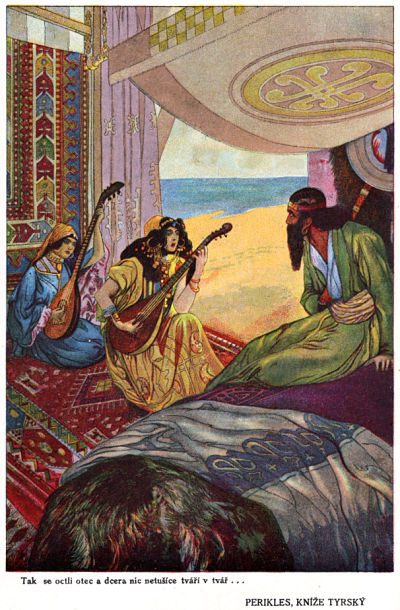
Pericles is a man of many sorrows and has the worst luck with ships of any character this side of Odysseus or Charles Lightoller. He strives to be a good ruler, a just man, and a moral man. When his dreams say “love” and morality gives warning, Pericles says:
But I must tell you, now my thoughts revolt
For he’s no man on whom perfections wait
That, knowing sin within, will touch the gate.
You are a fair viol, and your sense the strings;
Who, finger’d to make man his lawful music,
Would draw heaven down, and all the gods, to hearken:
But being play’d upon before your time,
Hell only danceth at so harsh a chime.
You cannot imagine Pericles cutting a deal with a mob boss to win like the “heroes” of Zootopia.
All the “good people” in Pericles suffer and this suffering produces one of the most moving reunion scenes in all of literature . . .surpassed only by The Winter’s Tale. Follow your heart in Pericles and the results are not good . No love is safe from excess and chastity is held up as a saving, powerful virtue. Chastity is not merely saying no to desire, but saying yes to the hard, moral way.
We can’t become anything we wish in Pericles, that way lies decadence punished by divine fire, but we can become more good, normal, just, and heroic. In fact, the “miracle” in the play partly depends on science and learning hitched to charity. Can we all get along? No. The world contains panders and bawds and this play portrays them as sickening and evil. Like the incestuous couple early in the play . . . immorality no longer shocks after a time, but still brings decay.
The gods work slowly, but morality always wins.
Or so the world Shakespeare created in Pericles contends. Of course, if you think about it, things are more complex. Justice sometimes waits for the next life. Deliverance from the bawd or the pander may not come in ways we would prefer. Life can be even harder than that of Pericles and the solution even further away.
A good fantasy world does not bend reality (say physics) so much that the world is no longer plausible. Moral facts are as important as physical facts and Zootopia is as careless with morality as it is with physics. Pericles has anachronisms and exists in no historic time . . . sort of classical world mashed up with Jacobean world and yet it gets moral reality just right.
The moral is as bluntly stated as a Marvel movie:
In Antiochus and his daughter you have heard
Of monstrous lust the due and just reward:
In Pericles, his queen and daughter, seen,
Although assail’d with fortune fierce and keen, 2625
Virtue preserved from fell destruction’s blast,
Led on by heaven, and crown’d with joy at last:
In Helicanus may you well descry
A figure of truth, of faith, of loyalty:
In reverend Cerimon there well appears 2630
The worth that learned charity aye wears:
For wicked Cleon and his wife, when fame
Had spread their cursed deed, and honour’d name
Of Pericles, to rage the city turn,
That him and his they in his palace burn; 2635
The gods for murder seemed so content
To punish them; although not done, but meant.
So, on your patience evermore attending,
New joy wait on you! Here our play has ending.
and this moral seems truer than “you be what you want, mostly, no internal or external force should check your dream.” In fact, the message of Pericles seems much more like The Incredibles. There is no doubt that Shakespeare, if alive today, would work for Pixar and be disgusted by Cars II.
Just saying.
———————————————————-
William Shakespeare went to God four hundred years ago. To recollect his death, I am writing a personal reflection on a few of his plays. The Winter’s Tale started things off, followed by As You Like It. Romeo and Juliet still matter, Lady Macbeth rebukes the lust for power, and Henry V is a hero. Richard II shows us not to presume on the grace of God or rebel against authority too easily. Coriolanus reminds us that our leaders need integrity and humility. Our life can be joyful if we realize that it is, at best, A Comedy of Errors. Hamlet needs to know himself better and talks to himself less. He is stuck with himself so he had better make his peace with God quickly and should stay far away from Ophelia. Shakespeare gets something wrong in Merchant of Venice . . . though not as badly as some in the English Labour Party or in my Twitter feed. Love if blind, but intellectualism is blind and impotent in Love’s Labours Lost. Brutus kills Caesar, but is overshadowed by him in Julius Caesar. We should learn not to make Much Ado about Nothing. We might all be Antony, but if we would avoid his fate then we must avoid flattery and the superficial love of Troilus and Cressida. We are fools, but our goal should be to accept it and not to degenerate into Biblical fools during our Midsummer Night’s Dream. Richard III is a symptom of a bad leadership community, but be careful that use Measure for Measure to guide your reaction to the mess. The modern university is Iago in Othello playing on our sins to destroy the nation. You can’t accumulate your way to a great leader and personal piety in Henry VI (Part I) is not enough to make a great king. God will save the King, not our stupid partisan squabbles seen in Henry VI (Part 2) and not kingmakers as existed in Henry VI (Part 3). Fortunately, in God’s world All’s Well That Ends Well. Two Gentlemen remind me that being in love is grand. King John keeps winning and so loses. Slander always gives way to truth in Cymbeline. We need patrons, but God help us if we flatter them and lose them as Athens did with Timon of Athens. We need good leaders and not have to hope against reason that one turns out well like young Prince Hal in Henry IV Part One. Being powerful is all fun and games, until it isn’t as Henry learns in Henry IV Part Two. Virtue can be jolly and edgy, as The Merry Wives of Windsor show. We can all be shrews and need The Taming of the Shrew. Pericles did not live in a Zootopia, his world was more realistic.
Previous Post

June 10, 2016
Taming Me (Taming of the Shrew)
Next Post
June 12, 2016 The Toxic Fruit of Revenge (Titus Andronicus)
Browse Our Archives
Select a Category Apologetics Art Culture Education On Books On Education Philosophy Politics Pop Culture Spiritual Reflections Uncategorized
Select a Month October 2026 September 2026 August 2026 July 2026 July 2025 June 2025 September 2024 July 2024 June 2024 December 2023 June 2023 September 2022 May 2022 April 2022 March 2022 February 2022 July 2021 June 2021 May 2021 April 2021 March 2021 February 2021 January 2021 December 2020 November 2020 October 2020 September 2020 August 2020 July 2020 June 2020 May 2020 April 2020 March 2020 February 2020 January 2020 December 2019 November 2019 October 2019 September 2019 August 2019 July 2019 June 2019 May 2019 April 2019 March 2019 February 2019 January 2019 December 2018 November 2018 October 2018 September 2018 August 2018 July 2018 June 2018 May 2018 April 2018 March 2018 February 2018 January 2018 December 2017 November 2017 October 2017 September 2017 August 2017 July 2017 June 2017 May 2017 April 2017 March 2017 February 2017 January 2017 December 2016 November 2016 October 2016 September 2016 August 2016 July 2016 June 2016 May 2016 April 2016 March 2016 February 2016 January 2016 December 2015 November 2015 October 2015 September 2015 August 2015 July 2015 June 2015 May 2015 April 2015 March 2015 February 2015 January 2015 November 2014 October 2014 September 2014 August 2014 July 2014 June 2014 May 2014 April 2014 March 2014 February 2014 January 2014 December 2013 November 2013 October 2013 September 2013 August 2013 July 2013 June 2013 May 2013 April 2013 March 2013 February 2013 January 2013 December 2012 November 2012 October 2012 September 2012 August 2012 July 2012 June 2012 May 2012
Follow Us!
TAKE THE
Religious Wisdom Quiz
Who was the only disciple who was not martyred?
Select your answer to see how you score.
Thomas James John Peter
Books by This Author John Mark Reynolds
Related posts from Eidos

Classical Education and the Art of Dying Well

Golden, Golden, Golden: My Mother's Last Lesson


When the Center Holds: A Tribute to My...
TRENDING AT PATHEOS Evangelical

The REST of Your Life: A Creative Wrestles...
This week I had a conversation with a good friend from church....

How the author of the world's best hymn...
I've been working with John Newton for a while now. This makes...

Long before this Lectio Divina, Psalm 130 - the song - started...

What About the Trees? Another Living Parable
After I finished writing the last article about falling leaves as a...

Why Classical Education Is a Conversation, Not a...
Come and Read: Joy in Classical Education When I was a little...

Cornell University has received a great deal of negative publicity and intense...
view all Evangelical blogs
Ad-Free & Subscriber Log-In Subscription Support
- About Us
- 2026 Calendar
- Videos
- Podcasts
- Library of World Religions
- Faith In Media Tracker
- Advertise With Us
- Write for Us
- Privacy Policy
- Terms of Service
- Do Not Sell My Data
- Contact Us
- Radiant Digital
- Manage Newsletter Subscriptions
- Unsubscribe From Notifications
- Sitemap
Copyright 2008-2026, Patheos. All rights reserved.
Subscription Support Ad-Free & Subscriber Log-In
Follow Patheos