
BuddhistCatholicContemplativeEvangelicalGeneral ChristianHinduJewishLatter-day SaintMuslimNew VisionsProgressive Christian
Beliefs
- Buddhist
- Catholic
- Contemplative
- Evangelical
- General Christian
- Hindu
- Jewish
- Latter-day Saint
- More Voices
- Muslim
- New Visions
- Pagan
- Progressive Christian
Topics
- Religion News
- Food and Religion
- Sports and Religion
- Religious Art
- Religious Music and Entertainment
- Religious Events
- History and Religion
- Style and Religion
- Politics and Religion
- Women in Religion
- Recreation Outdoors and Religion
- Business Finance and Religion
- Careers Workplace and Religion
- Education and Religion
- Family Parenting and Religion
- Health Fitness and Religion
- Home and Religion
- Relationships and Religion
- Technology and Religion
- Travel and Religion
Columnists
- Buddhist Columnists
- Business Finance and Religion Columnists
- Careers Workplace and Religion Columnists
- Catholic Columnists
- Contemplative Columnists
- Education and Religion Columnists
- Evangelists Columnists
- Family Parenting and Religion Columnists
- General Christian Columnists
- Health Fitness and Religion Columnists
- Hindu Columnists
- History and Religion Columnists
- Home and Religion Columnists
- Jewish Columnists
- More Voices Columnists
- Latter Day Columnists
- Muslim Columnists
- New Visions Columnists
- Nonreligious Columnists
- Pagan Columnists
- Politics and Religion Columnists
- Progressive Columnists
- Recreation Outdoors and Religion Columnists
- Relationships and Religion Columnists
- Religion News Columnists
- Religious Art Columnists
- Religious Events Columnists
- Religious Music and Entertainment Columnists
- Sports and Religion Columnists
- Style and Religion Columnists
- Technology and Religion Columnists
- Travel and Religion Columnists
- Women in Religion Columnists
Resource Library
- 2026 Calendar
- Library of World Religions
- The 100 Most Holy Places on Earth
- Patheos Answers
- Podcasts
- Videos
- Faith Leaders Database
- Anglican Episcopalian
- Bahai
- Baptist
- Buddhism
- Christianity
- Confucianism
- Eastern Orthodoxy
- Hinduism
- Holiness and Pentecostal
- ISKCON
- Islam
- Judaism
- Lutheran
- Methodist
- The Church of Jesus Christ of Latter-day Saints
- New Age
- Paganism
- Presbytarian and Reformed
- Protestantism
- Religion Behind the Scenes
- Roman Catholic
- Scientology
- Shia Islam
- Sikhism
- Sufism
- Sunni Islam
- Taoism
- Zen
- See all religions
Research Tools
 Ad-Free & Subscriber Log-In Subscription Support
Ad-Free & Subscriber Log-In Subscription Support
Follow Patheos 

- Trending:
- Forgiveness
- |
- Marriage
- |
- Consciousness
- |
- Death Penalty
- |
- Election
- |
- Halloween

- Home
- Evangelical
- Be Content, Know My Place, Avoid a Lust for Power (Macbeth)
Be Content, Know My Place, Avoid a Lust for Power (Macbeth)
Last updated on: April 20, 2016 at 2:43 pm by John Mark N. Reynolds
Be Content, Know My Place, Avoid a Lust for Power (Macbeth) 2016-04-20T14:43:49-04:00 John Mark N. Reynolds
Patheos Explore the world's faith through different perspectives on religion and spirituality! Patheos has the views of the prevalent religions and spiritualities of the world.
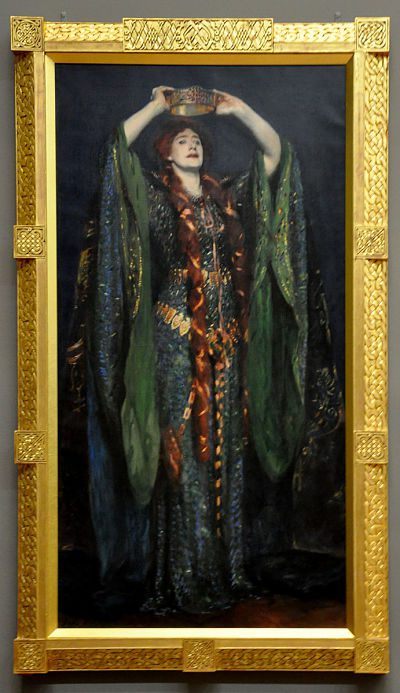 God exalts the humble and Satan tempts us with the kingdoms of this world. American self-help or business books may not like this truth, but true it is nonetheless. We are eternal beings and striving, coveting, lusting after place and position will destroy us. In this Presidential year, when we are apt to judge the candidates, perhaps we should turn the light of truth on ourselves.
Shakespeare, the great Christian sage, can help us. He gives us a perfect image of what the lust for power does to a person in the figure of Macbeth and his Lady. He starts as a hero and she as his powerful consort. She ends mad and he dies disgraced, dishonored, and damned. Demons (the Weird Sisters) tempt Macbeth with the kingdom and this unlawful knowledge tempts him to use unlawful means to get the crown.
Lady Macbeth, brilliant and powerful, pushes the two of them forward when he would hesitate. She shows greater strength of character and a better understanding of power than her husband, but she is also overly ambitious. She is the opposite of the Biblical David who learns by godly means that he is God’s anointed as King of Israel, but will not use violence and murder of his rival to seize the throne.
Instead she cries out:
Glamis thou art, and Cawdor; and shalt be
What thou art promised: yet do I fear thy nature;
It is too full o’ the milk of human kindness
To catch the nearest way: thou wouldst be great;
Art not without ambition, but without
The illness should attend it: what thou wouldst highly,
That wouldst thou holily; wouldst not play false,
Lady Macbeth knows the truth: her husband should be King. She fears that without ambition and cruelty that he will never rule. This might be true. We don’t live in the world as it should be. People can choose poorly and so the man who should be King does not become King. Old men can cling to power when they should give it up and in republics, voters can turn from heroes to demagogues.
We cannot “fix” this problem of our time by wickedness. Even if we succeed, we fail. The job we cannot retain or seize only by cruelty, throwing friends “under the bus,” or through knavery is not worth having. There are worse things than failure and wickedness is one of them.
Be content.
Macbeth and Lady Macbeth have good lives. They are honored and have positions of power and influence in Scotland, but this is not enough for either of them. Macbeth is more odious than his Lady, because he covets, but does not have the courage to admit his desires. He is too weak to sin and he ought to know it. We often enjoy the fruit of sin, but then are unable to digest what we have consumed. The sickness is greater than the pleasure. Some can endure longer, but eventually sin saps our judgment and drives us mad.
We begin to see what is not there and believe what is not true. When the lust for power consumes us, we start to do and believe things that we would have denied before the sin began to eat away at our conscience. At the worst, the grasping man becomes unrecognizable to his friends.
The antidote to this is contentment. Saint Paul says: “Not that I am speaking of being in need, for I have learned in whatever situation I am to be content.” Saint Paul was not afraid to ask for respect. He was not shy about asserting his prerogatives, but he was also content. The Roman Empire was not going to honor him as it should have. The Empire did not even always give him his rights. He was not hesitant to point this out: contentment is not weakness or compliance in evil. He forced the Romans to admit their wickedness and their failure did not take his happiness.
Macbeth seized what might have been his in a better Scotland (and who knows what God might have done in the future?) and it destroyed him. Saints like David and Saul asserted the truth of what should be and then were content with the results.
Know my place.
There is nothing less American than “knowing my place.” This is because we confuse my knowing my place with some tyrant telling me my place. As a leader, I try to behave honorably and so hope to be honored for what God has done through me. God does not mind his children being honored.
However, the tyrant would put us in our place . . . a place where one should not be. The tyranny of the tyrant is an action of a man who does not know his place. He has moved from being a leader to being a god and men are not gods. God asks men and women to know themselves and know their place in God’s divine economy. If I am a pastor or leader, it might be my role to suggest where a person fits (if asked), but it is not my job to force them to fill it.
The Saint Constantine School does not “label” students, but helps them to achieve their place in God’s Kingdom. We honor all positions as God given. We don’t assume every student must be academically equal to every other student, but we do not decide for a student their gifts. We help them discover their place.
My job as a human is to find my place, fill that role, and then be content. My job is not someone else’s job and I dare not covet someone else’s gifts
Macbeth fails. He says: “To know my deed, ’twere best not know myself.”
Avoid the lust for power.
There was a fine old rule that Americans were uncomfortable with any man who lusted for the Presidency. James Garfield managed to become a college president, war hero, general, Congressman, Senator, and President of the United States without grasping for the next job. At times he would ask for positions, but he was always uncomfortable pushing for what he wanted.
There can be a bad side to this virtue of humility, of course. Women in our culture are often taught that they “do not deserve” advancement or find themselves in companies with a dysfunctional male culture of grasping for advancement. The solution is not for women to learn vice, to become as cruelly ambitious as the men, but for men to learn virtue.We may have to start new companies and create new cultures that are less grasping. There is nothing wrong with asking for place or position, but the overweening ambition that will not be happy without it or the belief that I deserve more, always more, is rotten.
We are in greater danger from leaders who seek place, who exalt self rather than self-abasement. Let us recall that God’s promise to ancient Israel was that if they humbled themselves, that God would heal the land. We need some national humility just now. God save us.
————————————————
William Shakespeare went to God four hundred years ago. To recollect his death, I am writing a personal reflection on a few of his plays. The Winter’s Tale started things off, followed by As You Like It. Romeo and Juliet still matter and Lady Macbeth rebukes the lust for power.
Previous Post

April 19, 2016
Woe is not Romantic: Just Ask Juliet and Romeo
Next Post
April 21, 2016 Did I ever tell you you're my hero? (The Search for Henry V or Siegfried)
Browse Our Archives
Select a Category Apologetics Art Culture Education On Books On Education Philosophy Politics Pop Culture Spiritual Reflections Uncategorized
Select a Month October 2026 September 2026 August 2026 July 2026 July 2025 June 2025 September 2024 July 2024 June 2024 December 2023 June 2023 September 2022 May 2022 April 2022 March 2022 February 2022 July 2021 June 2021 May 2021 April 2021 March 2021 February 2021 January 2021 December 2020 November 2020 October 2020 September 2020 August 2020 July 2020 June 2020 May 2020 April 2020 March 2020 February 2020 January 2020 December 2019 November 2019 October 2019 September 2019 August 2019 July 2019 June 2019 May 2019 April 2019 March 2019 February 2019 January 2019 December 2018 November 2018 October 2018 September 2018 August 2018 July 2018 June 2018 May 2018 April 2018 March 2018 February 2018 January 2018 December 2017 November 2017 October 2017 September 2017 August 2017 July 2017 June 2017 May 2017 April 2017 March 2017 February 2017 January 2017 December 2016 November 2016 October 2016 September 2016 August 2016 July 2016 June 2016 May 2016 April 2016 March 2016 February 2016 January 2016 December 2015 November 2015 October 2015 September 2015 August 2015 July 2015 June 2015 May 2015 April 2015 March 2015 February 2015 January 2015 November 2014 October 2014 September 2014 August 2014 July 2014 June 2014 May 2014 April 2014 March 2014 February 2014 January 2014 December 2013 November 2013 October 2013 September 2013 August 2013 July 2013 June 2013 May 2013 April 2013 March 2013 February 2013 January 2013 December 2012 November 2012 October 2012 September 2012 August 2012 July 2012 June 2012 May 2012
Follow Us!
TAKE THE
Religious Wisdom Quiz
Who was Jacob’s only daughter?
Select your answer to see how you score.
Rachel Dinah Leah Tamar
Books by This Author John Mark Reynolds
Related posts from Eidos

Classical Education and the Art of Dying Well

Golden, Golden, Golden: My Mother's Last Lesson


When the Center Holds: A Tribute to My...
TRENDING AT PATHEOS Evangelical

The REST of Your Life: A Creative Wrestles...
This week I had a conversation with a good friend from church....

How the author of the world's best hymn...
I've been working with John Newton for a while now. This makes...

Long before this Lectio Divina, Psalm 130 - the song - started...

What About the Trees? Another Living Parable
After I finished writing the last article about falling leaves as a...

Why Classical Education Is a Conversation, Not a...
Come and Read: Joy in Classical Education When I was a little...

Cornell University has received a great deal of negative publicity and intense...
view all Evangelical blogs
Ad-Free & Subscriber Log-In Subscription Support
- About Us
- 2026 Calendar
- Videos
- Podcasts
- Library of World Religions
- Faith In Media Tracker
- Advertise With Us
- Write for Us
- Privacy Policy
- Terms of Service
- Do Not Sell My Data
- Contact Us
- Radiant Digital
- Manage Newsletter Subscriptions
- Unsubscribe From Notifications
- Sitemap
Copyright 2008-2026, Patheos. All rights reserved.
Subscription Support Ad-Free & Subscriber Log-In
Follow Patheos