
BuddhistCatholicContemplativeEvangelicalGeneral ChristianHinduJewishLatter-day SaintMuslimNew VisionsProgressive Christian
Beliefs
- Buddhist
- Catholic
- Contemplative
- Evangelical
- General Christian
- Hindu
- Jewish
- Latter-day Saint
- More Voices
- Muslim
- New Visions
- Pagan
- Progressive Christian
Topics
- Religion News
- Food and Religion
- Sports and Religion
- Religious Art
- Religious Music and Entertainment
- Religious Events
- History and Religion
- Style and Religion
- Politics and Religion
- Women in Religion
- Recreation Outdoors and Religion
- Business Finance and Religion
- Careers Workplace and Religion
- Education and Religion
- Family Parenting and Religion
- Health Fitness and Religion
- Home and Religion
- Relationships and Religion
- Technology and Religion
- Travel and Religion
Columnists
- Buddhist Columnists
- Business Finance and Religion Columnists
- Careers Workplace and Religion Columnists
- Catholic Columnists
- Contemplative Columnists
- Education and Religion Columnists
- Evangelists Columnists
- Family Parenting and Religion Columnists
- General Christian Columnists
- Health Fitness and Religion Columnists
- Hindu Columnists
- History and Religion Columnists
- Home and Religion Columnists
- Jewish Columnists
- More Voices Columnists
- Latter Day Columnists
- Muslim Columnists
- New Visions Columnists
- Nonreligious Columnists
- Pagan Columnists
- Politics and Religion Columnists
- Progressive Columnists
- Recreation Outdoors and Religion Columnists
- Relationships and Religion Columnists
- Religion News Columnists
- Religious Art Columnists
- Religious Events Columnists
- Religious Music and Entertainment Columnists
- Sports and Religion Columnists
- Style and Religion Columnists
- Technology and Religion Columnists
- Travel and Religion Columnists
- Women in Religion Columnists
Resource Library
- 2026 Calendar
- Library of World Religions
- The 100 Most Holy Places on Earth
- Patheos Answers
- Podcasts
- Videos
- Faith Leaders Database
- Anglican Episcopalian
- Bahai
- Baptist
- Buddhism
- Christianity
- Confucianism
- Eastern Orthodoxy
- Hinduism
- Holiness and Pentecostal
- ISKCON
- Islam
- Judaism
- Lutheran
- Methodist
- The Church of Jesus Christ of Latter-day Saints
- New Age
- Paganism
- Presbytarian and Reformed
- Protestantism
- Religion Behind the Scenes
- Roman Catholic
- Scientology
- Shia Islam
- Sikhism
- Sufism
- Sunni Islam
- Taoism
- Zen
- See all religions
Research Tools
 Ad-Free & Subscriber Log-In Subscription Support
Ad-Free & Subscriber Log-In Subscription Support
Follow Patheos 

- Trending:
- Forgiveness
- |
- Marriage
- |
- Consciousness
- |
- Death Penalty
- |
- Election
- |
- Halloween

- Home
- Evangelical
- Ancient Witches V: (Guest Voice: James Harrington)
Ancient Witches V: (Guest Voice: James Harrington)
Last updated on: June 9, 2019 at 8:38 pm by John Mark N. Reynolds
Ancient Witches V: (Guest Voice: James Harrington) 2019-06-09T20:38:19-04:00 John Mark N. Reynolds
Patheos Explore the world's faith through different perspectives on religion and spirituality! Patheos has the views of the prevalent religions and spiritualities of the world.
I asked for new voices and got some outstanding writers! Today we hear from the erudite James R. Harrington.
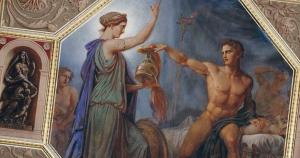 James R. Harrington earned his M.A. in Ancient History at California State University Fulleron and is a member of the Torrey Honors Institute. James has been a classical educator in a variety of settings over the past thirteen years. He lives in Houston with his wife, Sharon, and their daughter.
Harrington began with a series on shields in classical literature and now moves to witches as a theme.
On shields, Mr. Harrington responded to thoughts on his first post. Harrington wrote about the shield of Herakles, He continued to the shield of Aeneas and followed up on that post. We turned to a shield in Ovid. He concluded with Quintus and a follow up.
Now he turns to witches with a second post , a third, a fourth, and now a fabulous fifth:
The vast wealth and intercultural riches of the Hellenistic kingdoms that sprang up from the conquests of Alexander the Great created an artistic explosion across the Mediterranean world. Apollonius of Rhodes, as part of that creative ferment, sought to revive the writing of epic poetry in his four-book Argonautica. In the process, he infused epic with the emergent “genres” of idyll and novel. The result is an epic that revolves around a love story. At the heart of that love story is Medea: teenage witch.*
Apollonius inherited the character of Medea from Euripides and plays her witchy credentials to full effect. Medea is made to be Circe’s niece, establishing a family coven right out of the Salem courtroom.** Her coming inspires terror in rural peasants akin to Artemis the night hunter.***
She is a bane to her own family, killing even her brother when he gets in her way.° Medea’s rage is terrifying and full of malicious intent.°° She works her will not only with pharmaka, but also with incantations.°°° Most importantly (besides the black lipstick and Eva Green eyeliner), Apollonius repeatedly emphasizes that Medea’s powers come from her “pact” with the underworld goddess Hecate.◊
On the other hand, Apollonius’ Medea is not the wronged and vengeful woman of Euripides’ play, but the teen love interest and all-around heroine of the story. As with all epic loves, Medea and Jason’s is predestined. The goddesses of femininity—Athena the Virgin, Aphrodite the Lover, and Hera the Matron—serve as their faulty stars.◊◊ The symptoms of her crush are described in minute detail:
Time and again she darted a bright glance at Jason. All else was forgotten. Her heart, brimful of this new agony, throbbed within her and overflowed with the sweetness of the pain.◊◊◊
When Medea learns that Jason is her father’s enemy and is to be sent to his death facing fire-breathing bulls and magical warriors, she bursts out in lines worthy of Juliet:
What is the meaning of this grief? Hero or villain (and why should I care which?) the man is going to his death. Well, let him go! And yet I wish he had been spared. Yes, sovereign lady Hecate, this is my prayer. Let him live to reach his home. But if he must be conquered by the bulls, may he first learn that I for one do not rejoice in his cruel fate.⸸
After an awkwardly-romantic clandestine meeting, Medea decides that her magic is the key to saving her beloved Jason. In a scene that might be taken from Sabrina the Teenage Witch, Medea turns to her chest of pharmaka and calls on Hecate’s favor:
She took a magic ointment from her box. … A man had only to smear it on his body … to become invulnerable … To make the ointment, Medea, clothed in black, in the gloom of night, had drawn off this juice … calling seven times on Brimo … night-wanderer of the underworld, Queen of the dead. The dark earth shook and rumbled underneath …⸸⸸
The cumulative effect of these scenes is to transform Medea into Greek literature’s first witchy romantic lead. Indeed, it is Medea, rather than Jason, who ends up using her magical powers to win the golden fleece and earn the Argonauts a safe passage home. Jason himself acknowledges this in front of his crew:
My friends … let us start for home without delay. The prize for which we dared greatly and suffered misery on the cruel sea is ours. And the task proved easy, thanks to this lady … She is the true savior of Achaea and yourselves.⸸⸸⸸
Apollonius of Rhodes may be telling an old tale, but in so doing he is also creating something new. Argonautica’s Medea is a witch who is neither a figure to be feared nor an obstacle to be navigated, but a heroine in her own right who is meant to win the audience’s sympathy and respect. Her pharmaka and her pact with Hecate are not present to be renounced, nor is Medea presented as a hero despite them. Rather, they are integral to her character and the means by which she is able to help her friends, defeat her foes, and win Jason’s admiration. She is the first figure of a “heroine’s journey” that leads through Tolkien’s Luthien to Star Wars’ Rey. We should not be surprised by this. As self-described witch Pam Grossman observes when commenting on the witches of pop-culture:
Adolescent witches have to learn control and discernment, just as teen girls must with their burgeoning sexuality and protean senses of self. These stories portray magic as a mixed blessing: a source of vast potential, a mechanism of possible destruction. The teen witch is a key ready for ignition, a match with a promise to inflame.⸷
———————————-
*D.P. Nelis, Apollonius of Rhodes in A Companion to Ancient Epic, John Miles Foley ed., Malden: Blackwell Publishing Ltd., 2009. pp. 354, 356, 362.
**Apollonius of Rhodes, The Voyage of Argo, E.V. Rieu trans. New York: Penguin Books, 1971. pp. 165-167. translating for lines IV.651-758. see also Charles Williams, Witchcraft. Berkley, Apocryphile Press., 2005. pp. 153-154.
***Apollonius of Rhodes, p. 132. translating for lines III.845-886 see also Williams pp. 62-63.
°Apollonius of Rhodes, pp.158-160. translating for lines IV.395-501
°°Ibid., p. 157. translating for lines IV.359-394
°°°Ibid., pp. 130-131, 148. translating for lines III.765-844, IV.28-65
◊Ibid., pp. 116, 122-123, 132, 141. translating for lines III. 246-282, 468-541, 845-886, 1189-1227
◊◊Ibid., pp.109-113. translating for lines III.1-170
◊◊◊Ibid., p. 117. translating for lines III.283-322
⸸Ibid., pp. 121-122. translating for lines III.431-504
⸸⸸Ibid., pp. 131-132. translating for lines III.805-886 For just how closely Medea’s story matches that of modern teenage witches literary and real see Pam Grossman Waking the Witch: Reflections on Women, Magic, and Power. New York: Gallery Books, 2019. pp. 37-70.
⸸⸸⸸Apollonius of Rhodes, p. 152. translating for lines IV.186-223
⸷Pam Grossman, p. 60.
Previous Post
June 7, 2019
The Lonesome Gods (A Problem of the 1950’s Generation AND Louis L’Amour)
Next Post
June 9, 2019 Daddy King (The Rev. Martin Luther King, Sr.) an Autobiography
Browse Our Archives
Select a Category Apologetics Art Culture Education On Books On Education Philosophy Politics Pop Culture Spiritual Reflections Uncategorized
Select a Month October 2026 September 2026 August 2026 July 2026 July 2025 June 2025 September 2024 July 2024 June 2024 December 2023 June 2023 September 2022 May 2022 April 2022 March 2022 February 2022 July 2021 June 2021 May 2021 April 2021 March 2021 February 2021 January 2021 December 2020 November 2020 October 2020 September 2020 August 2020 July 2020 June 2020 May 2020 April 2020 March 2020 February 2020 January 2020 December 2019 November 2019 October 2019 September 2019 August 2019 July 2019 June 2019 May 2019 April 2019 March 2019 February 2019 January 2019 December 2018 November 2018 October 2018 September 2018 August 2018 July 2018 June 2018 May 2018 April 2018 March 2018 February 2018 January 2018 December 2017 November 2017 October 2017 September 2017 August 2017 July 2017 June 2017 May 2017 April 2017 March 2017 February 2017 January 2017 December 2016 November 2016 October 2016 September 2016 August 2016 July 2016 June 2016 May 2016 April 2016 March 2016 February 2016 January 2016 December 2015 November 2015 October 2015 September 2015 August 2015 July 2015 June 2015 May 2015 April 2015 March 2015 February 2015 January 2015 November 2014 October 2014 September 2014 August 2014 July 2014 June 2014 May 2014 April 2014 March 2014 February 2014 January 2014 December 2013 November 2013 October 2013 September 2013 August 2013 July 2013 June 2013 May 2013 April 2013 March 2013 February 2013 January 2013 December 2012 November 2012 October 2012 September 2012 August 2012 July 2012 June 2012 May 2012
Follow Us!
TAKE THE
Religious Wisdom Quiz
What year was the first complete English Bible printed?
Select your answer to see how you score.
1382 1450 1611 1535
Books by This Author John Mark Reynolds
Related posts from Eidos

Classical Education Must Teach Us to Make the...

Yet I Love Her: History and the Church


The Iceberg is There: Verbosity Cannot Defeat Reality
TRENDING AT PATHEOS Evangelical

The REST of Your Life: A Creative Wrestles...
This week I had a conversation with a good friend from church....

How the author of the world's best hymn...
I've been working with John Newton for a while now. This makes...

Long before this Lectio Divina, Psalm 130 - the song - started...

What About the Trees? Another Living Parable
After I finished writing the last article about falling leaves as a...

Why Classical Education Is a Conversation, Not a...
Come and Read: Joy in Classical Education When I was a little...

Cornell University has received a great deal of negative publicity and intense...
view all Evangelical blogs
Ad-Free & Subscriber Log-In Subscription Support
- About Us
- 2026 Calendar
- Videos
- Podcasts
- Library of World Religions
- Faith In Media Tracker
- Advertise With Us
- Write for Us
- Privacy Policy
- Terms of Service
- Do Not Sell My Data
- Contact Us
- Radiant Digital
- Manage Newsletter Subscriptions
- Unsubscribe From Notifications
- Sitemap
Copyright 2008-2026, Patheos. All rights reserved.
Subscription Support Ad-Free & Subscriber Log-In
Follow Patheos