
BuddhistCatholicContemplativeEvangelicalGeneral ChristianHinduJewishLatter-day SaintMuslimNew VisionsProgressive Christian
Beliefs
- Buddhist
- Catholic
- Contemplative
- Evangelical
- General Christian
- Hindu
- Jewish
- Latter-day Saint
- More Voices
- Muslim
- New Visions
- Pagan
- Progressive Christian
Topics
- Religion News
- Food and Religion
- Sports and Religion
- Religious Art
- Religious Music and Entertainment
- Religious Events
- History and Religion
- Style and Religion
- Politics and Religion
- Women in Religion
- Recreation Outdoors and Religion
- Business Finance and Religion
- Careers Workplace and Religion
- Education and Religion
- Family Parenting and Religion
- Health Fitness and Religion
- Home and Religion
- Relationships and Religion
- Technology and Religion
- Travel and Religion
Columnists
- Buddhist Columnists
- Business Finance and Religion Columnists
- Careers Workplace and Religion Columnists
- Catholic Columnists
- Contemplative Columnists
- Education and Religion Columnists
- Evangelists Columnists
- Family Parenting and Religion Columnists
- General Christian Columnists
- Health Fitness and Religion Columnists
- Hindu Columnists
- History and Religion Columnists
- Home and Religion Columnists
- Jewish Columnists
- More Voices Columnists
- Latter Day Columnists
- Muslim Columnists
- New Visions Columnists
- Nonreligious Columnists
- Pagan Columnists
- Politics and Religion Columnists
- Progressive Columnists
- Recreation Outdoors and Religion Columnists
- Relationships and Religion Columnists
- Religion News Columnists
- Religious Art Columnists
- Religious Events Columnists
- Religious Music and Entertainment Columnists
- Sports and Religion Columnists
- Style and Religion Columnists
- Technology and Religion Columnists
- Travel and Religion Columnists
- Women in Religion Columnists
Resource Library
- 2026 Calendar
- Library of World Religions
- The 100 Most Holy Places on Earth
- Patheos Answers
- Podcasts
- Videos
- Faith Leaders Database
- Anglican Episcopalian
- Bahai
- Baptist
- Buddhism
- Christianity
- Confucianism
- Eastern Orthodoxy
- Hinduism
- Holiness and Pentecostal
- ISKCON
- Islam
- Judaism
- Lutheran
- Methodist
- The Church of Jesus Christ of Latter-day Saints
- New Age
- Paganism
- Presbytarian and Reformed
- Protestantism
- Religion Behind the Scenes
- Roman Catholic
- Scientology
- Shia Islam
- Sikhism
- Sufism
- Sunni Islam
- Taoism
- Zen
- See all religions
Research Tools
 Ad-Free & Subscriber Log-In Subscription Support
Ad-Free & Subscriber Log-In Subscription Support
Follow Patheos 

- Trending:
- Forgiveness
- |
- Marriage
- |
- Consciousness
- |
- Death Penalty
- |
- Election
- |
- Halloween

- Home
- Evangelical
- Ancient Witches Part III (Guest Voices, James Harrington)
Ancient Witches Part III (Guest Voices, James Harrington)
Last updated on: May 25, 2019 at 12:12 am by John Mark N. Reynolds
Ancient Witches Part III (Guest Voices, James Harrington) 2019-05-25T00:12:04-04:00 John Mark N. Reynolds
Patheos Explore the world's faith through different perspectives on religion and spirituality! Patheos has the views of the prevalent religions and spiritualities of the world.
I asked for new voices and got some outstanding writers! Today we hear from the erudite James R. Harrington.
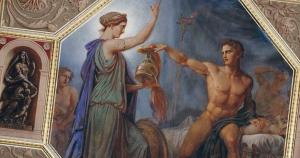 James R. Harrington earned his M.A. in Ancient History at California State University Fulleron and is a member of the Torrey Honors Institute. James has been a classical educator in a variety of settings over the past thirteen years. He lives in Houston with his wife, Sharon, and their daughter.
Harrington began with a series on shields in classical literature and now moves to witches as a theme.
On shields, Mr. Harrington responded to thoughts on his first post. Harrington wrote about the shield of Herakles, He continued to the shield of Aeneas and followed up on that post. We turned to a shield in Ovid. He concluded with Quintus and a follow up.
Now he turns to witches with a second post:
In our last post, we examined the close link between medicine and magic evinced by Homer’s healers in the Iliad. This week, we turn to another Homeric adept in the art of pharmaka, one step closer to the ideal European “witch” Judge Hathorne had in mind at Salem: Helen of Troy.
By 1692, Helen of Troy’s name had already entered the pop-canon of European witch-lore with Christopher Marlowe’s play Faust.* Marlowe specifically plays on the idea of Helen’s irresistible sexuality as a temptation of the Devil. While Homer knew nothing of the Devil, he does portray Helen’s beauty as supernaturally baleful. The Trojans are so enraptured by her that they refuse to release her, against the advice of the elders, even though it spells doom for their city. These elders see Helen clearly:
Small blame that Trojans and well-greaved Achaeans should for such a woman long
suffer woes; she is dreadfully like immortal goddesses to look on. But even so, though
she is like them, let her go home on the ships, and not be left here to be a bane to us and
to our children after us.**
Helen is thus the prototype in European literature of the fey enchantress, the woman who brings about destruction by her supernatural beauty. However, Helen’s beauty does not come about because of sorcery or pharmaka, but is due rather to her status as a daughter of Zeus; she cannot help being what she is.*** The harm she causes is not intentional.
Helen is a very intentional user of pharmaka, however, particularly those that grow in Homer’s magic-saturated land of Egypt.° As with the Iliad’s “combat medics,” the use of these pharmaka is benevolent: they cure pain. We see an example of this when Odysseus’ son, Telemachus, comes to question Helen and Menelaus regarding his father’s disappearance. As the young prince and the old war hero talk, neither can refrain from weeping. Ever the good hostess, Helen turns to her pharmaka:
Then Helen, daughter of Zeus, took other counsel. At once she cast into the wine of
which they were drinking a drug to quiet all pain and strife, and bring forgetfulness of every ill.… Such cunning drugs had the daughter of Zeus, drugs of healing, which Polydamna, the wife of Thon, had given her, a woman of Egypt, for there the earth, the giver of grain, bears greatest store of drugs … there every man is a physician, wise above human kind…°°
While there is scholarly debate over whether Helen is wise to use her pharmakon and whether its effect is entirely beneficial in this particular situation, it seems clear that Helen’s motive is to show hospitality by assuaging her guests’ grief.°°° She is not a wicked witch poisoning the princes, but an attentive hostess using all her resources in the important custom of xenia, or ritual hospitality.
Helen’s motives are the key to setting her apart from the witches of later European folklore. As theologian and occultist Charles Williams points out, the ideas that make a “witch” into a “Witch” are the use of magical power for harm and hatred/jealousy of the One God.§ Nonetheless, in her supernatural capacity for destruction, Helen has been persistently associated with the occult forces of evil.§§ While Helen of Troy may remain ambiguous, our next post turns to a more malevolent figure: the enchanting goddess, mixer of baleful drugs, wand-wielder, and necromancer, Circe.
—————————————————
*Bettany Hughes, Helen of Troy: Goddess, Princess, Whore. London: Pimlaco, 2006. pp. 298-307.
**Homer, Iliad. A.T. Murray trans. Cambridge: Harvard University Press, 1999. pp. 140-141. Translating for lines III.156-160.
***Suzanne Saïd, Homer and the Odyssey. Oxford: Oxford University Press, 2011. p. 273.
°François Hartog, Memories of Odysseus. Janet Loyd trans. Chicago: Chicago University Press, 2001. pp.47-48.
°°Homer, Odyssey. A.T. Murray trans. Cambridge: Harvard University Press, 1998. p. 135. Translating for lines IV.219-232.
°°°Saïd, 271-272.
§Charles Williams, Witchcraft. Berkley: Apocryphile Press, 2005. pp. 32, 38-39.
§§As early as the second century A.D. in Gnostic literature and the Simon Magus romance: Ibid., pp. 31-33. see also Hughes, 281-288.
Previous Post

May 16, 2019
God is Great as Opposed to Degenerate Democracy (5/5)
Next Post
May 18, 2019 The Limits of Romance (Sir Harry Hotspur, Anthony Trollope)
Browse Our Archives
Select a Category Apologetics Art Culture Education On Books On Education Philosophy Politics Pop Culture Spiritual Reflections Uncategorized
Select a Month October 2026 September 2026 August 2026 July 2026 July 2025 June 2025 September 2024 July 2024 June 2024 December 2023 June 2023 September 2022 May 2022 April 2022 March 2022 February 2022 July 2021 June 2021 May 2021 April 2021 March 2021 February 2021 January 2021 December 2020 November 2020 October 2020 September 2020 August 2020 July 2020 June 2020 May 2020 April 2020 March 2020 February 2020 January 2020 December 2019 November 2019 October 2019 September 2019 August 2019 July 2019 June 2019 May 2019 April 2019 March 2019 February 2019 January 2019 December 2018 November 2018 October 2018 September 2018 August 2018 July 2018 June 2018 May 2018 April 2018 March 2018 February 2018 January 2018 December 2017 November 2017 October 2017 September 2017 August 2017 July 2017 June 2017 May 2017 April 2017 March 2017 February 2017 January 2017 December 2016 November 2016 October 2016 September 2016 August 2016 July 2016 June 2016 May 2016 April 2016 March 2016 February 2016 January 2016 December 2015 November 2015 October 2015 September 2015 August 2015 July 2015 June 2015 May 2015 April 2015 March 2015 February 2015 January 2015 November 2014 October 2014 September 2014 August 2014 July 2014 June 2014 May 2014 April 2014 March 2014 February 2014 January 2014 December 2013 November 2013 October 2013 September 2013 August 2013 July 2013 June 2013 May 2013 April 2013 March 2013 February 2013 January 2013 December 2012 November 2012 October 2012 September 2012 August 2012 July 2012 June 2012 May 2012
Follow Us!
TAKE THE
Religious Wisdom Quiz
What prophet, along with Zechariah, encouraged the rebuilding of the Temple?
Select your answer to see how you score.
Elijah Haggai Malachi Obadiah
Books by This Author John Mark Reynolds
Related posts from Eidos

Classical Education and the Art of Dying Well

Golden, Golden, Golden: My Mother's Last Lesson


When the Center Holds: A Tribute to My...
TRENDING AT PATHEOS Evangelical

The REST of Your Life: A Creative Wrestles...
This week I had a conversation with a good friend from church....

How the author of the world's best hymn...
I've been working with John Newton for a while now. This makes...

Long before this Lectio Divina, Psalm 130 - the song - started...

What About the Trees? Another Living Parable
After I finished writing the last article about falling leaves as a...

Why Classical Education Is a Conversation, Not a...
Come and Read: Joy in Classical Education When I was a little...

Cornell University has received a great deal of negative publicity and intense...
view all Evangelical blogs
Ad-Free & Subscriber Log-In Subscription Support
- About Us
- 2026 Calendar
- Videos
- Podcasts
- Library of World Religions
- Faith In Media Tracker
- Advertise With Us
- Write for Us
- Privacy Policy
- Terms of Service
- Do Not Sell My Data
- Contact Us
- Radiant Digital
- Manage Newsletter Subscriptions
- Unsubscribe From Notifications
- Sitemap
Copyright 2008-2026, Patheos. All rights reserved.
Subscription Support Ad-Free & Subscriber Log-In
Follow Patheos