
BuddhistCatholicContemplativeEvangelicalGeneral ChristianHinduJewishLatter-day SaintMuslimNew VisionsProgressive Christian
Beliefs
- Buddhist
- Catholic
- Contemplative
- Evangelical
- General Christian
- Hindu
- Jewish
- Latter-day Saint
- More Voices
- Muslim
- New Visions
- Pagan
- Progressive Christian
Topics
- Religion News
- Food and Religion
- Sports and Religion
- Religious Art
- Religious Music and Entertainment
- Religious Events
- History and Religion
- Style and Religion
- Politics and Religion
- Women in Religion
- Recreation Outdoors and Religion
- Business Finance and Religion
- Careers Workplace and Religion
- Education and Religion
- Family Parenting and Religion
- Health Fitness and Religion
- Home and Religion
- Relationships and Religion
- Technology and Religion
- Travel and Religion
Columnists
- Buddhist Columnists
- Business Finance and Religion Columnists
- Careers Workplace and Religion Columnists
- Catholic Columnists
- Contemplative Columnists
- Education and Religion Columnists
- Evangelists Columnists
- Family Parenting and Religion Columnists
- General Christian Columnists
- Health Fitness and Religion Columnists
- Hindu Columnists
- History and Religion Columnists
- Home and Religion Columnists
- Jewish Columnists
- More Voices Columnists
- Latter Day Columnists
- Muslim Columnists
- New Visions Columnists
- Nonreligious Columnists
- Pagan Columnists
- Politics and Religion Columnists
- Progressive Columnists
- Recreation Outdoors and Religion Columnists
- Relationships and Religion Columnists
- Religion News Columnists
- Religious Art Columnists
- Religious Events Columnists
- Religious Music and Entertainment Columnists
- Sports and Religion Columnists
- Style and Religion Columnists
- Technology and Religion Columnists
- Travel and Religion Columnists
- Women in Religion Columnists
Resource Library
- 2026 Calendar
- Library of World Religions
- The 100 Most Holy Places on Earth
- Patheos Answers
- Podcasts
- Videos
- Faith Leaders Database
- Anglican Episcopalian
- Bahai
- Baptist
- Buddhism
- Christianity
- Confucianism
- Eastern Orthodoxy
- Hinduism
- Holiness and Pentecostal
- ISKCON
- Islam
- Judaism
- Lutheran
- Methodist
- The Church of Jesus Christ of Latter-day Saints
- New Age
- Paganism
- Presbytarian and Reformed
- Protestantism
- Religion Behind the Scenes
- Roman Catholic
- Scientology
- Shia Islam
- Sikhism
- Sufism
- Sunni Islam
- Taoism
- Zen
- See all religions
Research Tools
 Ad-Free & Subscriber Log-In Subscription Support
Ad-Free & Subscriber Log-In Subscription Support
Follow Patheos 

- Trending:
- Forgiveness
- |
- Marriage
- |
- Consciousness
- |
- Death Penalty
- |
- Election
- |
- Halloween

- Home
- Evangelical
- Visions of Truth (Reading Alan Noble as a Distracted Me 4/8)
Visions of Truth (Reading Alan Noble as a Distracted Me 4/8)
Last updated on: October 9, 2018 at 12:49 pm by John Mark N. Reynolds
Visions of Truth (Reading Alan Noble as a Distracted Me 4/8) 2018-10-09T12:49:17-04:00 John Mark N. Reynolds
Patheos Explore the world's faith through different perspectives on religion and spirituality! Patheos has the views of the prevalent religions and spiritualities of the world.
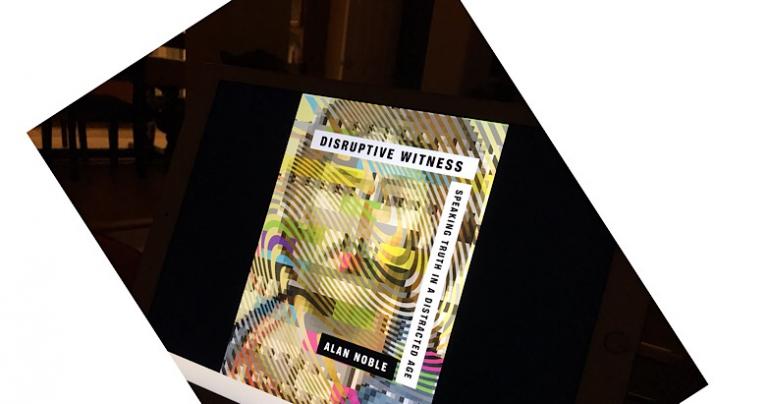
Times are tough for everyone, but what if:
Our faith has the resources to overcome the challenges of our times, but the church has often left those resources untapped.
Professor Alan Noble has written Disruptive Witness, a must-read book. What he calls “secularism” and “distraction” threatens to prevent us from becoming whole and from talking to each other, comprehensibly witnessing in Christian terms.
I am still unpersuaded that Noble’s use of “secularism” is useful, when “badly educated” or “mentally lazy” might better describe the phenomenon he outlines. He might also be describing a state of mind of a mostly white (though it wishes it were not), highly credentialed (not to be confused with thoughtful) elite, in Western parts of the world and less a picture of a global reality where secularism is fading and forms of charismatic religion are growing. People like me may live in an immanent frame, but many of my friends do not.
Thank God.
None of these concerns should keep anyone from reading this book. The illness of the Western world’s academic elites spread everywhere and Professor Noble unpacks them well. Nor should this be taken as a defense of any establishment on the right. Everyone’s house has the pox, including my own.
On distraction, Noble speaks the truth. Distraction keeps us from leaving our tribes, our lazy answers, because we can go on believing lies that are repeated by the carefully culled list of people we follow on social media.
Obviously, this is not to look to some past ‘Golden Age’ when things were better. No moral person, certainly no Christian, looks back before social media and would restore things as they were, even if this were possible.
A Good and Beautiful Burden
We must learn to think well, accept authority where we have no expertise, and take time to be quiet. Bluntly, one result of reading Alan Noble may be for me to close my Facebook and Twitter feeds.
As a depressive, they were always hard for me, but reading Professor Noble reminds me of how much time they waste. Yet there is also learning discipline and that would be better. . . Still, Noble challenges my particular behavior, not yours!
Professor Noble gets the deep truth of Plato’s Symposium: romance, the divine, absolute splendor of being alive and in love with all that is good, true, and beautiful is a weight: a weight of glory.
This is the burden of being. It’s only a burden because it is irreducibly beautiful and good. It forces the question: Why me? What can possibly explain the incredible splendor of my existence? How can we understand this goodness in light of the horrors and sufferings in this world?
Noble pauses where CS Lewis preached to wonder at the burden of the weight of glory. I sat in a quiet monastery, in a Georgian summer, with honey on bread made by the monks and nuns, and talked to good men. My wife Hope was next to me with dear friends and it was good. What is to be made of such civilized times?
Who can say?
This much is true: secularists had thrown the last head (but one) of the community to his death off the beautiful cliffs next to us. Our feast on words and food was beauty responding to the beauty of his sacrifice. Ugliness cannot win. That is a great burden.
How could we see such beauty on a Georgian night, far from home yet at home? I know I am unfit for such beauty, but beauty comes regardless.
Thank God.
Reasons to Believe in Beauty
Professor Noble sees that we need a reason for beauty, an explanation in the face of meaning. I am often asked about the meaningless of the universe, but the harder problem is the deep, pervasive, meaning in the cosmos that demands an explanation. Why should beauty, piercing beauty, come to us?
Noble rightly sees “existentialism” as an attractive option for moderns. We will impose meaning on the meaningless. Our experience makes the mindless matter meaningful.
The problem is that this is a lie.
When we are pierced by the sweetness of the honey on bread at twilight as nuns sing, we are not imposing anything on reality. Reality is pressing down on us with beauty. I am unfit, ill-formed for beauty, but beauty presses down on me because the cosmos contains gratuitous beauty.
Noble is right to say that society sends me on a quest for authenticity. Wisdom sends me on a quest to know myself. These are utterly different adventures. Society wants me to be my true self, philosophy demands I be as I should be.
A self is, in fact, made up of so many different qualities that it is impossible to truly, thoroughly know ourselves.
That is the joy of having eternity for this quest! Nobody should wish to remain what we are, but to become what we should be. Noble, to his infinite credit, affirms this dangerous truth. It got Socrates killed, so we can only hope that Noble has tenure! No faculty member with tenure has yet been given hemlock.
The Gospel’s Never Ending Story
Professor Noble is brave enough to point out that most of the values of the academic culture we both rightly love have become indefensible. We go on doing what we do (and that is a good) because we have always done so. It is here that Noble asserts:
As Christianity has ceased to offer the vision of fullness shared by the vast majority of people in the West, in its place we find billions of micro-narratives of fullness.
I dissent. Christianity continues to offer a vision of fullness in the West, just not overtly. There are no new stories, just Christianity without sexual morals, Christianity without Christ, Christianity without the Bible. . . But always—see Joss Whedon—the Christian story of creation, fall, redemption, and glory.
All the bad myths in the West look to me like Christian stories told by idiots. When I was a boy, for example, I thought to tell a tale of a brave lad who would destroy a cursed object—a bracelet. I didn’t yet realize, in sixth grade, that Tolkien had already told this story.
Most of the stories we tell are the Gospel for degenerates. I am curious as to what Noble would say to this. . . A generalization that invites the sort of nuance that is Professor Noble’s best calling!
I do have one quibble. Professor Noble says:
The quest for the platonic form of yourself deep inside you leads to self-deception, autonomous creation, or despair.
He is quite right to warn us against this, very wrong to call this Platonic. The form, for Plato, must be external: to know yourself is to know you are not such a much. We are not as we should be compared to an external standard. To look within to the roiling, changing desires for what is and call that Platonic is exactly wrong.
Professor Noble is brave in conclusion:
A disruptive witness denies the entire contemporary project of treating faith as a preference.
Buy the book.
_______________________
Alan Noble is the “co-founder and editor in chief of Christ and Pop Culture.” If you are not reading Christ and Pop Culture and you are interested in Christ and/or Pop Culture, then bad. Go and subscribe.
I am slow-reading his new book. Part 1, Part 2, Part 3, Part 4,
Rachel Motte edited this essay and added the sub-headings.
Next Post
October 6, 2018 A Poem for Nature’s Breakfast or A Very Bad Poem (Something for Fun)
Browse Our Archives
Select a Category Apologetics Art Culture Education On Books On Education Philosophy Politics Pop Culture Spiritual Reflections Uncategorized
Select a Month October 2026 September 2026 August 2026 July 2026 July 2025 June 2025 September 2024 July 2024 June 2024 December 2023 June 2023 September 2022 May 2022 April 2022 March 2022 February 2022 July 2021 June 2021 May 2021 April 2021 March 2021 February 2021 January 2021 December 2020 November 2020 October 2020 September 2020 August 2020 July 2020 June 2020 May 2020 April 2020 March 2020 February 2020 January 2020 December 2019 November 2019 October 2019 September 2019 August 2019 July 2019 June 2019 May 2019 April 2019 March 2019 February 2019 January 2019 December 2018 November 2018 October 2018 September 2018 August 2018 July 2018 June 2018 May 2018 April 2018 March 2018 February 2018 January 2018 December 2017 November 2017 October 2017 September 2017 August 2017 July 2017 June 2017 May 2017 April 2017 March 2017 February 2017 January 2017 December 2016 November 2016 October 2016 September 2016 August 2016 July 2016 June 2016 May 2016 April 2016 March 2016 February 2016 January 2016 December 2015 November 2015 October 2015 September 2015 August 2015 July 2015 June 2015 May 2015 April 2015 March 2015 February 2015 January 2015 November 2014 October 2014 September 2014 August 2014 July 2014 June 2014 May 2014 April 2014 March 2014 February 2014 January 2014 December 2013 November 2013 October 2013 September 2013 August 2013 July 2013 June 2013 May 2013 April 2013 March 2013 February 2013 January 2013 December 2012 November 2012 October 2012 September 2012 August 2012 July 2012 June 2012 May 2012
Follow Us!
TAKE THE
Religious Wisdom Quiz
Who was Samson's mother?
Select your answer to see how you score.
Manoah's wife Hannah Ruth Delilah
Books by This Author John Mark Reynolds
Related posts from Eidos

Classical Education Must Teach Us to Make the...

Classical Education and the Art of Dying Well

Golden, Golden, Golden: My Mother's Last Lesson

TRENDING AT PATHEOS Evangelical

The REST of Your Life: A Creative Wrestles...
This week I had a conversation with a good friend from church....

How the author of the world's best hymn...
I've been working with John Newton for a while now. This makes...

Long before this Lectio Divina, Psalm 130 - the song - started...

What About the Trees? Another Living Parable
After I finished writing the last article about falling leaves as a...

Why Classical Education Is a Conversation, Not a...
Come and Read: Joy in Classical Education When I was a little...

Cornell University has received a great deal of negative publicity and intense...
view all Evangelical blogs
Ad-Free & Subscriber Log-In Subscription Support
- About Us
- 2026 Calendar
- Videos
- Podcasts
- Library of World Religions
- Faith In Media Tracker
- Advertise With Us
- Write for Us
- Privacy Policy
- Terms of Service
- Do Not Sell My Data
- Contact Us
- Radiant Digital
- Manage Newsletter Subscriptions
- Unsubscribe From Notifications
- Sitemap
Copyright 2008-2026, Patheos. All rights reserved.
Subscription Support Ad-Free & Subscriber Log-In
Follow Patheos