
BuddhistCatholicContemplativeEvangelicalGeneral ChristianHinduJewishLatter-day SaintMuslimNew VisionsProgressive Christian
Beliefs
- Buddhist
- Catholic
- Contemplative
- Evangelical
- General Christian
- Hindu
- Jewish
- Latter-day Saint
- More Voices
- Muslim
- New Visions
- Pagan
- Progressive Christian
Topics
- Religion News
- Food and Religion
- Sports and Religion
- Religious Art
- Religious Music and Entertainment
- Religious Events
- History and Religion
- Style and Religion
- Politics and Religion
- Women in Religion
- Recreation Outdoors and Religion
- Business Finance and Religion
- Careers Workplace and Religion
- Education and Religion
- Family Parenting and Religion
- Health Fitness and Religion
- Home and Religion
- Relationships and Religion
- Technology and Religion
- Travel and Religion
Columnists
- Buddhist Columnists
- Business Finance and Religion Columnists
- Careers Workplace and Religion Columnists
- Catholic Columnists
- Contemplative Columnists
- Education and Religion Columnists
- Evangelists Columnists
- Family Parenting and Religion Columnists
- General Christian Columnists
- Health Fitness and Religion Columnists
- Hindu Columnists
- History and Religion Columnists
- Home and Religion Columnists
- Jewish Columnists
- More Voices Columnists
- Latter Day Columnists
- Muslim Columnists
- New Visions Columnists
- Nonreligious Columnists
- Pagan Columnists
- Politics and Religion Columnists
- Progressive Columnists
- Recreation Outdoors and Religion Columnists
- Relationships and Religion Columnists
- Religion News Columnists
- Religious Art Columnists
- Religious Events Columnists
- Religious Music and Entertainment Columnists
- Sports and Religion Columnists
- Style and Religion Columnists
- Technology and Religion Columnists
- Travel and Religion Columnists
- Women in Religion Columnists
Resource Library
- 2026 Calendar
- Library of World Religions
- The 100 Most Holy Places on Earth
- Patheos Answers
- Podcasts
- Videos
- Faith Leaders Database
- Anglican Episcopalian
- Bahai
- Baptist
- Buddhism
- Christianity
- Confucianism
- Eastern Orthodoxy
- Hinduism
- Holiness and Pentecostal
- ISKCON
- Islam
- Judaism
- Lutheran
- Methodist
- The Church of Jesus Christ of Latter-day Saints
- New Age
- Paganism
- Presbytarian and Reformed
- Protestantism
- Religion Behind the Scenes
- Roman Catholic
- Scientology
- Shia Islam
- Sikhism
- Sufism
- Sunni Islam
- Taoism
- Zen
- See all religions
Research Tools
 Ad-Free & Subscriber Log-In Subscription Support
Follow Patheos 

- Trending:
- Advent
- |
- Forgiveness
- |
- Thanksgiving
- |
- Election
- |
- Seasonal Holidays
- |
- Marriage

- Home
- Evangelical
- Education and Religion
- Why Music Is the Heart of a Classical Education
Why Music Is the Heart of a Classical Education
Last updated on: August 16, 2026 at 12:07 pm by John Mark N. Reynolds
Why Music Is the Heart of a Classical Education 2026-08-16T12:07:13-04:00 John Mark N. Reynolds
Patheos Explore the world's faith through different perspectives on religion and spirituality! Patheos has the views of the prevalent religions and spiritualities of the world.
 The Music of the Spheres: Music Matters – A Personal Argument

Music is classical education.
Music is not an elective, not “frosting on the cake,” but an art that must be mastered, a heritage to preserve, and a harmony to cultivate in one’s soul.
Eidos:
This is the fifth in a series on classical education. To read part one, click here.
Let me start with an experience and see if that experience opens up a path of plausibility to these big claims.
Dad was an excellent preacher and I can still recollect much of what he preached. Yet for all his eloquence, the music abides even more in my mind: obscure hymns like “The Restitution Chorus,” modish praise songs (of those hippy times) such as “This is the Day” and “Put Your Hand in the Hand.” Johnny Cash did not have to preach. His gravitas and gravel road voice made us forgive him a multitude of sins and taught us that you had to pay in this life for bad living on Saturday even if God forgave on Sunday.
One tool for worship that provided something to do when services got . . . long. . . was the hymn book. The book had hundreds of songs arranged by the Christian calendar and by topic. Studying all the indexes taught me something about music, church history, and how “first lines” are often what people remember and not titles. “I go to the garden alone. . .” starts a song that everyone knew when I was boy and nobody called it “In the Garden” except the author. The first line index was gold.
Hymn 1 in our hymnbook was the following:
This is my Father’s world,
And to my listening ears
All nature sings, and round me rings
The music of the spheres.
This is my Father’s world:
I rest me in the thought
Of rocks and trees, of skies and seas–
His hand the wonders wrought.
Music was memorable to me. Music united my body and my soul. Music was a field of knowledge and a mystery. I am not skilled at making music but music was memorable in powerful ways to me. When I talk to other people, they share that experience. When I read, people of the present and past share this experience.
Plato saw it. Music came first in a sound education. (Republic II 52ff) There is no education without music and any school that ignores music or treats it as a “treat” has failed. Amazingly in my little church in Clendenin, West Virginia I had been taught Pythagorean philosophy as mediated by the Church Fathers.
The Pythagoreans saw that math modeled the universe and that music incarnated math. Christians saw that truth in the person of Jesus and were left in wonder at the Father’s world.
The Unique Nature of Music as a Human Art
When a boy, I remember the year when music education became music appreciation. School went from teaching us a body of knowledge, skills, and new ways of feeling to catering to our (or the teacher’s) senses. This decay in the nature of musical education made music an elective instead of pervasive culture and music became one of the first things any bad school cuts.
Plato and Greek culture on “music” helps broaden our idea of what is included in music. Doing music was to be “under the muses,” and as Bloom points out in his translation, this could include many things (chanting with a lyre), just as harmony was broader than melody with parts. To the extent that musicologists have recreated Greek music, it differs from American/Western concepts in important ways. The very existence of modern musical notation has changed music. These facts necessitate that, from the very roots of classical culture, “musical education” will describe diverse sounds, means, instruments, and practices.
There is something, however, different about preaching or teaching and music. Every great human culture has come under the “power of the muses,” and so while we can and should begin with the homely sounds of our own society, an educated person can anticipate nearly limitless musical learning in his future!
To follow lines of thought in Republic and Timaeus, the “gods” can speak to us and give us knowledge. Because this does not come to us from our rational capacities (at first), there is a divine madness to it. Music or any contact with the muses will always be dangerous, as the irrational is dangerous, but also enlivening , as the shock of joy from a great chorus transforms. The body and the soul should work in harmony and so (eventually) the revelation of the muses will be subject to the discipline of reason, but this comes later. Just as important, the apparent cool reason will be checked by the revelation received from experience in the body and from the Divine.
In Plato’s image, reason governs, but in a body (city) that contains more than reason, there is access to truth, goodness, and beauty. We receive these through the senses and Divine revelation. As an art that combines passion, our best thought, and physical creation, music unifies all the elements of the human. An educated man will make music with a body and soul in harmony.
The Musical Soul
This harmony of body and soul is a preparation for the full unity of paradise. Christian canonical education rejects any idea that the body is bad or that we will dispense with our material selves in Paradise. We will be changed, tendencies to decay will vanish, but we will remain fully human. We will be more like the angels but never be angels.
Whatever the actual nature of the soul, many thinkers have found it useful to divide the soul into two or three parts. We seem to experience the world and ideas (physics and metaphysics) in different ways. If we use the image of the tripartite soul, we can think more clearly about those experiences for purposes of education. The soul is divided (in this image) between reason, emotion, and passion. The immortal soul is never without reason, emotion, and passion, but should be governed by reason with emotion to exercise passion joyfully.
Education begins in wisdom toward virtue with joy.
Music as a Response to Beauty
The arts of the muses reveal the motivational power of any canonical education: love.
We experience beauty, sometimes new or strange to us. The natural or healthy response to beauty is love. There is something there that I lack and yet it is not me. God forbid that one hears the strains of a John Williams score and thinks, “that is for me or about me.” I can experience the score, but I cannot have it.
Great beauty is for the possessor of the beauty and not for me.
Love makes the lover intent on the good of the beloved. The natural response to love is a desire for the beloved.
Imagine a love that is very great. A small love, save for McDonald’s breakfast burrito, inspires a small response. A greater love, in response to Michelangelo’s David, calls for a greater response. Ultimately, a truly divine vision will call forth a response of the whole body and soul: music will be made!
Only the impoverished soul will never make music.
Music Pervasive in the Curriculum of a Canonical (“Classical”) School
If these suggestions are true, then music must pervade a canonical school. Students should learn about music, first of their culture and then globally. Students must make music so they know how to respond romantically to great beauty, goodness, and truth.
A man grows over time and his vision of beauty will grow as well. As a result, he needs greater poetry and better music to respond. If not, he will be in a position to see the beauty of a sixty-year-old and respond with the simpler vision inspired by someone younger. He will not have the words or the music. This is serious when it comes to all of creation and to God. The mature person needs mature music.
Schooling must develop taste and ability as it continues. Just as the capstone mathematics class will cover more complex and useful maths, the music class will enable the creation of higher and more useful poetry and music. This needs time and prioritization.
A difficulty is that too many parents view music as impractical or a mere matter of taste. One could defend music by showing that it develops the intellect for other sciences, but this is a fundamental mistake. Music is a capstone science: practical, humane, and leading to a mind well prepared to think magnificently. There is no future culture where being able to make music would not be good and most important; we know that in Paradise we will sing before the Almighty.
Hope’s Trumpet: the Instrument Kept in Safety for All Time
Music, when we learn to make music, makes us an instrument in the hand of God. We glorify the perfect beauty that we will see for all eternity.
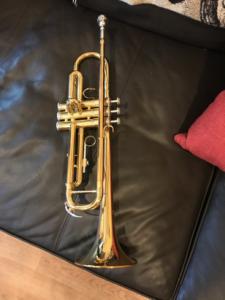
The first time I truly saw Hope, forty long years ago, in school before we were married, she was playing a trumpet. She stood under stage lights, and she glowed with blonde hair and a golden trumpet. The beauty was very great and all her own. The proper response was love but in tenth grade (and for some time thereafter) I lacked the appropriate means to respond.
I was mute before such beauty.
About thirty-five years later, after many adventures, some thief broke into our garage and stole that trumpet. I look for it every week, but surely it is gone. She has a new instrument, but she misses her old Bach.
Hope’s trumpet pictured in this piece is gone, but the music is not. The instrument is not the player any more than the soul is the brain. She played that Bach Stradivarius. It did not play her. She learned in our little Christian school to make music and she keeps making music.
This is her Father’s world and she can respond well to it. She is God’s instrument to make music and that instrument, much beloved, is kept in safety for all time. It cannot be stolen or lost.
Make music.
General Christian
Education and Religion
Religious Music and Entertainment

About John Mark N. Reynolds
John Mark Reynolds is the Vice President of Advancement and Strategic Leadership at the College of Biblical Studies in Houston. As an educational entrepreneur, he was the founding president of The Saint Constantine Schools and College and the founding director of the Torrey Honors College at Biola University. As provost at Houston Christian University, he oversaw the formation of the apologetics and media programs. He is also a philosopher and joyous curmudgeon. He lives with his wife, the Fairest Flower in Christendom, his two granddaughters, daughter, son-in-law, and brother in the jolly Saint Theodora House. You can read more about the author here.
Previous Post
August 5, 2026
Classical Education and the Art of Dying Well
Next Post
August 25, 2026 Speaking Math: the Language of Classical Education
Browse Our Archives
Select a Category Apologetics Art Culture Education On Books On Education Philosophy Politics Pop Culture Spiritual Reflections Uncategorized
Select a Month October 2026 September 2026 August 2026 July 2026 July 2025 June 2025 September 2024 July 2024 June 2024 December 2023 June 2023 September 2022 May 2022 April 2022 March 2022 February 2022 July 2021 June 2021 May 2021 April 2021 March 2021 February 2021 January 2021 December 2020 November 2020 October 2020 September 2020 August 2020 July 2020 June 2020 May 2020 April 2020 March 2020 February 2020 January 2020 December 2019 November 2019 October 2019 September 2019 August 2019 July 2019 June 2019 May 2019 April 2019 March 2019 February 2019 January 2019 December 2018 November 2018 October 2018 September 2018 August 2018 July 2018 June 2018 May 2018 April 2018 March 2018 February 2018 January 2018 December 2017 November 2017 October 2017 September 2017 August 2017 July 2017 June 2017 May 2017 April 2017 March 2017 February 2017 January 2017 December 2016 November 2016 October 2016 September 2016 August 2016 July 2016 June 2016 May 2016 April 2016 March 2016 February 2016 January 2016 December 2015 November 2015 October 2015 September 2015 August 2015 July 2015 June 2015 May 2015 April 2015 March 2015 February 2015 January 2015 November 2014 October 2014 September 2014 August 2014 July 2014 June 2014 May 2014 April 2014 March 2014 February 2014 January 2014 December 2013 November 2013 October 2013 September 2013 August 2013 July 2013 June 2013 May 2013 April 2013 March 2013 February 2013 January 2013 December 2012 November 2012 October 2012 September 2012 August 2012 July 2012 June 2012 May 2012
Follow Us!
TAKE THE
Religious Wisdom Quiz
What sea did Moses and the Israelites cross?
Select your answer to see how you score.
Black Sea Red Sea Dead Sea Sea of Galilee
Books by This Author John Mark Reynolds
Related posts from Eidos
Creation as Secondary to Judgment
Why Classical Education Is a Conversation, Not a...
Does Classical Education Belong Only to the West?

Classical Education Must Teach Us to Make the...
TRENDING AT PATHEOS Evangelical

When you hear the word riches, what comes to mind? For most...

Don’t Miss the Parents: A Creative Christmas Meditation
As we enter the Advent Season, I see many people trying to...

Making Stones Into Bread: Choosing the “Right” Work
I was on my online arts ministry Zoom meeting with the International...

Ukraine’s exhausted Christians face fifth winter of war
By Julian Lukins The full-scale war in Ukraine is taking “a serious...

Russell Brand's Conviction is not anti-Christian Persecution
How do we shed the reputation that the Church is OK with...

Have you ever caught yourself saying, “I’ll do it tomorrow,” or “Now...
view all Evangelical blogs
Ad-Free & Subscriber Log-In Subscription Support
- About Us
- 2026 Calendar
- Videos
- Podcasts
- Library of World Religions
- Faith In Media Tracker
- Advertise With Us
- Write for Us
- Privacy Policy
- Terms of Service
- Do Not Sell My Data
- Contact Us
- Radiant Digital
- Manage Newsletter Subscriptions
- Unsubscribe From Notifications
- Sitemap
Copyright 2008-2026, Patheos, part of the Radiant Digital network of media brands. All rights reserved.
Subscription Support Ad-Free & Subscriber Log-In
Follow Patheos