
BuddhistCatholicContemplativeEvangelicalGeneral ChristianHinduJewishLatter-day SaintMuslimNew VisionsProgressive Christian
Beliefs
- Buddhist
- Catholic
- Contemplative
- Evangelical
- General Christian
- Hindu
- Jewish
- Latter-day Saint
- More Voices
- Muslim
- New Visions
- Pagan
- Progressive Christian
Topics
- Religion News
- Food and Religion
- Sports and Religion
- Religious Art
- Religious Music and Entertainment
- Religious Events
- History and Religion
- Style and Religion
- Politics and Religion
- Women in Religion
- Recreation Outdoors and Religion
- Business Finance and Religion
- Careers Workplace and Religion
- Education and Religion
- Family Parenting and Religion
- Health Fitness and Religion
- Home and Religion
- Relationships and Religion
- Technology and Religion
- Travel and Religion
Columnists
- Buddhist Columnists
- Business Finance and Religion Columnists
- Careers Workplace and Religion Columnists
- Catholic Columnists
- Contemplative Columnists
- Education and Religion Columnists
- Evangelists Columnists
- Family Parenting and Religion Columnists
- General Christian Columnists
- Health Fitness and Religion Columnists
- Hindu Columnists
- History and Religion Columnists
- Home and Religion Columnists
- Jewish Columnists
- More Voices Columnists
- Latter Day Columnists
- Muslim Columnists
- New Visions Columnists
- Nonreligious Columnists
- Pagan Columnists
- Politics and Religion Columnists
- Progressive Columnists
- Recreation Outdoors and Religion Columnists
- Relationships and Religion Columnists
- Religion News Columnists
- Religious Art Columnists
- Religious Events Columnists
- Religious Music and Entertainment Columnists
- Sports and Religion Columnists
- Style and Religion Columnists
- Technology and Religion Columnists
- Travel and Religion Columnists
- Women in Religion Columnists
Resource Library
- 2026 Calendar
- Library of World Religions
- The 100 Most Holy Places on Earth
- Patheos Answers
- Podcasts
- Videos
- Faith Leaders Database
- Anglican Episcopalian
- Bahai
- Baptist
- Buddhism
- Christianity
- Confucianism
- Eastern Orthodoxy
- Hinduism
- Holiness and Pentecostal
- ISKCON
- Islam
- Judaism
- Lutheran
- Methodist
- The Church of Jesus Christ of Latter-day Saints
- New Age
- Paganism
- Presbytarian and Reformed
- Protestantism
- Religion Behind the Scenes
- Roman Catholic
- Scientology
- Shia Islam
- Sikhism
- Sufism
- Sunni Islam
- Taoism
- Zen
- See all religions
Research Tools
 Ad-Free & Subscriber Log-In Subscription Support
Follow Patheos 

- Trending:
- Advent
- |
- Forgiveness
- |
- Thanksgiving
- |
- Election
- |
- Seasonal Holidays
- |
- Marriage

- Home
- Evangelical
- History and Religion
- Speaking Math: the Language of Classical Education
Speaking Math: the Language of Classical Education
Last updated on: August 26, 2026 at 1:16 pm by John Mark N. Reynolds
Speaking Math: the Language of Classical Education 2026-08-26T13:16:53-04:00 John Mark N. Reynolds
Patheos Explore the world's faith through different perspectives on religion and spirituality! Patheos has the views of the prevalent religions and spiritualities of the world.
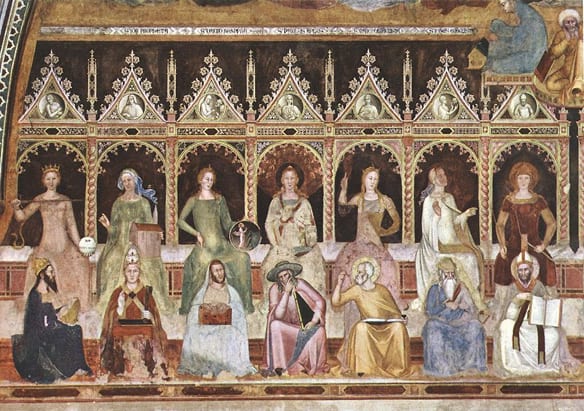
What Papaw Showed Me
Papaw would take out his compass and show you how to draw a perfect star inside a circle. He sat in the basement and invented at least one device on graph paper that Dupont bought from Papaw. The invention had to do with pipes and reaching the screws inside of them. . . Papaw worked on a way to release that screw to avoid scraping his knuckles. A favorite story was a day at the plant when Papaw saw that a recently hired college graduate needed to measure the height of a smokestack. The young man was confounded when Papaw applied the Pythagorean theorem in what appeared to be wizardry to estimate stack height.
Papaw got the most he could out of his one-room schoolhouse eighth-grade education. He knew, though. . . he knew for sure that his math fluency limited his advancement. I did not inherit his ability, or his love of mathematics, but he impressed on me that math matters. Just toying with that compass and making shapes in a perfect circle changed my view of the world somehow.
It unlocked something in my mind, and I could feel it, though I was never particularly good at the classes called “math.” Math, creation, and beauty went together in Papaw’s compass work.
Mathematics is the Language of Classical Education
You cannot even start classical training without numeracy.
I praise mathematics with great sympathy for the pain this would have caused younger me and may cause some of you, but it is true nonetheless. There is no classical reason, no getting to the heart of music, without mathematics.
Plato knew the lessons of the Academy, hidden from the public in his dialogues, would be nonsense without a grounding in mathematics. Plato did not actually place a sign warning students against even entering his Academy without geometric skills, but that later scholars said he did was myth-making that pointed to a deeper truth. The existence of mathematical objects made his theory of “forms” and the actual existence of ideas more plausible.
Platonism Needed Mathematics
Mathematicians have a sense of discovery when they run into new mathematical truths. They do not have a sense of “creation.”
Mathematicians postulate objects that do not exist in nature. A perfect “triangle” does not appear in nature but we can think about “triangles” nonetheless. There are “triangle-ish” shapes in nature and this led some philosophers to believe humans “created” the ideal triangle by thinking about those “triangle-ish” shapes. This explanation fails however when mathematicians begin to think about mathematical concepts that cannot even be drawn by humans or expressed in the English language.
Roger Penrose, one of the great physicists of the twentieth/early twenty-first century, experiences the great expanse of mathematics. The world of mathematics does not require nature but some (small fraction) of mathematical models or objects can be used to describe our visible cosmos with stunning accuracy. A mathematician works with ideas, mathematical equations, and is able to explain, explore, and make accurate predictions about the human world. Human consciousness for Penrose is the third realm of reality. We live in a natural world comprehended by our minds through mathematics.
So far as humans can study God’s creation, we must do so using mathematical modeling for the deepest comprehension possible.
Eidos:
This is the sixth in a series on classical education. To read part one, click here.
Mathematics as the Language of Creation
God spoke, and the world came into existence. We cannot know for certain what “speaking” means for the good God. He is “other.” No human mind can comprehend God in His essence and so we must settle for what God is not in most cases. God is not material. God is not evil. God is not without power.
Revelation of God to us helps our thinking by giving us the best possible language to use about God. Most vitally, God revealed Himself to us in the person of Jesus: the God-man. We can see and understand Jesus in His humanity and so there is a bridge to some aspects of the Divine reality not accessible to mere reason.
When we think about God and His creation and created order outside of the person of Jesus Christ, humans can only do the best we can. We model what God is in language like that of the Trinitarian formula. God revealed Himself to us in a Triune nature with one essence and so we assert that this is so and explore all the implications that the Trinity entails. For example, there is and must only be one God. There is and must be equality in the Triune persons.
Natural Precision
When we turned to study God’s creation, we began with natural language. Greeks modeled the world using Greek and, for the most part (more barbarian!) English speakers could translate the concepts. Natural human languages lack the precision needed to model the cosmos as we moved beyond mere sense observations.
Natural language works for simple observations: “That is a bunny. A bunny hops. A bunny has parts.” This all can be said, but if we wish to know about the nature of matter or energy, the terms are more fundamental and ultimately unobservable; mathematics is necessary. Pythagoreans found this was true for musical theory: mathematics works in the real world and has a precision that natural language does not.
Plato, in Timaeus, suggested that the best way to understand the cosmos was through mathematical models. This idea, developed over the centuries, helped drive the scientific revolution when applied to nature. A scientist could hypothesize using mathematical models and then check them against observations of the cosmos. He could make predictions. Some models worked better than other models.
Observation and Abstraction
What was the nature of this useful mathematics? For a time, one could believe “math” or “geometry” might be simply a mental shift from what humans see to abstraction about those observations. This became much less likely when mathematicians began to examine alternative mathematical worlds. What if one does not start with Euclid’s axioms? After all, one cannot “show” an axiom. Simultaneously, most non-Euclidean mathematics could not be the product of observation and abstraction.
When mathematicians announced alternative mathematics or geometries, just for the joy of mathematical discovery, they did not know these alternatives would be critical to advancing science. Yet without the prior discovery of non-Euclidean geometry, general relativity would have had no language. No circuit would exist without Boole, and his work in the 1850s in mathematical logic was not “needed” until the twentieth century.
The very relationship between “abstract” mathematics, not known through the senses, and the creation matters.
An Implication of the Existence of Mathematical Objects
To sum up:
- The experience of mathematicians suggests a sense of “discovery” of mathematical ideas, not a”creation” of them by the mathematician.
- Abstract mathematical systems came before they turned out to be useful in science.
- SO: Mathematical systems and objects exist.
- If mathematical objects have “existence,” then the philosophical systems like materialism and physicalism are false.
There is more to the heavens and earth than matter and energy. Such mathematical ideas are also very much odder to our experience than another difficult concept “consciousness.” We all experience consciousness and that experience is also (almost surely) not reducible to matter and energy. Natural science is not the only means to truth. There are at least two fields, mathematics (as the language of science) and psychology (consciousness), whose fundamental natures probably cannot be reduced to natural scientific explanations.
When conscious humans experience God, they cannot immediately be dismissed as irrational. We believe persons have at least one irreducible “thing” (consciousness) that is immaterial. Could this immaterial object exist without a body? This is a sensible hypothesis. After all, mathematical objects are immaterial and exist without material bodies.
Maybe.
A canonical (“classical”) education does not require the existence of mathematical objects or scientific methods. One could educate as a non-theist with a canon and do some good. Canonical education, however, opened the door to more, and thinkers like Plato or Kepler took that door and discovered new worlds of truth.
A Christian canonical education allows metaphysics and physics to be undergirded by mathematics.
We experience the world. We imagine. We think. We do mathematics. What is the relationship between our minds, nature, and abstract objects?
Christian canonical educators find the ground of being in the mind of the Almighty.
Practical Implications
Canonical (classical) schools must emphasize numeracy. We speak first in a natural language. Most humans do so with no more education than growing up provides. These languages vary from group to group and over time. Modern English is important for canonical schools in English-speaking countries but not essential to canonical education as a movement. If English had never existed, and the loss of Charlotte Brontë makes this a sad thought, then canonical schools would still exist. Some natural language would exist and we must learn our own but the existence of any particular language is an accident of history.
Mathematics is different from languages like English.
Education teaches a second, deeper language: mathematics. Every canonical school should provide all the mathematics a student can learn as quickly as the student can learn. If making music, a soul in harmony, is the heart of canonical education then minimal numeracy is the necessary speech taught.
Canonical or classical schools know we must teach hard things. We must read to lead, even if reading is not our favorite hobby. Literacy in our native language matters.
Numeracy, a minimum comfort with mathematics, is even more important. Why? Whatever culture there is in this world or any other, math works and makes sense. For example, the value of Pi will be recognized. We will be able to talk to any being with the language of creation: mathematics.
This is the way of building cathedrals and going to the moon: both for all mankind. This is the seminal language of the canon.
There is a reason that when we probe for other sentient life forms, we use mathematics as a common tongue. They may not understand Hamlet immediately but whatever they call the value of Pi, the other species will or can know it.
We can use the tools we have with the language of mathematics, like Papaw’s compass, to create cosmic beauty.
Papaw knew.
General Christian
History and Religion
Education and Religion

About John Mark N. Reynolds
John Mark Reynolds is the Vice President of Advancement and Strategic Leadership at the College of Biblical Studies in Houston. As an educational entrepreneur, he was the founding president of The Saint Constantine Schools and College and the founding director of the Torrey Honors College at Biola University. As provost at Houston Christian University, he oversaw the formation of the apologetics and media programs. He is also a philosopher and joyous curmudgeon. He lives with his wife, the Fairest Flower in Christendom, his two granddaughters, daughter, son-in-law, and brother in the jolly Saint Theodora House. You can read more about the author here.
Previous Post
August 15, 2026
Why Music Is the Heart of a Classical Education
Next Post
September 2, 2026 Classical Education: Discussion for Everyone
Browse Our Archives
Select a Category Apologetics Art Culture Education On Books On Education Philosophy Politics Pop Culture Spiritual Reflections Uncategorized
Select a Month October 2026 September 2026 August 2026 July 2026 July 2025 June 2025 September 2024 July 2024 June 2024 December 2023 June 2023 September 2022 May 2022 April 2022 March 2022 February 2022 July 2021 June 2021 May 2021 April 2021 March 2021 February 2021 January 2021 December 2020 November 2020 October 2020 September 2020 August 2020 July 2020 June 2020 May 2020 April 2020 March 2020 February 2020 January 2020 December 2019 November 2019 October 2019 September 2019 August 2019 July 2019 June 2019 May 2019 April 2019 March 2019 February 2019 January 2019 December 2018 November 2018 October 2018 September 2018 August 2018 July 2018 June 2018 May 2018 April 2018 March 2018 February 2018 January 2018 December 2017 November 2017 October 2017 September 2017 August 2017 July 2017 June 2017 May 2017 April 2017 March 2017 February 2017 January 2017 December 2016 November 2016 October 2016 September 2016 August 2016 July 2016 June 2016 May 2016 April 2016 March 2016 February 2016 January 2016 December 2015 November 2015 October 2015 September 2015 August 2015 July 2015 June 2015 May 2015 April 2015 March 2015 February 2015 January 2015 November 2014 October 2014 September 2014 August 2014 July 2014 June 2014 May 2014 April 2014 March 2014 February 2014 January 2014 December 2013 November 2013 October 2013 September 2013 August 2013 July 2013 June 2013 May 2013 April 2013 March 2013 February 2013 January 2013 December 2012 November 2012 October 2012 September 2012 August 2012 July 2012 June 2012 May 2012
Follow Us!
TAKE THE
Religious Wisdom Quiz
I went uninvited before the king, risking death, saying 'If I perish, I perish.' Who am I?
Select your answer to see how you score.
Esther Deborah Ruth Vashti
Books by This Author John Mark Reynolds
Related posts from Eidos
Creation as Secondary to Judgment
Why Classical Education Is a Conversation, Not a...
Does Classical Education Belong Only to the West?

Classical Education Must Teach Us to Make the...
TRENDING AT PATHEOS Evangelical

When you hear the word riches, what comes to mind? For most...

Don’t Miss the Parents: A Creative Christmas Meditation
As we enter the Advent Season, I see many people trying to...

Making Stones Into Bread: Choosing the “Right” Work
I was on my online arts ministry Zoom meeting with the International...

Ukraine’s exhausted Christians face fifth winter of war
By Julian Lukins The full-scale war in Ukraine is taking “a serious...

Russell Brand's Conviction is not anti-Christian Persecution
How do we shed the reputation that the Church is OK with...

Have you ever caught yourself saying, “I’ll do it tomorrow,” or “Now...
view all Evangelical blogs
Ad-Free & Subscriber Log-In Subscription Support
- About Us
- 2026 Calendar
- Videos
- Podcasts
- Library of World Religions
- Faith In Media Tracker
- Advertise With Us
- Write for Us
- Privacy Policy
- Terms of Service
- Do Not Sell My Data
- Contact Us
- Radiant Digital
- Manage Newsletter Subscriptions
- Unsubscribe From Notifications
- Sitemap
Copyright 2008-2026, Patheos, part of the Radiant Digital network of media brands. All rights reserved.
Subscription Support Ad-Free & Subscriber Log-In
Follow Patheos