
BuddhistCatholicContemplativeEvangelicalGeneral ChristianHinduJewishLatter-day SaintMuslimNew VisionsProgressive Christian
Beliefs
- Buddhist
- Catholic
- Contemplative
- Evangelical
- General Christian
- Hindu
- Jewish
- Latter-day Saint
- More Voices
- Muslim
- New Visions
- Pagan
- Progressive Christian
Topics
- Religion News
- Food and Religion
- Sports and Religion
- Religious Art
- Religious Music and Entertainment
- Religious Events
- History and Religion
- Style and Religion
- Politics and Religion
- Women in Religion
- Recreation Outdoors and Religion
- Business Finance and Religion
- Careers Workplace and Religion
- Education and Religion
- Family Parenting and Religion
- Health Fitness and Religion
- Home and Religion
- Relationships and Religion
- Technology and Religion
- Travel and Religion
Columnists
- Buddhist Columnists
- Business Finance and Religion Columnists
- Careers Workplace and Religion Columnists
- Catholic Columnists
- Contemplative Columnists
- Education and Religion Columnists
- Evangelists Columnists
- Family Parenting and Religion Columnists
- General Christian Columnists
- Health Fitness and Religion Columnists
- Hindu Columnists
- History and Religion Columnists
- Home and Religion Columnists
- Jewish Columnists
- More Voices Columnists
- Latter Day Columnists
- Muslim Columnists
- New Visions Columnists
- Nonreligious Columnists
- Pagan Columnists
- Politics and Religion Columnists
- Progressive Columnists
- Recreation Outdoors and Religion Columnists
- Relationships and Religion Columnists
- Religion News Columnists
- Religious Art Columnists
- Religious Events Columnists
- Religious Music and Entertainment Columnists
- Sports and Religion Columnists
- Style and Religion Columnists
- Technology and Religion Columnists
- Travel and Religion Columnists
- Women in Religion Columnists
Resource Library
- 2026 Calendar
- Library of World Religions
- The 100 Most Holy Places on Earth
- Patheos Answers
- Podcasts
- Videos
- Faith Leaders Database
- Anglican Episcopalian
- Bahai
- Baptist
- Buddhism
- Christianity
- Confucianism
- Eastern Orthodoxy
- Hinduism
- Holiness and Pentecostal
- ISKCON
- Islam
- Judaism
- Lutheran
- Methodist
- The Church of Jesus Christ of Latter-day Saints
- New Age
- Paganism
- Presbytarian and Reformed
- Protestantism
- Religion Behind the Scenes
- Roman Catholic
- Scientology
- Shia Islam
- Sikhism
- Sufism
- Sunni Islam
- Taoism
- Zen
- See all religions
Research Tools
 Ad-Free & Subscriber Log-In Subscription Support
Follow Patheos 

- Trending:
- Advent
- |
- Forgiveness
- |
- Thanksgiving
- |
- Election
- |
- Seasonal Holidays
- |
- Marriage

- Home
- Evangelical
- Education and Religion
- Classical Education and the Art of Dying Well
Classical Education and the Art of Dying Well
Last updated on: August 6, 2026 at 1:16 pm by John Mark N. Reynolds
Classical Education and the Art of Dying Well 2026-08-06T13:16:50-04:00 John Mark N. Reynolds
Patheos Explore the world's faith through different perspectives on religion and spirituality! Patheos has the views of the prevalent religions and spiritualities of the world.
An Education for Paradise
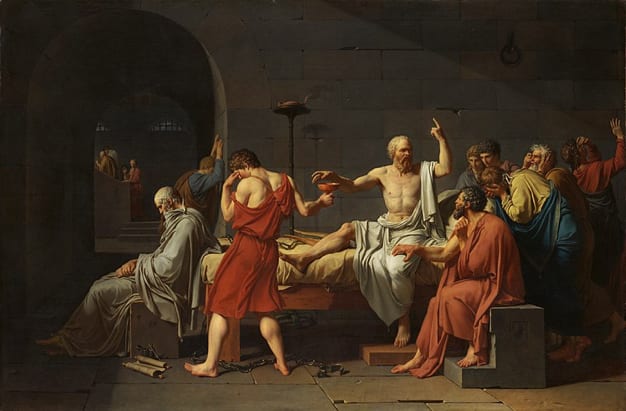
Socrates attacked that educational system. He exposed sophistry. He irritated the wrong people, and they tried to shut him up. He refused to be quiet, and so they decided to exile him. | Image courtesy of Jacques-Louis David, (French, Paris 1748–1825 Brussels) Public domain, via Wikimedia Commons. The painting is on display at The Met in New York city.

A Certainty Classical Education Cannot Ignore
“Nobody is sure of much,” Nana said, “except dying.” I did not find that cheering and yet Nana was right. We are “mortal men doomed to die.” My Nana had six years of formal education and years of church. When her time came, she was ready to go. That was true of Mom and Dad this last year, they were ready as a human can be to die and they had better have been. Even though we were there, dying is lonely: both could hear us but could not speak. We could help some, but Mom and Dad both passed the test by grace through faith instilled in them over decades. Their souls are now set in motion going ever Godward forever. They are as happy as they can be, more joyful every day.
If we are sure of this one thing, and so few other events in the life of our students, then preparation for Paradise seems a necessary part of the program. The future is cloudy; we see dimly, except here: we will die and face eternity. This is not, sadly, a great marketing slogan: learn to die like a gentleman.
I know this because I once tried to sell life insurance. The difficulty was that though most people really needed at least some term insurance to bury them, and though nobody knows how long they will live, the notion of death is not one that induces many lunch appointments. “Let’s grab coffee and discuss the Day of Doom” never worked for me. We were taught to avoid discussing the need for life insurance and to focus on investments or estate planning. (“You might need an estate at an early age before you have had a chance to set money aside for the kids. Why? Well, man knows not his time. Thanks for taking my call.”)
As my boss said to me: “People do not plan to fail, they just fail to plan.” This bromide introduced me to the second problem: death felt far away (even though it sometimes was not) for the client and the extra latte was today. Most folk could have purchased term insurance simply by cutting out a few treats, but what is the fun of that choice? Dad spent years in ministry watching folk die who had failed to plan. Their schooling, formal and informal, failed them at the last test.
Eidos:
This is the fourth in a series on classical education. To read part one, click here.
The canon, the rule for education, in a canonical (“classical”) school deals with life and death from the start: Genesis, the Iliad are just two examples. To place one’s life against the laser beam shining from the texts of Moses and Homer is to see where we are out of line. Education will rectify that crookedness to get in line with the good, truth, and beauty. Our souls are placed Godward.
The American style of education called “classical” originates in two great canonical deaths: Socrates and Jesus Christ.
The Death of Socrates
Socrates loved his city so much he refused to tolerate her little lies and hypocrisies. The intellectual and ruling establishment benefited from the worship of the Homeric gods in Athens. The Parthenon stood on the Acropolis, magnificent in color, drawing the eyes of all citizens to heaven and benefiting trade and the priestly class. Did the rulers believe?
Some perhaps, but education in decaying Athens had grown so twisted that education aspired to flim-flam. How could a man gain power and wealth through words? Rhetoric has great value in education, but this was rhetoric twisted to selfish ends. Sophistical educators trained students in plausible lies in exchange for decadence. So bad had education become that when the city needed the younger generation to act, the best of them, young men like Alcibiades, were the worst of them: hollowed out, driven by personal passions, unable to learn.
Socrates attacked that educational system. He exposed sophistry. He irritated the wrong people, and they tried to shut him up. He refused to be quiet, and so they decided to exile him. He was put on trial for his life, but the expected outcome would be that his friends would save him. The establishment hoped his friends would save him. Socrates’ running off to Corinth would not just be his silence but also his showing that he valued his life more than the wisdom he claimed to love.
Socrates refused to leave. He loved Athens, the city where genuine discussion had been possible. In Phaedo, we are given lessons in the formation of the soul: what the soul is and how it should be tuned by education. Socrates demonstrates in his death that tyrants and mobs cannot defeat a good, an educated man. At the very end, Socrates dies unafraid, forcing the hypocritical city to see that real education was dying in Athens.
Socrates had practiced the dialectic, the examined life. He did not examine every random idea but looked for questions and truths that could move him toward the good, truth, and beauty. Socrates took even the worst students seriously but resisted the sophistical members of the educational establishment who wanted prizes, puffery, and the satisfaction of prurience.
Socrates demonstrated preparation for eternity in his manner of leaving this life. First, he valued eternal things, such as wisdom, over temporal goods. He refused to prolong his life in exile. Second, Socrates was willing to listen to his students and teach them to the very end. He had helped his students but they did not feel ready to lose him. He urged them to realize that the pursuit of wisdom could and must continue after his death. Finally, he comforted the students by his manner. At one point, toward the end of the discussion, Socrates placed his feet firmly on the ground. He was in control but Socrates used that power to die willingly. Even after taking the poison, he remained in control. Socrates’ mind dominated his passions and his body.
Socrates was educated: the object of education is preparation for eternity. He knew this was true due to the immortality of the soul. What is the profit of delaying death when what is beyond offers the promise of wisdom?
He died because of the sins of the city, but in doing so, he incarnated a better Athenian. There was a greater educator coming.
The Death of the Christ
What if Mind, the very Word that made the cosmos, came down and lived with us? We cannot know God in God’s essence, but we could see a God that had become one of us. Seeing Him in His glory would show the very image of God: full of grace and truth.
Having witnessed Socrates’ death, Plato (in Republic II) understood that this vision would not lead every human to rejoice and head Godward. Some would hate the exposure of darkness and would try to quench that light. We might even take a perfectly just man and try to crucify him. Socrates was not perfectly just but even his integrity had been too much for Athens.
Jesus’ entire life was, for his students, a dialectic between His human and Divine nature. They could see Jesus in His humanity but that humanity was in synergy with God! His best students, the apostles, are constantly misunderstanding, seeing and then not seeing, but keep walking with the God-man. He asked them hard questions and allowed their bad answers.
They kept looking for full salvation in this life, and He kept pointing to the Kingdom that was, is, but was still to come.
And then, having loved them, He loved them to the end: Jesus died. He was murdered and while death could not keep Him, Jesus did what nearly all of us must and died. Jesus did not just die well; Jesus ultimately provided a way through death back to God. He gave us not just a hope for eternity but a door to paradise.
Dying, Jesus was placed on a tree between Heaven and earth, uniting both places.
Socrates loved wisdom. Jesus is Wisdom. Socrates showed us how a good man dies. Jesus showed how a God-man conquers death by death. We die once, then the judgment. For Socrates, education was the work of bringing the soul into harmony. Could this be done? By the end of the Republic, his best student, Plato, had his doubts.
These doubts were valid. At best, Plato could see a way for the best of us to escape what is less than a vision of goodness, truth, and beauty. For most of us, there was no escape. Even for the best of humanity.
The death of the Christ offered a divine work, freely available by God’s good grace, to “whosoever will.” If men cannot save themselves, and they cannot, then proper education always will include an element that goes beyond mere schooling. The work of grace and life in Christ will occur through the ministry of spiritual fathers and mothers in the life of Christ’s church. What Americans call “schooling” with preparation for this life and that which is to come will work in conjunction with that primary work but should not replace it.
Some of What Americans Call School is Good but “Unnecessary”
All must learn to die well. Not all of us need to be literate.
When God made the world, He made humankind with two genders: male and female. They are essential and irreducible. Without both voices, we cannot hear the full image of God. In the great drama of the cosmos, each has a role. As a result, a person must have a mother and father to exist. In the ideal case, the voice of both educates the child in the nature of reality.
Parents are necessary.
In the same manner, we are both physical and spiritual beings, and we cannot be fully human without connection to our Creator God: the essential one in three persons. The way the world is, shadowy as Plato knew it to be, we cannot know God sufficiently to become whole. We love goodness, beauty, and truth, but we misperceive far too often. As a result, we need the medicine, the restoration, found only in Christ Jesus.
He has not left us an abstract truth. He will come and dwell within us. We can know God through Jesus Christ by being born again in the Spirit. The fellowship of those who have experienced this Way is the Church: the gathering of those who are changed fundamentally. The Church is a necessary ark for the redeemed of all mankind.
There are nearly countless goods, however, in the great cosmos God created that while wonderful are not necessary. We can live and see God without learning to read. However, given that God spoke and preserved His message for all time in books, we wish to read. It is good to read. As a result, Christians should favor literacy. It is good to think God’s thoughts about His creation in the language of creation: mathematics. We wish to glory in the beauty He has made and so we want to be numerate.
We can be saints without literacy or numeracy. As children of God, we still long for these lesser gifts. As a result, we have mentors who teach both skills. We have guides who show us the dialectical way.
For those with questions, educators help form good ones. For those who seek a particular sort of knowledge, an academy can provide guides. We must have pastors and priests, but we also can have professors.
In that sense, the school and college, in the American sense of those terms, is a lesser good. We are not the greatest good, what is necessary for full humanity, but for those God has made in certain ways we are beneficial. Not all ask, but some do. Not all peer into distant space, but a few do. For those, the professor comes to support the pastors and the parents.
Our job as professors is a lesser role but for many humans very good.
Practical Implications for Canonical (“Classical”) Education
The need to die well goes far beyond character education. A gentleman will not cheat at cards, but death cannot be cheated in any case. There is no victory possible against death without the Christ. As a result, an American canonical school (“classical”) will know its place. It has been given the dual roles of preparing a student for life in the present and the greater task of cooperating with the family and Church in preparing for Paradise.
As a result, theology and metaphysics should be part of every class. We must not separate them from other topics as if they are “electives.” We cannot even make them merely foundational or capstone, because they are both the ground of every discipline and the ultimate purpose. We do science because we are formed in the image of Creator God. We do mathematics because we would speak His creative language. We make music because we would incarnate those creative words as He did in the music of the spheres.
A canonical school will support the Church without replacing the Church. Chapel will not replace divine services but introduce them. Every subject will be cruciform: connecting heaven and earth. A first question always will be: is this Socratic class cruciform? This will allow the humane use of tools (including advanced technology). It will keep the sure and present reality that we are mortal men doomed to die ever before us, but with hope Socrates could not have.
As a result, the canonical school will be both whimsical and practical. It will reflect local customs and the silly folkways. It will sanctify the attempts of the entire community to make beauty, find truth, and end in the Good God.
The educated man is sure of dying, but has hope and a reasonable faith in Paradise.
Education and Religion
Previous Post

July 24, 2026
An Education to Boldly Go Where No Man Has Gone Before
Next Post
August 15, 2026 Why Music Is the Heart of a Classical Education
Browse Our Archives
Select a Category Apologetics Art Culture Education On Books On Education Philosophy Politics Pop Culture Spiritual Reflections Uncategorized
Select a Month October 2026 September 2026 August 2026 July 2026 July 2025 June 2025 September 2024 July 2024 June 2024 December 2023 June 2023 September 2022 May 2022 April 2022 March 2022 February 2022 July 2021 June 2021 May 2021 April 2021 March 2021 February 2021 January 2021 December 2020 November 2020 October 2020 September 2020 August 2020 July 2020 June 2020 May 2020 April 2020 March 2020 February 2020 January 2020 December 2019 November 2019 October 2019 September 2019 August 2019 July 2019 June 2019 May 2019 April 2019 March 2019 February 2019 January 2019 December 2018 November 2018 October 2018 September 2018 August 2018 July 2018 June 2018 May 2018 April 2018 March 2018 February 2018 January 2018 December 2017 November 2017 October 2017 September 2017 August 2017 July 2017 June 2017 May 2017 April 2017 March 2017 February 2017 January 2017 December 2016 November 2016 October 2016 September 2016 August 2016 July 2016 June 2016 May 2016 April 2016 March 2016 February 2016 January 2016 December 2015 November 2015 October 2015 September 2015 August 2015 July 2015 June 2015 May 2015 April 2015 March 2015 February 2015 January 2015 November 2014 October 2014 September 2014 August 2014 July 2014 June 2014 May 2014 April 2014 March 2014 February 2014 January 2014 December 2013 November 2013 October 2013 September 2013 August 2013 July 2013 June 2013 May 2013 April 2013 March 2013 February 2013 January 2013 December 2012 November 2012 October 2012 September 2012 August 2012 July 2012 June 2012 May 2012
Follow Us!
TAKE THE
Religious Wisdom Quiz
Which prophet was told to eat a scroll in a vision?
Select your answer to see how you score.
Obadiah Ezekiel Daniel Joel
Books by This Author John Mark Reynolds
Related posts from Eidos

Creation as Secondary to Judgment
Why Classical Education Is a Conversation, Not a...
Does Classical Education Belong Only to the West?

Classical Education Must Teach Us to Make the...
TRENDING AT PATHEOS Evangelical

When you hear the word riches, what comes to mind? For most...

Don’t Miss the Parents: A Creative Christmas Meditation
As we enter the Advent Season, I see many people trying to...

Making Stones Into Bread: Choosing the “Right” Work
I was on my online arts ministry Zoom meeting with the International...

Ukraine’s exhausted Christians face fifth winter of war
By Julian Lukins The full-scale war in Ukraine is taking “a serious...

Russell Brand's Conviction is not anti-Christian Persecution
How do we shed the reputation that the Church is OK with...

Have you ever caught yourself saying, “I’ll do it tomorrow,” or “Now...
view all Evangelical blogs
Ad-Free & Subscriber Log-In Subscription Support
- About Us
- 2026 Calendar
- Videos
- Podcasts
- Library of World Religions
- Faith In Media Tracker
- Advertise With Us
- Write for Us
- Privacy Policy
- Terms of Service
- Do Not Sell My Data
- Contact Us
- Radiant Digital
- Manage Newsletter Subscriptions
- Unsubscribe From Notifications
- Sitemap
Copyright 2008-2026, Patheos, part of the Radiant Digital network of media brands. All rights reserved.
Subscription Support Ad-Free & Subscriber Log-In
Follow Patheos