
BuddhistCatholicContemplativeEvangelicalGeneral ChristianHinduJewishLatter-day SaintMuslimNew VisionsProgressive Christian
Beliefs
- Buddhist
- Catholic
- Contemplative
- Evangelical
- General Christian
- Hindu
- Jewish
- Latter-day Saint
- More Voices
- Muslim
- New Visions
- Pagan
- Progressive Christian
Topics
- Religion News
- Food and Religion
- Sports and Religion
- Religious Art
- Religious Music and Entertainment
- Religious Events
- History and Religion
- Style and Religion
- Politics and Religion
- Women in Religion
- Recreation Outdoors and Religion
- Business Finance and Religion
- Careers Workplace and Religion
- Education and Religion
- Family Parenting and Religion
- Health Fitness and Religion
- Home and Religion
- Relationships and Religion
- Technology and Religion
- Travel and Religion
Columnists
- Buddhist Columnists
- Business Finance and Religion Columnists
- Careers Workplace and Religion Columnists
- Catholic Columnists
- Contemplative Columnists
- Education and Religion Columnists
- Evangelists Columnists
- Family Parenting and Religion Columnists
- General Christian Columnists
- Health Fitness and Religion Columnists
- Hindu Columnists
- History and Religion Columnists
- Home and Religion Columnists
- Jewish Columnists
- More Voices Columnists
- Latter Day Columnists
- Muslim Columnists
- New Visions Columnists
- Nonreligious Columnists
- Pagan Columnists
- Politics and Religion Columnists
- Progressive Columnists
- Recreation Outdoors and Religion Columnists
- Relationships and Religion Columnists
- Religion News Columnists
- Religious Art Columnists
- Religious Events Columnists
- Religious Music and Entertainment Columnists
- Sports and Religion Columnists
- Style and Religion Columnists
- Technology and Religion Columnists
- Travel and Religion Columnists
- Women in Religion Columnists
Resource Library
- 2026 Calendar
- Library of World Religions
- The 100 Most Holy Places on Earth
- Patheos Answers
- Podcasts
- Videos
- Faith Leaders Database
- Anglican Episcopalian
- Bahai
- Baptist
- Buddhism
- Christianity
- Confucianism
- Eastern Orthodoxy
- Hinduism
- Holiness and Pentecostal
- ISKCON
- Islam
- Judaism
- Lutheran
- Methodist
- The Church of Jesus Christ of Latter-day Saints
- New Age
- Paganism
- Presbytarian and Reformed
- Protestantism
- Religion Behind the Scenes
- Roman Catholic
- Scientology
- Shia Islam
- Sikhism
- Sufism
- Sunni Islam
- Taoism
- Zen
- See all religions
Research Tools
 Ad-Free & Subscriber Log-In Subscription Support
Ad-Free & Subscriber Log-In Subscription Support
Follow Patheos 

- Trending:
- Forgiveness
- |
- Marriage
- |
- Consciousness
- |
- Death Penalty
- |
- Election
- |
- Halloween

- Home
- Evangelical
- On Ideas without Mind: Could Be, but Probably Not?
On Ideas without Mind: Could Be, but Probably Not?
Last updated on: March 17, 2021 at 11:08 am by John Mark N. Reynolds
On Ideas without Mind: Could Be, but Probably Not? 2021-03-17T11:08:37-04:00 John Mark N. Reynolds
Patheos Explore the world's faith through different perspectives on religion and spirituality! Patheos has the views of the prevalent religions and spiritualities of the world.
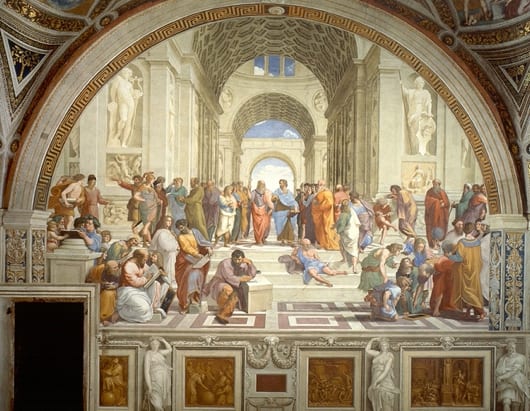
A cosmos of physical objects alone would lack justice.
Ideas, say justice, seem a different sort of thing than building blocks of matter. One could have all the Legos one wished, of any shape or color, but one could never build a “justice.” Material or physical stuff (right down to the sub-atomic level) does not seem like numbers or ideas. Ideas seem to exist apart from stuff. If there had been no humans, then 1 would still be the loneliest number and ideas would still exist.
Or is that right?
Naturally physicalists (people who believe everything can be reduced to physics explanations) respond to this problem in a variety of clever ways. What is the relationship of an idea to the physical? Still, just like human consciousness, the physicalist answers seem to explain away something they are not accurately describing when trying to account for the reality of ideas. The music is played on the organ by an organist, but the music is neither the organ nor the organist! Even amongst strong atheists, Platonism about numbers, that they exist non-physically, is common.
Idealism or dualism can account for all the workings of science without trying to reduce ideas to a physical thing.
Platonism, the existence of ideas, does not logically compel a person to be a theist, but suggests theism strongly. Theism is more plausible, given the existence of non-physical objects like ideas, if Platonism is true. Since ways of knowing we trust, like the methods of science, cannot account for the existence of ideas or number and since science depends on mathematics this is suggestive. After all, we experience ideas in our Mind. Where else could these eternal ideas exist, but the Mind of God as the medium?
Another possible relationship between ideas and God would be for ideas, like number or goodness, to exist eternally: not God, but existing eternally because of God. God being logically prior to ideas, His thought continuously sustaining them, but such ideas existing eternally with Him. God exists and so number, the good, and justice are always existing from Him.
My favorite Zen banjo playing atheist followed up on my comments on morality without God. He said:
Thanks for a very provocative response to my question.
I understand that “If God, then ideas.”
My question (which I think you addressed) is “If no God, ideas?” If I understand your answer correctly, there would be no ideas without God. Which would mean there could be no moral truths without God.
That seems fairly intuitive to a lot of people. (It is, after all, the first premise of the widely loved moral argument for the existence of God.)
But you seem to be making a much bolder statement. You’re actually saying that if there is no God there would be no mathematical truths, no beauty, or probably not even any truth of the proposition that “there is a cat on the mat.”
That settles the claim that there can be no moral truth without God. But it makes it a lot less interesting because there actually can’t be any ideas without God.
Am I following you there!
Clarity is always helpful! If ideas exist, then the existence of God is made more plausible. There are atheists who think numbers exist without believing in God. Mathematical Platonism is widespread in philosophy and obviously all (or most?) of those thinkers do not become theists.
However, if one goes further and assumes ideas exist in mind, then necessarily eternally existent ideas exist in an eternal Mind. If that Mind (God) did not exist ideas would not exist.
This is not a worry, however, given the relationship between God and ideas. God has a thought, therefore God exists. His thought shows God exists. Put simply and informally:
- An idea exists. (eg. the number 1)
- Ideas do not appear to be reducible to matter or physical objects, but appear in minds.
- The nature of human consciousness suggests that minds are non-physical. (Either dualism, matter/mind exist, or idealism, only mind exists, is true.)
- Hypothesis: Eternal ideas exist in the Mind of God.
If God ceased to exist, then ideas (like everything else) would cease to exist, since God is the very ground of being. If God exists, God is a being that cannot cease to exist by definition. There would be no moral truth without God, but there is a God and the very necessary existence of an idea like “1” or the Good suggests God necessarily is. There would not be beauty if not for the Mind: beauty really is in the eye of the Beholder, eternally, forever, kept for all time.
This sort of intellectual train of thought suggests theism, but certainly does not get a person all the way to Christian theism! I do think one reason some atheists resist even modest Mathematical Platonism is that it opens the door to this reasoning. Theist Platonism also is compatible with Christianity: ,see the scholar AE Taylor.
We are used to thinking of diamonds, dogs, and doors existing. We do not consider as often how different the mind is that is considering diamonds, dogs, and doors. We often do not reflect about the nature of mathematics, we just use math. Everything we see is in our mind’s eye, but we forget this fact.
Consciousness and ideas are not “spooky” or weird. We treat the organist as different from the organ all the time. We know our bodies and our minds are related, but they also naturally appear to be different categories of beings. An important job for philosophers, attending to science, the arts, and all humane experience, is to try to make honest sense of those intuitions.
I think either idealism or dualism is the best explanation: giving us science, mind, and ideas. Naturally not everyone will agree, but the possibilities and the differences such a point of view would make to our lives are great and profound.
Previous Post

March 14, 2021
But Wait! (First Assumptions Count)
Next Post

March 16, 2021 Searching for Truth: On Pragmatics, Babies and Bathwater
Browse Our Archives
Select a Category Apologetics Art Culture Education On Books On Education Philosophy Politics Pop Culture Spiritual Reflections Uncategorized
Select a Month October 2026 September 2026 August 2026 July 2026 July 2025 June 2025 September 2024 July 2024 June 2024 December 2023 June 2023 September 2022 May 2022 April 2022 March 2022 February 2022 July 2021 June 2021 May 2021 April 2021 March 2021 February 2021 January 2021 December 2020 November 2020 October 2020 September 2020 August 2020 July 2020 June 2020 May 2020 April 2020 March 2020 February 2020 January 2020 December 2019 November 2019 October 2019 September 2019 August 2019 July 2019 June 2019 May 2019 April 2019 March 2019 February 2019 January 2019 December 2018 November 2018 October 2018 September 2018 August 2018 July 2018 June 2018 May 2018 April 2018 March 2018 February 2018 January 2018 December 2017 November 2017 October 2017 September 2017 August 2017 July 2017 June 2017 May 2017 April 2017 March 2017 February 2017 January 2017 December 2016 November 2016 October 2016 September 2016 August 2016 July 2016 June 2016 May 2016 April 2016 March 2016 February 2016 January 2016 December 2015 November 2015 October 2015 September 2015 August 2015 July 2015 June 2015 May 2015 April 2015 March 2015 February 2015 January 2015 November 2014 October 2014 September 2014 August 2014 July 2014 June 2014 May 2014 April 2014 March 2014 February 2014 January 2014 December 2013 November 2013 October 2013 September 2013 August 2013 July 2013 June 2013 May 2013 April 2013 March 2013 February 2013 January 2013 December 2012 November 2012 October 2012 September 2012 August 2012 July 2012 June 2012 May 2012
Follow Us!
TAKE THE
Religious Wisdom Quiz
According to James, where does wisdom that is pure, peace-loving, and considerate come from?
Select your answer to see how you score.
From heaven From study From Prayer From experience
Books by This Author John Mark Reynolds
Related posts from Eidos

Classical Education Must Teach Us to Make the...

Yet I Love Her: History and the Church


The Iceberg is There: Verbosity Cannot Defeat Reality
TRENDING AT PATHEOS Evangelical

The REST of Your Life: A Creative Wrestles...
This week I had a conversation with a good friend from church....

How the author of the world's best hymn...
I've been working with John Newton for a while now. This makes...

Long before this Lectio Divina, Psalm 130 - the song - started...

What About the Trees? Another Living Parable
After I finished writing the last article about falling leaves as a...

Why Classical Education Is a Conversation, Not a...
Come and Read: Joy in Classical Education When I was a little...

Cornell University has received a great deal of negative publicity and intense...
view all Evangelical blogs
Ad-Free & Subscriber Log-In Subscription Support
- About Us
- 2026 Calendar
- Videos
- Podcasts
- Library of World Religions
- Faith In Media Tracker
- Advertise With Us
- Write for Us
- Privacy Policy
- Terms of Service
- Do Not Sell My Data
- Contact Us
- Radiant Digital
- Manage Newsletter Subscriptions
- Unsubscribe From Notifications
- Sitemap
Copyright 2008-2026, Patheos. All rights reserved.
Subscription Support Ad-Free & Subscriber Log-In
Follow Patheos