
BuddhistCatholicContemplativeEvangelicalGeneral ChristianHinduJewishLatter-day SaintMuslimNew VisionsProgressive Christian
Beliefs
- Buddhist
- Catholic
- Contemplative
- Evangelical
- General Christian
- Hindu
- Jewish
- Latter-day Saint
- More Voices
- Muslim
- New Visions
- Pagan
- Progressive Christian
Topics
- Religion News
- Food and Religion
- Sports and Religion
- Religious Art
- Religious Music and Entertainment
- Religious Events
- History and Religion
- Style and Religion
- Politics and Religion
- Women in Religion
- Recreation Outdoors and Religion
- Business Finance and Religion
- Careers Workplace and Religion
- Education and Religion
- Family Parenting and Religion
- Health Fitness and Religion
- Home and Religion
- Relationships and Religion
- Technology and Religion
- Travel and Religion
Columnists
- Buddhist Columnists
- Business Finance and Religion Columnists
- Careers Workplace and Religion Columnists
- Catholic Columnists
- Contemplative Columnists
- Education and Religion Columnists
- Evangelists Columnists
- Family Parenting and Religion Columnists
- General Christian Columnists
- Health Fitness and Religion Columnists
- Hindu Columnists
- History and Religion Columnists
- Home and Religion Columnists
- Jewish Columnists
- More Voices Columnists
- Latter Day Columnists
- Muslim Columnists
- New Visions Columnists
- Nonreligious Columnists
- Pagan Columnists
- Politics and Religion Columnists
- Progressive Columnists
- Recreation Outdoors and Religion Columnists
- Relationships and Religion Columnists
- Religion News Columnists
- Religious Art Columnists
- Religious Events Columnists
- Religious Music and Entertainment Columnists
- Sports and Religion Columnists
- Style and Religion Columnists
- Technology and Religion Columnists
- Travel and Religion Columnists
- Women in Religion Columnists
Resource Library
- 2026 Calendar
- Library of World Religions
- The 100 Most Holy Places on Earth
- Patheos Answers
- Podcasts
- Videos
- Faith Leaders Database
- Anglican Episcopalian
- Bahai
- Baptist
- Buddhism
- Christianity
- Confucianism
- Eastern Orthodoxy
- Hinduism
- Holiness and Pentecostal
- ISKCON
- Islam
- Judaism
- Lutheran
- Methodist
- The Church of Jesus Christ of Latter-day Saints
- New Age
- Paganism
- Presbytarian and Reformed
- Protestantism
- Religion Behind the Scenes
- Roman Catholic
- Scientology
- Shia Islam
- Sikhism
- Sufism
- Sunni Islam
- Taoism
- Zen
- See all religions
Research Tools
 Ad-Free & Subscriber Log-In Subscription Support
Ad-Free & Subscriber Log-In Subscription Support
Follow Patheos 

- Trending:
- Forgiveness
- |
- Marriage
- |
- Consciousness
- |
- Death Penalty
- |
- Election
- |
- Halloween

- Home
- Evangelical
- On Genuine Morality Without God?
On Genuine Morality Without God?
Last updated on: March 12, 2021 at 12:07 am by John Mark N. Reynolds
On Genuine Morality Without God? 2021-03-12T00:07:13-04:00 John Mark N. Reynolds
Patheos Explore the world's faith through different perspectives on religion and spirituality! Patheos has the views of the prevalent religions and spiritualities of the world.
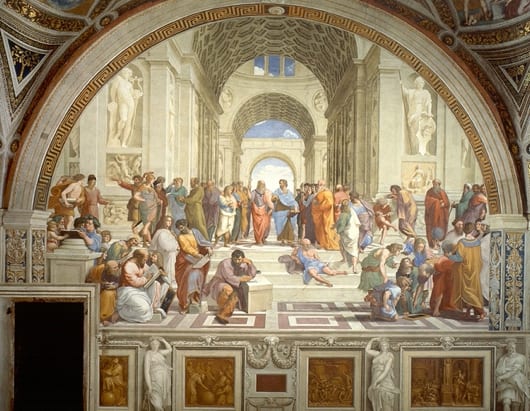
Wisdom cries out, but we often miss her voice. We are too busy and too content in our lives to listen.
Good questions inspire deeper reflection, while great questions never leave a person. When I find a person who asks great questions, I try to keep them around! A sometime contributor asked for a quick answer (one or two lines!) in response, but the question is so good that words multiply. Hopefully error will be lacking.
His question:
Is a moral Platonist Christian committed or at least generally inclined to believe that there can be moral truths without God?
The quick answer is “no,” but the quick answer needs an explanation. My guess is that right now many are tempted to stop reading. Wait! You might not be very interested in Plato or philosophy (though why not?), but we might be able to clear up an error Christians sometimes make in thinking about atheism. We do not want to bear false witness!
Our friend has asked a good question, but one that requires some simple definition of terms. In this context*, a Platonist is convinced by experience and argument that some ideas exist part from the mind thinking about them. A Platonist could disagree about what ideas exist, a usual example is mathematical objects, say the idea of “1.” When talking about “minds” Plato is usually referring to the minds of people or (perhaps) divine beings like the Greek gods. These ideas, unlike the minds of men and gods, do not change. Unlike any body they do not decay.
They are real and compared to ideas our own changing world has a shadowy existence.*
Where did the eternal, unchanging Ideas exist? One possibility for a Plato is that ideas exist eternally beyond the cosmos and their very existence induced creation to come to be. Another obvious possibility is that these Ideas exist in the great Mind of an unchanging, eternal God. Plato never says this directly, but many find this great Mind (God) implied in his works.
If there are ideas, including moral ideas, Plato asserts there is a Good, that exist mind independently, then an atheist could discover them. On this Platonic account, one could be an atheist and believe in objective (or absolute) goodness. Plato himself could be an atheist, since the Almighty would not exist for him, just some godlings**.
This why the assertion that an atheist cannot defensibly believe in an absolute Good as an atheist is false.****
If there is a Platonic Good, and even if there is a God there might be, an atheist could find that Good and so discover an objective, eternal morality. There is, however, a catch for most atheists one meets outside of philosophy seminar rooms.
For these atheists the Platonic Good comes at too high a price: the existence of ideas (Platonism) means there is more to the cosmos than just stuff: physics. Another interesting consequence of Platonism being true, even for an atheist, is that the methods of science cannot account for everything. Mathematics is the language of science, but is not subject to or part of science.Since many atheist mathematicians think numbers are “real” in the Platonic sense, strong materialism/physicalism always has seemed implausible to me.
I am a Platonist, convinced some ideas exist, but also a Christian.
This means, apart from the arguments for the existence of ideas, I think there is good reason and human experience to point to a Creator God who is omnipotent and omniscient. If this is true, then there is a Mind in which the Platonic ideas can exist. There are problems with the arguments for the existence of ideas and simply putting those ideas in the Mind of God.**** What if some ideas are eternal and exist “apart from God?” Is that possible?
This does not seem to be possible, since God is the creator of all things and so must have created and sustained the Ideas in His Mind. As you might fear by this point, this is probably the case, but there is another possibility. One could believe that God’s existence is logically prior to the existence of ideas: If God, then ideas. The ideas are not God, but proceed from God’s being. Since God exists eternally, the ideas exist eternally. God is the “creator” of the ideas because God’s existence is why they exist, but they are not the same as God. The laws of logic, for example, are not God, but exist because of God. One can discover the laws of logic without discovering God. One can know the son without ever knowing the mother, though if one thinks for a bit one might start looking for the mother! If this form of Christian Platonism is correct, then an atheist could discover objective morality and not need to reference God in discussing that morality.
Let’s be blunt. If Platonism is true (and I think it is about numbers and some ideas), then theism will be easier for thinking people to accept. The idea that the “cosmos,” matter and energy in mindless motion, is all there is will be know to be false: no strong materialism/physicalism. Platonism is a gateway path to Christianity as it was in CS Lewis! See his Pilgrim’s Regress.
*All of this could be complicated endlessly, but let’s use the terms as we have been given them! Christian writers such as CS Lewis and JRR Tolkien were some kind of Platonists.
***Atheists that believe in objective morality have other strategies that can lead to the same conclusion.
***I will not spell those problems out here.

Next Post

March 10, 2021 The Limits of Unaided Reason
Browse Our Archives
Select a Category Apologetics Art Culture Education On Books On Education Philosophy Politics Pop Culture Spiritual Reflections Uncategorized
Select a Month October 2026 September 2026 August 2026 July 2026 July 2025 June 2025 September 2024 July 2024 June 2024 December 2023 June 2023 September 2022 May 2022 April 2022 March 2022 February 2022 July 2021 June 2021 May 2021 April 2021 March 2021 February 2021 January 2021 December 2020 November 2020 October 2020 September 2020 August 2020 July 2020 June 2020 May 2020 April 2020 March 2020 February 2020 January 2020 December 2019 November 2019 October 2019 September 2019 August 2019 July 2019 June 2019 May 2019 April 2019 March 2019 February 2019 January 2019 December 2018 November 2018 October 2018 September 2018 August 2018 July 2018 June 2018 May 2018 April 2018 March 2018 February 2018 January 2018 December 2017 November 2017 October 2017 September 2017 August 2017 July 2017 June 2017 May 2017 April 2017 March 2017 February 2017 January 2017 December 2016 November 2016 October 2016 September 2016 August 2016 July 2016 June 2016 May 2016 April 2016 March 2016 February 2016 January 2016 December 2015 November 2015 October 2015 September 2015 August 2015 July 2015 June 2015 May 2015 April 2015 March 2015 February 2015 January 2015 November 2014 October 2014 September 2014 August 2014 July 2014 June 2014 May 2014 April 2014 March 2014 February 2014 January 2014 December 2013 November 2013 October 2013 September 2013 August 2013 July 2013 June 2013 May 2013 April 2013 March 2013 February 2013 January 2013 December 2012 November 2012 October 2012 September 2012 August 2012 July 2012 June 2012 May 2012
Follow Us!
TAKE THE
Religious Wisdom Quiz
Which book of the Bible has the longest chapter?
Select your answer to see how you score.
Isaiah Psalms Jeremiah Genesis
Books by This Author John Mark Reynolds
Related posts from Eidos

Rooted: Why Classical Education Needs Community


When the Center Holds: A Tribute to My...

Yet I Love Her: History and the Church
TRENDING AT PATHEOS Evangelical

The REST of Your Life: A Creative Wrestles...
This week I had a conversation with a good friend from church....

How the author of the world's best hymn...
I've been working with John Newton for a while now. This makes...

Long before this Lectio Divina, Psalm 130 - the song - started...

What About the Trees? Another Living Parable
After I finished writing the last article about falling leaves as a...

Why Classical Education Is a Conversation, Not a...
Come and Read: Joy in Classical Education When I was a little...

Cornell University has received a great deal of negative publicity and intense...
view all Evangelical blogs
Ad-Free & Subscriber Log-In Subscription Support
- About Us
- 2026 Calendar
- Videos
- Podcasts
- Library of World Religions
- Faith In Media Tracker
- Advertise With Us
- Write for Us
- Privacy Policy
- Terms of Service
- Do Not Sell My Data
- Contact Us
- Radiant Digital
- Manage Newsletter Subscriptions
- Unsubscribe From Notifications
- Sitemap
Copyright 2008-2026, Patheos. All rights reserved.
Subscription Support Ad-Free & Subscriber Log-In
Follow Patheos