
BuddhistCatholicContemplativeEvangelicalGeneral ChristianHinduJewishLatter-day SaintMuslimNew VisionsProgressive Christian
Beliefs
- Buddhist
- Catholic
- Contemplative
- Evangelical
- General Christian
- Hindu
- Jewish
- Latter-day Saint
- More Voices
- Muslim
- New Visions
- Pagan
- Progressive Christian
Topics
- Religion News
- Food and Religion
- Sports and Religion
- Religious Art
- Religious Music and Entertainment
- Religious Events
- History and Religion
- Style and Religion
- Politics and Religion
- Women in Religion
- Recreation Outdoors and Religion
- Business Finance and Religion
- Careers Workplace and Religion
- Education and Religion
- Family Parenting and Religion
- Health Fitness and Religion
- Home and Religion
- Relationships and Religion
- Technology and Religion
- Travel and Religion
Columnists
- Buddhist Columnists
- Business Finance and Religion Columnists
- Careers Workplace and Religion Columnists
- Catholic Columnists
- Contemplative Columnists
- Education and Religion Columnists
- Evangelists Columnists
- Family Parenting and Religion Columnists
- General Christian Columnists
- Health Fitness and Religion Columnists
- Hindu Columnists
- History and Religion Columnists
- Home and Religion Columnists
- Jewish Columnists
- More Voices Columnists
- Latter Day Columnists
- Muslim Columnists
- New Visions Columnists
- Nonreligious Columnists
- Pagan Columnists
- Politics and Religion Columnists
- Progressive Columnists
- Recreation Outdoors and Religion Columnists
- Relationships and Religion Columnists
- Religion News Columnists
- Religious Art Columnists
- Religious Events Columnists
- Religious Music and Entertainment Columnists
- Sports and Religion Columnists
- Style and Religion Columnists
- Technology and Religion Columnists
- Travel and Religion Columnists
- Women in Religion Columnists
Resource Library
- 2026 Calendar
- Library of World Religions
- The 100 Most Holy Places on Earth
- Patheos Answers
- Podcasts
- Videos
- Faith Leaders Database
- Anglican Episcopalian
- Bahai
- Baptist
- Buddhism
- Christianity
- Confucianism
- Eastern Orthodoxy
- Hinduism
- Holiness and Pentecostal
- ISKCON
- Islam
- Judaism
- Lutheran
- Methodist
- The Church of Jesus Christ of Latter-day Saints
- New Age
- Paganism
- Presbytarian and Reformed
- Protestantism
- Religion Behind the Scenes
- Roman Catholic
- Scientology
- Shia Islam
- Sikhism
- Sufism
- Sunni Islam
- Taoism
- Zen
- See all religions
Research Tools
 Ad-Free & Subscriber Log-In Subscription Support
Ad-Free & Subscriber Log-In Subscription Support
Follow Patheos 

- Trending:
- Forgiveness
- |
- Marriage
- |
- Consciousness
- |
- Death Penalty
- |
- Election
- |
- Halloween

- Home
- Evangelical
- Ten Ways to Avoid Getting Duped by Information
Ten Ways to Avoid Getting Duped by Information
Last updated on: February 2, 2021 at 11:05 pm by John Mark N. Reynolds
Ten Ways to Avoid Getting Duped by Information 2021-02-02T23:05:26-04:00 John Mark N. Reynolds
Patheos Explore the world's faith through different perspectives on religion and spirituality! Patheos has the views of the prevalent religions and spiritualities of the world.
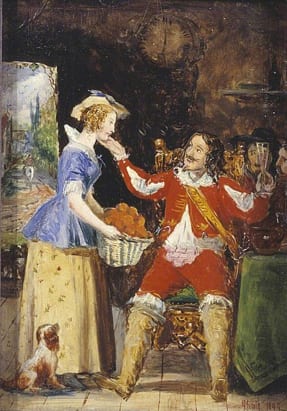
Millais, John Everett; A Maid Offering a Basket of Fruit to a Cavalier; Tate; http://www.artuk.org/artworks/a-maid-offering-a-basket-of-fruit-to-a-cavalier-200816
I once called the eminent scientist Alfred Wallace, “Lord Alfred Wallace.” He was not a lord, despite the fact that I had read this in a book. The book was wrong and I was wrong. This was not a very serious mistake in the context of my argument, though noting that Wallace was from a lower class background than Darwin might be interesting in another context. Getting the fact wrong was not good, so I corrected the error, apologized, and was reminded of a lesson.
All sources are not created equal.
As a lad, getting any information, even a Packers’ score was harder than it is now. It took years to get a book* on Plato that Amazon would send me right now for $299.99. Books are easier to find, but you no longer get a good deal from a seller who does not know the market is small, but the few buyers are desperate! The Encyclopedia had any number of biases (my historian friends keep showing me!), but they most often got the facts right. In addition, the bias was middle-of-the-road academic, so the craziness was limited and the twist was easier to spot. (I once did quite well on a professional multiple choice exam by simply assuming a left-of-center view of reality was true. This went very well.)
Let us not forget that our ability to get millions of book instantly is most excellent. You can get an excellent, if controversial, academic biography of Alfred Wallace now!
In the midst of this goodness, we get a good bit of clutter, static, bad information. When I was a kid, you had to “tune” your television to get a clear picture. The “snow” would obscure the “program” and you could even lose the color (assuming you were rich and had a cool TV). We can easily tune into data on almost anything, but there is a good bit of junk or snow. The clutter when we Google (or Duck Duck Go!) can ruin the picture we get of reality.
There is no infallible way to avoid the snow, to get the world in full living color, but here are some rules that help me.
People should have some background, experience, or education in what they are describing.
This is not foolproof. Academic fields have their own blindspots, yet at least people in a field will tend to get the details right. This expertise does not have to be credentials. A person with a lifetime experience in a field (say finance) may know more than a person with the proper degrees! Still, if they are going to guide you in an area, find out why they think they can.
Being there matters. Find someone who was. Such dissidents may be right.
I once was at a nationally reported on event. I wondered around (this was decades ago) and then read about what I attended the next day in the Washington Post. Whatever the reporter saw, I did not. Surely my experience counted? This was the first time I realized that there was never going to be a full proof way to avoid bad or partial information. I have no reason to think the reporter was lying, but the bias and the partial list of facts presented something very different than what I saw.
The assumptions of white supremacy dominated 1920’s mainstream and accessible sources including those from most of the experts. The mainstream experts told my grandmothers to use “certified milk” (scientific!) and not to breast feed.
If one had listened to dissident voices in the Black community (and one should have!), then truth was out there. The experience of millions of mothers counted when it came to infant care! The experts on feeding babies were overwhelming male. Sometimes the dissidents are right. This is especially true when the dissidents are there and the experts are not.
Maybe.
Be dubious about people who always go against the grain.
There is a certain kind of person and source that is always contrarian. Experts are wrong. I am skeptical about several things against the “smart” consensus. However, I always remember that most of the time when you go against the house (the experts), the house wins (is right). If a site or source is always contrarian, you should suspect they are looking for the monetized clicks and not for goodness, truth and beauty.
We had a very smart friend in church as a boy and he had many interesting things to say. The trouble was that he had too many interesting things to say. You could start to (almost, maybe) follow the pyramid stuff, but then he would be off on banking and gallop over to Atlantis. He was, I fear, a full service crank.
Avoid the crank.
Primary sources are best. Read the person who did the work when you can.
A problem with any news story on a topic requiring specialized knowledge, even from a normally reliable site, is that the reporter may lack the expertise to get it right. Recently a poor reporter lauded a translation of Virgil’s Aeneid for pointing out a new interpretation of the text! How exciting! This would have been exciting, except this is the first insight most freshmen in college have about the text. The translator knew this (of course), but the reporter jumbled the ideas (easy to do) and got the story wrong.
If something is very important, read the primary documents. This can be hard, but do the work. For example, if someone claims a court case says “x,” then follow the link and read. Take the time to see if what the report is claiming is true. Often, I have discovered, that some websites embed links, but the link does not say what they claim. One atheist blogger linked to a story on the decline of religion, but the story showed globally religion was increasing and not decreasing. They kept confusing a decline in religion in North American and Europe with the world.
If it is shocking, double check. There is an immediate cash motive for shocking (clicks!), while careful is hard work.
If the “establishment” has a motive for what they do, anyone cranking up the volume, saying something surprising has one as well. This piece is not good enough, I suppose, to be much read, but another reason will be that it is not shocking. All of us in our hearts know the truth is usually mundane. Things are as we thought they were. Booth killed Lincoln and then the Union army killed Booth. There is no conspiracy, nothing but what we have known. The wild books do not check out when you check the bibliography.
Sometimes the unexpected is true: we found Richard III’s body in a parking lot. Consider though the source and a long experience with that source. Remember what you read there last week. Did they make predictions? What about things you know yourself? Once I went to a “shocking” news site on the election and they claimed RealClear Politics had changed an election call. Since I go to that site everyday, I knew they had done no such thing. They had never made a call on the state in question. I lost some faith at that moment. Of course, as my mistake with “Lord” Wallace shows, one mistake does not make a monkey of a man, but what is the overall track record? Do the predictions hold up over time?
Can the story and the original writer last the first wave of criticism? (“Will they claim it in court?”)
One trustworthy guide has been whether the claims can stand the first wave of criticism. Good ideas can be defended. Decent theories answer objections by doing more research and growing better. The truth teller will usually be able to respond to the critic. Maybe nobody wins, this is not the old Perry Mason television show where people all crack on the stand, but the case gets stronger. Reasonable people make reasonable claims. That does not mean they cannot be passionate, some things matter, but generally if the first line of defense is mere repetition of the original idea, then something is fishy. If the first move is always to attack the person asking questions, then skepticism is warranted.
Again, some people do not take criticism well and not all critics are fair. Nothing is infallible. This side of Paradise we live in uncertain times.
Is anyone you normally find credible, with the proper credentials, skeptical about the source?
If folks you have normally found honest, are skeptical about the source. Pause. That is a sign to use some care.
Ask locally.
When I faced making a COVID policy, I looked at experts online, but I also contacted local medical doctors I know. Check around the Church for relevant experts. You may know some! What do they think? Ask them to explain what you are reading online from their perspective. This is always helpful to me! Think locally when you can.
What is the history of the writer? Do they have bias or something to lose if wrong? Do they win just by playing?
Finding the bias of a site or writer is not hard. That does not mean dismissing what they have to say if it fights their “bias.” I am a Christian who sees the world through that perspective, though hopefully I am willing to see things fairly. It is good, though, to take that bias into account. Note though if I just keep being why off base, then I will “lose.” Being wrong is not good for a professor! We avoid it when we can.
On the other hand, some online areas risk nothing if they are wrong. They can move forward and keep the clicks coming. They win just through being outrageous. They are not part of a guild, a community, that holds them to account. Beware.
What is the harm if you are wrong?
If we say something very harsh about a community, then we must acknowledge a risk. If we are wrong, then we have done harm. Jesus tells us to love our enemies and God forbids a false witness. The more serious the charge the more caution we should show. Must we opine in any case? Does America need my take on this or that politician? Do I really know anything other than some half-digested stuff I have read? What if I am wrong?
The law of love does not prevent a jeremiad, but one should love people as much as Jeremiah loved Judah before unleashing one.
Previous Post

January 30, 2021
Education and Truth in Advertising
Next Post

February 1, 2021 The African's Dream
Browse Our Archives
Select a Category Apologetics Art Culture Education On Books On Education Philosophy Politics Pop Culture Spiritual Reflections Uncategorized
Select a Month October 2026 September 2026 August 2026 July 2026 July 2025 June 2025 September 2024 July 2024 June 2024 December 2023 June 2023 September 2022 May 2022 April 2022 March 2022 February 2022 July 2021 June 2021 May 2021 April 2021 March 2021 February 2021 January 2021 December 2020 November 2020 October 2020 September 2020 August 2020 July 2020 June 2020 May 2020 April 2020 March 2020 February 2020 January 2020 December 2019 November 2019 October 2019 September 2019 August 2019 July 2019 June 2019 May 2019 April 2019 March 2019 February 2019 January 2019 December 2018 November 2018 October 2018 September 2018 August 2018 July 2018 June 2018 May 2018 April 2018 March 2018 February 2018 January 2018 December 2017 November 2017 October 2017 September 2017 August 2017 July 2017 June 2017 May 2017 April 2017 March 2017 February 2017 January 2017 December 2016 November 2016 October 2016 September 2016 August 2016 July 2016 June 2016 May 2016 April 2016 March 2016 February 2016 January 2016 December 2015 November 2015 October 2015 September 2015 August 2015 July 2015 June 2015 May 2015 April 2015 March 2015 February 2015 January 2015 November 2014 October 2014 September 2014 August 2014 July 2014 June 2014 May 2014 April 2014 March 2014 February 2014 January 2014 December 2013 November 2013 October 2013 September 2013 August 2013 July 2013 June 2013 May 2013 April 2013 March 2013 February 2013 January 2013 December 2012 November 2012 October 2012 September 2012 August 2012 July 2012 June 2012 May 2012
Follow Us!
TAKE THE
Religious Wisdom Quiz
According to Philippians, whose name is above every name?
Select your answer to see how you score.
The Lord Jesus God Christ
Books by This Author John Mark Reynolds
Related posts from Eidos

Rooted: Why Classical Education Needs Community


When the Center Holds: A Tribute to My...

Yet I Love Her: History and the Church
TRENDING AT PATHEOS Evangelical

The REST of Your Life: A Creative Wrestles...
This week I had a conversation with a good friend from church....

How the author of the world's best hymn...
I've been working with John Newton for a while now. This makes...

Long before this Lectio Divina, Psalm 130 - the song - started...

What About the Trees? Another Living Parable
After I finished writing the last article about falling leaves as a...

Why Classical Education Is a Conversation, Not a...
Come and Read: Joy in Classical Education When I was a little...

Cornell University has received a great deal of negative publicity and intense...
view all Evangelical blogs
Ad-Free & Subscriber Log-In Subscription Support
- About Us
- 2026 Calendar
- Videos
- Podcasts
- Library of World Religions
- Faith In Media Tracker
- Advertise With Us
- Write for Us
- Privacy Policy
- Terms of Service
- Do Not Sell My Data
- Contact Us
- Radiant Digital
- Manage Newsletter Subscriptions
- Unsubscribe From Notifications
- Sitemap
Copyright 2008-2026, Patheos. All rights reserved.
Subscription Support Ad-Free & Subscriber Log-In
Follow Patheos