
BuddhistCatholicContemplativeEvangelicalGeneral ChristianHinduJewishLatter-day SaintMuslimNew VisionsProgressive Christian
Beliefs
- Buddhist
- Catholic
- Contemplative
- Evangelical
- General Christian
- Hindu
- Jewish
- Latter-day Saint
- More Voices
- Muslim
- New Visions
- Pagan
- Progressive Christian
Topics
- Religion News
- Food and Religion
- Sports and Religion
- Religious Art
- Religious Music and Entertainment
- Religious Events
- History and Religion
- Style and Religion
- Politics and Religion
- Women in Religion
- Recreation Outdoors and Religion
- Business Finance and Religion
- Careers Workplace and Religion
- Education and Religion
- Family Parenting and Religion
- Health Fitness and Religion
- Home and Religion
- Relationships and Religion
- Technology and Religion
- Travel and Religion
Columnists
- Buddhist Columnists
- Business Finance and Religion Columnists
- Careers Workplace and Religion Columnists
- Catholic Columnists
- Contemplative Columnists
- Education and Religion Columnists
- Evangelists Columnists
- Family Parenting and Religion Columnists
- General Christian Columnists
- Health Fitness and Religion Columnists
- Hindu Columnists
- History and Religion Columnists
- Home and Religion Columnists
- Jewish Columnists
- More Voices Columnists
- Latter Day Columnists
- Muslim Columnists
- New Visions Columnists
- Nonreligious Columnists
- Pagan Columnists
- Politics and Religion Columnists
- Progressive Columnists
- Recreation Outdoors and Religion Columnists
- Relationships and Religion Columnists
- Religion News Columnists
- Religious Art Columnists
- Religious Events Columnists
- Religious Music and Entertainment Columnists
- Sports and Religion Columnists
- Style and Religion Columnists
- Technology and Religion Columnists
- Travel and Religion Columnists
- Women in Religion Columnists
Resource Library
- 2026 Calendar
- Library of World Religions
- The 100 Most Holy Places on Earth
- Patheos Answers
- Podcasts
- Videos
- Faith Leaders Database
- Anglican Episcopalian
- Bahai
- Baptist
- Buddhism
- Christianity
- Confucianism
- Eastern Orthodoxy
- Hinduism
- Holiness and Pentecostal
- ISKCON
- Islam
- Judaism
- Lutheran
- Methodist
- The Church of Jesus Christ of Latter-day Saints
- New Age
- Paganism
- Presbytarian and Reformed
- Protestantism
- Religion Behind the Scenes
- Roman Catholic
- Scientology
- Shia Islam
- Sikhism
- Sufism
- Sunni Islam
- Taoism
- Zen
- See all religions
Research Tools
 Ad-Free & Subscriber Log-In Subscription Support
Ad-Free & Subscriber Log-In Subscription Support
Follow Patheos 

- Trending:
- Forgiveness
- |
- Marriage
- |
- Consciousness
- |
- Death Penalty
- |
- Election
- |
- Halloween

- Home
- Evangelical
- Beware Powerful Opinion: The Shoddy Argument often Appears in a Trendy Book (Beware the Eristic)
Beware Powerful Opinion: The Shoddy Argument often Appears in a Trendy Book (Beware the Eristic)
Last updated on: October 27, 2020 at 8:17 pm by John Mark N. Reynolds
Beware Powerful Opinion: The Shoddy Argument often Appears in a Trendy Book (Beware the Eristic) 2020-10-27T20:17:54-04:00 John Mark N. Reynolds
Patheos Explore the world's faith through different perspectives on religion and spirituality! Patheos has the views of the prevalent religions and spiritualities of the world.
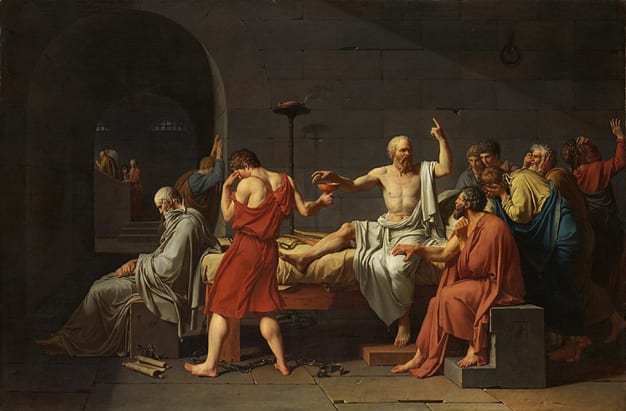
http://www.metmuseum.org/art/collection/search/436105
Be brave. Be prophetic, but take care.
Jeremiah loved Judah, would take nothing, certainly no gold, from Babylon, but Jeremiah predicted victory for Babylon and just punishment for Judah.
That is intellectual bravery.
There is no courage in attacking an establishment that does not pay you or that you despise. Many would rather lose their jobs than their social status. There is bravery in speaking the truth to the powerful in the group that pays your salary or whose approval you would crave.
If you love wisdom, the establishment often kills you. As a result, there is a trickster who manages not to die by going up to a line and not (quite!) crossing that line. There is a job in any society for the one who is the resident critic. A man can take on his party, his philosophical allies, as long as he does not go too far.
The sophists of ancient Athens got rich charming the elite for tuition to educate the children of the powerful. They made fun of the parents, always a good way to get cheap popularity with the children, but never went too far. You can poke at the rulers of the age as long as you do not go after their grift or pleasures. Ask Socrates.
Take on Athenian educational practices, like Socrates did, and you had to get some blowback that consists of being forced to drink hemlock. Socrates could not be controlled and so he had to go. The problem with Socrates was not being critical, since puckish criticism can be entertaining. The court fool is allowed to poke fun at the king within limits. Socrates would not draw any lines. Socrates insisted on examining everything, always, without limits.
Socrates would go to the places, intellectually, where nobody was allowed to go. As a result, Socrates had to die if he would not leave the city. Socrates would not stop questioning himself and so he could not stop questioning everyone he met. If you asked Socrates a question, he kept following reason to the end, even if the establishment grew restless.
Socrates dared monotheism in polytheistic times. Socrates pressed for virtue when pragmatism was a virtue.
Ever since Socrates’s time, a certain kind of religious “scholar” has written the “brave book” taking on exactly the targets the educational establishment loathe. This is brave only if the writer desired the approval of the religious establishment. Since the “religious establishment” has no power in the mainstream “academic establishment,” one has to determine what one wishes! If one wanted to work at Liberty U under Jerry Falwell Jr. (Heaven forfend!) then a person had one strategy, but if one wished to get a job at a typical Christian college or university, one adopted an utterly different strategy. One wrote a book attacking the “religious right,” earned a NPR interview, and went on to earn tenure from the approving, and every growing administrators at Christian colleges that hated Liberty and listened to NPR. Christian parents would keep paying usury to fund your salary.
Sadly, grifters grasped this truth and in many “educational” institutions these humbugs postured as “conservative” in order to get money, students, and donors from those people hurt or fearful of the bigger secular academic establishment. A small, new inner ring of powerful people came into existence to oppose the other, greater elite.
This is worse. If Orthodox Christianity is true, then misusing the Truth for personal peace and affluence is particularly vile. We must oppose our seeming allies if they fall into ruinous behavior as hard as we oppose ideological enemies.
We cannot live by lies. We need the truth.
Like the prophets, let us love justice and mercy. Let us speak against those doing injustice. Let’s particularly speak against those unjust powerful people whose approval we crave.
Inspired by a Junior College class on Plato’s Euthydemus.
Previous Post

October 26, 2020
At Least I am Happy. . . No Small Thing
Next Post
October 28, 2020 O Procla!
Browse Our Archives
Select a Category Apologetics Art Culture Education On Books On Education Philosophy Politics Pop Culture Spiritual Reflections Uncategorized
Select a Month October 2026 September 2026 August 2026 July 2026 July 2025 June 2025 September 2024 July 2024 June 2024 December 2023 June 2023 September 2022 May 2022 April 2022 March 2022 February 2022 July 2021 June 2021 May 2021 April 2021 March 2021 February 2021 January 2021 December 2020 November 2020 October 2020 September 2020 August 2020 July 2020 June 2020 May 2020 April 2020 March 2020 February 2020 January 2020 December 2019 November 2019 October 2019 September 2019 August 2019 July 2019 June 2019 May 2019 April 2019 March 2019 February 2019 January 2019 December 2018 November 2018 October 2018 September 2018 August 2018 July 2018 June 2018 May 2018 April 2018 March 2018 February 2018 January 2018 December 2017 November 2017 October 2017 September 2017 August 2017 July 2017 June 2017 May 2017 April 2017 March 2017 February 2017 January 2017 December 2016 November 2016 October 2016 September 2016 August 2016 July 2016 June 2016 May 2016 April 2016 March 2016 February 2016 January 2016 December 2015 November 2015 October 2015 September 2015 August 2015 July 2015 June 2015 May 2015 April 2015 March 2015 February 2015 January 2015 November 2014 October 2014 September 2014 August 2014 July 2014 June 2014 May 2014 April 2014 March 2014 February 2014 January 2014 December 2013 November 2013 October 2013 September 2013 August 2013 July 2013 June 2013 May 2013 April 2013 March 2013 February 2013 January 2013 December 2012 November 2012 October 2012 September 2012 August 2012 July 2012 June 2012 May 2012
Follow Us!
TAKE THE
Religious Wisdom Quiz
Who said, "I am the resurrection and the life"?
Select your answer to see how you score.
Peter Moses Jesus Paul
Books by This Author John Mark Reynolds
Related posts from Eidos

Classical Education and the Art of Dying Well

Golden, Golden, Golden: My Mother's Last Lesson


When the Center Holds: A Tribute to My...
TRENDING AT PATHEOS Evangelical

The REST of Your Life: A Creative Wrestles...
This week I had a conversation with a good friend from church....

How the author of the world's best hymn...
I've been working with John Newton for a while now. This makes...

Long before this Lectio Divina, Psalm 130 - the song - started...

What About the Trees? Another Living Parable
After I finished writing the last article about falling leaves as a...

Why Classical Education Is a Conversation, Not a...
Come and Read: Joy in Classical Education When I was a little...

Cornell University has received a great deal of negative publicity and intense...
view all Evangelical blogs
Ad-Free & Subscriber Log-In Subscription Support
- About Us
- 2026 Calendar
- Videos
- Podcasts
- Library of World Religions
- Faith In Media Tracker
- Advertise With Us
- Write for Us
- Privacy Policy
- Terms of Service
- Do Not Sell My Data
- Contact Us
- Radiant Digital
- Manage Newsletter Subscriptions
- Unsubscribe From Notifications
- Sitemap
Copyright 2008-2026, Patheos. All rights reserved.
Subscription Support Ad-Free & Subscriber Log-In
Follow Patheos