
BuddhistCatholicContemplativeEvangelicalGeneral ChristianHinduJewishLatter-day SaintMuslimNew VisionsProgressive Christian
Beliefs
- Buddhist
- Catholic
- Contemplative
- Evangelical
- General Christian
- Hindu
- Jewish
- Latter-day Saint
- More Voices
- Muslim
- New Visions
- Pagan
- Progressive Christian
Topics
- Religion News
- Food and Religion
- Sports and Religion
- Religious Art
- Religious Music and Entertainment
- Religious Events
- History and Religion
- Style and Religion
- Politics and Religion
- Women in Religion
- Recreation Outdoors and Religion
- Business Finance and Religion
- Careers Workplace and Religion
- Education and Religion
- Family Parenting and Religion
- Health Fitness and Religion
- Home and Religion
- Relationships and Religion
- Technology and Religion
- Travel and Religion
Columnists
- Buddhist Columnists
- Business Finance and Religion Columnists
- Careers Workplace and Religion Columnists
- Catholic Columnists
- Contemplative Columnists
- Education and Religion Columnists
- Evangelists Columnists
- Family Parenting and Religion Columnists
- General Christian Columnists
- Health Fitness and Religion Columnists
- Hindu Columnists
- History and Religion Columnists
- Home and Religion Columnists
- Jewish Columnists
- More Voices Columnists
- Latter Day Columnists
- Muslim Columnists
- New Visions Columnists
- Nonreligious Columnists
- Pagan Columnists
- Politics and Religion Columnists
- Progressive Columnists
- Recreation Outdoors and Religion Columnists
- Relationships and Religion Columnists
- Religion News Columnists
- Religious Art Columnists
- Religious Events Columnists
- Religious Music and Entertainment Columnists
- Sports and Religion Columnists
- Style and Religion Columnists
- Technology and Religion Columnists
- Travel and Religion Columnists
- Women in Religion Columnists
Resource Library
- 2026 Calendar
- Library of World Religions
- The 100 Most Holy Places on Earth
- Patheos Answers
- Podcasts
- Videos
- Faith Leaders Database
- Anglican Episcopalian
- Bahai
- Baptist
- Buddhism
- Christianity
- Confucianism
- Eastern Orthodoxy
- Hinduism
- Holiness and Pentecostal
- ISKCON
- Islam
- Judaism
- Lutheran
- Methodist
- The Church of Jesus Christ of Latter-day Saints
- New Age
- Paganism
- Presbytarian and Reformed
- Protestantism
- Religion Behind the Scenes
- Roman Catholic
- Scientology
- Shia Islam
- Sikhism
- Sufism
- Sunni Islam
- Taoism
- Zen
- See all religions
Research Tools
 Ad-Free & Subscriber Log-In Subscription Support
Ad-Free & Subscriber Log-In Subscription Support
Follow Patheos 

- Trending:
- Forgiveness
- |
- Marriage
- |
- Consciousness
- |
- Death Penalty
- |
- Election
- |
- Halloween

- Home
- Evangelical
- The Interruptions ( With a Bonus Thought on Plato’s Republic)
The Interruptions ( With a Bonus Thought on Plato’s Republic)
Last updated on: October 12, 2020 at 8:19 am by John Mark N. Reynolds
The Interruptions ( With a Bonus Thought on Plato’s Republic) 2020-10-12T08:19:00-04:00 John Mark N. Reynolds
Patheos Explore the world's faith through different perspectives on religion and spirituality! Patheos has the views of the prevalent religions and spiritualities of the world.
 I would be hard at work on some important email or working on the media system (so fearfully complex that the children called it The System) and one of them would come and interrupt.
Oh, blessed days!
I knew just enough then to know that the day would come when I would miss those interruptions. Now, decades later, I would wish that this piece or anything else I am doing would be interrupted by, “Dad . . . ”
Work had to be done. There was nothing wrong, I guess, with fixing things so we could stream movies (long before streaming was a thing). Yet as I knew then would be true, not one minute I ignored the people in my house seems worthwhile now and not one moment I spent with them seems wasted. We took a few trips before they got too busy, when they could still go, and we could not (quite) afford those trips. I am not sorry.
The interruptions of our children were not interruptions, but life. “Beware,” I think, “even now confusing the meaningful moments of life for interruptions.”
How can we know the difference?
When our routine is disturbed, this might be a distraction from our key work, like the men who tried to get Nehemiah from rebuilding the walls of Jerusalem. This bad distraction, the true interruption, prevents us from doing what we should. We should work through this kind of interruption the best we can. Our enemies (the world, our own flesh, and evils) mean to keep us from what brings flourishing.
Sometimes, however, we confuse (or at least I confuse) some auxiliary task for the main job of being a whole soul ready for Paradise. We are grinding away at some job and our real life “interrupts.” This interruption is not, but an unexpected opportunity. When the dwarves turn up at Bilbo’s front door in The Hobbit, this was not an interruption in Bilbo’s life, but the beginning of his real life.
When our children come to us to learn, then we are most often doing our key work when we stop and talk with them.* When building The System, this was for the family to enjoy. One cannot (generally) ignore family time in order to have family time. The System must be built for the family, not the family for The System. In the world of home electronics and computers, I did not always remember this truth.
What am I doing? Why am I doing this thing? In education, learning is never a disruption. The student, if acting as a true student, is the class, not a disruption to the class.
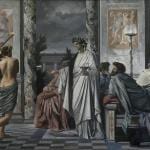
I thought of this, because of three interruptions in the masterwork on education The Republic. At the start of Books II, IV, and V, young men interrupt Socrates. One might think this is bad, Socrates is one of the greatest teachers who ever lived after all. Yet a main reason he is so marvelous as a teacher is that Socrates never views a sincere interruption as a distraction. He knows that the discussion is for the students, not the students for the discussion. In Book II the students interrupt and save the discussion from ending. In Book IV a student is unsure that the thought experiment is really doing justice. Even more shockingly, Socrates’ students refuse to follow his lead at the start of Book V and so there is a great distraction. . .
This interlude lasts until Book VIII, but the intermediate books contain some of Plato’s greatest imagery and ideas. The City in Words gains a philosopher king. Plato’s theory of knowledge gains the “divided line” and Book VII begins with the cave analogy. The distraction produces brilliance when the teacher followed the students and risked their misunderstandings, confusions, and questions.
The interruptions become key to the dialogue. Every teacher who follows Socrates in teaching knows this truth. The lesson plan proposes, the student disposes!
So it goes in parenting, education, business. The main thing, almost always a human or Divine thing, must remain the main thing.
Come life. Come wisdom. Come children, now adult, and interrupt me. Come Holy Spirit and interrupt us all.
—————————-
*Obviously there are other important tasks that we must do and children can prevent those tasks. . .but there are far fewer of those than many of us think.
Previous Post

October 11, 2020
Our seeming error? Your fault.
Browse Our Archives
Select a Category Apologetics Art Culture Education On Books On Education Philosophy Politics Pop Culture Spiritual Reflections Uncategorized
Select a Month October 2026 September 2026 August 2026 July 2026 July 2025 June 2025 September 2024 July 2024 June 2024 December 2023 June 2023 September 2022 May 2022 April 2022 March 2022 February 2022 July 2021 June 2021 May 2021 April 2021 March 2021 February 2021 January 2021 December 2020 November 2020 October 2020 September 2020 August 2020 July 2020 June 2020 May 2020 April 2020 March 2020 February 2020 January 2020 December 2019 November 2019 October 2019 September 2019 August 2019 July 2019 June 2019 May 2019 April 2019 March 2019 February 2019 January 2019 December 2018 November 2018 October 2018 September 2018 August 2018 July 2018 June 2018 May 2018 April 2018 March 2018 February 2018 January 2018 December 2017 November 2017 October 2017 September 2017 August 2017 July 2017 June 2017 May 2017 April 2017 March 2017 February 2017 January 2017 December 2016 November 2016 October 2016 September 2016 August 2016 July 2016 June 2016 May 2016 April 2016 March 2016 February 2016 January 2016 December 2015 November 2015 October 2015 September 2015 August 2015 July 2015 June 2015 May 2015 April 2015 March 2015 February 2015 January 2015 November 2014 October 2014 September 2014 August 2014 July 2014 June 2014 May 2014 April 2014 March 2014 February 2014 January 2014 December 2013 November 2013 October 2013 September 2013 August 2013 July 2013 June 2013 May 2013 April 2013 March 2013 February 2013 January 2013 December 2012 November 2012 October 2012 September 2012 August 2012 July 2012 June 2012 May 2012
Follow Us!
TAKE THE
Religious Wisdom Quiz
What is the lesson of the Parable of the Wheat and the Weeds?
Select your answer to see how you score.
Never trust a stranger Judgment will separate good and evil Sow only good seed Water the crops often
Books by This Author John Mark Reynolds
Related posts from Eidos

Classical Education Must Teach Us to Make the...

Classical Education and the Art of Dying Well

Golden, Golden, Golden: My Mother's Last Lesson

TRENDING AT PATHEOS Evangelical

The REST of Your Life: A Creative Wrestles...
This week I had a conversation with a good friend from church....

How the author of the world's best hymn...
I've been working with John Newton for a while now. This makes...

Long before this Lectio Divina, Psalm 130 - the song - started...

What About the Trees? Another Living Parable
After I finished writing the last article about falling leaves as a...

Why Classical Education Is a Conversation, Not a...
Come and Read: Joy in Classical Education When I was a little...

Cornell University has received a great deal of negative publicity and intense...
view all Evangelical blogs
Ad-Free & Subscriber Log-In Subscription Support
- About Us
- 2026 Calendar
- Videos
- Podcasts
- Library of World Religions
- Faith In Media Tracker
- Advertise With Us
- Write for Us
- Privacy Policy
- Terms of Service
- Do Not Sell My Data
- Contact Us
- Radiant Digital
- Manage Newsletter Subscriptions
- Unsubscribe From Notifications
- Sitemap
Copyright 2008-2026, Patheos. All rights reserved.
Subscription Support Ad-Free & Subscriber Log-In
Follow Patheos