
BuddhistCatholicContemplativeEvangelicalGeneral ChristianHinduJewishLatter-day SaintMuslimNew VisionsProgressive Christian
Beliefs
- Buddhist
- Catholic
- Contemplative
- Evangelical
- General Christian
- Hindu
- Jewish
- Latter-day Saint
- More Voices
- Muslim
- New Visions
- Pagan
- Progressive Christian
Topics
- Religion News
- Food and Religion
- Sports and Religion
- Religious Art
- Religious Music and Entertainment
- Religious Events
- History and Religion
- Style and Religion
- Politics and Religion
- Women in Religion
- Recreation Outdoors and Religion
- Business Finance and Religion
- Careers Workplace and Religion
- Education and Religion
- Family Parenting and Religion
- Health Fitness and Religion
- Home and Religion
- Relationships and Religion
- Technology and Religion
- Travel and Religion
Columnists
- Buddhist Columnists
- Business Finance and Religion Columnists
- Careers Workplace and Religion Columnists
- Catholic Columnists
- Contemplative Columnists
- Education and Religion Columnists
- Evangelists Columnists
- Family Parenting and Religion Columnists
- General Christian Columnists
- Health Fitness and Religion Columnists
- Hindu Columnists
- History and Religion Columnists
- Home and Religion Columnists
- Jewish Columnists
- More Voices Columnists
- Latter Day Columnists
- Muslim Columnists
- New Visions Columnists
- Nonreligious Columnists
- Pagan Columnists
- Politics and Religion Columnists
- Progressive Columnists
- Recreation Outdoors and Religion Columnists
- Relationships and Religion Columnists
- Religion News Columnists
- Religious Art Columnists
- Religious Events Columnists
- Religious Music and Entertainment Columnists
- Sports and Religion Columnists
- Style and Religion Columnists
- Technology and Religion Columnists
- Travel and Religion Columnists
- Women in Religion Columnists
Resource Library
- 2026 Calendar
- Library of World Religions
- The 100 Most Holy Places on Earth
- Patheos Answers
- Podcasts
- Videos
- Faith Leaders Database
- Anglican Episcopalian
- Bahai
- Baptist
- Buddhism
- Christianity
- Confucianism
- Eastern Orthodoxy
- Hinduism
- Holiness and Pentecostal
- ISKCON
- Islam
- Judaism
- Lutheran
- Methodist
- The Church of Jesus Christ of Latter-day Saints
- New Age
- Paganism
- Presbytarian and Reformed
- Protestantism
- Religion Behind the Scenes
- Roman Catholic
- Scientology
- Shia Islam
- Sikhism
- Sufism
- Sunni Islam
- Taoism
- Zen
- See all religions
Research Tools
 Ad-Free & Subscriber Log-In Subscription Support
Ad-Free & Subscriber Log-In Subscription Support
Follow Patheos 

- Trending:
- Forgiveness
- |
- Marriage
- |
- Consciousness
- |
- Death Penalty
- |
- Election
- |
- Halloween

- Home
- Evangelical
- Asking Questions While Reading: An Example
Asking Questions While Reading: An Example
Last updated on: September 5, 2020 at 11:39 am by John Mark N. Reynolds
Asking Questions While Reading: An Example 2020-09-05T11:39:26-04:00 John Mark N. Reynolds
Patheos Explore the world's faith through different perspectives on religion and spirituality! Patheos has the views of the prevalent religions and spiritualities of the world.
http://www.metmuseum.org/art/collection/search/436105
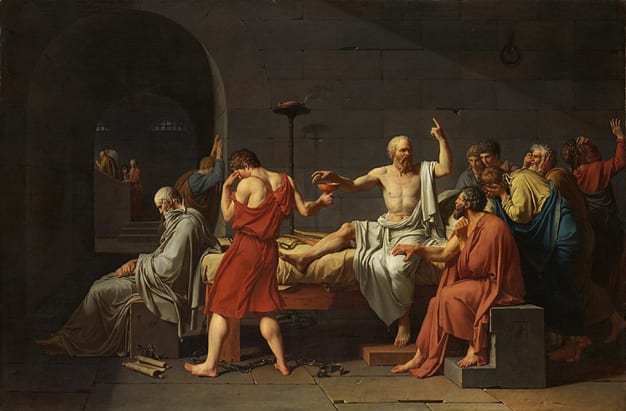
I am sometimes asked how to prepare a class, or take notes in reading. For me asking questions of the text is a start and this happens over time. What does this look like? Here are notes drawn from a Republic teaching session. Because they were started a long time ago and continued over time, I cannot be sure all of the questions are mine. A good class requires a set of questions and as his collection grows and I become unsure where the origin story of the document. When you work with bright colleagues and students, this grows ever more difficult!
Many are reacting to conversations with Professor Al Geier over decades found in my notes of the Republic. When I teach a dialogue (next week Phaedo in The College), this the kind of preparation that required for a meaningful session. If the tutor is not asking questions, challenging his own view of the text, or seeing different perspectives, then the session will drag. Much of “classical education” fails, because this process is short changed.
One of these questions listed below would likely will be the opening of a session. The vitality of a class comes from hiding the preparatory work and allowing the “practical considerations” of the students (see Book V of Republic) to steer what the conversation will be. A great book like Republic, if known well enough, will allow a shift in topics (virtue, science, metaphysics, ethics). The particulars of the discussion rarely will be the same, though the opening questions and some of the background might be for a particular tutor.
Here are some notes:
Republic
Books V and VI
Book V
449 a Do the young men conspire against Socrates? Does this derail the argument? If so, then would we really wish to lose out on Books V, VI, and VII? We care so much about those books, but does this show them to be a bit of a distraction? Or is this part of the education of the soul that is pictured at the start of Book VII?
449 a Do practical considerations “slow down” theoretical growth?
449 b Does the Eros driving the young men save them from a vision too great for their souls? What is the source of this passion? The source is unlikely merely to be a Socratic show, but something deeper. What triggers this?
449 b That Polemarchus speaks reminds us of Book I and suggest a dragging down. See Phaedrus. Where are they coming from? Where are they going in this dialogue?
449 c Has Socrates (again?) given up on the long argument? (See Book II)
450 a Thrasymachus a tamed member voting in the new city. How has this happened?
450 c Is love of argument really the measure of virtue in a young man?
451 a How can Socrates go forward in safety? Socrates will develop a new means of learning in an uncertain world.
451 b Glaucon laughs. As Geier often has said, the laughter in a dialogue is rare enough to be meaningful.
452 b Socrates points to the absurdity, but young men are not deterred by the absurd!
453 d A great sea of difficulties is to come, but a man can drown in a tea cup.
454 a Contradiction is an unsatisfactory way to “show” a proof and yet it is very powerful.
454 e Socrate defends women in philosophy. Compare J.S. Mill. Contrast with Aristotle. Why a change for the worse in Timaeus? Is “science” (as the ancients construed it) at war with justice?
456 b The marriage of equals. Compare Aristophanes in Symposium. Note end of Jane Eyre.
457 b Note: the laughing man knows nothing.
457 c A greater wave: children and property in common.
457 e Compare Swinburne’s bucket argument for theism and the “coalition of arguments here.” Can arguments gain cumulative force, even if they have possible flaws? What is the nature of persuasion to these young men who want to see and not just seem to see?
458 b “postpone” the topic of whether this is all feasible. Does it matter in a City of Words? If we not building this City (in fact), then why ever return to details?
458 c Note key words: νομοθετας and μιμουμενους
458 e Note geometry and love. How does the abstract and the passionate interact here?
460 a The creation of hymns to good marriages. What kinds of songs will be made? Are they geometric?
461 d Young men that have chased out their father act as if family relationships are the strongest bond?
462 b Should diversity actually be a goal in a good state? Isn’t unity harder to achieve? Or is that the road to tyranny? (See Book IX)
462 c How does one develop corporate feeling?
462 d Key to this book: There is a divine part of the soul. Up to this point the soul is mortal and connects to the body. We are reminded the City is an excuse to see the soul.
462 e The return to the City reminds us that the need to see the many is for the sake of the one: Glaucon.
463 b “saviours and helpers” Why this combination?
463 c The powerful or philosophic outsider is a threat to any City. How can the natural “outsider” become an “insider?”
464 d Just linked with piety. Piety? Compare to Euthyphro
464 a Pleasures and pains in common! A shared cross . . . the just man (Book I) is always crucified.
464 d One faith?
465 d Note the use of sight again. These men are happy, blessed.
467 a Compare Timaeus: there Socrates asks to see the City in action. . . only he “sees” it in words.
471 c The nadir of the dialogue?
472 a Note the impatience. The dismissal of “everything else” is very strong.
472 b We face the greatest wave: philosopher kings. Compare with Odysseus on his raft.
472 d Is the Timaeus a paradigm of this sort? Does the Timaeus a commentary to the
Republic, because the purpose of Republic is revealed: to tell a likely myth?
473 d Can one make a just man miserable and still be a just city?
473 e Socrates must fear the city after this section. Why all the speculation given this peril? Why not action? Why is even mentioning the philosopher king so dangerous?
474 c Reminder: philosophy. Socrates tries to find first the lover and only then the sophist.
476 a “base and ugly” What is the role of these two in seeing the just man?
476 e Socrates commands us to consider for ourselves. Can Glaucon think for himself at this point?
478 a What is the relationship of modern “science” to true science?
479 d Two political affirmations. Note the use of “necessarily.” A great harmony has been achieved after the waves.
480 a Not e the command to “remember.” Compare Meno. Does Alcibiades have something to contribute?
Book VI
484 a “the long winding way” What is it?
484 c Note the repetition of paradigm.
485 d What is the relationship between the lover of knowledge and the lover of wisdom? Compare to Metaphysics Book I.
487 b “And Adeimantus said:” Why now? Why is he speaking?
487 b Why draughts? Why this particular simple game?
489 a Teach this story as Timaeus style story or a fable or what kind of literature?
490 b “beget intelligence and truth” What is the relationship between the two?
492 b compare 493 a and Meno.
492 e note the “divine part.” How far can we go in calling this part of the soul divine? Is the tripartite soul complex?
493 c “the great beast” and dogma: how can truth be kept from becoming monstrous dogma in our souls?
494 b How can the nature of the body be made compatible with the nature of the soul?
494 c Check out the word for “flattery” here. Very deep term.
496 c Relate the “divine sign” to the “divine part” of the soul.
497 b This entire section is worth memorizing! There is no eternally good city in this life. What are the implications for Plato’s actual politics as opposed to those in the City of
Words?
498 c There is a new eagerness on the part of Socrates. From whence does it come?
500 d Another key passage in all of Plato. Astronomy as a cure for the body. What is the role of the stars in Plato? Can we become “like” the thing we look at?
500 d Note the possible action of the divine “craftsman.”
501 b Here is an element “almost divine.” Note “seeing” Why Homer here?
501 d If they are moderate/reasonable/a gentleman?
505 d-e Brings us back to Book II. Compare.
506 d Strong statement by Glaucon. Why would Socrates draw back? Why is Glaucon so passionate? What does he see? He speaks in the plural (“us”).
508 a Socrates challenges Glaucon: “‘The thing,’ I said, ‘you call light.'”
509 a This is a word found only in Plato . . . beauty beyond beauty. αγαθοειδη Relate beauty as a source of knowledge!
509 c “And Glaucon very ludicrously said . . . ” This may be the most important sentence in Republic (according to Al Geier). What is going on in Glaucon?
510 d Compare this “Certainly . . . ” with 509 c.
510 e What does it mean to be a “reality” in the mind?
511 d Glaucon is honest. Section deserves a full class.
511 e Geier: “high point of the dialogue.” I think not . . . because the community is still not full as it will be at the end. You decide. I think Glaucon and Socrates reach a deeper community in the “we” passage that closes Republic. Continue to think.
Previous Post

September 3, 2020
Learning from the Wise: Thanks Orlando Ferrell
Next Post

September 5, 2020 Precisely Suited In Character (On a Wedding)
Browse Our Archives
Select a Category Apologetics Art Culture Education On Books On Education Philosophy Politics Pop Culture Spiritual Reflections Uncategorized
Select a Month October 2026 September 2026 August 2026 July 2026 July 2025 June 2025 September 2024 July 2024 June 2024 December 2023 June 2023 September 2022 May 2022 April 2022 March 2022 February 2022 July 2021 June 2021 May 2021 April 2021 March 2021 February 2021 January 2021 December 2020 November 2020 October 2020 September 2020 August 2020 July 2020 June 2020 May 2020 April 2020 March 2020 February 2020 January 2020 December 2019 November 2019 October 2019 September 2019 August 2019 July 2019 June 2019 May 2019 April 2019 March 2019 February 2019 January 2019 December 2018 November 2018 October 2018 September 2018 August 2018 July 2018 June 2018 May 2018 April 2018 March 2018 February 2018 January 2018 December 2017 November 2017 October 2017 September 2017 August 2017 July 2017 June 2017 May 2017 April 2017 March 2017 February 2017 January 2017 December 2016 November 2016 October 2016 September 2016 August 2016 July 2016 June 2016 May 2016 April 2016 March 2016 February 2016 January 2016 December 2015 November 2015 October 2015 September 2015 August 2015 July 2015 June 2015 May 2015 April 2015 March 2015 February 2015 January 2015 November 2014 October 2014 September 2014 August 2014 July 2014 June 2014 May 2014 April 2014 March 2014 February 2014 January 2014 December 2013 November 2013 October 2013 September 2013 August 2013 July 2013 June 2013 May 2013 April 2013 March 2013 February 2013 January 2013 December 2012 November 2012 October 2012 September 2012 August 2012 July 2012 June 2012 May 2012
Follow Us!
TAKE THE
Religious Wisdom Quiz
Who was the first Judge of Israel?
Select your answer to see how you score.
Othniel Deborah Gideon Samson
Books by This Author John Mark Reynolds
Related posts from Eidos

Why Classical Education Is a Conversation, Not a...

Rooted: Why Classical Education Needs Community

Classical Education: Discussion for Everyone
Speaking Math: the Language of Classical Education
TRENDING AT PATHEOS Evangelical

The REST of Your Life: A Creative Wrestles...
This week I had a conversation with a good friend from church....

How the author of the world's best hymn...
I've been working with John Newton for a while now. This makes...

Long before this Lectio Divina, Psalm 130 - the song - started...

What About the Trees? Another Living Parable
After I finished writing the last article about falling leaves as a...

Why Classical Education Is a Conversation, Not a...
Come and Read: Joy in Classical Education When I was a little...

Cornell University has received a great deal of negative publicity and intense...
view all Evangelical blogs
Ad-Free & Subscriber Log-In Subscription Support
- About Us
- 2026 Calendar
- Videos
- Podcasts
- Library of World Religions
- Faith In Media Tracker
- Advertise With Us
- Write for Us
- Privacy Policy
- Terms of Service
- Do Not Sell My Data
- Contact Us
- Radiant Digital
- Manage Newsletter Subscriptions
- Unsubscribe From Notifications
- Sitemap
Copyright 2008-2026, Patheos. All rights reserved.
Subscription Support Ad-Free & Subscriber Log-In
Follow Patheos