
BuddhistCatholicContemplativeEvangelicalGeneral ChristianHinduJewishLatter-day SaintMuslimNew VisionsProgressive Christian
Beliefs
- Buddhist
- Catholic
- Contemplative
- Evangelical
- General Christian
- Hindu
- Jewish
- Latter-day Saint
- More Voices
- Muslim
- New Visions
- Pagan
- Progressive Christian
Topics
- Religion News
- Food and Religion
- Sports and Religion
- Religious Art
- Religious Music and Entertainment
- Religious Events
- History and Religion
- Style and Religion
- Politics and Religion
- Women in Religion
- Recreation Outdoors and Religion
- Business Finance and Religion
- Careers Workplace and Religion
- Education and Religion
- Family Parenting and Religion
- Health Fitness and Religion
- Home and Religion
- Relationships and Religion
- Technology and Religion
- Travel and Religion
Columnists
- Buddhist Columnists
- Business Finance and Religion Columnists
- Careers Workplace and Religion Columnists
- Catholic Columnists
- Contemplative Columnists
- Education and Religion Columnists
- Evangelists Columnists
- Family Parenting and Religion Columnists
- General Christian Columnists
- Health Fitness and Religion Columnists
- Hindu Columnists
- History and Religion Columnists
- Home and Religion Columnists
- Jewish Columnists
- More Voices Columnists
- Latter Day Columnists
- Muslim Columnists
- New Visions Columnists
- Nonreligious Columnists
- Pagan Columnists
- Politics and Religion Columnists
- Progressive Columnists
- Recreation Outdoors and Religion Columnists
- Relationships and Religion Columnists
- Religion News Columnists
- Religious Art Columnists
- Religious Events Columnists
- Religious Music and Entertainment Columnists
- Sports and Religion Columnists
- Style and Religion Columnists
- Technology and Religion Columnists
- Travel and Religion Columnists
- Women in Religion Columnists
Resource Library
- 2026 Calendar
- Library of World Religions
- The 100 Most Holy Places on Earth
- Patheos Answers
- Podcasts
- Videos
- Faith Leaders Database
- Anglican Episcopalian
- Bahai
- Baptist
- Buddhism
- Christianity
- Confucianism
- Eastern Orthodoxy
- Hinduism
- Holiness and Pentecostal
- ISKCON
- Islam
- Judaism
- Lutheran
- Methodist
- The Church of Jesus Christ of Latter-day Saints
- New Age
- Paganism
- Presbytarian and Reformed
- Protestantism
- Religion Behind the Scenes
- Roman Catholic
- Scientology
- Shia Islam
- Sikhism
- Sufism
- Sunni Islam
- Taoism
- Zen
- See all religions
Research Tools
 Ad-Free & Subscriber Log-In Subscription Support
Ad-Free & Subscriber Log-In Subscription Support
Follow Patheos 

- Trending:
- Forgiveness
- |
- Marriage
- |
- Consciousness
- |
- Death Penalty
- |
- Election
- |
- Halloween

- Home
- Evangelical
- An Apologia for my Fandom: Why care about Socrates?
An Apologia for my Fandom: Why care about Socrates?
Last updated on: September 10, 2020 at 5:58 am by John Mark N. Reynolds
An Apologia for my Fandom: Why care about Socrates? 2020-09-09T17:55:37-04:00 John Mark N. Reynolds
Patheos Explore the world's faith through different perspectives on religion and spirituality! Patheos has the views of the prevalent religions and spiritualities of the world.
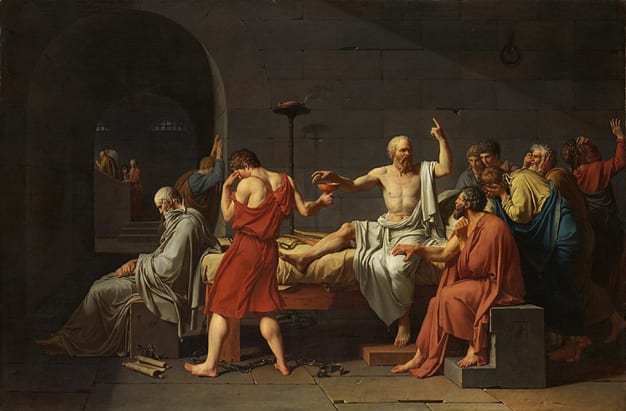
http://www.metmuseum.org/art/collection/search/436105
Why care about Socrates? Why care about any person who lived a long time ago? Haven’t times changed? Why linger over any wisdom the old Athenian might have had centuries before Jesus was born? As one commentator said of me: “You are really obsessed about the past and Socrates”
This is quite true. I think Socrates life and death matter and still teach us. Why?
First, Socrates created a method of learning, the dialectic, that can play a central part in genuine education. The student of Socrates learns to wonder about everything, beginning with himself. His greatest student Plato, captured this method in Socratic dialogs. These are not hard to read on a superficial level, but read deeply, force us confront our ethics, culture, politics, our religious assumptions, every idea.
The Socrates of the Platonic dialogues is a trustworthy teacher, because he is nobly dead. His physical life is long over and in his life and death he was a good man. He challenged the corrupt educational system of Athens and was murdered by the state. We need not fear his commitment to wisdom. But how can a dead person still teach us to ask questions? Aren’t books by teachers just filled with pronouncements like the “moral” of a fable?
The genius of Plato was to write in a manner that does not “capture” a dialogue, that would kill the wondering, but in a way that provokes discussion in us. The first time reading a Socratic dialogue with a group, most of us feel frustration. How could the students be so dense? Isn’t this argument by Socrates bad? Why don’t they ask this question? The discussion in print, through the genius of Plato, is notoriously hard to pin down. What does it mean?
Do not ignore any of those questions. The dialogue has provoked them in you.
Socrates count historically for anyone who thinks in the English language. Plato’s description of the life, teachings, and death of Socrates have had an overwhelming influence in education in the English speaking world. This has been so profound that for centuries educated Englishmen learned Greek to read Socrates and his intellectual heirs. What is trending intellectual right now in the English speaking world changes quickly and none of us can learn all we might wish to know. A good shortcut is to learn the thinkers that are at the start of our cultural conversation, because that will often equip us to more rapidly grasp even very disparate ideas that spring from discussion that (even way back when!) interacted with Socrates.
Interacting with Plato’s Socrates has done good in many culture.
Centuries of students of Socrates (and Plato), discovered that each detail mattered or provoked fruitful questions that lead to interesting answers. When thinkers like Kepler or Copernicus began to apply what they saw in Plato, modern science was given a shove forward. Jewish, Christian, Islamic, and many forms of secular philosophy developed and improved through interaction with Plato’s Socrates.
On a personal note, I read and consider Socrates, because I personally have learned much from the process. When I am in a dogmatic slumber, Socrates demands I wake up. When I am too interested in other things to consider the joys of heaven, Socrates pushes me to reconsider. He, above all thinkers, keeps reminding us that the goal of a good life is dying well and (mayhap!) preparing for the life to come.
Socrates is not the only such thinker. Other great sages have existed in the world, but this man, this Socrates, is one splendid one that has long guided the intellectual tradition in which I live. Off to reread Phaedo.. . the perfect dialogue for perilous times. What will I wonder about today?
Previous Post
September 9, 2020
Weird Purity Culture Kills
Next Post
September 11, 2020 Wisdom, Art, Math, Science. . . Oh My!
Browse Our Archives
Select a Category Apologetics Art Culture Education On Books On Education Philosophy Politics Pop Culture Spiritual Reflections Uncategorized
Select a Month October 2026 September 2026 August 2026 July 2026 July 2025 June 2025 September 2024 July 2024 June 2024 December 2023 June 2023 September 2022 May 2022 April 2022 March 2022 February 2022 July 2021 June 2021 May 2021 April 2021 March 2021 February 2021 January 2021 December 2020 November 2020 October 2020 September 2020 August 2020 July 2020 June 2020 May 2020 April 2020 March 2020 February 2020 January 2020 December 2019 November 2019 October 2019 September 2019 August 2019 July 2019 June 2019 May 2019 April 2019 March 2019 February 2019 January 2019 December 2018 November 2018 October 2018 September 2018 August 2018 July 2018 June 2018 May 2018 April 2018 March 2018 February 2018 January 2018 December 2017 November 2017 October 2017 September 2017 August 2017 July 2017 June 2017 May 2017 April 2017 March 2017 February 2017 January 2017 December 2016 November 2016 October 2016 September 2016 August 2016 July 2016 June 2016 May 2016 April 2016 March 2016 February 2016 January 2016 December 2015 November 2015 October 2015 September 2015 August 2015 July 2015 June 2015 May 2015 April 2015 March 2015 February 2015 January 2015 November 2014 October 2014 September 2014 August 2014 July 2014 June 2014 May 2014 April 2014 March 2014 February 2014 January 2014 December 2013 November 2013 October 2013 September 2013 August 2013 July 2013 June 2013 May 2013 April 2013 March 2013 February 2013 January 2013 December 2012 November 2012 October 2012 September 2012 August 2012 July 2012 June 2012 May 2012
Follow Us!
TAKE THE
Religious Wisdom Quiz
My hair held my strength, but a woman's betrayal led to my capture and blindness. Who am I?
Select your answer to see how you score.
Absalom Gideon Samson Saul
Books by This Author John Mark Reynolds
Related posts from Eidos

Classical Education Must Teach Us to Make the...

Rooted: Why Classical Education Needs Community


When the Center Holds: A Tribute to My...
TRENDING AT PATHEOS Evangelical

The REST of Your Life: A Creative Wrestles...
This week I had a conversation with a good friend from church....

How the author of the world's best hymn...
I've been working with John Newton for a while now. This makes...

Long before this Lectio Divina, Psalm 130 - the song - started...

What About the Trees? Another Living Parable
After I finished writing the last article about falling leaves as a...

Why Classical Education Is a Conversation, Not a...
Come and Read: Joy in Classical Education When I was a little...

Cornell University has received a great deal of negative publicity and intense...
view all Evangelical blogs
Ad-Free & Subscriber Log-In Subscription Support
- About Us
- 2026 Calendar
- Videos
- Podcasts
- Library of World Religions
- Faith In Media Tracker
- Advertise With Us
- Write for Us
- Privacy Policy
- Terms of Service
- Do Not Sell My Data
- Contact Us
- Radiant Digital
- Manage Newsletter Subscriptions
- Unsubscribe From Notifications
- Sitemap
Copyright 2008-2026, Patheos. All rights reserved.
Subscription Support Ad-Free & Subscriber Log-In
Follow Patheos