
BuddhistCatholicContemplativeEvangelicalGeneral ChristianHinduJewishLatter-day SaintMuslimNew VisionsProgressive Christian
Beliefs
- Buddhist
- Catholic
- Contemplative
- Evangelical
- General Christian
- Hindu
- Jewish
- Latter-day Saint
- More Voices
- Muslim
- New Visions
- Pagan
- Progressive Christian
Topics
- Religion News
- Food and Religion
- Sports and Religion
- Religious Art
- Religious Music and Entertainment
- Religious Events
- History and Religion
- Style and Religion
- Politics and Religion
- Women in Religion
- Recreation Outdoors and Religion
- Business Finance and Religion
- Careers Workplace and Religion
- Education and Religion
- Family Parenting and Religion
- Health Fitness and Religion
- Home and Religion
- Relationships and Religion
- Technology and Religion
- Travel and Religion
Columnists
- Buddhist Columnists
- Business Finance and Religion Columnists
- Careers Workplace and Religion Columnists
- Catholic Columnists
- Contemplative Columnists
- Education and Religion Columnists
- Evangelists Columnists
- Family Parenting and Religion Columnists
- General Christian Columnists
- Health Fitness and Religion Columnists
- Hindu Columnists
- History and Religion Columnists
- Home and Religion Columnists
- Jewish Columnists
- More Voices Columnists
- Latter Day Columnists
- Muslim Columnists
- New Visions Columnists
- Nonreligious Columnists
- Pagan Columnists
- Politics and Religion Columnists
- Progressive Columnists
- Recreation Outdoors and Religion Columnists
- Relationships and Religion Columnists
- Religion News Columnists
- Religious Art Columnists
- Religious Events Columnists
- Religious Music and Entertainment Columnists
- Sports and Religion Columnists
- Style and Religion Columnists
- Technology and Religion Columnists
- Travel and Religion Columnists
- Women in Religion Columnists
Resource Library
- 2026 Calendar
- Library of World Religions
- The 100 Most Holy Places on Earth
- Patheos Answers
- Podcasts
- Videos
- Faith Leaders Database
- Anglican Episcopalian
- Bahai
- Baptist
- Buddhism
- Christianity
- Confucianism
- Eastern Orthodoxy
- Hinduism
- Holiness and Pentecostal
- ISKCON
- Islam
- Judaism
- Lutheran
- Methodist
- The Church of Jesus Christ of Latter-day Saints
- New Age
- Paganism
- Presbytarian and Reformed
- Protestantism
- Religion Behind the Scenes
- Roman Catholic
- Scientology
- Shia Islam
- Sikhism
- Sufism
- Sunni Islam
- Taoism
- Zen
- See all religions
Research Tools
 Ad-Free & Subscriber Log-In Subscription Support
Ad-Free & Subscriber Log-In Subscription Support
Follow Patheos 

- Trending:
- Forgiveness
- |
- Marriage
- |
- Consciousness
- |
- Death Penalty
- |
- Election
- |
- Halloween

- Home
- Evangelical
- God Is Not A Big Us and Other Mistakes Lots of Us Make
God Is Not A Big Us and Other Mistakes Lots of Us Make
Last updated on: August 24, 2020 at 7:44 pm by John Mark N. Reynolds
God Is Not A Big Us and Other Mistakes Lots of Us Make 2020-08-24T19:44:18-04:00 John Mark N. Reynolds
Patheos Explore the world's faith through different perspectives on religion and spirituality! Patheos has the views of the prevalent religions and spiritualities of the world.
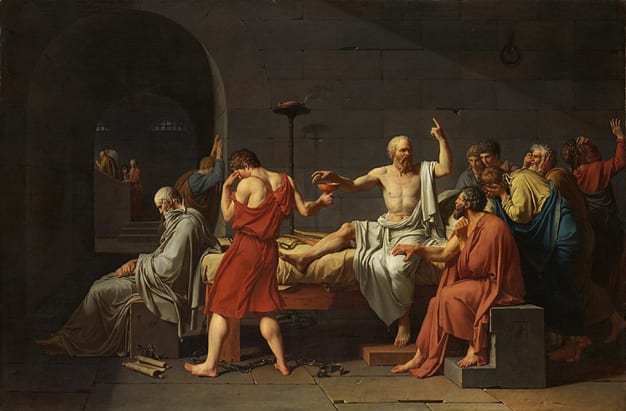
http://www.metmuseum.org/art/collection/search/436105
We worship God, not a giant “us.”
God is not made in our image. He cannot be. If such a being exists, then God does not need us. He might choose to create humankind or not. God is, in God’s essence, totally different from humanity. This matters greatly, since it is deadly error to think God is actually some bigger, faster, stronger version of us. Some of us might picture God as a big, bearded man (perhaps our race) sitting on a throne. That image might have value up to a point, but only if we recall that the image is also false. “Large” is not always greater than “small.” God as God does not literally sit. God as God does not have a beard and is not a man.
Since God loves us, there is power in picturing Him like a loving human father, but this is an image. Sacred Scriptures give us many images, ones that have proven safer than most, but sages and prophets constantly were pointing to the limits of those images. The Temple was “an abiding place,” but God did not literally live there and He could survive the destruction of His “home.” All our language about God is a sign pointing to the fundamental truth of something different in kind from all of Creation.
God is not just a perfect human, a Mary Sue. We err greatly when we limit him to our particular nation or our times. God is as Plato said: “the known Unknown.” We can know that someone like God is, what God is not, and develop some general descriptions that say what God is most like, but not (by definition) capture God in essence. So an interlocutor errs when he says:
Buddy, your god is, by your faith own claim, all-powerful, all-knowing, all-seeing. He can do no wrong and apparently unable to change his nature, because he is already perfect. That is the definition of Mary Sue. And yes, God is in stand-in for humanity, but not of single group. God is the ideal of humanity at best or at least what Christian think humanity should try be.
God is not more of the kind of power we have. God is the First Cause, the ground of Being. He does not have power, but is beyond power. God can do anything, because God sustains everything. We can only picture God. The critic misunderstands reality when he worries:
Hell, modern day artist of the Christian faith frequently paint their either God or Jesus as their own ethicthy or culture. Christian are worshiping an ideal they know they can’t reach, so they created a divinity that is both similar and alien to humans.
This is just so. Why? God can only be known by images and so we try for images that relate immediately to us. God is like this good father or that just king. However, note that genuine monotheists keep pointing out that these icons (verbal or artistic) are only icons. They are not God. They cannot be God. They help us, but can harm us if we turn them into idols. Imagine thinking God is an American! God is not “us” with all the bad gone: those beings are the redeemed humans at the end of time. We will never be God in His essence. Meanwhile, our images, icons, words, point us Godward best they can.
We do worship the ideal, because that is fit for a free person’s worship. We do not wish to be God, that would be bizarre, but to be like God as Image bearers. We will reflect His glory in part. Each of us, all the billions of us, can reflect a different aspect of that glory. There is enough glory to go around!
As for those sages, prophets, philosophers, simple folk who wrote the books of the Bible, they keep reminding us of their lived experience and how they expressed that experience. Sadly, some dismiss this:
And please don’t keep on pointing to your Bible as if would magically transform my mind. We all already know the basis of your thoughts and beliefs, pal, but you might as will be a Muslim pointing to the Quran to win all your battle. To a non-believer, you might as well saying a spell from Harry Potter.
Any change of mind toward goodness, truth, and beauty is, in one sense of the term, magical (beautiful and immaterial). A really great book, and the Bible is a collection of great books, has the power to do this. The Quran has that power. The Harry Potter series, though a lesser set of books, can do so as well. These three book collections (the Bible, Quran, Harry Potter) agree on somethings (God) and disagree on other things. I conclude that the Biblical books are the best description of God we have. Obviously billions disagree! That is the joy of dialog: expressing the truth as you see it, learning where you are wrong, helping others where you are right.
This is philosophy, though sometimes philosophy is rejected as well as the Bible:
And as philosophy pointing to your god, that your opinion buddy, not fact. There as many philosophers as their are stars in the skies, and they all have many different truth. Hell, even your favorite philosophers, Plato and Aristotle probably never had your god in mind. They might have heard of the weird Jews, but they certainly made no attempts to join them in worship of the ‘one’ true god. Honestly, they probably burning in hell based on your beliefs, unless you’re going to give them a past for whatever weird reason.
Sadly, there are not as many philosophers as stars in the sky, though there are more than a few. Philosophy does not promote agreement as much as refine the ideas that are worth considering. Theism is one of those ideas. Christianity, which is theist, is a set of those ideas. We have made our beliefs better by interaction with those who reject them! Plato may or may not have been a monotheist but he certainly believed in an unchanging good. Aristotle was a monotheist, but his ideas about God are not always those I would share. Still, both when they pointed to unchanging, eternal reality (like the existence of numbers), pointed to God.
Jewish sages encountered this reality in the person of God over their history. They could, then, incorporate congenial ideas from Plato and Aristotle. We have no evidence that Plato met the Jewish sages, but when the Jewish sages met Platonism, they knew how to use it. Monotheism is grand that way: a great structure that can adapt and adopt the repeated insights over history that point to God.
As for Hell, there must be one. God, after all, truly loves us, so must provide someplace for those who will not consent to His love. If you say “no” to the “I AM,” then you will get the best that can be had without him. Still God is good, just, and loves His creation. That makes me hopeful for all of us, not just these two great men.
Previous Post
August 23, 2020
The Man Comes Around: Embrace the Weird
Next Post
August 25, 2020 Proper Weirdness!
Browse Our Archives
Select a Category Apologetics Art Culture Education On Books On Education Philosophy Politics Pop Culture Spiritual Reflections Uncategorized
Select a Month October 2026 September 2026 August 2026 July 2026 July 2025 June 2025 September 2024 July 2024 June 2024 December 2023 June 2023 September 2022 May 2022 April 2022 March 2022 February 2022 July 2021 June 2021 May 2021 April 2021 March 2021 February 2021 January 2021 December 2020 November 2020 October 2020 September 2020 August 2020 July 2020 June 2020 May 2020 April 2020 March 2020 February 2020 January 2020 December 2019 November 2019 October 2019 September 2019 August 2019 July 2019 June 2019 May 2019 April 2019 March 2019 February 2019 January 2019 December 2018 November 2018 October 2018 September 2018 August 2018 July 2018 June 2018 May 2018 April 2018 March 2018 February 2018 January 2018 December 2017 November 2017 October 2017 September 2017 August 2017 July 2017 June 2017 May 2017 April 2017 March 2017 February 2017 January 2017 December 2016 November 2016 October 2016 September 2016 August 2016 July 2016 June 2016 May 2016 April 2016 March 2016 February 2016 January 2016 December 2015 November 2015 October 2015 September 2015 August 2015 July 2015 June 2015 May 2015 April 2015 March 2015 February 2015 January 2015 November 2014 October 2014 September 2014 August 2014 July 2014 June 2014 May 2014 April 2014 March 2014 February 2014 January 2014 December 2013 November 2013 October 2013 September 2013 August 2013 July 2013 June 2013 May 2013 April 2013 March 2013 February 2013 January 2013 December 2012 November 2012 October 2012 September 2012 August 2012 July 2012 June 2012 May 2012
Follow Us!
TAKE THE
Religious Wisdom Quiz
Three of the four beasts from Daniel's vision are: a bear with three ribs in its mouth, a leopard with four wings and four heads, and a terrifying beast with iron teeth and ten horns. Which beast is missing?
Select your answer to see how you score.
A lion with eagle's wings A bull breathing fire A dragon with seven heads A ram with two sets of gilded horns
Books by This Author John Mark Reynolds
Related posts from Eidos

Yet I Love Her: History and the Church


The Iceberg is There: Verbosity Cannot Defeat Reality

One Weeping Icon at Christmas is Enough
TRENDING AT PATHEOS Evangelical

The REST of Your Life: A Creative Wrestles...
This week I had a conversation with a good friend from church....

How the author of the world's best hymn...
I've been working with John Newton for a while now. This makes...

Long before this Lectio Divina, Psalm 130 - the song - started...

What About the Trees? Another Living Parable
After I finished writing the last article about falling leaves as a...

Why Classical Education Is a Conversation, Not a...
Come and Read: Joy in Classical Education When I was a little...

Cornell University has received a great deal of negative publicity and intense...
view all Evangelical blogs
Ad-Free & Subscriber Log-In Subscription Support
- About Us
- 2026 Calendar
- Videos
- Podcasts
- Library of World Religions
- Faith In Media Tracker
- Advertise With Us
- Write for Us
- Privacy Policy
- Terms of Service
- Do Not Sell My Data
- Contact Us
- Radiant Digital
- Manage Newsletter Subscriptions
- Unsubscribe From Notifications
- Sitemap
Copyright 2008-2026, Patheos. All rights reserved.
Subscription Support Ad-Free & Subscriber Log-In
Follow Patheos