
BuddhistCatholicContemplativeEvangelicalGeneral ChristianHinduJewishLatter-day SaintMuslimNew VisionsProgressive Christian
Beliefs
- Buddhist
- Catholic
- Contemplative
- Evangelical
- General Christian
- Hindu
- Jewish
- Latter-day Saint
- More Voices
- Muslim
- New Visions
- Pagan
- Progressive Christian
Topics
- Religion News
- Food and Religion
- Sports and Religion
- Religious Art
- Religious Music and Entertainment
- Religious Events
- History and Religion
- Style and Religion
- Politics and Religion
- Women in Religion
- Recreation Outdoors and Religion
- Business Finance and Religion
- Careers Workplace and Religion
- Education and Religion
- Family Parenting and Religion
- Health Fitness and Religion
- Home and Religion
- Relationships and Religion
- Technology and Religion
- Travel and Religion
Columnists
- Buddhist Columnists
- Business Finance and Religion Columnists
- Careers Workplace and Religion Columnists
- Catholic Columnists
- Contemplative Columnists
- Education and Religion Columnists
- Evangelists Columnists
- Family Parenting and Religion Columnists
- General Christian Columnists
- Health Fitness and Religion Columnists
- Hindu Columnists
- History and Religion Columnists
- Home and Religion Columnists
- Jewish Columnists
- More Voices Columnists
- Latter Day Columnists
- Muslim Columnists
- New Visions Columnists
- Nonreligious Columnists
- Pagan Columnists
- Politics and Religion Columnists
- Progressive Columnists
- Recreation Outdoors and Religion Columnists
- Relationships and Religion Columnists
- Religion News Columnists
- Religious Art Columnists
- Religious Events Columnists
- Religious Music and Entertainment Columnists
- Sports and Religion Columnists
- Style and Religion Columnists
- Technology and Religion Columnists
- Travel and Religion Columnists
- Women in Religion Columnists
Resource Library
- 2026 Calendar
- Library of World Religions
- The 100 Most Holy Places on Earth
- Patheos Answers
- Podcasts
- Videos
- Faith Leaders Database
- Anglican Episcopalian
- Bahai
- Baptist
- Buddhism
- Christianity
- Confucianism
- Eastern Orthodoxy
- Hinduism
- Holiness and Pentecostal
- ISKCON
- Islam
- Judaism
- Lutheran
- Methodist
- The Church of Jesus Christ of Latter-day Saints
- New Age
- Paganism
- Presbytarian and Reformed
- Protestantism
- Religion Behind the Scenes
- Roman Catholic
- Scientology
- Shia Islam
- Sikhism
- Sufism
- Sunni Islam
- Taoism
- Zen
- See all religions
Research Tools
 Ad-Free & Subscriber Log-In Subscription Support
Ad-Free & Subscriber Log-In Subscription Support
Follow Patheos 

- Trending:
- Forgiveness
- |
- Marriage
- |
- Consciousness
- |
- Death Penalty
- |
- Election
- |
- Halloween

- Home
- Evangelical
- Based on the World Around Me and In Me
Based on the World Around Me and In Me
Last updated on: August 19, 2020 at 10:19 pm by John Mark N. Reynolds
Based on the World Around Me and In Me 2020-08-19T22:19:52-04:00 John Mark N. Reynolds
Patheos Explore the world's faith through different perspectives on religion and spirituality! Patheos has the views of the prevalent religions and spiritualities of the world.
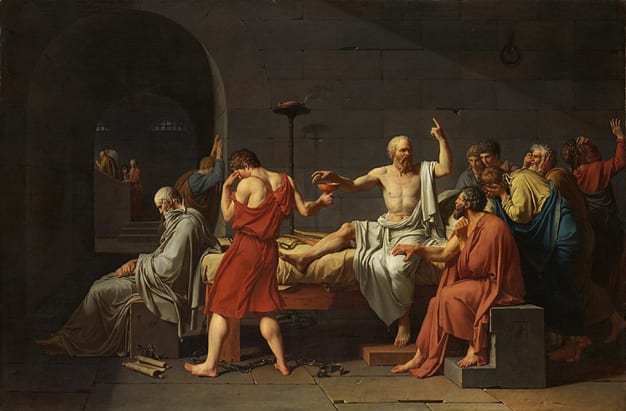
http://www.metmuseum.org/art/collection/search/436105
Let’s live based on the world around and in us. Fantasy, even high fantasy, is valuable as “what-if-ery”, but not as a final account of the truth, the good, and beauty.
I loved fantasy novels as a boy, even groaners like Elfstones of Shannara, but never doubted that they were unreal. Science fiction, another literary passion, think Isaac Asimov or Ray Bradbury, had this advantage: it claimed a “could be.” Imagine the disappointment when after enough science reading, I discovered that science fiction and science mostly were related though fiction: science fictionalized. The “science babble” of Star Trek: the Next Generation and all later Treks, where characters use science sounding words in meaningless ways, ruined the pleasure. That kind of “science” fiction was just fantasy with phasers instead of swords. Star Wars gave me the swords.
None of it gave me reality: the world in which I lived.
Oddly, this love of fantasy meant that when I read the New Testament I could tell the difference. The Gospel of Mark was not that sort of thing, whatever it was. The writer might be wrong, misguided, or brilliantly crazy, but Mark was doing something different than even the best fantasy writer. He was not a Judea-Roman Tolkien!
Often I run into folk who misunderstand my theory of knowing, my epistemology of belief, including people writing here at Patheos. This criticism helps clarify what I meant to say and said so badly that smart people misunderstood what I meant.
Sometimes people who are not Christians assume I begin with the Bible or my own religious experience and then look for something, anything, to make this seem sensible. That would not be good. What if I were wrong in my starting assumptions?
One must be begin by challenging starting assumptions. One should be skeptical about any idea. Examine everything. After doing the best one can to do so, a person moves forward and builds the best explanation of reality one can. This is, fundamentally, a delightful process, full of wonder, and if we get things wrong, assuming we really have had intellectual integrity, then all will be well. The good God, if the good God exists, will damn nobody for an intellectual error if he has made an intellectual error and is not just putting some smart-words over his moral evil. It’s easy to kind ourselves.
Recently a commentator on my writing decided that I had cut loose from real life. He wishes me to be grounded in “real life.”
Just so!
He is bothered by any use of Plato and Aristotle, because they were wrong about so many things. Real life should guide us.
Yes!
However, surely, maybe, what is “real” is not so easy to discern! We might think the Earth the center of the cosmos, since that looks true. Later, against appearances, we might postulate the Sun as the center of the cosmos. Both are wrong, neither is the center of the entire cosmos. Writers who suggest either idea are incorrect, so far as we now know.
Good. What about their other ideas? Some who write me suggest that their other ideas do not matter, because they have gotten “reality” wrong. This is puzzling to me. Of course one should not quote Plato and Aristotle as if that shows that some smart person agrees with me so I must be right. Instead, one looks to these great thinkers for good ideas and then uses those ideas to challenge or confirm ideas we have! We acknowledge what they got wrong, that is obvious to us, and then puzzle over the challenges to our own views (almost surely wrong somewhere!) they give us.
This is wondering and is wonderful!
Wondering is one element to “faith:” believing what you have reasons to believe that also is not certain.
One should not believe in God (there can only be one) if the existence of God is illogical. God can not be merely a “big guy.” This is obvious since “big” is not part of greatness. A whale is bigger than a woman, but a woman can invent a space ship and a whale cannot. A giant snake cannot be God, though perhaps a god, since if a snake, then the being is limited! God is unlimited. If there was a Flying Spaghetti Monster, and I wish there were, that also would not be God, since such a being is locked into one particular part of space and time. God is omnipresent. If anyone, Plato, a Hindu, a Christian, a Jewish person postulates “the greatest possible being,” then whatever else is true of that Being, that Being is not Zeus (ethically suspect), a big guy (leaves out women), or a Flying Spaghetti Monster (leaves out other form of pasta).
One could find the God of monotheism (Christianity, Judaism, Islam, and many other religions) and one would find most of the world’s thinkers.
One need not start with believing such a God exists, but look at the world and ask what is sufficient to explain that external world. Most vitally, we look at our own experience, the “within” we cannot escape, that is also part of reality, and find religious experience. We sense the divine. I once debated the atheist Dan Barker and he admitted to many such experiences. He explained them away, as is his right, but he was explaining away an experience more basic than any other.
After all, everything we experience “is in our heads,” and so looking to anything outside our heads is foolish.
When we know this then we must beware! Why? We must not merely grasp the first interpretation of our experiences (in our heads). Our interpretation might be wrong, so we keep thinking, examining data, looking at our experiences, and doing the best we can.
Orthodox Christianity, gloriously, has so far been true, good, and beautiful. It is not bound to one culture, one time. Orthodoxy endures. We must not be like the “ghost hunters” so eager to find “ghosts at every noise, declaring it to be from the other word.” We must be calm, examine everything, challenge all, and proceed apace. The good news is that this precisely what Christianity advises (in her global form).
There are many things that go bump in the night, there are only is one One that can endure the true light.
Here is the whole commentl. I am not bored by this person, because he has a mind awake. He is, like many I publish here, skeptical. God bless me with a more skeptical spirit! Do not judge small typographical errors or autocorrect replacements of names. They happen to me all the time. Instead, in charity, feel and consider the force of the argument. I do.
You must be bored if you taking your time to listen to me. And it is interesting to see a respond, so it I might as well play along. I will not deny you have a point. If you believer everything start from your world view of the Bible, then your assumes have some basis. And you are correct that as an atheist, I have no reason to think any of it is true. That’s a fair point. Nothing about this is baffling and confusion.
The problem is this basis of these assumptions to be trusted. Bring in Pluto, Jesus, Paul, and Aristotle everyone else in the world in if you like to support your position on ‘nature.’. You more then welcome, but that doesn’t make any of what you say any more base in real life. Pluto and Aristotle were influential and made good contributions to this world, but they were also wrong on so many things.They were limited on their word view by their tech, cultural, and many other things. It’s worthy to give them attention, but that doesn’t mean we have to take everything they say at face value.
As for Jesus and Paul, there isn’t much reason to believe them to be right, logically at least. All of what they proclaimed is theology and legends, which at the end of the day, is a matter of the heart then of reason. That true for all faiths. Either you believe there some big guy, snake, or spaghetti monster in the sky controlling everything or you do not. And if you believe so, that the end of it, personally. Yet if you want to try to convince other this divinity is real, I get why you try to appeal to reason. It would be nice if logic found in this world could find this mysterious being watching over it all.
Yet this bring us to why it hard to take you assumptions seriously. Your not basing your reasoning on the world around us. Instead of ‘can the world I live in point to any sort of god,’, you start from the assumption ‘there is a god in this world, and the proof is there if you just look.’
You’re not much different from those ghost hunter shows where people seek out the spirits. Already believing in ghosts, they jump at every noise, declaring it to be from the other word. Yet to a skeptic,they might seek it out and find it just a rock that fell over. And if the skeptic can’t find the source of the noise, it doesn’t mean right away there is a ghost. Only that there is a noise and it came from the night. There are many things that go bump out there.
And so jump toward your god and demons, no matter where the boulder might have rolled off to.
Previous Post

August 18, 2020
Old Vices Don’t Improve With Age
Next Post
August 20, 2020 The Way
Browse Our Archives
Select a Category Apologetics Art Culture Education On Books On Education Philosophy Politics Pop Culture Spiritual Reflections Uncategorized
Select a Month October 2026 September 2026 August 2026 July 2026 July 2025 June 2025 September 2024 July 2024 June 2024 December 2023 June 2023 September 2022 May 2022 April 2022 March 2022 February 2022 July 2021 June 2021 May 2021 April 2021 March 2021 February 2021 January 2021 December 2020 November 2020 October 2020 September 2020 August 2020 July 2020 June 2020 May 2020 April 2020 March 2020 February 2020 January 2020 December 2019 November 2019 October 2019 September 2019 August 2019 July 2019 June 2019 May 2019 April 2019 March 2019 February 2019 January 2019 December 2018 November 2018 October 2018 September 2018 August 2018 July 2018 June 2018 May 2018 April 2018 March 2018 February 2018 January 2018 December 2017 November 2017 October 2017 September 2017 August 2017 July 2017 June 2017 May 2017 April 2017 March 2017 February 2017 January 2017 December 2016 November 2016 October 2016 September 2016 August 2016 July 2016 June 2016 May 2016 April 2016 March 2016 February 2016 January 2016 December 2015 November 2015 October 2015 September 2015 August 2015 July 2015 June 2015 May 2015 April 2015 March 2015 February 2015 January 2015 November 2014 October 2014 September 2014 August 2014 July 2014 June 2014 May 2014 April 2014 March 2014 February 2014 January 2014 December 2013 November 2013 October 2013 September 2013 August 2013 July 2013 June 2013 May 2013 April 2013 March 2013 February 2013 January 2013 December 2012 November 2012 October 2012 September 2012 August 2012 July 2012 June 2012 May 2012
Follow Us!
TAKE THE
Religious Wisdom Quiz
What is the longest verse in the Bible?
Select your answer to see how you score.
Romans 8:28 John 3:16 Esther 8:9 Psalm 119:105
Books by This Author John Mark Reynolds
Related posts from Eidos

Rooted: Why Classical Education Needs Community

Classical Education and the Art of Dying Well

Golden, Golden, Golden: My Mother's Last Lesson

TRENDING AT PATHEOS Evangelical

The REST of Your Life: A Creative Wrestles...
This week I had a conversation with a good friend from church....

How the author of the world's best hymn...
I've been working with John Newton for a while now. This makes...

Long before this Lectio Divina, Psalm 130 - the song - started...

What About the Trees? Another Living Parable
After I finished writing the last article about falling leaves as a...

Why Classical Education Is a Conversation, Not a...
Come and Read: Joy in Classical Education When I was a little...

Cornell University has received a great deal of negative publicity and intense...
view all Evangelical blogs
Ad-Free & Subscriber Log-In Subscription Support
- About Us
- 2026 Calendar
- Videos
- Podcasts
- Library of World Religions
- Faith In Media Tracker
- Advertise With Us
- Write for Us
- Privacy Policy
- Terms of Service
- Do Not Sell My Data
- Contact Us
- Radiant Digital
- Manage Newsletter Subscriptions
- Unsubscribe From Notifications
- Sitemap
Copyright 2008-2026, Patheos. All rights reserved.
Subscription Support Ad-Free & Subscriber Log-In
Follow Patheos