
BuddhistCatholicContemplativeEvangelicalGeneral ChristianHinduJewishLatter-day SaintMuslimNew VisionsProgressive Christian
Beliefs
- Buddhist
- Catholic
- Contemplative
- Evangelical
- General Christian
- Hindu
- Jewish
- Latter-day Saint
- More Voices
- Muslim
- New Visions
- Pagan
- Progressive Christian
Topics
- Religion News
- Food and Religion
- Sports and Religion
- Religious Art
- Religious Music and Entertainment
- Religious Events
- History and Religion
- Style and Religion
- Politics and Religion
- Women in Religion
- Recreation Outdoors and Religion
- Business Finance and Religion
- Careers Workplace and Religion
- Education and Religion
- Family Parenting and Religion
- Health Fitness and Religion
- Home and Religion
- Relationships and Religion
- Technology and Religion
- Travel and Religion
Columnists
- Buddhist Columnists
- Business Finance and Religion Columnists
- Careers Workplace and Religion Columnists
- Catholic Columnists
- Contemplative Columnists
- Education and Religion Columnists
- Evangelists Columnists
- Family Parenting and Religion Columnists
- General Christian Columnists
- Health Fitness and Religion Columnists
- Hindu Columnists
- History and Religion Columnists
- Home and Religion Columnists
- Jewish Columnists
- More Voices Columnists
- Latter Day Columnists
- Muslim Columnists
- New Visions Columnists
- Nonreligious Columnists
- Pagan Columnists
- Politics and Religion Columnists
- Progressive Columnists
- Recreation Outdoors and Religion Columnists
- Relationships and Religion Columnists
- Religion News Columnists
- Religious Art Columnists
- Religious Events Columnists
- Religious Music and Entertainment Columnists
- Sports and Religion Columnists
- Style and Religion Columnists
- Technology and Religion Columnists
- Travel and Religion Columnists
- Women in Religion Columnists
Resource Library
- 2026 Calendar
- Library of World Religions
- The 100 Most Holy Places on Earth
- Patheos Answers
- Podcasts
- Videos
- Faith Leaders Database
- Anglican Episcopalian
- Bahai
- Baptist
- Buddhism
- Christianity
- Confucianism
- Eastern Orthodoxy
- Hinduism
- Holiness and Pentecostal
- ISKCON
- Islam
- Judaism
- Lutheran
- Methodist
- The Church of Jesus Christ of Latter-day Saints
- New Age
- Paganism
- Presbytarian and Reformed
- Protestantism
- Religion Behind the Scenes
- Roman Catholic
- Scientology
- Shia Islam
- Sikhism
- Sufism
- Sunni Islam
- Taoism
- Zen
- See all religions
Research Tools
 Ad-Free & Subscriber Log-In Subscription Support
Ad-Free & Subscriber Log-In Subscription Support
Follow Patheos 

- Trending:
- Forgiveness
- |
- Marriage
- |
- Consciousness
- |
- Death Penalty
- |
- Election
- |
- Halloween

- Home
- Evangelical
- Assuming about God?
Assuming about God?
Last updated on: August 15, 2020 at 7:21 pm by John Mark N. Reynolds
Assuming about God? 2020-08-15T19:21:11-04:00 John Mark N. Reynolds
Patheos Explore the world's faith through different perspectives on religion and spirituality! Patheos has the views of the prevalent religions and spiritualities of the world.
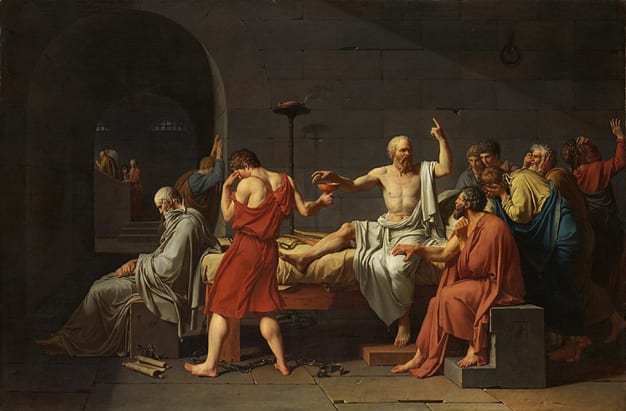
http://www.metmuseum.org/art/collection/search/436105
“Assuming” when I was a kid led to somebody, usually the fifth grade know-it-all, telling us “assuming made an ass out of you and me.” Annoying as he was the kid had a point. If you just assume what you wish to be true is true, then you will often be a fool. This kind of assuming is fatal: epistemologically fatal.
Growing up one learns that the same word can have two meanings and in sixth grade hilarity can ensue. Pity the teacher who says that something happened on the “poop deck.”
So it goes as we grow up: language turns out to be complicated.
The word “assume” also has more than one meaning: one embarrassing and the other quite philosophically respectable. To work a logical problem, you might take a proposition and then see what the consequences are. If assuming the negation (that the proposition is false) leads to a contradiction, then you have shown that the original assumption is true! For example, if you start with the desire to:
- Show that P is true or not P is true.
- If you then assume NOT (P is true or not P is true),
- this is equivalent to saying P is true AND not P is true,
- but this is a contradiction.
We can assume a thing is true based on a previous argument and use that proposition in a further argument or we can assume something we think is false to see if it creates a contradiction. Informally, imagine that some wondered if vampires existed. Suppose they assume vampires do not exist. What facts of the world would contradicted by that assumption? Similarly, suppose (previously) a thinker had shown that abortion is murder, then they could proceed to show what the implications of that would be.
Sometimes in an argument, one begins with IF this is true, then the following might be true . . .
After all, if Atlantis had existed (it did not), then there might be capitol city of Atlantis. If Atlantis did exist, the arguing about the ruling city would be waste of time.
But wait! Suppose we are not talking about Atlantis, but something more disputed such as the proper tariff policy. A person might believe that this tariff policy (let’s call it “X”) has been shown to be best, and so then argue that this implies policy A, B, and C.
Sometimes one idea, if assumed, implies another. Now imagine a critic who has not, quite, gotten past the old fifth grade meaning of “assume.” If someone said, “If X, then assume A, B, C,” he would snort. . . “LOL! You are just assuming X is true.”
Just so.
Ideas “A, B, C” are dependent on the truth of X. Sometimes the only reason to an idea is worthy of belief is based on an earlier, more reputable idea that implies the other ideas! For example, I think that tonight that Hope will wish to watch a movie with me, but this idea flows from thirty years of previous ideas and experiences. If those experiences did not exist, those ideas had not been shown to be true, then thinking “this wonderful fifty-six year old wishes to watch a movie with me” is very improbable. Yet every day, I assume the past truths (having shown them to be truth) and then act on those assumptions without (usually) making an ass out of you or even me (much harder!).
If a person attacks an idea I have, but does not accept the bigger idea, he has missed the force of the argument. Maybe my central idea is wrong, but that has to be shown. If it is right, and accepted, then all is changed. To give a simple example: if I assume my wife loves me, then many, many decisions will flow from that central belief. You cannot dismiss some implication of that idea (“She teases me to help me.”) by simply saying: “You are just assuming your wife loves you.”
I am, but based on previous arguments.
This has implications in every area of life. If a person is convinced that socialism as a general system is best, then she will draw out the implications. One cannot just say: “You are assuming socialism is true!”
Of course, she is.
Instead, the critic would have to do the very hard work of showing the root belief is false and so the implications are not true. When it comes to religion, the rules are the same. IF God exists, then the cosmos is more varied than many think. This results in possibilities (for example the existence of demons) that are not possible if God does not exist. The plausibility of one idea depends on a more central idea being true.
A besetting intellectual problem is that we think that our rational assent to any given truth depends on nothing but that truth. For example, if God exists, then perhaps we will consider the existence of demons. IF demons existed, they would have evil natures. One implication of having an evil nature is that they would have no desire to help us be rational. They would tease and not confirm their existence. IF we have shown God exist (earlier), then mayhap demons exist. IF we think we can show God does not exist, then there will never be conclusive evidence for the demonic.
Why?
Demons delight in our intellectual torture!
Here is one critic of this what I am saying here when it comes to demons:
This is assuming you know the nature of a god, and that you can say with no doubt that god acts like this. Yet you don’t, only assuming since a book, that can only be assume correct through circle reasoning, say so. This is also assuming that demons even exist or even describe correctly. How do I know the book isn’t just holy progranada used to discredit the devils. Or the devils haven’t tricked you into thinking there a good god at all? So many assumption without much proof or logic to it.
I am assuming that IF the nature of God is as Plato, Aristotle, Jesus, and Paul describe that nature, THEN there would be certain logical implications. A man might attack those assumptions and a man might. However, merely saying that what one has assumed (by way of argument) is assumed is not so interesting.
Do demons exist? There is not sufficient evidence if one is an atheist to say that demons exist. One will not come to Christ by way of demons. However, if God exists, and is revealed in the person of Jesus Christ, then demons may very well exist. The second idea is dependent of the plausibility of the first. This is NOT circular reasoning at all, but sequential reasoning: if A, then B.
I do not assume devils exist. They are, if Christianity is true, a brokenness in the model. I assume that IF a good God exist, then devils MIGHT exist or they might not. We can go either way.
The critic becomes confused, because he will not think sequentially. “How do I know?”
I am not sure, let us look at first things first.
What are the first things?
What would you suggest?
Dialogue is a friend of the one who loves the Word made flesh.
*informal logic

Next Post

August 16, 2020 The Education Called Classical
Browse Our Archives
Select a Category Apologetics Art Culture Education On Books On Education Philosophy Politics Pop Culture Spiritual Reflections Uncategorized
Select a Month October 2026 September 2026 August 2026 July 2026 July 2025 June 2025 September 2024 July 2024 June 2024 December 2023 June 2023 September 2022 May 2022 April 2022 March 2022 February 2022 July 2021 June 2021 May 2021 April 2021 March 2021 February 2021 January 2021 December 2020 November 2020 October 2020 September 2020 August 2020 July 2020 June 2020 May 2020 April 2020 March 2020 February 2020 January 2020 December 2019 November 2019 October 2019 September 2019 August 2019 July 2019 June 2019 May 2019 April 2019 March 2019 February 2019 January 2019 December 2018 November 2018 October 2018 September 2018 August 2018 July 2018 June 2018 May 2018 April 2018 March 2018 February 2018 January 2018 December 2017 November 2017 October 2017 September 2017 August 2017 July 2017 June 2017 May 2017 April 2017 March 2017 February 2017 January 2017 December 2016 November 2016 October 2016 September 2016 August 2016 July 2016 June 2016 May 2016 April 2016 March 2016 February 2016 January 2016 December 2015 November 2015 October 2015 September 2015 August 2015 July 2015 June 2015 May 2015 April 2015 March 2015 February 2015 January 2015 November 2014 October 2014 September 2014 August 2014 July 2014 June 2014 May 2014 April 2014 March 2014 February 2014 January 2014 December 2013 November 2013 October 2013 September 2013 August 2013 July 2013 June 2013 May 2013 April 2013 March 2013 February 2013 January 2013 December 2012 November 2012 October 2012 September 2012 August 2012 July 2012 June 2012 May 2012
Follow Us!
TAKE THE
Religious Wisdom Quiz
What does "Apostle" mean in Greek?
Select your answer to see how you score.
Elder King One who is sent Preacher
Books by This Author John Mark Reynolds
Related posts from Eidos

Classical Education and the Art of Dying Well

Golden, Golden, Golden: My Mother's Last Lesson


When the Center Holds: A Tribute to My...
TRENDING AT PATHEOS Evangelical

The REST of Your Life: A Creative Wrestles...
This week I had a conversation with a good friend from church....

How the author of the world's best hymn...
I've been working with John Newton for a while now. This makes...

Long before this Lectio Divina, Psalm 130 - the song - started...

What About the Trees? Another Living Parable
After I finished writing the last article about falling leaves as a...

Why Classical Education Is a Conversation, Not a...
Come and Read: Joy in Classical Education When I was a little...

Cornell University has received a great deal of negative publicity and intense...
view all Evangelical blogs
Ad-Free & Subscriber Log-In Subscription Support
- About Us
- 2026 Calendar
- Videos
- Podcasts
- Library of World Religions
- Faith In Media Tracker
- Advertise With Us
- Write for Us
- Privacy Policy
- Terms of Service
- Do Not Sell My Data
- Contact Us
- Radiant Digital
- Manage Newsletter Subscriptions
- Unsubscribe From Notifications
- Sitemap
Copyright 2008-2026, Patheos. All rights reserved.
Subscription Support Ad-Free & Subscriber Log-In
Follow Patheos