
BuddhistCatholicContemplativeEvangelicalGeneral ChristianHinduJewishLatter-day SaintMuslimNew VisionsProgressive Christian
Beliefs
- Buddhist
- Catholic
- Contemplative
- Evangelical
- General Christian
- Hindu
- Jewish
- Latter-day Saint
- More Voices
- Muslim
- New Visions
- Pagan
- Progressive Christian
Topics
- Religion News
- Food and Religion
- Sports and Religion
- Religious Art
- Religious Music and Entertainment
- Religious Events
- History and Religion
- Style and Religion
- Politics and Religion
- Women in Religion
- Recreation Outdoors and Religion
- Business Finance and Religion
- Careers Workplace and Religion
- Education and Religion
- Family Parenting and Religion
- Health Fitness and Religion
- Home and Religion
- Relationships and Religion
- Technology and Religion
- Travel and Religion
Columnists
- Buddhist Columnists
- Business Finance and Religion Columnists
- Careers Workplace and Religion Columnists
- Catholic Columnists
- Contemplative Columnists
- Education and Religion Columnists
- Evangelists Columnists
- Family Parenting and Religion Columnists
- General Christian Columnists
- Health Fitness and Religion Columnists
- Hindu Columnists
- History and Religion Columnists
- Home and Religion Columnists
- Jewish Columnists
- More Voices Columnists
- Latter Day Columnists
- Muslim Columnists
- New Visions Columnists
- Nonreligious Columnists
- Pagan Columnists
- Politics and Religion Columnists
- Progressive Columnists
- Recreation Outdoors and Religion Columnists
- Relationships and Religion Columnists
- Religion News Columnists
- Religious Art Columnists
- Religious Events Columnists
- Religious Music and Entertainment Columnists
- Sports and Religion Columnists
- Style and Religion Columnists
- Technology and Religion Columnists
- Travel and Religion Columnists
- Women in Religion Columnists
Resource Library
- 2026 Calendar
- Library of World Religions
- The 100 Most Holy Places on Earth
- Patheos Answers
- Podcasts
- Videos
- Faith Leaders Database
- Anglican Episcopalian
- Bahai
- Baptist
- Buddhism
- Christianity
- Confucianism
- Eastern Orthodoxy
- Hinduism
- Holiness and Pentecostal
- ISKCON
- Islam
- Judaism
- Lutheran
- Methodist
- The Church of Jesus Christ of Latter-day Saints
- New Age
- Paganism
- Presbytarian and Reformed
- Protestantism
- Religion Behind the Scenes
- Roman Catholic
- Scientology
- Shia Islam
- Sikhism
- Sufism
- Sunni Islam
- Taoism
- Zen
- See all religions
Research Tools
 Ad-Free & Subscriber Log-In Subscription Support
Ad-Free & Subscriber Log-In Subscription Support
Follow Patheos 

- Trending:
- Forgiveness
- |
- Marriage
- |
- Consciousness
- |
- Death Penalty
- |
- Election
- |
- Halloween

- Home
- Evangelical
- The Bad Question (Plato’s Meno)
The Bad Question (Plato’s Meno)
Last updated on: April 26, 2020 at 5:25 am by John Mark N. Reynolds
The Bad Question (Plato’s Meno) 2020-04-25T15:39:01-04:00 John Mark N. Reynolds
Patheos Explore the world's faith through different perspectives on religion and spirituality! Patheos has the views of the prevalent religions and spiritualities of the world.
“There is no such thing as a bad question.”
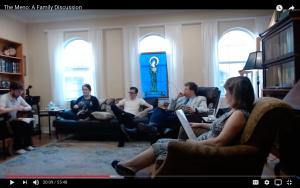
Some of the Fam discussing Meno.
This is wrong, sort of.
There are bad questions, though there are very few bad sincere questions. Imagine a “question” that is just a set up for a lecture or a social media shaming. This is the insincere question and it is worse than asking no questions at all.
An insincere question is a bad question, because such a question kills any genuine conversation. The insincerity is a virus that sickens the conversation and eventually kills the community needed to learn. I have seen this happen. . . God help me I have done this myself. When I face a problem like this, I turn to wiser people, in this case Plato.
Plato gives an example of a bad question in his dialogue Meno. Since the entire educational method he advocates begins with questions, the fact that the dialogue begins with a question is very important.
MENO: I wonder whether you can tell me, Socrates, whether excellence is teachable or, if not teachable, at least a product of habituation. Or perhaps it isn’t the kind of thing one can practice or learn, but is a natural human endowment. If not, how do people become good?*
This seems like a very good question. Is virtue something that can be taught? Our entire School and College hopes that we can teach, encourage, help souls achieve virtue. That is our bias, but a commitment to the dialectic, the endless pursuit of the Logos of God, means we have to consider that we are wrong. Plato challenges the idea that virtue can be taught and we are left unsure at the end of the dialogue or at least we are left unsure if we follow the arguments. Meno is not interested in following arguments. He likes giving grandiloquent speeches that increase his social prestige. He thinks he knows the answer so he is not really asking, but setting up his powerful speech. In the end, this sort of man will kill Socrates, because he loves the truth more than culturally acceptable ideas.
Beware the false or insincere question.
Too often we start a sermon or teaching with a question, but the question is unreal. We do not wish to hear alternative points of view. Instead, we “know” and so we pause to let the audience (God help us!) give their views and then we blast them with our truth. This is false education, not a genuine education, because the answers are immune to any genuine question. Error needs this defense, truth is too confident to stoop to such a tactic.
Of course, another false move is the slick rhetorician who apes the spirit of our age while playing off his or her knowledge of culturally unpopular ideas. He has “outgrown” (often scandalously) the “old” ideas and now is merely “posing questions.” This sophist, often famous for being the decadent child of some genuine Christian figure, can parlay his “questions” (which have only one acceptable answer to the sophist and his marks) to a living. You can spot such a person by their obsessive recapitulation of the “I was once one of them” and “now I stand as an honest broker asking my questions.” We all know that there is only one acceptable set of answers.
These are grandiloquent-Judas to the dialectic.
Yet nobody should assume that their own views, politics, or theories make them safe from this vice. Genuine Christianity, orthodox, is often corrupted by those who will not consider their own beliefs. They do not wish to live by faith, but weird certainty. When certainty does not come, they preach louder. They ask questions, but have the answers in mind. Even if the answers are true, the dialectic, the spirit of wisdom, has been betrayed.
These are the religious leaders who find the Judas and give him the silver.
What must we do? We must ask the questions we have. We must be guided by best reason, experience, and revelation. We dare not rely on our personal experience.
“There is, probably, no such thing as a bad sincere question.”
*Waterfield, Robin. Meno and Other Dialogues: Charmides, Laches, Lysis, Meno (Oxford World’s Classics) (p. 99). Oxford University Press. Kindle Edition.
Previous Post

April 25, 2020
Hope's Giant Cabbage
Next Post
April 27, 2020 The Angry Interlocutor (Meno)
Browse Our Archives
Select a Category Apologetics Art Culture Education On Books On Education Philosophy Politics Pop Culture Spiritual Reflections Uncategorized
Select a Month October 2026 September 2026 August 2026 July 2026 July 2025 June 2025 September 2024 July 2024 June 2024 December 2023 June 2023 September 2022 May 2022 April 2022 March 2022 February 2022 July 2021 June 2021 May 2021 April 2021 March 2021 February 2021 January 2021 December 2020 November 2020 October 2020 September 2020 August 2020 July 2020 June 2020 May 2020 April 2020 March 2020 February 2020 January 2020 December 2019 November 2019 October 2019 September 2019 August 2019 July 2019 June 2019 May 2019 April 2019 March 2019 February 2019 January 2019 December 2018 November 2018 October 2018 September 2018 August 2018 July 2018 June 2018 May 2018 April 2018 March 2018 February 2018 January 2018 December 2017 November 2017 October 2017 September 2017 August 2017 July 2017 June 2017 May 2017 April 2017 March 2017 February 2017 January 2017 December 2016 November 2016 October 2016 September 2016 August 2016 July 2016 June 2016 May 2016 April 2016 March 2016 February 2016 January 2016 December 2015 November 2015 October 2015 September 2015 August 2015 July 2015 June 2015 May 2015 April 2015 March 2015 February 2015 January 2015 November 2014 October 2014 September 2014 August 2014 July 2014 June 2014 May 2014 April 2014 March 2014 February 2014 January 2014 December 2013 November 2013 October 2013 September 2013 August 2013 July 2013 June 2013 May 2013 April 2013 March 2013 February 2013 January 2013 December 2012 November 2012 October 2012 September 2012 August 2012 July 2012 June 2012 May 2012
Follow Us!
TAKE THE
Religious Wisdom Quiz
True or False: King Saul was anointed by the prophet Nathan.
Select your answer to see how you score.
FALSE TRUE
Books by This Author John Mark Reynolds
Related posts from Eidos

Classical Education Must Teach Us to Make the...

The Iceberg is There: Verbosity Cannot Defeat Reality

One Weeping Icon at Christmas is Enough

The Power of Dissenting Societies: A Thought
TRENDING AT PATHEOS Evangelical

The REST of Your Life: A Creative Wrestles...
This week I had a conversation with a good friend from church....

How the author of the world's best hymn...
I've been working with John Newton for a while now. This makes...

Long before this Lectio Divina, Psalm 130 - the song - started...

What About the Trees? Another Living Parable
After I finished writing the last article about falling leaves as a...

Why Classical Education Is a Conversation, Not a...
Come and Read: Joy in Classical Education When I was a little...

Cornell University has received a great deal of negative publicity and intense...
view all Evangelical blogs
Ad-Free & Subscriber Log-In Subscription Support
- About Us
- 2026 Calendar
- Videos
- Podcasts
- Library of World Religions
- Faith In Media Tracker
- Advertise With Us
- Write for Us
- Privacy Policy
- Terms of Service
- Do Not Sell My Data
- Contact Us
- Radiant Digital
- Manage Newsletter Subscriptions
- Unsubscribe From Notifications
- Sitemap
Copyright 2008-2026, Patheos. All rights reserved.
Subscription Support Ad-Free & Subscriber Log-In
Follow Patheos