
BuddhistCatholicContemplativeEvangelicalGeneral ChristianHinduJewishLatter-day SaintMuslimNew VisionsProgressive Christian
Beliefs
- Buddhist
- Catholic
- Contemplative
- Evangelical
- General Christian
- Hindu
- Jewish
- Latter-day Saint
- More Voices
- Muslim
- New Visions
- Pagan
- Progressive Christian
Topics
- Religion News
- Food and Religion
- Sports and Religion
- Religious Art
- Religious Music and Entertainment
- Religious Events
- History and Religion
- Style and Religion
- Politics and Religion
- Women in Religion
- Recreation Outdoors and Religion
- Business Finance and Religion
- Careers Workplace and Religion
- Education and Religion
- Family Parenting and Religion
- Health Fitness and Religion
- Home and Religion
- Relationships and Religion
- Technology and Religion
- Travel and Religion
Columnists
- Buddhist Columnists
- Business Finance and Religion Columnists
- Careers Workplace and Religion Columnists
- Catholic Columnists
- Contemplative Columnists
- Education and Religion Columnists
- Evangelists Columnists
- Family Parenting and Religion Columnists
- General Christian Columnists
- Health Fitness and Religion Columnists
- Hindu Columnists
- History and Religion Columnists
- Home and Religion Columnists
- Jewish Columnists
- More Voices Columnists
- Latter Day Columnists
- Muslim Columnists
- New Visions Columnists
- Nonreligious Columnists
- Pagan Columnists
- Politics and Religion Columnists
- Progressive Columnists
- Recreation Outdoors and Religion Columnists
- Relationships and Religion Columnists
- Religion News Columnists
- Religious Art Columnists
- Religious Events Columnists
- Religious Music and Entertainment Columnists
- Sports and Religion Columnists
- Style and Religion Columnists
- Technology and Religion Columnists
- Travel and Religion Columnists
- Women in Religion Columnists
Resource Library
- 2026 Calendar
- Library of World Religions
- The 100 Most Holy Places on Earth
- Patheos Answers
- Podcasts
- Videos
- Faith Leaders Database
- Anglican Episcopalian
- Bahai
- Baptist
- Buddhism
- Christianity
- Confucianism
- Eastern Orthodoxy
- Hinduism
- Holiness and Pentecostal
- ISKCON
- Islam
- Judaism
- Lutheran
- Methodist
- The Church of Jesus Christ of Latter-day Saints
- New Age
- Paganism
- Presbytarian and Reformed
- Protestantism
- Religion Behind the Scenes
- Roman Catholic
- Scientology
- Shia Islam
- Sikhism
- Sufism
- Sunni Islam
- Taoism
- Zen
- See all religions
Research Tools
 Ad-Free & Subscriber Log-In Subscription Support
Ad-Free & Subscriber Log-In Subscription Support
Follow Patheos 

- Trending:
- Forgiveness
- |
- Marriage
- |
- Consciousness
- |
- Death Penalty
- |
- Election
- |
- Halloween

- Home
- Evangelical
- The Alphabet in the Park (Adelia Prado)
The Alphabet in the Park (Adelia Prado)
Last updated on: April 30, 2020 at 11:26 pm by John Mark N. Reynolds
The Alphabet in the Park (Adelia Prado) 2020-04-30T23:26:47-04:00 John Mark N. Reynolds
Patheos Explore the world's faith through different perspectives on religion and spirituality! Patheos has the views of the prevalent religions and spiritualities of the world.
 To feel is human, passionate living is divine.
The place of the rational in human life is not made greater by downplaying the need of experience and revelation. From Plato to Part, the wise have known that head listens to the heart and the heart is guided by reason. To live must include doing, making, creating. In his wonderfully profound, comic, and literary work Timaeus, Plato suggested the liver as the organ of revelation. The gods would give wisdom to the liver and this passionate experience, mystical, poetical, a bit mad, should be heeded by the mind! (Buy some.)
Orthodox Christians worship body, soul, and spirit the God who is Divine Logos, Creator, Helper. We may think the faith is reasonable, yet that is not at all inconsistent with the faith being physical. The Word became flesh and was glorious and full of truth. To fracture our experience, the revelation that says “Aha!” when we finally see the beauty in the chicken coop or the possibilities for philosophy in a field of bluebonnets.
I learned much from lilacs in Rochester, rhododendrons in West Virginia.
Before Names
I don’t care about the word, that commonplace.
What I want is the grand chaos that spins our syntax
the obscure birthplace of “of,” “otherwise”
“nevertheless” and “how” and all those inscrutable
crutches I walk on.
Who understands language understands God,
Whose Son is the Word. It kills you to understand.
Words only hide something deeper, deaf, and dumb,
something invented to be silenced.
In moments of grace, rare as they are,
you’ll be able to snatch it out, a live fish
in your bare hand.
Pure terror.
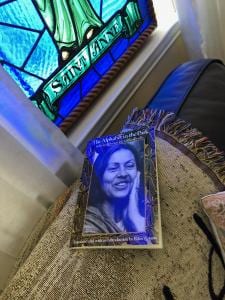
A present help in very time of pandemic is the illuminated soul, Adelia Prado. She is a poet of a place, a region of Brazil, and by herself she makes me wish to read Portuguese. Her poetry is erotic in the Platonic sense: passionate, tied to eating, desire, and physical life. She is not (as my older relatives might have put it) nasty, but also not nice. She recognizes that purity is one with the act of mothering.
I love the bits of the Prado Poetry I have read in English, mostly because she both introduces me to something I can only see, not know, and because she understands something universal. She is not just from Brazil, but from a region of Brazil. I shan’t try to explain the region, how it is different from “greater Brazil,” or what (I am told by commentators) are regional traits. They are far beyond me and in poetry that is felt impossible for me to fully get. This part of Prado is listening, learning, and loving some beauty not mine or my people.
What is common is that she loves the common folk, the wisdom she finds there, the folly, the experience of being who she is. This is just so. My whole life has been improved, educated, made richer by people who nobody describes as elite. There is no division in the soul of this poet between common wisdom and uncommon revelation. She sees that God comes to Mary and Mary inspires Thomas Aquinas and all is made whole.
Here is a poem and a pandemic prayer:
A Sick Man Says a Morning Prayer
By the sign of the Holy Cross,
may my swollen belly come unto You
and my sickness without cure move You, Lord.
I begin my day, I who in my favour
explain that I passed the dark night in wakefulness.
I heard – and this is when at times I rest –
voices from more than thirty years ago.
I saw bright wedges of sunlight in the middle of the night.
My mother spoke to me,
I shooed away cats that licked
the bowl of my childhood.
Deliver me from hurling against You
my body’s sorrow,
its zealous decay.
I must say, to relieve my feelings:
what wrathful love You have.
Take pity on me,
have mercy on me
through this sign of the Holy Cross
which 1 make over forehead, heart, mouth,
from toe tip to head,
from palm to palm.
Previous Post

April 29, 2020
The Dazzled Intellect (Plato, Paradise, Pandemics)

Browse Our Archives
Select a Category Apologetics Art Culture Education On Books On Education Philosophy Politics Pop Culture Spiritual Reflections Uncategorized
Select a Month October 2026 September 2026 August 2026 July 2026 July 2025 June 2025 September 2024 July 2024 June 2024 December 2023 June 2023 September 2022 May 2022 April 2022 March 2022 February 2022 July 2021 June 2021 May 2021 April 2021 March 2021 February 2021 January 2021 December 2020 November 2020 October 2020 September 2020 August 2020 July 2020 June 2020 May 2020 April 2020 March 2020 February 2020 January 2020 December 2019 November 2019 October 2019 September 2019 August 2019 July 2019 June 2019 May 2019 April 2019 March 2019 February 2019 January 2019 December 2018 November 2018 October 2018 September 2018 August 2018 July 2018 June 2018 May 2018 April 2018 March 2018 February 2018 January 2018 December 2017 November 2017 October 2017 September 2017 August 2017 July 2017 June 2017 May 2017 April 2017 March 2017 February 2017 January 2017 December 2016 November 2016 October 2016 September 2016 August 2016 July 2016 June 2016 May 2016 April 2016 March 2016 February 2016 January 2016 December 2015 November 2015 October 2015 September 2015 August 2015 July 2015 June 2015 May 2015 April 2015 March 2015 February 2015 January 2015 November 2014 October 2014 September 2014 August 2014 July 2014 June 2014 May 2014 April 2014 March 2014 February 2014 January 2014 December 2013 November 2013 October 2013 September 2013 August 2013 July 2013 June 2013 May 2013 April 2013 March 2013 February 2013 January 2013 December 2012 November 2012 October 2012 September 2012 August 2012 July 2012 June 2012 May 2012
Follow Us!
TAKE THE
Religious Wisdom Quiz
Who was the first man created, according to the Bible?
Select your answer to see how you score.
Jacob Moses Abraham Adam
Books by This Author John Mark Reynolds
Related posts from Eidos

Classical Education Must Teach Us to Make the...

Yet I Love Her: History and the Church


The Iceberg is There: Verbosity Cannot Defeat Reality
TRENDING AT PATHEOS Evangelical

The REST of Your Life: A Creative Wrestles...
This week I had a conversation with a good friend from church....

How the author of the world's best hymn...
I've been working with John Newton for a while now. This makes...

Long before this Lectio Divina, Psalm 130 - the song - started...

What About the Trees? Another Living Parable
After I finished writing the last article about falling leaves as a...

Why Classical Education Is a Conversation, Not a...
Come and Read: Joy in Classical Education When I was a little...

Cornell University has received a great deal of negative publicity and intense...
view all Evangelical blogs
Ad-Free & Subscriber Log-In Subscription Support
- About Us
- 2026 Calendar
- Videos
- Podcasts
- Library of World Religions
- Faith In Media Tracker
- Advertise With Us
- Write for Us
- Privacy Policy
- Terms of Service
- Do Not Sell My Data
- Contact Us
- Radiant Digital
- Manage Newsletter Subscriptions
- Unsubscribe From Notifications
- Sitemap
Copyright 2008-2026, Patheos. All rights reserved.
Subscription Support Ad-Free & Subscriber Log-In
Follow Patheos