
BuddhistCatholicContemplativeEvangelicalGeneral ChristianHinduJewishLatter-day SaintMuslimNew VisionsProgressive Christian
Beliefs
- Buddhist
- Catholic
- Contemplative
- Evangelical
- General Christian
- Hindu
- Jewish
- Latter-day Saint
- More Voices
- Muslim
- New Visions
- Pagan
- Progressive Christian
Topics
- Religion News
- Food and Religion
- Sports and Religion
- Religious Art
- Religious Music and Entertainment
- Religious Events
- History and Religion
- Style and Religion
- Politics and Religion
- Women in Religion
- Recreation Outdoors and Religion
- Business Finance and Religion
- Careers Workplace and Religion
- Education and Religion
- Family Parenting and Religion
- Health Fitness and Religion
- Home and Religion
- Relationships and Religion
- Technology and Religion
- Travel and Religion
Columnists
- Buddhist Columnists
- Business Finance and Religion Columnists
- Careers Workplace and Religion Columnists
- Catholic Columnists
- Contemplative Columnists
- Education and Religion Columnists
- Evangelists Columnists
- Family Parenting and Religion Columnists
- General Christian Columnists
- Health Fitness and Religion Columnists
- Hindu Columnists
- History and Religion Columnists
- Home and Religion Columnists
- Jewish Columnists
- More Voices Columnists
- Latter Day Columnists
- Muslim Columnists
- New Visions Columnists
- Nonreligious Columnists
- Pagan Columnists
- Politics and Religion Columnists
- Progressive Columnists
- Recreation Outdoors and Religion Columnists
- Relationships and Religion Columnists
- Religion News Columnists
- Religious Art Columnists
- Religious Events Columnists
- Religious Music and Entertainment Columnists
- Sports and Religion Columnists
- Style and Religion Columnists
- Technology and Religion Columnists
- Travel and Religion Columnists
- Women in Religion Columnists
Resource Library
- 2026 Calendar
- Library of World Religions
- The 100 Most Holy Places on Earth
- Patheos Answers
- Podcasts
- Videos
- Faith Leaders Database
- Anglican Episcopalian
- Bahai
- Baptist
- Buddhism
- Christianity
- Confucianism
- Eastern Orthodoxy
- Hinduism
- Holiness and Pentecostal
- ISKCON
- Islam
- Judaism
- Lutheran
- Methodist
- The Church of Jesus Christ of Latter-day Saints
- New Age
- Paganism
- Presbytarian and Reformed
- Protestantism
- Religion Behind the Scenes
- Roman Catholic
- Scientology
- Shia Islam
- Sikhism
- Sufism
- Sunni Islam
- Taoism
- Zen
- See all religions
Research Tools
 Ad-Free & Subscriber Log-In Subscription Support
Ad-Free & Subscriber Log-In Subscription Support
Follow Patheos 

- Trending:
- Forgiveness
- |
- Marriage
- |
- Consciousness
- |
- Death Penalty
- |
- Election
- |
- Halloween

- Home
- Evangelical
- The Beginning and the End of Fire (Saint Constantine and Dorothy Sayers)
The Beginning and the End of Fire (Saint Constantine and Dorothy Sayers)
Last updated on: April 20, 2020 at 10:56 am by John Mark N. Reynolds
The Beginning and the End of Fire (Saint Constantine and Dorothy Sayers) 2020-04-20T10:56:34-04:00 John Mark N. Reynolds
Patheos Explore the world's faith through different perspectives on religion and spirituality! Patheos has the views of the prevalent religions and spiritualities of the world.
Earth and water and air- but the beginning and the ending is fire; Light in the first day, fire in the last day, at the coming of the Word; and Our Lord the Spirit descending in light and in fire.
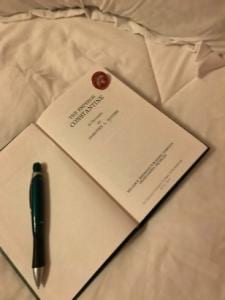 Dorothy Sayers wrote a very good play on Saint Constantine, the patron of our College. She ends the play with old King Coel (he that was a merry old soul) who may have been Constantine’s grandfather speaking these “prophetic” lines and then the audience confessing the Creed of Nicaea.
On Constantine
Constantine the Great got two things right. He saw that Rome, the idea of law and classical civilization, could exist without the City of Rome. The ancient City could no longer be defended consistently and was a drag on the economy of the rest of the Empire. Constantine realized that there could be Rome without Rome and built a new city in a place that could be defended easily and was a trade chokepoint.
Rare is the genius, the progressive conservative, who can kill what must be killed in order to save all that can be saved. If you enjoy reading Homer or Plato, thank Constantine.
The other stroke of genius was to stop the off-and-on persecution of Christians and allow their intellectual rigor, artistic brilliance, and ability to attract all classes to unite his Empire. His mother, every bit the ruler he was, made all this possible. Nobody left a guide on how to be a Christian and an emperor. Safe to say, nobody would use most of Constantine’s life to write such a guide. The Church and Crown worked out better models over time.
Eventually there would be a return to Roman republican models, but all began in the man of fire: Constantine. He fought his way to the purple, but only after a vision pointed him Christ-ward. What did he believe after that vision? This is impossible to say, possibly at first a strange blend of high paganism, almost monotheism, with Christian doctrine. Reality persisted, however, and so Constantine ended by shunning the purple robes of rule at the end of his life and putting on the white of Christian baptism. Even then he might have been a bit of a heretic, but the fire of the Holy Spirit burns on the material He is given.
On Sayer’s Constantine
Constantine the Great is no role model for us in the day to day, but Dorothy Sayers manages to strip away the details to show what it must have been to be the first almost-Christian emperor. How could a person who had to rule by blood, at least the way the Empire had become, serve the Prince of Peace? How could he gather a group of Christian leaders, many still carrying the scars of torture from his predecessors, and provide the space for them to produce on the most concise, philosophically interesting few paragraphs in world history? He built a City that would become the wonder of the world: a museum for Greek and Roman culture, where the classics could be studied, and a laboratory for Christian civilization.
Who was this man?
Sayers presents him as confident, not conflicted. Long before the vision, he was heading for power in Rome. He was a man associated with Britain, on the edge of the Empire, who moved East all his life toward civilization. His mother had been abandoned by his father, but Helen was too wise to quibble about a political decision. Sayers has her out maneuvering, thinking, and praying all foes.
She also worshipped the one, true God. There is splendor and power in truth. Sayers returns to the necessity of power if eventually your ideas prevail and the crown of thorns that comes from having to wear a crown of gold with a conscience. Constantine the Great was not enslaved to guessing at ends to justify cruel means. Whatever he did, Christianity would be judging him, the Emperor. He could be sure that if he bloodied up a province, some future monk, patriarch, or Christian scholar would write about the evil of the action.
Christians will make a man a saint and then list his faults, being that realistic. Great men, especially the first to fill their roles, the forerunners, are often difficult people. Ask those who had to live near John the Baptist. Sayers captures the difficulty of a man of fire being a saint. The watery souls find piety easier, superficially, but too often they omit to do what they should while doing what they should not. Men of earth plod carefully, moderately, and that is a virtue, but when great deeds are to be done then they can be Sam Gamgee, but not Aragorn son of Arathorn.
To be passionate without excess, lead without ego, and have zeal without zealotry, that is rare. Constantine inconsistently, imperfectly, fundamentally stumbled his way toward becoming such a leader . . . with Helen and the Church’s help.
Read the play.
Previous Post

April 19, 2020
Life! Life! Eternal Life!
Next Post

April 21, 2020 An Appreciation of Simon and Garfunkel
Browse Our Archives
Select a Category Apologetics Art Culture Education On Books On Education Philosophy Politics Pop Culture Spiritual Reflections Uncategorized
Select a Month October 2026 September 2026 August 2026 July 2026 July 2025 June 2025 September 2024 July 2024 June 2024 December 2023 June 2023 September 2022 May 2022 April 2022 March 2022 February 2022 July 2021 June 2021 May 2021 April 2021 March 2021 February 2021 January 2021 December 2020 November 2020 October 2020 September 2020 August 2020 July 2020 June 2020 May 2020 April 2020 March 2020 February 2020 January 2020 December 2019 November 2019 October 2019 September 2019 August 2019 July 2019 June 2019 May 2019 April 2019 March 2019 February 2019 January 2019 December 2018 November 2018 October 2018 September 2018 August 2018 July 2018 June 2018 May 2018 April 2018 March 2018 February 2018 January 2018 December 2017 November 2017 October 2017 September 2017 August 2017 July 2017 June 2017 May 2017 April 2017 March 2017 February 2017 January 2017 December 2016 November 2016 October 2016 September 2016 August 2016 July 2016 June 2016 May 2016 April 2016 March 2016 February 2016 January 2016 December 2015 November 2015 October 2015 September 2015 August 2015 July 2015 June 2015 May 2015 April 2015 March 2015 February 2015 January 2015 November 2014 October 2014 September 2014 August 2014 July 2014 June 2014 May 2014 April 2014 March 2014 February 2014 January 2014 December 2013 November 2013 October 2013 September 2013 August 2013 July 2013 June 2013 May 2013 April 2013 March 2013 February 2013 January 2013 December 2012 November 2012 October 2012 September 2012 August 2012 July 2012 June 2012 May 2012
Follow Us!
TAKE THE
Religious Wisdom Quiz
What Christian group uses "Meeting Houses" instead of traditional churches?
Select your answer to see how you score.
Quakers Methodists Lutherans Baptists
Books by This Author John Mark Reynolds
Related posts from Eidos

Classical Education Must Teach Us to Make the...

Classical Education and the Art of Dying Well

Golden, Golden, Golden: My Mother's Last Lesson

TRENDING AT PATHEOS Evangelical

The REST of Your Life: A Creative Wrestles...
This week I had a conversation with a good friend from church....

How the author of the world's best hymn...
I've been working with John Newton for a while now. This makes...

Long before this Lectio Divina, Psalm 130 - the song - started...

What About the Trees? Another Living Parable
After I finished writing the last article about falling leaves as a...

Why Classical Education Is a Conversation, Not a...
Come and Read: Joy in Classical Education When I was a little...

Cornell University has received a great deal of negative publicity and intense...
view all Evangelical blogs
Ad-Free & Subscriber Log-In Subscription Support
- About Us
- 2026 Calendar
- Videos
- Podcasts
- Library of World Religions
- Faith In Media Tracker
- Advertise With Us
- Write for Us
- Privacy Policy
- Terms of Service
- Do Not Sell My Data
- Contact Us
- Radiant Digital
- Manage Newsletter Subscriptions
- Unsubscribe From Notifications
- Sitemap
Copyright 2008-2026, Patheos. All rights reserved.
Subscription Support Ad-Free & Subscriber Log-In
Follow Patheos