
BuddhistCatholicContemplativeEvangelicalGeneral ChristianHinduJewishLatter-day SaintMuslimNew VisionsProgressive Christian
Beliefs
- Buddhist
- Catholic
- Contemplative
- Evangelical
- General Christian
- Hindu
- Jewish
- Latter-day Saint
- More Voices
- Muslim
- New Visions
- Pagan
- Progressive Christian
Topics
- Religion News
- Food and Religion
- Sports and Religion
- Religious Art
- Religious Music and Entertainment
- Religious Events
- History and Religion
- Style and Religion
- Politics and Religion
- Women in Religion
- Recreation Outdoors and Religion
- Business Finance and Religion
- Careers Workplace and Religion
- Education and Religion
- Family Parenting and Religion
- Health Fitness and Religion
- Home and Religion
- Relationships and Religion
- Technology and Religion
- Travel and Religion
Columnists
- Buddhist Columnists
- Business Finance and Religion Columnists
- Careers Workplace and Religion Columnists
- Catholic Columnists
- Contemplative Columnists
- Education and Religion Columnists
- Evangelists Columnists
- Family Parenting and Religion Columnists
- General Christian Columnists
- Health Fitness and Religion Columnists
- Hindu Columnists
- History and Religion Columnists
- Home and Religion Columnists
- Jewish Columnists
- More Voices Columnists
- Latter Day Columnists
- Muslim Columnists
- New Visions Columnists
- Nonreligious Columnists
- Pagan Columnists
- Politics and Religion Columnists
- Progressive Columnists
- Recreation Outdoors and Religion Columnists
- Relationships and Religion Columnists
- Religion News Columnists
- Religious Art Columnists
- Religious Events Columnists
- Religious Music and Entertainment Columnists
- Sports and Religion Columnists
- Style and Religion Columnists
- Technology and Religion Columnists
- Travel and Religion Columnists
- Women in Religion Columnists
Resource Library
- 2026 Calendar
- Library of World Religions
- The 100 Most Holy Places on Earth
- Patheos Answers
- Podcasts
- Videos
- Faith Leaders Database
- Anglican Episcopalian
- Bahai
- Baptist
- Buddhism
- Christianity
- Confucianism
- Eastern Orthodoxy
- Hinduism
- Holiness and Pentecostal
- ISKCON
- Islam
- Judaism
- Lutheran
- Methodist
- The Church of Jesus Christ of Latter-day Saints
- New Age
- Paganism
- Presbytarian and Reformed
- Protestantism
- Religion Behind the Scenes
- Roman Catholic
- Scientology
- Shia Islam
- Sikhism
- Sufism
- Sunni Islam
- Taoism
- Zen
- See all religions
Research Tools
 Ad-Free & Subscriber Log-In Subscription Support
Ad-Free & Subscriber Log-In Subscription Support
Follow Patheos 

- Trending:
- Forgiveness
- |
- Marriage
- |
- Consciousness
- |
- Death Penalty
- |
- Election
- |
- Halloween

- Home
- Evangelical
- Plato and Basil: Athens and Jerusalem in Education
Plato and Basil: Athens and Jerusalem in Education
Last updated on: February 24, 2020 at 12:46 am by John Mark N. Reynolds
Plato and Basil: Athens and Jerusalem in Education 2020-02-24T00:46:00-04:00 John Mark N. Reynolds
Patheos Explore the world's faith through different perspectives on religion and spirituality! Patheos has the views of the prevalent religions and spiritualities of the world.
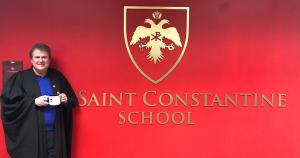 Plato gave the ancient world the form of dialectic education in his writings, especially his masterwork Republic. Plato presented education that began in questioning the received wisdom, moved to constructing a hypothesis about the problem, and ended in a great Myth, the most likely story to explain all of reality. This worldview generates new questions, having become the new received wisdom, and so is refined in the same process. Eventually Plato hoped we would have a vision of the Good and so gain certainty. This seems very abstract, but has been applied at schools for millennia, a pedagogy refined over centuries (by the same process!), and now in use in nursery through college at The Saint Constantine School.
Kindergartener and college student: master received wisdom, dialog in wonder, hypothesize, tell likely stories. Once we seem to be done, having settled all, we begin again. This process may seem to “go in circles,” as some critics suggest and so it does! The circles, however, corkscrew up. The lover of wisdom ascends to better and more complete answers. So in younger grades the image of the atom as a nucleus/sun with electron/planets, gives way to a better image in junior high school, and then to a simple version of quantum theory in high school physics. By college the student might be introduced to something closer to the best contemporary theory when he has the mathematics needed. I am told by my friends in real physics that this process has not yet ended!
A Christian can see this same growth in theology. We slowly gained a better and more consummate understanding of the holy Trinity. After centuries this was refined into a creed, but the questions then shifted to higher and better things! Our wondering never ends, thank God.
Yet this ideal comes with dangers for a Christian. We might forget Jerusalem in a love for Athens. This danger caused Tertullian to thunder that Athens had nothing to do with Jerusalem. Sadly, this only caused Tertullian to miss how much his thinking was dependent on Athens and he ended up in a funny, heretical place.
There is a need for a pastor to keep us from monomania, not Athens or Jerusalem, but Athens as a suburb of Jerusalem!
The pastoral practicality came most clearly from the genius of Saint Basil. Adopting any ideas from the Greeks and Romans who had been persecutors must have been difficult, but the Saint overcame prejudice and did so. He also was not swallowed up by Greek thought as was a less balanced thinker like Origen. He did not cast out Greek thought like Tertullian. Obviously there is a tension in reading the pagan Homer with his polytheism and the truth.
Giving practical advice to young men on the right use of Greek literature, Saint Basil did not deny the tension. He embraced all truth. He put Christian education on this balanced course when he said:
To be sure, we shall become more intimately acquainted with these precepts in the sacred writings, but it is incumbent upon us, for the present, to trace, as it were, the silhouette of virtue in the pagan authors. For those who carefully gather the useful from each book are wont, like mighty rivers, to gain accessions on every hand.
Sacred writings are studied in school and the truths lived in the liturgy. We shall become “more intimately acquainted.” Still Saint Basil saw the quest for virtue in the pagan authors as very valuable. He knew through his own studies, however, how overwhelming teachers in higher education can be. The good Basil did not suggest dropping out of school! Instead, he said:
Now this is my counsel, that you should not unqualifiedly give over your minds to these men, as a ship is surrendered to the rudder, to follow whither they list, but that, while receiving whatever of value they have to offer, you yet recognize what it is wise to ignore.
Basil also returned to the teleology of classical Christian education: we are preparing saints for paradise. Eternity is so much greater than mortal life that all must be measured in that scale, yet with that goal in mind Saint Basil still found value in the pagan classics.
This is a miracle of insight. Homer could teach virtue. Indeed for many of us, Homer is a necessary introduction to the dialectic. We can learn to inquire on a rougher text and so avoid any hint of impiety.
The holy things are for the holy and (especially) younger students are not yet fully ready for the deep things of God. (Many of us older folk are also in this condition!) We read, question, debate, and try to understand lesser books such as the Iliad. There our mistakes count for less!
We find virtue in these writings, but even the errors can teach us:
If, then, there is any affinity between the two literatures, a knowledge of them should be useful to us in our search for truth; if not, the comparison, by emphasizing the contrast, will be of no small service in strengthening our regard for the better one.
Saint Basil also distinguishes between reading and praising. We read to understand and then choose to praise the good and condemn the bad we find in such writings. The fundamentalist cannot read, he is weak. The syncretist reads and is uncritical. Saint Basil urges us to read and be discerning.
This process can shine a further pastoral light on us as we can read without doing. We do what is good, weeding out any call to vice in a pagan (or Christian!) text. We should not just read about virtue, but go practice good works.
Another great vice of some classical Christian schools is that they hear, talk, hear some more, talk a lot more and do nothing. We should emulate the great Reverend Doctor Martin Luther King and strive to stand with justice and bring forth the beloved community: hearers and doers.
————————————————
Saint Basil. To the Young Men on the Right Use of Greek Literature.
For more on Plato and education: See chapter six in my When Athens Met Jerusalem.
On King and doing: See his sermon Guidelines for a Constructive Church. I summarize this sermon with links to the full message here.
Previous Post
February 20, 2020
Embracing the Tension: Education against Monomania
Next Post
February 22, 2020 A Dialog with a Critic: In Summary (Guest Voice: Jeff Williams)
Browse Our Archives
Select a Category Apologetics Art Culture Education On Books On Education Philosophy Politics Pop Culture Spiritual Reflections Uncategorized
Select a Month October 2026 September 2026 August 2026 July 2026 July 2025 June 2025 September 2024 July 2024 June 2024 December 2023 June 2023 September 2022 May 2022 April 2022 March 2022 February 2022 July 2021 June 2021 May 2021 April 2021 March 2021 February 2021 January 2021 December 2020 November 2020 October 2020 September 2020 August 2020 July 2020 June 2020 May 2020 April 2020 March 2020 February 2020 January 2020 December 2019 November 2019 October 2019 September 2019 August 2019 July 2019 June 2019 May 2019 April 2019 March 2019 February 2019 January 2019 December 2018 November 2018 October 2018 September 2018 August 2018 July 2018 June 2018 May 2018 April 2018 March 2018 February 2018 January 2018 December 2017 November 2017 October 2017 September 2017 August 2017 July 2017 June 2017 May 2017 April 2017 March 2017 February 2017 January 2017 December 2016 November 2016 October 2016 September 2016 August 2016 July 2016 June 2016 May 2016 April 2016 March 2016 February 2016 January 2016 December 2015 November 2015 October 2015 September 2015 August 2015 July 2015 June 2015 May 2015 April 2015 March 2015 February 2015 January 2015 November 2014 October 2014 September 2014 August 2014 July 2014 June 2014 May 2014 April 2014 March 2014 February 2014 January 2014 December 2013 November 2013 October 2013 September 2013 August 2013 July 2013 June 2013 May 2013 April 2013 March 2013 February 2013 January 2013 December 2012 November 2012 October 2012 September 2012 August 2012 July 2012 June 2012 May 2012
Follow Us!
TAKE THE
Religious Wisdom Quiz
How many people did Jesus feed with five loaves and two fish?
Select your answer to see how you score.
About 12 About 100 About 5000 men About 7000
Books by This Author John Mark Reynolds
Related posts from Eidos

Why Classical Education Is a Conversation, Not a...

Does Classical Education Belong Only to the West?

Classical Education Must Teach Us to Make the...

Rooted: Why Classical Education Needs Community
TRENDING AT PATHEOS Evangelical

The REST of Your Life: A Creative Wrestles...
This week I had a conversation with a good friend from church....

How the author of the world's best hymn...
I've been working with John Newton for a while now. This makes...

Long before this Lectio Divina, Psalm 130 - the song - started...

What About the Trees? Another Living Parable
After I finished writing the last article about falling leaves as a...

Why Classical Education Is a Conversation, Not a...
Come and Read: Joy in Classical Education When I was a little...

Cornell University has received a great deal of negative publicity and intense...
view all Evangelical blogs
Ad-Free & Subscriber Log-In Subscription Support
- About Us
- 2026 Calendar
- Videos
- Podcasts
- Library of World Religions
- Faith In Media Tracker
- Advertise With Us
- Write for Us
- Privacy Policy
- Terms of Service
- Do Not Sell My Data
- Contact Us
- Radiant Digital
- Manage Newsletter Subscriptions
- Unsubscribe From Notifications
- Sitemap
Copyright 2008-2026, Patheos. All rights reserved.
Subscription Support Ad-Free & Subscriber Log-In
Follow Patheos