
BuddhistCatholicContemplativeEvangelicalGeneral ChristianHinduJewishLatter-day SaintMuslimNew VisionsProgressive Christian
Beliefs
- Buddhist
- Catholic
- Contemplative
- Evangelical
- General Christian
- Hindu
- Jewish
- Latter-day Saint
- More Voices
- Muslim
- New Visions
- Pagan
- Progressive Christian
Topics
- Religion News
- Food and Religion
- Sports and Religion
- Religious Art
- Religious Music and Entertainment
- Religious Events
- History and Religion
- Style and Religion
- Politics and Religion
- Women in Religion
- Recreation Outdoors and Religion
- Business Finance and Religion
- Careers Workplace and Religion
- Education and Religion
- Family Parenting and Religion
- Health Fitness and Religion
- Home and Religion
- Relationships and Religion
- Technology and Religion
- Travel and Religion
Columnists
- Buddhist Columnists
- Business Finance and Religion Columnists
- Careers Workplace and Religion Columnists
- Catholic Columnists
- Contemplative Columnists
- Education and Religion Columnists
- Evangelists Columnists
- Family Parenting and Religion Columnists
- General Christian Columnists
- Health Fitness and Religion Columnists
- Hindu Columnists
- History and Religion Columnists
- Home and Religion Columnists
- Jewish Columnists
- More Voices Columnists
- Latter Day Columnists
- Muslim Columnists
- New Visions Columnists
- Nonreligious Columnists
- Pagan Columnists
- Politics and Religion Columnists
- Progressive Columnists
- Recreation Outdoors and Religion Columnists
- Relationships and Religion Columnists
- Religion News Columnists
- Religious Art Columnists
- Religious Events Columnists
- Religious Music and Entertainment Columnists
- Sports and Religion Columnists
- Style and Religion Columnists
- Technology and Religion Columnists
- Travel and Religion Columnists
- Women in Religion Columnists
Resource Library
- 2026 Calendar
- Library of World Religions
- The 100 Most Holy Places on Earth
- Patheos Answers
- Podcasts
- Videos
- Faith Leaders Database
- Anglican Episcopalian
- Bahai
- Baptist
- Buddhism
- Christianity
- Confucianism
- Eastern Orthodoxy
- Hinduism
- Holiness and Pentecostal
- ISKCON
- Islam
- Judaism
- Lutheran
- Methodist
- The Church of Jesus Christ of Latter-day Saints
- New Age
- Paganism
- Presbytarian and Reformed
- Protestantism
- Religion Behind the Scenes
- Roman Catholic
- Scientology
- Shia Islam
- Sikhism
- Sufism
- Sunni Islam
- Taoism
- Zen
- See all religions
Research Tools
 Ad-Free & Subscriber Log-In Subscription Support
Ad-Free & Subscriber Log-In Subscription Support
Follow Patheos 

- Trending:
- Forgiveness
- |
- Marriage
- |
- Consciousness
- |
- Death Penalty
- |
- Election
- |
- Halloween

- Home
- Evangelical
- Christian School, not Church School? The Eastern Solution
Christian School, not Church School? The Eastern Solution
Last updated on: February 16, 2020 at 11:52 pm by John Mark N. Reynolds
Christian School, not Church School? The Eastern Solution 2020-02-16T23:52:57-04:00 John Mark N. Reynolds
Patheos Explore the world's faith through different perspectives on religion and spirituality! Patheos has the views of the prevalent religions and spiritualities of the world.
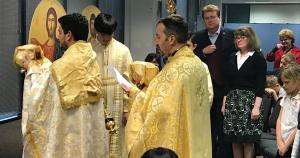 Theological education was less a product of the theological schools and more in the monastic communities. By 425 Theodosius II had founded the “University” of Constantinople. There was work for the Emperor and for the church in terms of education and spiritual formation.
The soul of the student was formed in the school and in the liturgy of the Church. The dual nature of learning, church and school, is one in essence and different in persons without confusion or contradiction.
The sermons came from priests who came from the rigorous formation of the monasteries or from exceptionally Spirit-filled men recognized as such by the church. The rich treasures of revelation were communicated through the sermons such as those of Saint John Chrysostom, the lives of the saints, the beauty and truth in stone and iconography of the Orthodox Church, and the liturgy.
The orthodox layman saw the True Light.
Simultaneously, the layman could attend an Orthodox school where he learned to read well, write well, think well using the best of literature and scholarship available. This school was “secular,” in the sense that the state and not the church controlled the curriculum, but was Christian. Homer does not belong, after all, in the liturgy, but one cannot understand Christendom without seeing how Iliad and Odyssey were forerunners of revelation.
When one sees the True Light directly, the right response is worship. The brilliant aesthetic revelation is a direct education of experience. This is the philosopher’s experience outside the cave when he sees the sun only made available to all the faithful, regardless of class or previous education.
Schooling provided a place for learning the wisdom of outsiders to Christendom. Plato would ruin the beauty and power of the liturgy, but is at home in schooling. By providing a place for both, united by a shared Orthodox vision, the possibility of synergy between the body and the soul was restored. The Orthodox student, having seen the True Light, could recognize virtue in the readings of the ancient pagans or even in more contemporary Islamic sages!
Myths of “book burning” have scarred the reputation of the Church. Instead, history reveals a Church and state that consistently saved all that could be saved. Over time, much was lost that all regret, much was forgotten, we would wish to remember, but this is true of Christian and pagan texts! We have lost both, because saving anything over centuries is hard.
Sometimes we did lose sight of the tension, the conversation, and listened predominantly to Athens, silencing Jerusalem. This was the error of Origen that continues into the present, even within the Church. In other periods, beset by outside attacks, bewildered by economic and imperial decline, we turned to an unnatural fundamentalism and did reject Athens. Books were rejected, sometimes even destroyed. Thank God this was not the norm or we would have nothing of the Greek philosophical patrimony to the world.
Those parts of the Empire more geographically Western or Latin developed a tradition of church based education that ended in models like the parochial schools of the Roman Church in the United States. The Christian educational system that could found schools such as Oxford and Cambridge should not be despised! When most or almost all educated people were Christians, the West’s solution to the educational problem was fine.
Still, the Eastern Empire maintained a secular and religious tradition that intertwined and that was culturally fecund. The very creation of the so-called Byzantine commonwealth was as much an educational as a religious project: language, learning, and liturgy.
The education that would allow the scientific revolution was in place with an ethical check in the monasteries to prevent merely exploiting nature.
I stood in our School and College Chapel, connected to no individual parish but in love with all of them (!), and saw the True Light. I then went with my wife to teach Jane Eyre and discuss the nature of romance with college students. This was illuminating as the great author, not Orthodox, but wise, taught us. The pure beauty of the liturgy guided us while the virtue in the text, from the image-bearer Bronte, taught us.
Thanks be to God.
—————————————————
Resources:
[1] Reynolds, John Mark When Athens Met Jerusalem (IVP, 2010)
[2] For an explication of the dialectic in Plato see Geier, Alfred. Plato’s Erotic Thought (Rochester Studies in Philosophy, 2002) and The Beloved Unknown and the Learning Soul (Tiger Bark Press, 2016)
[3] Kirk, Raven, Schofield, Presocratic Philosophy (Kindle Edition), Location 4932.
[4] Ibid. Location 5385.
[5] Republic, 621c “And thus, Glaucon, a tale was saved and not lost; and it could save us, if we were persuaded by it, and we shall make a good crossing of the river of Lethe and not defile our soul.” (Bloom translation)
[6] See https://historyforatheists.com/2017/07/the-destruction-of-the-great-library-of-alexandria/.
[7] The Church went through “fundamentalist” periods where books were burned, but these were, thank God, fairly rare. We have all of Plato, because the Church saved Plato! The good done was greater than the harm or nobody would have any texts at all.
Previous Post
February 15, 2020
One Body, Two Heads: the Image Education Needs
Next Post

February 17, 2020 Universal Education: the Light Knows No True Barriers
Browse Our Archives
Select a Category Apologetics Art Culture Education On Books On Education Philosophy Politics Pop Culture Spiritual Reflections Uncategorized
Select a Month October 2026 September 2026 August 2026 July 2026 July 2025 June 2025 September 2024 July 2024 June 2024 December 2023 June 2023 September 2022 May 2022 April 2022 March 2022 February 2022 July 2021 June 2021 May 2021 April 2021 March 2021 February 2021 January 2021 December 2020 November 2020 October 2020 September 2020 August 2020 July 2020 June 2020 May 2020 April 2020 March 2020 February 2020 January 2020 December 2019 November 2019 October 2019 September 2019 August 2019 July 2019 June 2019 May 2019 April 2019 March 2019 February 2019 January 2019 December 2018 November 2018 October 2018 September 2018 August 2018 July 2018 June 2018 May 2018 April 2018 March 2018 February 2018 January 2018 December 2017 November 2017 October 2017 September 2017 August 2017 July 2017 June 2017 May 2017 April 2017 March 2017 February 2017 January 2017 December 2016 November 2016 October 2016 September 2016 August 2016 July 2016 June 2016 May 2016 April 2016 March 2016 February 2016 January 2016 December 2015 November 2015 October 2015 September 2015 August 2015 July 2015 June 2015 May 2015 April 2015 March 2015 February 2015 January 2015 November 2014 October 2014 September 2014 August 2014 July 2014 June 2014 May 2014 April 2014 March 2014 February 2014 January 2014 December 2013 November 2013 October 2013 September 2013 August 2013 July 2013 June 2013 May 2013 April 2013 March 2013 February 2013 January 2013 December 2012 November 2012 October 2012 September 2012 August 2012 July 2012 June 2012 May 2012
Follow Us!
TAKE THE
Religious Wisdom Quiz
What city is known as the birthplace of Jesus?
Select your answer to see how you score.
Bethlehem Jerusalem Galilee Nazareth
Books by This Author John Mark Reynolds
Related posts from Eidos

Why Classical Education Is a Conversation, Not a...

Does Classical Education Belong Only to the West?

Classical Education Must Teach Us to Make the...

Rooted: Why Classical Education Needs Community
TRENDING AT PATHEOS Evangelical

The REST of Your Life: A Creative Wrestles...
This week I had a conversation with a good friend from church....

How the author of the world's best hymn...
I've been working with John Newton for a while now. This makes...

Long before this Lectio Divina, Psalm 130 - the song - started...

What About the Trees? Another Living Parable
After I finished writing the last article about falling leaves as a...

Why Classical Education Is a Conversation, Not a...
Come and Read: Joy in Classical Education When I was a little...

Cornell University has received a great deal of negative publicity and intense...
view all Evangelical blogs
Ad-Free & Subscriber Log-In Subscription Support
- About Us
- 2026 Calendar
- Videos
- Podcasts
- Library of World Religions
- Faith In Media Tracker
- Advertise With Us
- Write for Us
- Privacy Policy
- Terms of Service
- Do Not Sell My Data
- Contact Us
- Radiant Digital
- Manage Newsletter Subscriptions
- Unsubscribe From Notifications
- Sitemap
Copyright 2008-2026, Patheos. All rights reserved.
Subscription Support Ad-Free & Subscriber Log-In
Follow Patheos