
BuddhistCatholicContemplativeEvangelicalGeneral ChristianHinduJewishLatter-day SaintMuslimNew VisionsProgressive Christian
Beliefs
- Buddhist
- Catholic
- Contemplative
- Evangelical
- General Christian
- Hindu
- Jewish
- Latter-day Saint
- More Voices
- Muslim
- New Visions
- Pagan
- Progressive Christian
Topics
- Religion News
- Food and Religion
- Sports and Religion
- Religious Art
- Religious Music and Entertainment
- Religious Events
- History and Religion
- Style and Religion
- Politics and Religion
- Women in Religion
- Recreation Outdoors and Religion
- Business Finance and Religion
- Careers Workplace and Religion
- Education and Religion
- Family Parenting and Religion
- Health Fitness and Religion
- Home and Religion
- Relationships and Religion
- Technology and Religion
- Travel and Religion
Columnists
- Buddhist Columnists
- Business Finance and Religion Columnists
- Careers Workplace and Religion Columnists
- Catholic Columnists
- Contemplative Columnists
- Education and Religion Columnists
- Evangelists Columnists
- Family Parenting and Religion Columnists
- General Christian Columnists
- Health Fitness and Religion Columnists
- Hindu Columnists
- History and Religion Columnists
- Home and Religion Columnists
- Jewish Columnists
- More Voices Columnists
- Latter Day Columnists
- Muslim Columnists
- New Visions Columnists
- Nonreligious Columnists
- Pagan Columnists
- Politics and Religion Columnists
- Progressive Columnists
- Recreation Outdoors and Religion Columnists
- Relationships and Religion Columnists
- Religion News Columnists
- Religious Art Columnists
- Religious Events Columnists
- Religious Music and Entertainment Columnists
- Sports and Religion Columnists
- Style and Religion Columnists
- Technology and Religion Columnists
- Travel and Religion Columnists
- Women in Religion Columnists
Resource Library
- 2026 Calendar
- Library of World Religions
- The 100 Most Holy Places on Earth
- Patheos Answers
- Podcasts
- Videos
- Faith Leaders Database
- Anglican Episcopalian
- Bahai
- Baptist
- Buddhism
- Christianity
- Confucianism
- Eastern Orthodoxy
- Hinduism
- Holiness and Pentecostal
- ISKCON
- Islam
- Judaism
- Lutheran
- Methodist
- The Church of Jesus Christ of Latter-day Saints
- New Age
- Paganism
- Presbytarian and Reformed
- Protestantism
- Religion Behind the Scenes
- Roman Catholic
- Scientology
- Shia Islam
- Sikhism
- Sufism
- Sunni Islam
- Taoism
- Zen
- See all religions
Research Tools
 Ad-Free & Subscriber Log-In Subscription Support
Ad-Free & Subscriber Log-In Subscription Support
Follow Patheos 

- Trending:
- Forgiveness
- |
- Marriage
- |
- Consciousness
- |
- Death Penalty
- |
- Election
- |
- Halloween

- Home
- Evangelical
- If the Magic is Real (Ethics and Limits in Shakespeare’s Tempest)
If the Magic is Real (Ethics and Limits in Shakespeare’s Tempest)
Last updated on: November 16, 2019 at 12:22 pm by John Mark N. Reynolds
If the Magic is Real (Ethics and Limits in Shakespeare’s Tempest) 2019-11-16T12:22:02-04:00 John Mark N. Reynolds
Patheos Explore the world's faith through different perspectives on religion and spirituality! Patheos has the views of the prevalent religions and spiritualities of the world.
The Magic is Real
 If magic were real, then what would you do with (say) an invisible ring? College students over the decades have answered this question with an astounding lack of creativity. Apparently, many who were given magical power would misuse that power. Plato and Tolkien both saw that coming!
Most of what we now call “magic” are the methods that failed, worth a try, but not productive or wholly dangerous. Yet we need not guess what we would do as science, the methods that worked for the natural philosophers, gives us powers that previous generations did not have.
This device contains thousands of books, including all of Shakespeare, and also gives me easy access to (nearly) limitless information. What should I do with this power?
Mostly we do useless things. Sometimes we do good things.
Oldsters like I am can recall not being able to easily check Packer scores. At best, one waited by CBS to update you during some other game and at worst, one had to wait until the next day when the newspaper would print a short story. There are commentaries on Plato that took me months to buy as finding a copy was a slow process utilizing specialized shops. The scores and great books come easily now.
One need not be a Spider-Man to know that with great power comes great responsibility and so it is with scientific power. We can build a bomb that would destroy the world, but should we? I can waste my day building a virtual town, but should I?
“Can” and “should” are not the same for anyone and the greater our power, the greater the responsibility to use that power carefully. In an inter-connected world everything we do has unknown impact. Switching to plastic nets in fishing has created a horrible ecological problem of “ghost nets,” lost fishing equipment, that kill marine life. Old nets were biodegradable, these are not. We gained power to achieve our desires in nature, only to use that power unwisely.
As a route to knowledge, science (natural philosophy) is a method that gave us power: a magic that worked. Most of what we call magic today were dead ends (eg. alchemy). With that useful magic, where the world could do our bidding came great responsibility. We have often failed that test.
Shakespeare to the Rescue?
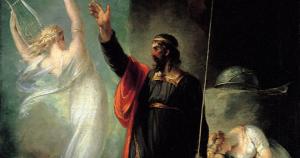
The Tempest, one of Shakespeare’s last plays, deals in endings. This is a romance, of a sort, set on a magical island created by the power of words.
This is also a play about power and giving up that power or limiting the usage through morality.
The ruler who makes the magic, Prospero, is a mixture of motives, vices, and virtues. He had been a ruler, but pushed the day-to-day practical rule off on his brother while he pursued arcane knowledge. The brother decided he wanted the title to go with the work and sent Prospero packing.
Prospero kept studying and preparing for his return to his city and power. He picks an odd means to do so, but one that is (I think) a standby for the dangerous choices Shakespeare saw being made in his own time by natural philosophers. They sought knowledge, but without wisdom.
A Christian faces four possible roots to knowledge, one forbidden, one dubious, one practical, and the last divine:
- We can seek knowledge through devils, but this is forbidden. Demons do not exist to teach us, so to learn from the devils is to harm one’s soul and gain nothing.
- We seek knowledge through supernatural beings, if they exist, that are not devils. Beings might exist (gnomes, fairies, elves, pixies) that are not devils or angels, but also are not animals. A Christian could believe in such beings, though by now few Christians do. The evidence that they exist (at least at present) is insufficient. Prospero takes this route in Tempest and in Shakespeare’s play this works, but is always a dubious means to knowledge, because one can never (quite) be sure the powers one is meeting.
- Practical wisdom, natural philosophy (science), and political arts are guides to living a decent life in the material realm and in harmony with the divine. They can increase the stock of a certain kind of human knowledge. However, any power gained carries moral risk of misuse. How can we keep from doing what we ought not to do?
- Finally, there is divine revelation which exists as a check on our own wisdom, but which we can misunderstand. For most of us, the proper balance is between living with what God has revealed and what practical wisdom makes of this revelation.
Prospero gains power through dubious means, not illicit, but not quite good either. Shakespeare presents him as a man who ignores practical politics, never turns to evil (as did the mother of Caliban). As a result, he can raise a tempest and manipulate certain outcomes, but there is a cost. He deals with powers that tax his soul and tempt him to control more than he should.
He keeps his beloved daughter far from this occult science, putting her to sleep when she gets too close. Prospero is saved by his Christian morality: he will not use the “powers” for deadly revenge and he pities and has mercy on even his enemies. However, he also manipulates them as if he were God. In the end, Prospero must give up the great power he has gained and return to prayer and practical wisdom.
He will no longer be a wizard, but a nobleman.
We are not in danger of gaining the powers that Prospero had in the play through his means. They do not (at least now!) produce such sure results. However, discipline and work can give humanity similar powers using natural philosophy (science). We can now raise a tempest and do much to control and manipulate people “for their good.”
This might, at times, be licit, but it is dangerous. The clever politician, the good talker, the world class scientists perhaps can, but should not do many things! We can only hope that our greatest wizards of politics, culture, and science will be guided (as Prospero was) by the revelation of Christ.
The magician must put down his magical implements, leave the lab, and see not just the world as it is, or as he could make it, but the brave new world that is the City of God that is coming. He must not stand in the way of justice, beauty, mercy, or goodness.
The magic of natural philosophy (science) and practical politics (rhetoric/psychology) is real and powerful. What should be done with that power? We look to metaphysics and divine revelation to help learn what God alone teaches: love your enemies, pray for those who despitefully use you, the Christian ethic of love.
Only then can we enter the world of love: wise, moderate, just, courageous.

Next Post

November 16, 2019 Light Phone: You can buy an excellent phone with no camera, no Internet.
Browse Our Archives
Select a Category Apologetics Art Culture Education On Books On Education Philosophy Politics Pop Culture Spiritual Reflections Uncategorized
Select a Month October 2026 September 2026 August 2026 July 2026 July 2025 June 2025 September 2024 July 2024 June 2024 December 2023 June 2023 September 2022 May 2022 April 2022 March 2022 February 2022 July 2021 June 2021 May 2021 April 2021 March 2021 February 2021 January 2021 December 2020 November 2020 October 2020 September 2020 August 2020 July 2020 June 2020 May 2020 April 2020 March 2020 February 2020 January 2020 December 2019 November 2019 October 2019 September 2019 August 2019 July 2019 June 2019 May 2019 April 2019 March 2019 February 2019 January 2019 December 2018 November 2018 October 2018 September 2018 August 2018 July 2018 June 2018 May 2018 April 2018 March 2018 February 2018 January 2018 December 2017 November 2017 October 2017 September 2017 August 2017 July 2017 June 2017 May 2017 April 2017 March 2017 February 2017 January 2017 December 2016 November 2016 October 2016 September 2016 August 2016 July 2016 June 2016 May 2016 April 2016 March 2016 February 2016 January 2016 December 2015 November 2015 October 2015 September 2015 August 2015 July 2015 June 2015 May 2015 April 2015 March 2015 February 2015 January 2015 November 2014 October 2014 September 2014 August 2014 July 2014 June 2014 May 2014 April 2014 March 2014 February 2014 January 2014 December 2013 November 2013 October 2013 September 2013 August 2013 July 2013 June 2013 May 2013 April 2013 March 2013 February 2013 January 2013 December 2012 November 2012 October 2012 September 2012 August 2012 July 2012 June 2012 May 2012
Follow Us!
TAKE THE
Religious Wisdom Quiz
Who wrote many letters (epistles) in the New Testament?
Select your answer to see how you score.
John Jude Peter Paul
Books by This Author John Mark Reynolds
Related posts from Eidos

Classical Education Must Teach Us to Make the...

Classical Education and the Art of Dying Well

Golden, Golden, Golden: My Mother's Last Lesson

TRENDING AT PATHEOS Evangelical

The REST of Your Life: A Creative Wrestles...
This week I had a conversation with a good friend from church....

How the author of the world's best hymn...
I've been working with John Newton for a while now. This makes...

Long before this Lectio Divina, Psalm 130 - the song - started...

What About the Trees? Another Living Parable
After I finished writing the last article about falling leaves as a...

Why Classical Education Is a Conversation, Not a...
Come and Read: Joy in Classical Education When I was a little...

Cornell University has received a great deal of negative publicity and intense...
view all Evangelical blogs
Ad-Free & Subscriber Log-In Subscription Support
- About Us
- 2026 Calendar
- Videos
- Podcasts
- Library of World Religions
- Faith In Media Tracker
- Advertise With Us
- Write for Us
- Privacy Policy
- Terms of Service
- Do Not Sell My Data
- Contact Us
- Radiant Digital
- Manage Newsletter Subscriptions
- Unsubscribe From Notifications
- Sitemap
Copyright 2008-2026, Patheos. All rights reserved.
Subscription Support Ad-Free & Subscriber Log-In
Follow Patheos