
BuddhistCatholicContemplativeEvangelicalGeneral ChristianHinduJewishLatter-day SaintMuslimNew VisionsProgressive Christian
Beliefs
- Buddhist
- Catholic
- Contemplative
- Evangelical
- General Christian
- Hindu
- Jewish
- Latter-day Saint
- More Voices
- Muslim
- New Visions
- Pagan
- Progressive Christian
Topics
- Religion News
- Food and Religion
- Sports and Religion
- Religious Art
- Religious Music and Entertainment
- Religious Events
- History and Religion
- Style and Religion
- Politics and Religion
- Women in Religion
- Recreation Outdoors and Religion
- Business Finance and Religion
- Careers Workplace and Religion
- Education and Religion
- Family Parenting and Religion
- Health Fitness and Religion
- Home and Religion
- Relationships and Religion
- Technology and Religion
- Travel and Religion
Columnists
- Buddhist Columnists
- Business Finance and Religion Columnists
- Careers Workplace and Religion Columnists
- Catholic Columnists
- Contemplative Columnists
- Education and Religion Columnists
- Evangelists Columnists
- Family Parenting and Religion Columnists
- General Christian Columnists
- Health Fitness and Religion Columnists
- Hindu Columnists
- History and Religion Columnists
- Home and Religion Columnists
- Jewish Columnists
- More Voices Columnists
- Latter Day Columnists
- Muslim Columnists
- New Visions Columnists
- Nonreligious Columnists
- Pagan Columnists
- Politics and Religion Columnists
- Progressive Columnists
- Recreation Outdoors and Religion Columnists
- Relationships and Religion Columnists
- Religion News Columnists
- Religious Art Columnists
- Religious Events Columnists
- Religious Music and Entertainment Columnists
- Sports and Religion Columnists
- Style and Religion Columnists
- Technology and Religion Columnists
- Travel and Religion Columnists
- Women in Religion Columnists
Resource Library
- 2026 Calendar
- Library of World Religions
- The 100 Most Holy Places on Earth
- Patheos Answers
- Podcasts
- Videos
- Faith Leaders Database
- Anglican Episcopalian
- Bahai
- Baptist
- Buddhism
- Christianity
- Confucianism
- Eastern Orthodoxy
- Hinduism
- Holiness and Pentecostal
- ISKCON
- Islam
- Judaism
- Lutheran
- Methodist
- The Church of Jesus Christ of Latter-day Saints
- New Age
- Paganism
- Presbytarian and Reformed
- Protestantism
- Religion Behind the Scenes
- Roman Catholic
- Scientology
- Shia Islam
- Sikhism
- Sufism
- Sunni Islam
- Taoism
- Zen
- See all religions
Research Tools
 Ad-Free & Subscriber Log-In Subscription Support
Ad-Free & Subscriber Log-In Subscription Support
Follow Patheos 

- Trending:
- Forgiveness
- |
- Marriage
- |
- Consciousness
- |
- Death Penalty
- |
- Election
- |
- Halloween

- Home
- Evangelical
- On All Being Well (Some Shakespeare)
On All Being Well (Some Shakespeare)
Last updated on: November 4, 2019 at 11:19 pm by John Mark N. Reynolds
On All Being Well (Some Shakespeare) 2019-11-04T23:19:40-04:00 John Mark N. Reynolds
Patheos Explore the world's faith through different perspectives on religion and spirituality! Patheos has the views of the prevalent religions and spiritualities of the world.
We do not, of course, always know what is good for us.
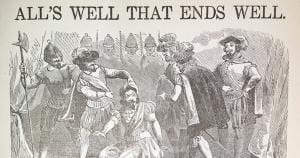 Our choices tend to be for what we think we want instead of what we need: our heart’s truest longing. If we go for what we think we want, life will not end well. If we find the absolute desire of our heart, and move with all our strength and God’s good mercy toward that bliss, then all will be well in the end.
Our choices foretell certain ends, even the best of us needing grace and mercy. Shakespeare understood the need for mercy that many of us have. He reminds us that God keeps working in us and that the end counts: All’s Well that Ends Well.
Life ends in death, so far as we can see. Hope suggests that, mayhap, there is more and we can live again. Hope looks to an eternity where every pain will be given meaning in the context of goodness. Those we miss will be met again. Reflecting in hope, we study, we live, we discuss, and during the process, the truth begins to be revealed. We find faith more substantial intellectually and emotionally than hope. We never end up with surety of our fondest desires, but gain good reason to think death is not the end. So Shakespeare can begin:
Moderate lamentation is the right of the dead, excessive grief the enemy to the living.
This reflection on death at the start of the action seems odd in a comedy, one of the last pure comedies Shakespeare wrote. A comedy has a happy ending and Shakespeare agrees with the Greeks that one cannot call a man happy until he is dead. As a Christian, he goes further and will not call a man happy (blessed!) until he sees what he needs, really needs, and not just what he wants: grace and mercy to end well.
We lament the dead, they have earned our grief by their good lives, yet to fixate on our sorrow will turn our lives into a living death. Our houses cannot become shrines, our lives memorials. We move forward toward where they have gone, lamenting their end, but moderately.
Why?
We must make our own good end and excessive grief will keep us from that project. We are, all of us, headed to the end of the “play” and that end can produce either a tragedy (ask Macbeth) or comedy. All’s Well begins with a sick King and missing parents, taken by death.
The “hero” of the play, the hapless Bertram, is headed in the wrong direction. He should love Helena, is blessed Helena loves him, but his social snobbery blinds him to her graces. She is grace to him and just what he needs. Bertram, however, wants what he should not have, trusts the wrong people, and in general makes an ass of himself. Fortunately, Helena is clever, and in this fairy tale, wins her prince-not-so-charming by meeting his every challenge and causing him, at last, to see that he loves her, needs her, and has no future without her.
The play does not end as much as point to the possibility of a happy ending. If all do as they should as they say they will, then all’s well, because life will end well. Helena gains the title of nobility that matches the nobility in her soul and Bertram has hope of transformation. They will marry, raise their child, and come to a good end. Still, Bertram’s repentance might be shallow and so we are left a bit uncertain. We are hopeful, with faith in any project Helena begins, but unsure of Bertram. He may make a good end after a bad beginning.
Maybe.
Moderate hope is the right of the living, excessive certainty the enemy of a noble death.
Previous Post

October 31, 2019
All Saints (From the Play “Conquer” on Saint Elizabeth, New Martyr)
Next Post

November 2, 2019 Men must endure their going hence (Phillip E. Johnson)
Browse Our Archives
Select a Category Apologetics Art Culture Education On Books On Education Philosophy Politics Pop Culture Spiritual Reflections Uncategorized
Select a Month October 2026 September 2026 August 2026 July 2026 July 2025 June 2025 September 2024 July 2024 June 2024 December 2023 June 2023 September 2022 May 2022 April 2022 March 2022 February 2022 July 2021 June 2021 May 2021 April 2021 March 2021 February 2021 January 2021 December 2020 November 2020 October 2020 September 2020 August 2020 July 2020 June 2020 May 2020 April 2020 March 2020 February 2020 January 2020 December 2019 November 2019 October 2019 September 2019 August 2019 July 2019 June 2019 May 2019 April 2019 March 2019 February 2019 January 2019 December 2018 November 2018 October 2018 September 2018 August 2018 July 2018 June 2018 May 2018 April 2018 March 2018 February 2018 January 2018 December 2017 November 2017 October 2017 September 2017 August 2017 July 2017 June 2017 May 2017 April 2017 March 2017 February 2017 January 2017 December 2016 November 2016 October 2016 September 2016 August 2016 July 2016 June 2016 May 2016 April 2016 March 2016 February 2016 January 2016 December 2015 November 2015 October 2015 September 2015 August 2015 July 2015 June 2015 May 2015 April 2015 March 2015 February 2015 January 2015 November 2014 October 2014 September 2014 August 2014 July 2014 June 2014 May 2014 April 2014 March 2014 February 2014 January 2014 December 2013 November 2013 October 2013 September 2013 August 2013 July 2013 June 2013 May 2013 April 2013 March 2013 February 2013 January 2013 December 2012 November 2012 October 2012 September 2012 August 2012 July 2012 June 2012 May 2012
Follow Us!
TAKE THE
Religious Wisdom Quiz
What does the name "Isaac" mean?
Select your answer to see how you score.
He rules He fights He laughs He prays
Books by This Author John Mark Reynolds
Related posts from Eidos

Classical Education Must Teach Us to Make the...

Classical Education and the Art of Dying Well

Golden, Golden, Golden: My Mother's Last Lesson

TRENDING AT PATHEOS Evangelical

The REST of Your Life: A Creative Wrestles...
This week I had a conversation with a good friend from church....

How the author of the world's best hymn...
I've been working with John Newton for a while now. This makes...

Long before this Lectio Divina, Psalm 130 - the song - started...

What About the Trees? Another Living Parable
After I finished writing the last article about falling leaves as a...

Why Classical Education Is a Conversation, Not a...
Come and Read: Joy in Classical Education When I was a little...

Cornell University has received a great deal of negative publicity and intense...
view all Evangelical blogs
Ad-Free & Subscriber Log-In Subscription Support
- About Us
- 2026 Calendar
- Videos
- Podcasts
- Library of World Religions
- Faith In Media Tracker
- Advertise With Us
- Write for Us
- Privacy Policy
- Terms of Service
- Do Not Sell My Data
- Contact Us
- Radiant Digital
- Manage Newsletter Subscriptions
- Unsubscribe From Notifications
- Sitemap
Copyright 2008-2026, Patheos. All rights reserved.
Subscription Support Ad-Free & Subscriber Log-In
Follow Patheos