
BuddhistCatholicContemplativeEvangelicalGeneral ChristianHinduJewishLatter-day SaintMuslimNew VisionsProgressive Christian
Beliefs
- Buddhist
- Catholic
- Contemplative
- Evangelical
- General Christian
- Hindu
- Jewish
- Latter-day Saint
- More Voices
- Muslim
- New Visions
- Pagan
- Progressive Christian
Topics
- Religion News
- Food and Religion
- Sports and Religion
- Religious Art
- Religious Music and Entertainment
- Religious Events
- History and Religion
- Style and Religion
- Politics and Religion
- Women in Religion
- Recreation Outdoors and Religion
- Business Finance and Religion
- Careers Workplace and Religion
- Education and Religion
- Family Parenting and Religion
- Health Fitness and Religion
- Home and Religion
- Relationships and Religion
- Technology and Religion
- Travel and Religion
Columnists
- Buddhist Columnists
- Business Finance and Religion Columnists
- Careers Workplace and Religion Columnists
- Catholic Columnists
- Contemplative Columnists
- Education and Religion Columnists
- Evangelists Columnists
- Family Parenting and Religion Columnists
- General Christian Columnists
- Health Fitness and Religion Columnists
- Hindu Columnists
- History and Religion Columnists
- Home and Religion Columnists
- Jewish Columnists
- More Voices Columnists
- Latter Day Columnists
- Muslim Columnists
- New Visions Columnists
- Nonreligious Columnists
- Pagan Columnists
- Politics and Religion Columnists
- Progressive Columnists
- Recreation Outdoors and Religion Columnists
- Relationships and Religion Columnists
- Religion News Columnists
- Religious Art Columnists
- Religious Events Columnists
- Religious Music and Entertainment Columnists
- Sports and Religion Columnists
- Style and Religion Columnists
- Technology and Religion Columnists
- Travel and Religion Columnists
- Women in Religion Columnists
Resource Library
- 2026 Calendar
- Library of World Religions
- The 100 Most Holy Places on Earth
- Patheos Answers
- Podcasts
- Videos
- Faith Leaders Database
- Anglican Episcopalian
- Bahai
- Baptist
- Buddhism
- Christianity
- Confucianism
- Eastern Orthodoxy
- Hinduism
- Holiness and Pentecostal
- ISKCON
- Islam
- Judaism
- Lutheran
- Methodist
- The Church of Jesus Christ of Latter-day Saints
- New Age
- Paganism
- Presbytarian and Reformed
- Protestantism
- Religion Behind the Scenes
- Roman Catholic
- Scientology
- Shia Islam
- Sikhism
- Sufism
- Sunni Islam
- Taoism
- Zen
- See all religions
Research Tools
 Ad-Free & Subscriber Log-In Subscription Support
Ad-Free & Subscriber Log-In Subscription Support
Follow Patheos 

- Trending:
- Forgiveness
- |
- Marriage
- |
- Consciousness
- |
- Death Penalty
- |
- Election
- |
- Halloween

- Home
- Evangelical
- Finding Wisdom Even in Apparent Folly, Questions Matter (King Lear, William Shakespeare)
Finding Wisdom Even in Apparent Folly, Questions Matter (King Lear, William Shakespeare)
Last updated on: November 11, 2019 at 5:07 am by John Mark N. Reynolds
Finding Wisdom Even in Apparent Folly, Questions Matter (King Lear, William Shakespeare) 2019-11-10T22:11:41-04:00 John Mark N. Reynolds
Patheos Explore the world's faith through different perspectives on religion and spirituality! Patheos has the views of the prevalent religions and spiritualities of the world.
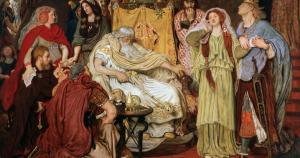
Education begins in wonder, asking the right questions, and never ends. That’s great, but if we choose badly, and many of us choose badly, we might end up needing wisdom, longing for wise guides, but surrounded by (apparent) fools.
Phillip E. Johnson loved to quote The Court Jester where the tyrant says: “Why must I be surrounded by fools?” The answer, of course, is that like is attracted to like and fools have come to answer us in our folly. This seems deeply hopeless and though we are in a bad place due to our own choices, must we lose hope? Fortunately, the good God has created a good cosmos so the dialectic is (almost) always possible.
If we ask good questions, then mayhap even a fool can help us. Why? God’s cosmos is favorable to learning and finding truth. We have to be very far gone to be unable to find the way back to Him. Thankfully, few of us have the means and opportunity to get that lost.
Shakespeare Gives an Image of Hope
Humanist Christian William Shakespeare paints the picture for us. A king turned tyrant fritters away his power and ends up abused and destitute. The two daughters he trusted betray him and Lear ends up homeless in a terrific storm. He finds friends, though, including a good man pretending to be a fool. Edgar, pretending to be a fool, must keep up the pretense, but he can help Lear if Lear will persist in asking questions. Fortunately, Lear is finding his way back to the good, truth, and beauty. He persists in asking questions, bad questions, any questions.
He starts assuming that what went wrong for him, bad children, went wrong for the fool:
LEAR: Didst thou give all to thy two daughters, And art thou come to this?
EDGAR Who gives anything to Poor Tom, whom the foul fiend hath led through fire and through flame, through ford and whirlpool, o’er bog and quagmire; that hath laid knives under his pillow and halters in his pew, set ratsbane by his porridge, made him proud of heart to ride on a bay trotting-horse over four-inched bridges, to course his own shadow for a traitor.
Edgar is not really mad, but must pretend to be so. Lear is fixated on the wrongs done to him, but has not yet seen the wrongs he has done. Lear made this mess, but he is still justifying himself by reducing evils to the evils done to him.
LEAR Has his daughters brought him to this pass? (To Edgar) Couldst thou save nothing? Wouldst thou give ’em all?
FOOL Nay, he reserved a blanket, else we had been all shamed. (….)
Lear says a foolish thing: anyone in trouble must have evil daughters. He has been a tyrant and raised two bad daughters and one good one. He sided with the bad, because they flattered him. He is now at the bottom and beginning to realize his error, but cannot quite yet own that he has been a bad king. Lear wishes to blame other people and since other people are far more vile than he is, that seems easy to do, but Lear is the start of all the evil. He needs to see this truth, but this is hard:
LEAR Death, traitor! Nothing could have subdued nature To such a lowness but his unkind daughters. (To Edgar) Is it the fashion that discarded fathers Should have thus little mercy on their flesh? Judicious punishment: ’twas this flesh begot Those pelican daughters. (. . .)
EDGAR Pillicock sat on Pillicock Hill; alow, alow, loo, loo.
Edgar, who is not really mad, responds with nonsense. Most of us would stop the dialog here: our interlocutor is crazy and crazy people are generally not insightful. Yet Lear knows, as all Christians do, that there is the holy fool: the man who speaks truth in ways a culture cannot hear, in words that sound like nonsense, but are really jarring to the elite.
Lear asks the key question in the play:
LEAR What hast thou been?
EDGAR A servingman, proud in heart and mind, that curled my hair, wore gloves in my cap, served the lust of my mistress’ heart, and did the act of darkness with her; swore as many oaths as I spake words, and broke them in the sweet face of heaven; one that slept in the contriving of lust, and waked to do it. (…)
LEAR Thou wert better in a grave than to answer with thy uncovered body this extremity of the skies. Is man no more than this? Consider him well. Thou owest the worm no silk, the beast no hide, the sheep no wool, the cat no perfume. Ha, here’s three on ’s are sophisticated; thou art the thing itself. Unaccommodated man is no more but such a poor, bare, forked animal as thou art. Off, off, you lendings! Come, unbutton here. (…)
This exchange transforms Lear and could change us if we too would persist in asking questions. Lear moves beyond himself and questions this battered, storm tossed, (seeming) fool, about what this apparent fool has been. The answer is long, mostly nonsensical, but triggers growth in Lear. Why? Lear is no longer repeating his grinding, endless self-justifications: he is asking about someone else. Why is this fool a fool? Maybe, just maybe, everything isn’t the fault of bad daughters!
LEAR What’s he?
KENT (to Gloucester) Who’s there? What is’t you seek?
GLOUCESTER What are you there? Your names?
EDGAR Poor Tom, that eats the swimming frog, the toad, the tadpole, the wall-newt and the water; that in the fury of his heart, when the foul fiend rages, eats cowdung for salads, swallows the old rat and the ditch-dog, drinks the green mantle of the standing pool; who is whipped from tithing to tithing, and stocked, punished, and imprisoned; who hath had three suits to his back, six shirts to his body, Horse to ride, and weapon to wear; But mice and rats and such small deer Have been Tom’s food for seven long year. Beware my follower. Peace, Smulkin; peace, thou fiend!
LEAR First let me talk with this philosopher. (To Edgar) What is the cause of thunder?
Lear has found a “philosopher,” a lover of wisdom. How? Edgar (in his guise as a fool) has not said “Wise Things,” but has forced Lear to realize that he has nothing better. Edgar (as a fool) says nonsense and that is what Lear realizes he has.
Lear learns what we all must learn: we are all ignorant. We must always recollect that the known Unknown is not known fully by us. We are children of God and God is beyond our imagination.
————————————-
*Shakespeare, King Lear 3.4.
King Lear gives readers a truth telling Cordelia, the heroine we need just now, a happy ending if you are a regular person, even if the rulers suffer for their sins, and lessons in what not to do as an aging leader.
Next Post
November 12, 2019 Liberty and Law: a Bull Moose Future?
Browse Our Archives
Select a Category Apologetics Art Culture Education On Books On Education Philosophy Politics Pop Culture Spiritual Reflections Uncategorized
Select a Month October 2026 September 2026 August 2026 July 2026 July 2025 June 2025 September 2024 July 2024 June 2024 December 2023 June 2023 September 2022 May 2022 April 2022 March 2022 February 2022 July 2021 June 2021 May 2021 April 2021 March 2021 February 2021 January 2021 December 2020 November 2020 October 2020 September 2020 August 2020 July 2020 June 2020 May 2020 April 2020 March 2020 February 2020 January 2020 December 2019 November 2019 October 2019 September 2019 August 2019 July 2019 June 2019 May 2019 April 2019 March 2019 February 2019 January 2019 December 2018 November 2018 October 2018 September 2018 August 2018 July 2018 June 2018 May 2018 April 2018 March 2018 February 2018 January 2018 December 2017 November 2017 October 2017 September 2017 August 2017 July 2017 June 2017 May 2017 April 2017 March 2017 February 2017 January 2017 December 2016 November 2016 October 2016 September 2016 August 2016 July 2016 June 2016 May 2016 April 2016 March 2016 February 2016 January 2016 December 2015 November 2015 October 2015 September 2015 August 2015 July 2015 June 2015 May 2015 April 2015 March 2015 February 2015 January 2015 November 2014 October 2014 September 2014 August 2014 July 2014 June 2014 May 2014 April 2014 March 2014 February 2014 January 2014 December 2013 November 2013 October 2013 September 2013 August 2013 July 2013 June 2013 May 2013 April 2013 March 2013 February 2013 January 2013 December 2012 November 2012 October 2012 September 2012 August 2012 July 2012 June 2012 May 2012
Follow Us!
TAKE THE
Religious Wisdom Quiz
Whose daughter did Jesus raise from the dead in Capernaum?
Select your answer to see how you score.
Nicodemus' daughter Joseph's daughter Mary's daughter Jairus' daughter
Books by This Author John Mark Reynolds
Related posts from Eidos

Classical Education Must Teach Us to Make the...

Classical Education and the Art of Dying Well

Golden, Golden, Golden: My Mother's Last Lesson

TRENDING AT PATHEOS Evangelical

The REST of Your Life: A Creative Wrestles...
This week I had a conversation with a good friend from church....

How the author of the world's best hymn...
I've been working with John Newton for a while now. This makes...

Long before this Lectio Divina, Psalm 130 - the song - started...

What About the Trees? Another Living Parable
After I finished writing the last article about falling leaves as a...

Why Classical Education Is a Conversation, Not a...
Come and Read: Joy in Classical Education When I was a little...

Cornell University has received a great deal of negative publicity and intense...
view all Evangelical blogs
Ad-Free & Subscriber Log-In Subscription Support
- About Us
- 2026 Calendar
- Videos
- Podcasts
- Library of World Religions
- Faith In Media Tracker
- Advertise With Us
- Write for Us
- Privacy Policy
- Terms of Service
- Do Not Sell My Data
- Contact Us
- Radiant Digital
- Manage Newsletter Subscriptions
- Unsubscribe From Notifications
- Sitemap
Copyright 2008-2026, Patheos. All rights reserved.
Subscription Support Ad-Free & Subscriber Log-In
Follow Patheos