
BuddhistCatholicContemplativeEvangelicalGeneral ChristianHinduJewishLatter-day SaintMuslimNew VisionsProgressive Christian
Beliefs
- Buddhist
- Catholic
- Contemplative
- Evangelical
- General Christian
- Hindu
- Jewish
- Latter-day Saint
- More Voices
- Muslim
- New Visions
- Pagan
- Progressive Christian
Topics
- Religion News
- Food and Religion
- Sports and Religion
- Religious Art
- Religious Music and Entertainment
- Religious Events
- History and Religion
- Style and Religion
- Politics and Religion
- Women in Religion
- Recreation Outdoors and Religion
- Business Finance and Religion
- Careers Workplace and Religion
- Education and Religion
- Family Parenting and Religion
- Health Fitness and Religion
- Home and Religion
- Relationships and Religion
- Technology and Religion
- Travel and Religion
Columnists
- Buddhist Columnists
- Business Finance and Religion Columnists
- Careers Workplace and Religion Columnists
- Catholic Columnists
- Contemplative Columnists
- Education and Religion Columnists
- Evangelists Columnists
- Family Parenting and Religion Columnists
- General Christian Columnists
- Health Fitness and Religion Columnists
- Hindu Columnists
- History and Religion Columnists
- Home and Religion Columnists
- Jewish Columnists
- More Voices Columnists
- Latter Day Columnists
- Muslim Columnists
- New Visions Columnists
- Nonreligious Columnists
- Pagan Columnists
- Politics and Religion Columnists
- Progressive Columnists
- Recreation Outdoors and Religion Columnists
- Relationships and Religion Columnists
- Religion News Columnists
- Religious Art Columnists
- Religious Events Columnists
- Religious Music and Entertainment Columnists
- Sports and Religion Columnists
- Style and Religion Columnists
- Technology and Religion Columnists
- Travel and Religion Columnists
- Women in Religion Columnists
Resource Library
- 2026 Calendar
- Library of World Religions
- The 100 Most Holy Places on Earth
- Patheos Answers
- Podcasts
- Videos
- Faith Leaders Database
- Anglican Episcopalian
- Bahai
- Baptist
- Buddhism
- Christianity
- Confucianism
- Eastern Orthodoxy
- Hinduism
- Holiness and Pentecostal
- ISKCON
- Islam
- Judaism
- Lutheran
- Methodist
- The Church of Jesus Christ of Latter-day Saints
- New Age
- Paganism
- Presbytarian and Reformed
- Protestantism
- Religion Behind the Scenes
- Roman Catholic
- Scientology
- Shia Islam
- Sikhism
- Sufism
- Sunni Islam
- Taoism
- Zen
- See all religions
Research Tools
 Ad-Free & Subscriber Log-In Subscription Support
Ad-Free & Subscriber Log-In Subscription Support
Follow Patheos 

- Trending:
- Forgiveness
- |
- Marriage
- |
- Consciousness
- |
- Death Penalty
- |
- Election
- |
- Halloween

- Home
- Evangelical
- Being Cordelia: She Would Not Flatter for a Kingdom (King Lear, William Shakespeare)
Being Cordelia: She Would Not Flatter for a Kingdom (King Lear, William Shakespeare)
Last updated on: November 10, 2019 at 9:27 pm by John Mark N. Reynolds
Being Cordelia: She Would Not Flatter for a Kingdom (King Lear, William Shakespeare) 2019-11-10T21:27:32-04:00 John Mark N. Reynolds
Patheos Explore the world's faith through different perspectives on religion and spirituality! Patheos has the views of the prevalent religions and spiritualities of the world.
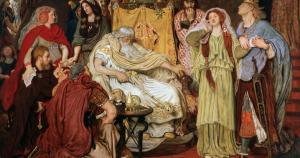 Lying to the Leader: Self-Dealing or Clever?
Would you tell the leader, a President, Pope, or potentate, what in his pride he wished to hear? Would you lie? What if a kingdom the reward for a bit of flattery? Isn’t London worth a lie? Many would prevaricate, confident their own character would survive one little “white lie” and that the outcome of the lie is (somehow) certain.
After all, God can forgive anything. We might lie and then be sorry. Wouldn’t any decent parent, especially an all good God, wish us to lie to save our life, get a kingdom, do a great deal of good? I am sure my dad, his dad, and his dad before him would not have wished me to lie. This is not merely because they were Christians, but because they were gentlemen.
They knew lying for personal gain in a tough situation protects tyrants, assumes what we cannot know (all the results of our actions) in order to do what do know is wrong (flattering a tyrant), and is dangerous for character. God can and will forgive, but we might become used to “white lies,” convenient fictions, and soon one ends with up with pastors who no longer believe, but collect a paycheck, politicians who pander to powerful narcissists in office, and a people who will betray their deepest values to eke out their lives.
In the light of eternity, sound women and men tell the truth to tyrants. We might help the mentally ill, who cannot know the truth, but to the wicked systems of our time, we owe them the truth and speak it unbendingly: “No. We are not afraid. We will not lie, even if we die.”
When the Soviet Union faced a mass of people who would not lie, the system failed. The same can happen in atheist China if enough folk will not tell the tyrants in Beijing what they wish to hear. Washington DC would be a better place if we measured alleged ends less than the corrupting power on our character of convenient lies.
Thank God this week the College is focused on King Lear that provides a guide to dealing with madmen with power.
Shakespeare Provides some Moral Clarity: Better to Die than to Tell a Lie
Shakespeare, as usual, humanist Christian that he was, deals with just this issue: one of his bravest, greatest heroines will not flatter her father, lie for a kingdom. As a result, she loses an inheritance, a husband, and her father.
So why not lie?
She puts it this way:
Unhappy that I am, I cannot heave My heart into my mouth. I love your majesty According to my bond, no more nor less.
Cordelia knows three things. First, against tyrants the truth must be spoken. Why? The tyrant may repent. One does not know and even he has a soul one wishes could be saved. Second, if she speaks the truth, then she can stand as an icon of integrity against the flattery and “go along” folk. The martyr to the truth spreads the truth, even if only in whispers in the politburo, the court, the Congress.
Third, the future is complicated. Cordelia will (almost) certainly lose a kingdom and a husband if she tells the truth. She might lose her life. Yet when dealing with a madman, who can be sure? Perhaps the truth will jar him to a better course. Cordelia knows that if she lies, she has surely done what benefits her. Nobody is so good they can be sure of their motives. She might be looking for a “greater good” if she lies or she might simply be a moral coward covering up by pretending. She would have to live with this in the future and so would everyone who works with her.
Instead, Cordelia tells the truth. The immediate result is mixed. The mad king deprives his best daughter of a kingdom, but she also flushes out a man who would have married her just for her inheritance. Instead, she finds a man who marries her for love when she is at the bottom. That’s not so bad. Meanwhile, in the long term, Cordelia is a moral center for English in exile. She will return and her invasion, though it fails, will precipitate the end of tyranny in England.
Against the complicated future, Cordelia controls the one thing in her power: her moral choice. She chooses the truth in the face of power. She is not afraid of the sword, being more afraid of a lie.
There is a certain self-serving cad calculating just why the coward’s way is actually brave, sensible, or for the greater good. He habituates himself to convenient white lies and then has reasons why what appears to be cowardice is really sound policy. He never hears King Lear say:
Thy truth then be thy dower; For by the sacred radiance of the sun, The mysteries of Hecate and the night, By all the operation of the orbs From whom we do exist and cease to be, Here I disclaim all my paternal care, Propinquity, and property of blood, And as a stranger to my heart and me Hold thee from this for ever. The barbarous Scythian, Or he that makes his generation messes To gorge his appetite, shall to my bosom Be as well neighboured, pitied, and relieved As thou, my sometime daughter.*
Truth was her inheritance and Shakespeare shows the truth prevails in the end. The King was a fool, but even he comes to see this truth in the end. Why? The liars and the flatterers are revealed as the cads, self-serving double dealers, as false friends are.
Cordelia might tell a lie to protect someone else. People like Cordelia shan’t lie to flatter a tyrant, save themselves, or betray their values. Better after all to die than to tell a lie. Cordelia does die, but her death saves England. The common folk have a moral example for all time of integrity and they are free of the rot of the tyrant Lear. She even redeems her mad father: her moral integrity puts her in a position to do so. If she had, like her sisters, been the sort to flatter for policy, then Lear would have had no child able to hear his confession and restore him to honor.
God help us. This Republic should raises up citizens who all aspire to be Cordelia.
————————-
*Shakespeare, King Lear. Act 1.1
King Lear gives readers Cordelia, the heroine we need just now, a happy ending if you are a regular person, even if the rulers suffer for their sins, and lessons in what not to do as an aging leader.
Previous Post

November 9, 2019
Thwarted Ambition? Avoid “Edmunding”
Browse Our Archives
Select a Category Apologetics Art Culture Education On Books On Education Philosophy Politics Pop Culture Spiritual Reflections Uncategorized
Select a Month October 2026 September 2026 August 2026 July 2026 July 2025 June 2025 September 2024 July 2024 June 2024 December 2023 June 2023 September 2022 May 2022 April 2022 March 2022 February 2022 July 2021 June 2021 May 2021 April 2021 March 2021 February 2021 January 2021 December 2020 November 2020 October 2020 September 2020 August 2020 July 2020 June 2020 May 2020 April 2020 March 2020 February 2020 January 2020 December 2019 November 2019 October 2019 September 2019 August 2019 July 2019 June 2019 May 2019 April 2019 March 2019 February 2019 January 2019 December 2018 November 2018 October 2018 September 2018 August 2018 July 2018 June 2018 May 2018 April 2018 March 2018 February 2018 January 2018 December 2017 November 2017 October 2017 September 2017 August 2017 July 2017 June 2017 May 2017 April 2017 March 2017 February 2017 January 2017 December 2016 November 2016 October 2016 September 2016 August 2016 July 2016 June 2016 May 2016 April 2016 March 2016 February 2016 January 2016 December 2015 November 2015 October 2015 September 2015 August 2015 July 2015 June 2015 May 2015 April 2015 March 2015 February 2015 January 2015 November 2014 October 2014 September 2014 August 2014 July 2014 June 2014 May 2014 April 2014 March 2014 February 2014 January 2014 December 2013 November 2013 October 2013 September 2013 August 2013 July 2013 June 2013 May 2013 April 2013 March 2013 February 2013 January 2013 December 2012 November 2012 October 2012 September 2012 August 2012 July 2012 June 2012 May 2012
Follow Us!
TAKE THE
Religious Wisdom Quiz
Who is the Good Shepherd in Jesus' teaching?
Select your answer to see how you score.
Peter Jesus Moses David
Books by This Author John Mark Reynolds
Related posts from Eidos

Classical Education Must Teach Us to Make the...

The Iceberg is There: Verbosity Cannot Defeat Reality

One Weeping Icon at Christmas is Enough

The Power of Dissenting Societies: A Thought
TRENDING AT PATHEOS Evangelical

The REST of Your Life: A Creative Wrestles...
This week I had a conversation with a good friend from church....

How the author of the world's best hymn...
I've been working with John Newton for a while now. This makes...

Long before this Lectio Divina, Psalm 130 - the song - started...

What About the Trees? Another Living Parable
After I finished writing the last article about falling leaves as a...

Why Classical Education Is a Conversation, Not a...
Come and Read: Joy in Classical Education When I was a little...

Cornell University has received a great deal of negative publicity and intense...
view all Evangelical blogs
Ad-Free & Subscriber Log-In Subscription Support
- About Us
- 2026 Calendar
- Videos
- Podcasts
- Library of World Religions
- Faith In Media Tracker
- Advertise With Us
- Write for Us
- Privacy Policy
- Terms of Service
- Do Not Sell My Data
- Contact Us
- Radiant Digital
- Manage Newsletter Subscriptions
- Unsubscribe From Notifications
- Sitemap
Copyright 2008-2026, Patheos. All rights reserved.
Subscription Support Ad-Free & Subscriber Log-In
Follow Patheos