
BuddhistCatholicContemplativeEvangelicalGeneral ChristianHinduJewishLatter-day SaintMuslimNew VisionsProgressive Christian
Beliefs
- Buddhist
- Catholic
- Contemplative
- Evangelical
- General Christian
- Hindu
- Jewish
- Latter-day Saint
- More Voices
- Muslim
- New Visions
- Pagan
- Progressive Christian
Topics
- Religion News
- Food and Religion
- Sports and Religion
- Religious Art
- Religious Music and Entertainment
- Religious Events
- History and Religion
- Style and Religion
- Politics and Religion
- Women in Religion
- Recreation Outdoors and Religion
- Business Finance and Religion
- Careers Workplace and Religion
- Education and Religion
- Family Parenting and Religion
- Health Fitness and Religion
- Home and Religion
- Relationships and Religion
- Technology and Religion
- Travel and Religion
Columnists
- Buddhist Columnists
- Business Finance and Religion Columnists
- Careers Workplace and Religion Columnists
- Catholic Columnists
- Contemplative Columnists
- Education and Religion Columnists
- Evangelists Columnists
- Family Parenting and Religion Columnists
- General Christian Columnists
- Health Fitness and Religion Columnists
- Hindu Columnists
- History and Religion Columnists
- Home and Religion Columnists
- Jewish Columnists
- More Voices Columnists
- Latter Day Columnists
- Muslim Columnists
- New Visions Columnists
- Nonreligious Columnists
- Pagan Columnists
- Politics and Religion Columnists
- Progressive Columnists
- Recreation Outdoors and Religion Columnists
- Relationships and Religion Columnists
- Religion News Columnists
- Religious Art Columnists
- Religious Events Columnists
- Religious Music and Entertainment Columnists
- Sports and Religion Columnists
- Style and Religion Columnists
- Technology and Religion Columnists
- Travel and Religion Columnists
- Women in Religion Columnists
Resource Library
- 2026 Calendar
- Library of World Religions
- The 100 Most Holy Places on Earth
- Patheos Answers
- Podcasts
- Videos
- Faith Leaders Database
- Anglican Episcopalian
- Bahai
- Baptist
- Buddhism
- Christianity
- Confucianism
- Eastern Orthodoxy
- Hinduism
- Holiness and Pentecostal
- ISKCON
- Islam
- Judaism
- Lutheran
- Methodist
- The Church of Jesus Christ of Latter-day Saints
- New Age
- Paganism
- Presbytarian and Reformed
- Protestantism
- Religion Behind the Scenes
- Roman Catholic
- Scientology
- Shia Islam
- Sikhism
- Sufism
- Sunni Islam
- Taoism
- Zen
- See all religions
Research Tools
 Ad-Free & Subscriber Log-In Subscription Support
Ad-Free & Subscriber Log-In Subscription Support
Follow Patheos 

- Trending:
- Forgiveness
- |
- Marriage
- |
- Consciousness
- |
- Death Penalty
- |
- Election
- |
- Halloween

- Home
- Evangelical
- The Beloved is a Profoundly Wonderful “Whatever”
The Beloved is a Profoundly Wonderful “Whatever”
Last updated on: October 18, 2019 at 5:42 am by John Mark N. Reynolds
The Beloved is a Profoundly Wonderful “Whatever” 2019-10-16T19:39:21-04:00 John Mark N. Reynolds
Patheos Explore the world's faith through different perspectives on religion and spirituality! Patheos has the views of the prevalent religions and spiritualities of the world.
It is clear then that the essential object of love, or the Beloved, is “whatever.”
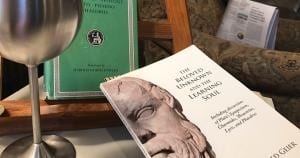 So said Professor Alfred Geier,* but if we pause and understand, then a life changing truth will result.
Over a lifetime Plato reflected on the life of Socrates and discovered a few essential truths about humankind. These ideas have been disputed and those disputes are the footnotes to philosophy.**
In Plato’s Symposium, Socrates and the tragic poet Agathon are discussing “love.” What is love? Both realize that there exists a longing, a love, that cannot be satisfied by a human person, a City, or even ideas. We love something. Agathon and Socrates agree on this and if love comes, then (in all probability) love is of something. Something causes the desire that cannot be satisfied, is not sated, by any finite being.
We have eternity in our hearts. Agathon is sure his love is of something, a something Geier translates as “whatever.” The Beloved Uknown is there, has done this, and yet that is not the Beloved. The sign, the very icon of the Beloved, is not the Beloved. He is there until we look there and then the Beloved is gone.
What is that something that causes love? Who knows? We know we love, but for Plato this Beloved (so divine!) is known to exist, but unknown. Professor Geier concludes that this mystery (my term) allows all learning in humankind. We see a tentative truth, but always are (not quite) sure. We wonder and the wonder, the knowledge that not only may we be wrong (obviously), but that our picture of the Beloved is so limited that the picture might as well be false keeps us learning.
The Beloved is eternal, unchanging. We are neither of those things. We can know, but the Beloved cannot be exhausted. There is always more and this uncertainty, this “all may change” is the basis for learning. In another dialogue, Plato’s Phaedrus, Socrates faces a Phaedrus (his very name is “bright one”) that is in love, but badly. Socrates and Phaedrus talk, Socrates listens, and slowly both are changed. Socrates starts enamored with the handsome Phaedrus while he is in love with a speech he has heard from another teacher.
Socrates starts to give another speech and in the middle stops. He has stopped focusing on Phaedrus (Geier, 89ff) and turned toward the Beloved Unknown. He begins to speak poetically and finally stops:
Socrates: And now, dear Phaedrus, I shall pause for an instant to ask whether you do not think me, as I appear to myself, inspired?
PHAEDRUS: Yes, Socrates, you seem to have a very unusual flow of words.
SOCRATES: Listen to me, then, in silence; for surely the place is holy; so that you must not wonder, if, as I proceed, I appear to be in a divine fury, for already I am getting into dithyrambics.**
At the end of Phaedrus, Geier points out that the last speaker in the dialogue is actually unknown (though what he said is known!). Translators (usually) choose to give Socrates the literal last word, but the text is ambiguous. There is only one word at the end which means, roughly: we go.*** Phaedrus and Socrates go, together. They know where they are going, where they have been, but they do not know, cannot know, the End. There is no end. . . Just one question leading to another to another world without end.
Amen.
For a Christian, this attitude is vital: we live by faith, not sight. This is not an appeal to non-reason, but to the incomplete knowledge that must always exist regarding the Known Unknown: God. One truth at the very center of Orthodoxy is that we cannot fully describe God. We know best what God is not: limited, powerless, foolish. The Orthodox would not dare limit God. He is not a liar, God is not a sinner, but God is known and unknown, beloved yet never exhausted.
A vital, theological rich, devotionally profound book, Father’s Love Journey, by Professor Fount Shults makes the point that the God of Saint John’s Gospel is always forcing us out of our bubble, theological and philosophic. God the Father comes to be known in the person of Jesus Christ, but as God can never be fully known. Saint John points to Christ, he is not the Christ. John the Baptist is a signpost of the Messiah: the Baptist is not the Messiah.
Even our words about God the Father, truly seen in Jesus are so limited as to almost (but not quite), be false. They are the best words we have: the liberal Christian sure they are too limited, the doctrinaire positive they are the end of all wondering. The Christian begins with what is seen, revealed, and then wonders about more and more. Nothing contradicting, all tentative, all in the great “whatever” of God. The faithful creeds launching us further into a relationship with a God who is known, but can never fully be known.
Let’s worship the God known to be “whatever.” God is that God: not finite, not imperfect, not changing. God is love, but love is that whatever that we love. This mystery, to us not to reality, is a constant joy. We can see love without end for all time and into eternity.
And doing so, wonder of wonders, holding Orthodoxy by faith, knowing our fallibility, and the more and even more that is always there in the Beloved Unknown.
—————————————
*Geier, Alfred. The Beloved Unknown and the Learning Soul (Tiger Bark Press, 2016)
**Plato, Phaedrus. 238 C. (Lowell translation.)
** To paraphrase sort-of-Whitehead.
***Plato, Phaedrus, 279 C.
Previous Post

October 17, 2019
Knowing Self, God Knowing Us (Bonus: On False Stories about Gods!)
Next Post

October 19, 2019 As God Likes It (Shakespeare!)
Browse Our Archives
Select a Category Apologetics Art Culture Education On Books On Education Philosophy Politics Pop Culture Spiritual Reflections Uncategorized
Select a Month October 2026 September 2026 August 2026 July 2026 July 2025 June 2025 September 2024 July 2024 June 2024 December 2023 June 2023 September 2022 May 2022 April 2022 March 2022 February 2022 July 2021 June 2021 May 2021 April 2021 March 2021 February 2021 January 2021 December 2020 November 2020 October 2020 September 2020 August 2020 July 2020 June 2020 May 2020 April 2020 March 2020 February 2020 January 2020 December 2019 November 2019 October 2019 September 2019 August 2019 July 2019 June 2019 May 2019 April 2019 March 2019 February 2019 January 2019 December 2018 November 2018 October 2018 September 2018 August 2018 July 2018 June 2018 May 2018 April 2018 March 2018 February 2018 January 2018 December 2017 November 2017 October 2017 September 2017 August 2017 July 2017 June 2017 May 2017 April 2017 March 2017 February 2017 January 2017 December 2016 November 2016 October 2016 September 2016 August 2016 July 2016 June 2016 May 2016 April 2016 March 2016 February 2016 January 2016 December 2015 November 2015 October 2015 September 2015 August 2015 July 2015 June 2015 May 2015 April 2015 March 2015 February 2015 January 2015 November 2014 October 2014 September 2014 August 2014 July 2014 June 2014 May 2014 April 2014 March 2014 February 2014 January 2014 December 2013 November 2013 October 2013 September 2013 August 2013 July 2013 June 2013 May 2013 April 2013 March 2013 February 2013 January 2013 December 2012 November 2012 October 2012 September 2012 August 2012 July 2012 June 2012 May 2012
Follow Us!
TAKE THE
Religious Wisdom Quiz
Who was the king who arranged for Hezekiah's scribes to compile additional Proverbs?
Select your answer to see how you score.
Hezekiah Jeroboam Solomon Ahab
Books by This Author John Mark Reynolds
Related posts from Eidos

Classical Education Must Teach Us to Make the...

Classical Education and the Art of Dying Well

Golden, Golden, Golden: My Mother's Last Lesson

TRENDING AT PATHEOS Evangelical

The REST of Your Life: A Creative Wrestles...
This week I had a conversation with a good friend from church....

How the author of the world's best hymn...
I've been working with John Newton for a while now. This makes...

Long before this Lectio Divina, Psalm 130 - the song - started...

What About the Trees? Another Living Parable
After I finished writing the last article about falling leaves as a...

Why Classical Education Is a Conversation, Not a...
Come and Read: Joy in Classical Education When I was a little...

Cornell University has received a great deal of negative publicity and intense...
view all Evangelical blogs
Ad-Free & Subscriber Log-In Subscription Support
- About Us
- 2026 Calendar
- Videos
- Podcasts
- Library of World Religions
- Faith In Media Tracker
- Advertise With Us
- Write for Us
- Privacy Policy
- Terms of Service
- Do Not Sell My Data
- Contact Us
- Radiant Digital
- Manage Newsletter Subscriptions
- Unsubscribe From Notifications
- Sitemap
Copyright 2008-2026, Patheos. All rights reserved.
Subscription Support Ad-Free & Subscriber Log-In
Follow Patheos