
BuddhistCatholicContemplativeEvangelicalGeneral ChristianHinduJewishLatter-day SaintMuslimNew VisionsProgressive Christian
Beliefs
- Buddhist
- Catholic
- Contemplative
- Evangelical
- General Christian
- Hindu
- Jewish
- Latter-day Saint
- More Voices
- Muslim
- New Visions
- Pagan
- Progressive Christian
Topics
- Religion News
- Food and Religion
- Sports and Religion
- Religious Art
- Religious Music and Entertainment
- Religious Events
- History and Religion
- Style and Religion
- Politics and Religion
- Women in Religion
- Recreation Outdoors and Religion
- Business Finance and Religion
- Careers Workplace and Religion
- Education and Religion
- Family Parenting and Religion
- Health Fitness and Religion
- Home and Religion
- Relationships and Religion
- Technology and Religion
- Travel and Religion
Columnists
- Buddhist Columnists
- Business Finance and Religion Columnists
- Careers Workplace and Religion Columnists
- Catholic Columnists
- Contemplative Columnists
- Education and Religion Columnists
- Evangelists Columnists
- Family Parenting and Religion Columnists
- General Christian Columnists
- Health Fitness and Religion Columnists
- Hindu Columnists
- History and Religion Columnists
- Home and Religion Columnists
- Jewish Columnists
- More Voices Columnists
- Latter Day Columnists
- Muslim Columnists
- New Visions Columnists
- Nonreligious Columnists
- Pagan Columnists
- Politics and Religion Columnists
- Progressive Columnists
- Recreation Outdoors and Religion Columnists
- Relationships and Religion Columnists
- Religion News Columnists
- Religious Art Columnists
- Religious Events Columnists
- Religious Music and Entertainment Columnists
- Sports and Religion Columnists
- Style and Religion Columnists
- Technology and Religion Columnists
- Travel and Religion Columnists
- Women in Religion Columnists
Resource Library
- 2026 Calendar
- Library of World Religions
- The 100 Most Holy Places on Earth
- Patheos Answers
- Podcasts
- Videos
- Faith Leaders Database
- Anglican Episcopalian
- Bahai
- Baptist
- Buddhism
- Christianity
- Confucianism
- Eastern Orthodoxy
- Hinduism
- Holiness and Pentecostal
- ISKCON
- Islam
- Judaism
- Lutheran
- Methodist
- The Church of Jesus Christ of Latter-day Saints
- New Age
- Paganism
- Presbytarian and Reformed
- Protestantism
- Religion Behind the Scenes
- Roman Catholic
- Scientology
- Shia Islam
- Sikhism
- Sufism
- Sunni Islam
- Taoism
- Zen
- See all religions
Research Tools
 Ad-Free & Subscriber Log-In Subscription Support
Ad-Free & Subscriber Log-In Subscription Support
Follow Patheos 

- Trending:
- Forgiveness
- |
- Marriage
- |
- Consciousness
- |
- Death Penalty
- |
- Election
- |
- Halloween

- Home
- Evangelical
- Love’s Dream (Romeo and Juliet)
Love’s Dream (Romeo and Juliet)
Last updated on: September 17, 2019 at 5:07 am by John Mark N. Reynolds
Love’s Dream (Romeo and Juliet) 2019-09-17T00:23:08-04:00 John Mark N. Reynolds
Patheos Explore the world's faith through different perspectives on religion and spirituality! Patheos has the views of the prevalent religions and spiritualities of the world.
Beware a love or a life based on mere dreams.
God may speak in dreams, but so do devils. A good man knows a godly dream commands to virtue with prudence. Devils or our own passions stir us to quick, irrational behavior that has no time or patience for reason, virtue, or prudence.
True love may come with dreams, but true love is never based on a dream, too uncertain to base the most important decisions of life. Too often we deceive ourselves that what we wish, our passions, or rapidly gained desires are love and this false love can call up dreams, though never dreams that match God’s revelation or best reason.
Shakespeare warns of such delusions, the false love dream, in his Romeo and Juliet.
Romeo and Juliet is a great many things: a picture of what love is not, a demonstration that woe is not romantic, and a caution waiting to end familial strife when someone dies is unwise, and not ancestral to YAF. Romeo and Juliet’s rapid “romance” and marriage is unwise, but Romeo, in particular acts on fantasy and dreams. The love between the pair is in contrast to the faithful love of the Biblical dreamer Joseph: he lived by the law, acted reasonably, but dreams drove him to mercy (to accept Mary) and to flee the wrath of Herod. His prudent act to flee to Egypt immediately fit the facts as this enabled his little family to escape the slaughter of the babies in Bethlehem.*
Romeo goes from a dreamy love of “fair Rosalind” to Juliet quickly, because dreams need not be tied to a real future. Shakespeare has Romeo’s friend Mercutio warn him:
ROMEO I dreamt a dream tonight.
MERCUTIO And so did I.
ROMEO Well, what was yours?
MERCUTIO That dreamers often lie.*
Such dreams, Murcutio claims come (symbolically) from fairy the Queen Mab, a midwife, who brings to birth in the night desires of the sleepers. Some are pleasant, granting in sleep simple desires, but still insubstantial and unconstant. In the end, Mab’s dreams, if brought into the day, make a mess. Of such dreams, Mercutio warns:
I talk of dreams, Which are the children of an idle brain, Begot of nothing but vain fantasy, Which is as thin of substance as the air, And more inconstant than the wind, who woos Even now the frozen bosom of the north, And, being angered, puffs away from thence, Turning his face to the dew-dropping south.**
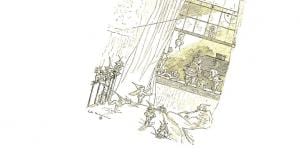
The living dream of passion overrides all reason. Dreamy love pushes us to make “the thin” of substance substantial, but this cannot be done. The living dream of the balcony scene between Romeo and Juliet has this lightness, thinness to it. This is not the love of Joseph and Mary or the enduring passion of a mature couple:
JULIET But to be frank and give it thee again. And yet I wish but for the thing I have. My bounty is as boundless as the sea, My love as deep. The more I give to thee The more I have, for both are infinite. Nurse calls within I hear some noise within. Dear love, adieu.—Anon, good Nurse!—Sweet Montague, be true. Stay but a little; I will come again. Exit
ROMEO O blessed, blessèd night! I am afeard, Being in night, all this is but a dream, Too flattering-sweet to be substantial.***
The culminating dream of the play comes when Romeo is in exile and all is about to go smash. He is not worried, because dreams have flattered him:
If I may trust the flattering truth of sleep, My dreams presage some joyful news at hand. My bosom’s lord sits lightly in his throne, And all this day an unaccustomed spirit Lifts me above the ground with cheerful thoughts. I dreamt my lady came and found me dead—Strange dream, that gives a dead man leave to think!—And breathed such life with kisses in my lips That I revived and was an emperor. Ah me, how sweet is love itself possessed When but love’s shadows are so rich in joy!****
“Reality” or what he thinks is reality wakes him up from the false love dream, but this reality is also a fiction. Romeo hears that Juliet is dead and goes to Verona to kill himself. He is not capable of thought, prudence, or investigation. This nightmare, Juliet dead, easily deceives him, because a man accustomed to living by dreams in a thoughtless manner will be easily swayed.
The good dreams that come from God and our better nature build on our desires for virtue. They spur us to act and give us hope in doing good. They fit the facts and do not hide from confirmation in history.
May all our loves, especially our love of God, be based in reality with sweet sleep and wonderful dreams. May we never live by Mab’s dreams or our own delusions.
Lord Jesus Christ, son of God, have mercy on me a sinner.
———————————-
*Note that the dreamers in the play, and many actors, make frequent use of rosemary, a herb symbolizing love, faithfulness, and (also) death. Most significantly the plant is linked to the flight of Mary to Egypt. She places her cloak on the rosemary bush to dry and the flowers are changed to the blue of her cloak. In 2.2 Friar Lawrence points out the mixed use of any herb:
Many for many virtues excellent, None but for some, and yet all different. O mickle is the powerful grace that lies In plants, herbs, stones, and their true qualities, For naught so vile that on the earth doth live But to the earth some special good doth give; Nor aught so good but, strained from that fair use, Revolts from true birth, stumbling on abuse. Virtue itself turns vice being misapplied, And vice sometime’s by action dignified.
The rosemary that might be a sign of the pure enduring love of the Mother of God and of holy marriage is turned toward death. Joseph saved Mary by his godly dreams ground in the Law of God, the community of faith, history, and experience. Romeo destroys Juliet (with her cooperation) through his dreamy refusal to listen to anything other than their passions.
**Shakespeare, Romeo and Juliet, Act 1.4
***Shakespeare, Romeo and Juliet, Act 2.1
****Shakespeare, Romeo and Juliet, Act 5.1
Previous Post

September 16, 2019
Love of Place and People (Shakespeares’s Richard II)

Browse Our Archives
Select a Category Apologetics Art Culture Education On Books On Education Philosophy Politics Pop Culture Spiritual Reflections Uncategorized
Select a Month October 2026 September 2026 August 2026 July 2026 July 2025 June 2025 September 2024 July 2024 June 2024 December 2023 June 2023 September 2022 May 2022 April 2022 March 2022 February 2022 July 2021 June 2021 May 2021 April 2021 March 2021 February 2021 January 2021 December 2020 November 2020 October 2020 September 2020 August 2020 July 2020 June 2020 May 2020 April 2020 March 2020 February 2020 January 2020 December 2019 November 2019 October 2019 September 2019 August 2019 July 2019 June 2019 May 2019 April 2019 March 2019 February 2019 January 2019 December 2018 November 2018 October 2018 September 2018 August 2018 July 2018 June 2018 May 2018 April 2018 March 2018 February 2018 January 2018 December 2017 November 2017 October 2017 September 2017 August 2017 July 2017 June 2017 May 2017 April 2017 March 2017 February 2017 January 2017 December 2016 November 2016 October 2016 September 2016 August 2016 July 2016 June 2016 May 2016 April 2016 March 2016 February 2016 January 2016 December 2015 November 2015 October 2015 September 2015 August 2015 July 2015 June 2015 May 2015 April 2015 March 2015 February 2015 January 2015 November 2014 October 2014 September 2014 August 2014 July 2014 June 2014 May 2014 April 2014 March 2014 February 2014 January 2014 December 2013 November 2013 October 2013 September 2013 August 2013 July 2013 June 2013 May 2013 April 2013 March 2013 February 2013 January 2013 December 2012 November 2012 October 2012 September 2012 August 2012 July 2012 June 2012 May 2012
Follow Us!
TAKE THE
Religious Wisdom Quiz
What Christian celebration commemorates the resurrection of Jesus Christ?
Select your answer to see how you score.
Christmas Lent Epiphany Easter
Books by This Author John Mark Reynolds
Related posts from Eidos

Classical Education Must Teach Us to Make the...

Classical Education and the Art of Dying Well

Golden, Golden, Golden: My Mother's Last Lesson

TRENDING AT PATHEOS Evangelical

The REST of Your Life: A Creative Wrestles...
This week I had a conversation with a good friend from church....

How the author of the world's best hymn...
I've been working with John Newton for a while now. This makes...

Long before this Lectio Divina, Psalm 130 - the song - started...

What About the Trees? Another Living Parable
After I finished writing the last article about falling leaves as a...

Why Classical Education Is a Conversation, Not a...
Come and Read: Joy in Classical Education When I was a little...

Cornell University has received a great deal of negative publicity and intense...
view all Evangelical blogs
Ad-Free & Subscriber Log-In Subscription Support
- About Us
- 2026 Calendar
- Videos
- Podcasts
- Library of World Religions
- Faith In Media Tracker
- Advertise With Us
- Write for Us
- Privacy Policy
- Terms of Service
- Do Not Sell My Data
- Contact Us
- Radiant Digital
- Manage Newsletter Subscriptions
- Unsubscribe From Notifications
- Sitemap
Copyright 2008-2026, Patheos. All rights reserved.
Subscription Support Ad-Free & Subscriber Log-In
Follow Patheos