
BuddhistCatholicContemplativeEvangelicalGeneral ChristianHinduJewishLatter-day SaintMuslimNew VisionsProgressive Christian
Beliefs
- Buddhist
- Catholic
- Contemplative
- Evangelical
- General Christian
- Hindu
- Jewish
- Latter-day Saint
- More Voices
- Muslim
- New Visions
- Pagan
- Progressive Christian
Topics
- Religion News
- Food and Religion
- Sports and Religion
- Religious Art
- Religious Music and Entertainment
- Religious Events
- History and Religion
- Style and Religion
- Politics and Religion
- Women in Religion
- Recreation Outdoors and Religion
- Business Finance and Religion
- Careers Workplace and Religion
- Education and Religion
- Family Parenting and Religion
- Health Fitness and Religion
- Home and Religion
- Relationships and Religion
- Technology and Religion
- Travel and Religion
Columnists
- Buddhist Columnists
- Business Finance and Religion Columnists
- Careers Workplace and Religion Columnists
- Catholic Columnists
- Contemplative Columnists
- Education and Religion Columnists
- Evangelists Columnists
- Family Parenting and Religion Columnists
- General Christian Columnists
- Health Fitness and Religion Columnists
- Hindu Columnists
- History and Religion Columnists
- Home and Religion Columnists
- Jewish Columnists
- More Voices Columnists
- Latter Day Columnists
- Muslim Columnists
- New Visions Columnists
- Nonreligious Columnists
- Pagan Columnists
- Politics and Religion Columnists
- Progressive Columnists
- Recreation Outdoors and Religion Columnists
- Relationships and Religion Columnists
- Religion News Columnists
- Religious Art Columnists
- Religious Events Columnists
- Religious Music and Entertainment Columnists
- Sports and Religion Columnists
- Style and Religion Columnists
- Technology and Religion Columnists
- Travel and Religion Columnists
- Women in Religion Columnists
Resource Library
- 2026 Calendar
- Library of World Religions
- The 100 Most Holy Places on Earth
- Patheos Answers
- Podcasts
- Videos
- Faith Leaders Database
- Anglican Episcopalian
- Bahai
- Baptist
- Buddhism
- Christianity
- Confucianism
- Eastern Orthodoxy
- Hinduism
- Holiness and Pentecostal
- ISKCON
- Islam
- Judaism
- Lutheran
- Methodist
- The Church of Jesus Christ of Latter-day Saints
- New Age
- Paganism
- Presbytarian and Reformed
- Protestantism
- Religion Behind the Scenes
- Roman Catholic
- Scientology
- Shia Islam
- Sikhism
- Sufism
- Sunni Islam
- Taoism
- Zen
- See all religions
Research Tools
 Ad-Free & Subscriber Log-In Subscription Support
Ad-Free & Subscriber Log-In Subscription Support
Follow Patheos 

- Trending:
- Forgiveness
- |
- Marriage
- |
- Consciousness
- |
- Death Penalty
- |
- Election
- |
- Halloween

- Home
- Evangelical
- Never Have Paris (Iliad)
Never Have Paris (Iliad)
Last updated on: August 25, 2019 at 12:18 am by John Mark N. Reynolds
Never Have Paris (Iliad) 2019-08-25T00:18:47-04:00 John Mark N. Reynolds
Patheos Explore the world's faith through different perspectives on religion and spirituality! Patheos has the views of the prevalent religions and spiritualities of the world.
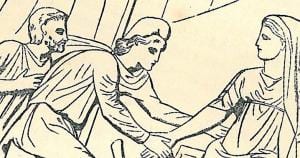 He is so unbelievably shallow, he could only be played by Orlando Bloom: Paris of Troy. He wears leopard skin and as a result slanders this noble beast for the rest of literary time. Helen was so beautiful her face launched a thousand ships, while Paris was so superficial he let Troy burn rather than lose a prize.
Iliad is full of passages where Paris lacks any redeeming qualities. He could end the war by doing his duty and dying, but instead boldly runs away in the arms of mighty Aphrodite. Hector has to hector him to go to battle or he would stay in the arms of Helen. Paris lurks on the edges of battle shooting arrows at the brave warriors.
Yet sometimes, less rarely now that a few decades ago, I will have a student that thinks Paris is a winner. After all if Achilles is the greatest warrior, the atom bomb of the ancient battlefield, Paris is “Star Wars” and kills Achilles. The shot may be lucky, and it might happen after Iliad ends, but Paris is proof, the students claim, that is is better to be lucky than good. Paris kills the mightiest warrior, sleeps with the hottest woman, and lives in luxury for the entire war. Paris is a winner to these lads. If fate decrees he must die in the War, even his ex-wife is kills herself when she hears the news.
This is a mistake, even if judged only by Homeric ethics.
Virtue in Homer is excellence. The good man is good at something worthwhile. Achilles is good, because he is a good fighter and fighting is worth doing. Paris is good at nothing meaningful. He makes love, but animals can do this well. He fights, but poorly. He is lucky, but the gods get the credit for his wins. Paris betrays the relationship between a guest and his host, very sacred to the Homeric era Greeks, by stealing Helen. As a result, he is hardly a man in the poem, let alone a hero.
Paris condemns himself at times, as Helen does, but the most powerful condemnation is at the end of Iliad in a scene where Paris does not speak. He is silent before a father’s righteous wrath.
The last time we see Paris (in Iliad) is in Book XXIV when old King Priam goes to rescue the body of his son Hector:
He (Priam) spoke, and drove the men off with his staff; and they went out before the old man’s urgency. And to his own sons he shouted rebuke, railing at Helenos and Paris and brilliant Agathon and Pammon and Antiphonos and Polites of the war cry 250 and Deïphobos and Hippothoös, too, and noble Dios. To these nine, the old man, shouting his threats, gave orders: “Make haste, worthless children, my disgraces. I would the pack of you together had been slain by the swift ship instead of Hector. Woe is me, fated utterly, since I sired the best sons in broad Troy, but I say not one of them is left, Mestor the godlike and Troilos the chariot fighter and Hector, who was a god among men, nor did he seem to be the son of mortal man, but of a god. War destroyed these men, and all these things of shame are left, 260 the liars and dancers, and heroes of the dance floor, snatchers of lambs and kids in their own land. Will you all not prepare a wagon for me at once, and place all these things in it, so that we can go upon our way?” So he spoke; and they trembling before the old man’s threats lifted out the strong-wheeled wagon for the mule, a beautiful thing, newly made, and fastened the wicker carrier on it, and took down from its peg the mule yoke made of boxwood and with a nob upon it, well-fitted with rings to guide the reins; and they brought out the yoke strap of nine cubits length together with the yoke.*
Paris ends up shamed by his father, doing menial work, all so the corpse of his decent, virtuous brother can be rescued for burial. He receives no respect, no honor, and in the end his father leaves with a mule and calls Paris a “thing of shame.” So he is. No great civilization can defend a Paris, the man of passion who lives for personal peace and pleasure.
Paris is authentic: he never is less than Paris. He is true to his desires: when he sees something good, Paris takes that good. Paris is a cad, because he never says “no” to Paris. The man confuses his passions with virtue.
God save us.
——————————-
Homer, Iliad. Book XXIV. Translated by Caroline Alexander.
Previous Post

August 19, 2019
Small Beginnings
Next Post

August 21, 2019 Never Marry An Angry Man: Achilles is not a Catch
Browse Our Archives
Select a Category Apologetics Art Culture Education On Books On Education Philosophy Politics Pop Culture Spiritual Reflections Uncategorized
Select a Month October 2026 September 2026 August 2026 July 2026 July 2025 June 2025 September 2024 July 2024 June 2024 December 2023 June 2023 September 2022 May 2022 April 2022 March 2022 February 2022 July 2021 June 2021 May 2021 April 2021 March 2021 February 2021 January 2021 December 2020 November 2020 October 2020 September 2020 August 2020 July 2020 June 2020 May 2020 April 2020 March 2020 February 2020 January 2020 December 2019 November 2019 October 2019 September 2019 August 2019 July 2019 June 2019 May 2019 April 2019 March 2019 February 2019 January 2019 December 2018 November 2018 October 2018 September 2018 August 2018 July 2018 June 2018 May 2018 April 2018 March 2018 February 2018 January 2018 December 2017 November 2017 October 2017 September 2017 August 2017 July 2017 June 2017 May 2017 April 2017 March 2017 February 2017 January 2017 December 2016 November 2016 October 2016 September 2016 August 2016 July 2016 June 2016 May 2016 April 2016 March 2016 February 2016 January 2016 December 2015 November 2015 October 2015 September 2015 August 2015 July 2015 June 2015 May 2015 April 2015 March 2015 February 2015 January 2015 November 2014 October 2014 September 2014 August 2014 July 2014 June 2014 May 2014 April 2014 March 2014 February 2014 January 2014 December 2013 November 2013 October 2013 September 2013 August 2013 July 2013 June 2013 May 2013 April 2013 March 2013 February 2013 January 2013 December 2012 November 2012 October 2012 September 2012 August 2012 July 2012 June 2012 May 2012
Follow Us!
TAKE THE
Religious Wisdom Quiz
What is a "cubit's" approximate length according to the Bible?
Select your answer to see how you score.
24 inches 12 inches 18 inches 36 inches
Books by This Author John Mark Reynolds
Related posts from Eidos

Classical Education Must Teach Us to Make the...

Classical Education and the Art of Dying Well

Golden, Golden, Golden: My Mother's Last Lesson

TRENDING AT PATHEOS Evangelical

The REST of Your Life: A Creative Wrestles...
This week I had a conversation with a good friend from church....

How the author of the world's best hymn...
I've been working with John Newton for a while now. This makes...

Long before this Lectio Divina, Psalm 130 - the song - started...

What About the Trees? Another Living Parable
After I finished writing the last article about falling leaves as a...

Why Classical Education Is a Conversation, Not a...
Come and Read: Joy in Classical Education When I was a little...

Cornell University has received a great deal of negative publicity and intense...
view all Evangelical blogs
Ad-Free & Subscriber Log-In Subscription Support
- About Us
- 2026 Calendar
- Videos
- Podcasts
- Library of World Religions
- Faith In Media Tracker
- Advertise With Us
- Write for Us
- Privacy Policy
- Terms of Service
- Do Not Sell My Data
- Contact Us
- Radiant Digital
- Manage Newsletter Subscriptions
- Unsubscribe From Notifications
- Sitemap
Copyright 2008-2026, Patheos. All rights reserved.
Subscription Support Ad-Free & Subscriber Log-In
Follow Patheos