
BuddhistCatholicContemplativeEvangelicalGeneral ChristianHinduJewishLatter-day SaintMuslimNew VisionsProgressive Christian
Beliefs
- Buddhist
- Catholic
- Contemplative
- Evangelical
- General Christian
- Hindu
- Jewish
- Latter-day Saint
- More Voices
- Muslim
- New Visions
- Pagan
- Progressive Christian
Topics
- Religion News
- Food and Religion
- Sports and Religion
- Religious Art
- Religious Music and Entertainment
- Religious Events
- History and Religion
- Style and Religion
- Politics and Religion
- Women in Religion
- Recreation Outdoors and Religion
- Business Finance and Religion
- Careers Workplace and Religion
- Education and Religion
- Family Parenting and Religion
- Health Fitness and Religion
- Home and Religion
- Relationships and Religion
- Technology and Religion
- Travel and Religion
Columnists
- Buddhist Columnists
- Business Finance and Religion Columnists
- Careers Workplace and Religion Columnists
- Catholic Columnists
- Contemplative Columnists
- Education and Religion Columnists
- Evangelists Columnists
- Family Parenting and Religion Columnists
- General Christian Columnists
- Health Fitness and Religion Columnists
- Hindu Columnists
- History and Religion Columnists
- Home and Religion Columnists
- Jewish Columnists
- More Voices Columnists
- Latter Day Columnists
- Muslim Columnists
- New Visions Columnists
- Nonreligious Columnists
- Pagan Columnists
- Politics and Religion Columnists
- Progressive Columnists
- Recreation Outdoors and Religion Columnists
- Relationships and Religion Columnists
- Religion News Columnists
- Religious Art Columnists
- Religious Events Columnists
- Religious Music and Entertainment Columnists
- Sports and Religion Columnists
- Style and Religion Columnists
- Technology and Religion Columnists
- Travel and Religion Columnists
- Women in Religion Columnists
Resource Library
- 2026 Calendar
- Library of World Religions
- The 100 Most Holy Places on Earth
- Patheos Answers
- Podcasts
- Videos
- Faith Leaders Database
- Anglican Episcopalian
- Bahai
- Baptist
- Buddhism
- Christianity
- Confucianism
- Eastern Orthodoxy
- Hinduism
- Holiness and Pentecostal
- ISKCON
- Islam
- Judaism
- Lutheran
- Methodist
- The Church of Jesus Christ of Latter-day Saints
- New Age
- Paganism
- Presbytarian and Reformed
- Protestantism
- Religion Behind the Scenes
- Roman Catholic
- Scientology
- Shia Islam
- Sikhism
- Sufism
- Sunni Islam
- Taoism
- Zen
- See all religions
Research Tools
 Ad-Free & Subscriber Log-In Subscription Support
Ad-Free & Subscriber Log-In Subscription Support
Follow Patheos 

- Trending:
- Forgiveness
- |
- Marriage
- |
- Consciousness
- |
- Death Penalty
- |
- Election
- |
- Halloween

- Home
- Evangelical
- Wrong Ideas Were Helpful (Heraclitus)
Wrong Ideas Were Helpful (Heraclitus)
Last updated on: June 23, 2019 at 12:50 pm by John Mark N. Reynolds
Wrong Ideas Were Helpful (Heraclitus) 2019-06-23T12:50:57-04:00 John Mark N. Reynolds
Patheos Explore the world's faith through different perspectives on religion and spirituality! Patheos has the views of the prevalent religions and spiritualities of the world.
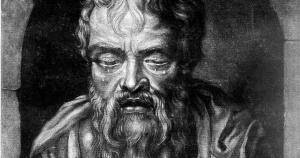 Wrong ideas can be helpful. . . Sometimes. Nobody ought to wish to be wrong, but being wrong is not sinful. If you are learning symbolic logic, making an error in moving from one line to the next is not a sin unless when shown the problem you refuse to address the issue and learn.
Learning, growing, being human is full of wrong turns, bad ideas, and mistakes.
If you are studying the cosmos today, the following explanation for planets, the sun, and other stars will not help you:
224 He does not reveal the nature of the surrounding; it contains, however, bowls turned with their hollow side towards us, in which the bright exhalations are collected and form flames, which are the heavenly bodies. Brightest and hottest is the flame of the sun…. And sun and moon are eclipsed when the bowls turn upwards; and the monthly phases of the moon occur as its bowl is gradually turned.*
No.
Really no.
But so said Heraclitus: the wisest man to live in Ephesus until Saint John moved there. Saint Basil recommends we begin our studies learning from the noble pagans, particularly in terms of virtue. Says the Saint: “Since the life to come is to be attained through virtue, chief attention must be paid to those passages in which virtue is praised. . . .”
Heraclitus looked at the heavens and tried to explain what was happening. He appears to have thought that the earth, in his geometric cosmos, emitted fire. Perhaps, he had volcanoes or steam vents in mind. The planets, stars, moon, and sun were bowl shaped and collected these bright exhalations, accumulated them, and formed flames. These flames were hotter than the the fire they collected, being concentrated, the hottest being the sun. Heraclitus could explain an eclipse by the turning of the bowls away from the earth. This is entirely wrong. The earth is not the center of the cosmos and the moon, sun, stars, and planets are not bowls. Eclipses are not caused by the turning of the sun or moon.
Yet if you are doing contemporary cosmology, you owe these wrong ideas a debt. Heraclitus gave his readers a theory about how natural phenomena worked. His theory was wrong, but showing how it was wrong helped knowledge to progress. Because Heraclitus explained natural phenomena naturally, he was a forerunner to the scientific revolution. Just as vitally, Heraclitus explained personal phenomena with persons.
When we come to human consciousness or to the actions of intelligence, Heraclitus saw a “Logos” (a God) that permeated the cosmos. The very word “cosmos” came from an ordered rank of troops. There were events that did not require the immediate intervention of God, humans, or any other persons (like gods!), but there were other events that did show intelligent agency. His hometown of Ephesus was not the result of natural agency (like his cosmology), but logos (mind/word). The cosmos was fundamentally, because ordered, a product of Mind, though that Mind intelligently allowed material processes to unfold. Heraclitus thought there were four elements (water, earth, air, fire) and that God worked through fire.
He was wrong in the details of his theory, but as a forerunner to Christianity, correct in seeing the cosmos as dualistic. The cosmos changes, that is (generally) the result of materials interacting with each other without the direct result of mind (the light from the sun, eclipses). The plan that set up this system is the product of Mind! In a smaller way (a microcosmic view), the city of Ephesus was a product of logos/mind that also had to deal with the changes that came from matter interacting with matter.
Heraclitus had a cosmos that allowed for change, material causation, and intelligent causation. He could look at a room and understand that the fire in the fireplace was causing the heat and explain that heat naturally, but also see the form or pattern of the fireplace and existence of the fire in that very room as the product of intelligence.
Heraclitus got the details wrong, that matters, but he set humankind up for a conversation that could correct the details. He did not reduce the cosmos to fire (his favored element) or ignore the material while looking to the God-Logos. Instead, Heraclitus postulated Mind steering the elements. Mind/God was not a science stopper, explaining too much, and matter was not a humanity denier, explaining away our souls.
Thank God for Heraclitus, an intellectual John the Baptist for better thinkers like Saint John.
—————————————————
Heraclitus, Presocratic Philosophers Kirk, Raven, Schofield.
Previous Post

June 22, 2019
Is this the best of all possible worlds?
Next Post
June 24, 2019 Wax and Wane: Just What Happened to Brandon Sanderson?
Browse Our Archives
Select a Category Apologetics Art Culture Education On Books On Education Philosophy Politics Pop Culture Spiritual Reflections Uncategorized
Select a Month October 2026 September 2026 August 2026 July 2026 July 2025 June 2025 September 2024 July 2024 June 2024 December 2023 June 2023 September 2022 May 2022 April 2022 March 2022 February 2022 July 2021 June 2021 May 2021 April 2021 March 2021 February 2021 January 2021 December 2020 November 2020 October 2020 September 2020 August 2020 July 2020 June 2020 May 2020 April 2020 March 2020 February 2020 January 2020 December 2019 November 2019 October 2019 September 2019 August 2019 July 2019 June 2019 May 2019 April 2019 March 2019 February 2019 January 2019 December 2018 November 2018 October 2018 September 2018 August 2018 July 2018 June 2018 May 2018 April 2018 March 2018 February 2018 January 2018 December 2017 November 2017 October 2017 September 2017 August 2017 July 2017 June 2017 May 2017 April 2017 March 2017 February 2017 January 2017 December 2016 November 2016 October 2016 September 2016 August 2016 July 2016 June 2016 May 2016 April 2016 March 2016 February 2016 January 2016 December 2015 November 2015 October 2015 September 2015 August 2015 July 2015 June 2015 May 2015 April 2015 March 2015 February 2015 January 2015 November 2014 October 2014 September 2014 August 2014 July 2014 June 2014 May 2014 April 2014 March 2014 February 2014 January 2014 December 2013 November 2013 October 2013 September 2013 August 2013 July 2013 June 2013 May 2013 April 2013 March 2013 February 2013 January 2013 December 2012 November 2012 October 2012 September 2012 August 2012 July 2012 June 2012 May 2012
Follow Us!
TAKE THE
Religious Wisdom Quiz
I will heal their waywardness and love them freely, making them blossom like this flower and fragrant like this tree. What plant and tree are mentioned?
Select your answer to see how you score.
Iris and cypress Lotus and palm Lebanon Cedar and Lilies Rose and olive
Books by This Author John Mark Reynolds
Related posts from Eidos

Classical Education Must Teach Us to Make the...

Yet I Love Her: History and the Church


The Iceberg is There: Verbosity Cannot Defeat Reality
TRENDING AT PATHEOS Evangelical

The REST of Your Life: A Creative Wrestles...
This week I had a conversation with a good friend from church....

How the author of the world's best hymn...
I've been working with John Newton for a while now. This makes...

Long before this Lectio Divina, Psalm 130 - the song - started...

What About the Trees? Another Living Parable
After I finished writing the last article about falling leaves as a...

Why Classical Education Is a Conversation, Not a...
Come and Read: Joy in Classical Education When I was a little...

Cornell University has received a great deal of negative publicity and intense...
view all Evangelical blogs
Ad-Free & Subscriber Log-In Subscription Support
- About Us
- 2026 Calendar
- Videos
- Podcasts
- Library of World Religions
- Faith In Media Tracker
- Advertise With Us
- Write for Us
- Privacy Policy
- Terms of Service
- Do Not Sell My Data
- Contact Us
- Radiant Digital
- Manage Newsletter Subscriptions
- Unsubscribe From Notifications
- Sitemap
Copyright 2008-2026, Patheos. All rights reserved.
Subscription Support Ad-Free & Subscriber Log-In
Follow Patheos