
BuddhistCatholicContemplativeEvangelicalGeneral ChristianHinduJewishLatter-day SaintMuslimNew VisionsProgressive Christian
Beliefs
- Buddhist
- Catholic
- Contemplative
- Evangelical
- General Christian
- Hindu
- Jewish
- Latter-day Saint
- More Voices
- Muslim
- New Visions
- Pagan
- Progressive Christian
Topics
- Religion News
- Food and Religion
- Sports and Religion
- Religious Art
- Religious Music and Entertainment
- Religious Events
- History and Religion
- Style and Religion
- Politics and Religion
- Women in Religion
- Recreation Outdoors and Religion
- Business Finance and Religion
- Careers Workplace and Religion
- Education and Religion
- Family Parenting and Religion
- Health Fitness and Religion
- Home and Religion
- Relationships and Religion
- Technology and Religion
- Travel and Religion
Columnists
- Buddhist Columnists
- Business Finance and Religion Columnists
- Careers Workplace and Religion Columnists
- Catholic Columnists
- Contemplative Columnists
- Education and Religion Columnists
- Evangelists Columnists
- Family Parenting and Religion Columnists
- General Christian Columnists
- Health Fitness and Religion Columnists
- Hindu Columnists
- History and Religion Columnists
- Home and Religion Columnists
- Jewish Columnists
- More Voices Columnists
- Latter Day Columnists
- Muslim Columnists
- New Visions Columnists
- Nonreligious Columnists
- Pagan Columnists
- Politics and Religion Columnists
- Progressive Columnists
- Recreation Outdoors and Religion Columnists
- Relationships and Religion Columnists
- Religion News Columnists
- Religious Art Columnists
- Religious Events Columnists
- Religious Music and Entertainment Columnists
- Sports and Religion Columnists
- Style and Religion Columnists
- Technology and Religion Columnists
- Travel and Religion Columnists
- Women in Religion Columnists
Resource Library
- 2026 Calendar
- Library of World Religions
- The 100 Most Holy Places on Earth
- Patheos Answers
- Podcasts
- Videos
- Faith Leaders Database
- Anglican Episcopalian
- Bahai
- Baptist
- Buddhism
- Christianity
- Confucianism
- Eastern Orthodoxy
- Hinduism
- Holiness and Pentecostal
- ISKCON
- Islam
- Judaism
- Lutheran
- Methodist
- The Church of Jesus Christ of Latter-day Saints
- New Age
- Paganism
- Presbytarian and Reformed
- Protestantism
- Religion Behind the Scenes
- Roman Catholic
- Scientology
- Shia Islam
- Sikhism
- Sufism
- Sunni Islam
- Taoism
- Zen
- See all religions
Research Tools
 Ad-Free & Subscriber Log-In Subscription Support
Ad-Free & Subscriber Log-In Subscription Support
Follow Patheos 

- Trending:
- Forgiveness
- |
- Marriage
- |
- Consciousness
- |
- Death Penalty
- |
- Election
- |
- Halloween

- Home
- Evangelical
- The Artful Knavery of the Intellectual Class Today
The Artful Knavery of the Intellectual Class Today
Last updated on: June 12, 2019 at 11:20 pm by John Mark N. Reynolds
The Artful Knavery of the Intellectual Class Today 2019-06-12T23:20:51-04:00 John Mark N. Reynolds
Patheos Explore the world's faith through different perspectives on religion and spirituality! Patheos has the views of the prevalent religions and spiritualities of the world.
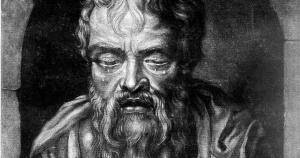 Too often education, even classical education, is training in pompous “assery:” training in the jargon of the spirit of the age berift of actual wisdom. Many teachers do something wonderful in one field (say mathematics) and use this to become gurus for all of life. Pythagoras, he of geometrical fame,* became such a public intellectual and not everybody was happy:
256 Pythagoras, son of Mnesarchus, practised enquiry beyond all other men and selecting these made them his own–wisdom, the learning of many things, artful knavery.**
Some “education,” the sort Pythagoras promoted, is mere training in “artful knavery” or so claimed Heraclitus of Ephesus, one of the first philosophers, who attacked the errors of his day without fear or flattery. He was unpopular with the educational and government rulers, but his pithy, pointed proverbs were memorable.
We only have fragments of Heraclitus, but when he evaluated the School of Pythagoras, Heraclitus seems to have thought Pythagoras was a collector of facts, piles and piles of facts, that Pythagoras used in educational grift. Pythagoras learned a good bit, but remained unwise. He accumulated a good bit of knowledge in service to a long con: the School of Pythagoras.
Beware the man who starts a school in his name: he is either very great, a saint, or a grifter and he is usually a grifter.
The problem with Pythagoras (as Heraclitus sees him) is not his endless desire to know, but “making” what he learns “his own.” A man cannot copyright common knowledge, truths are common to all. His learning was his and this can never be wisdom! When a man sets himself up as a guru, the source of knowledge, then there can be no dialogue only a monologue. The guru dispenses knowledge, the lover of wisdom does whatever he can to find eternal goodness, truth, and beauty that no man can sell or own.
Perhaps the great measure of a real educational institution in our time is, if Heraclitus is correct, that with great cheer, wisdom is shared. Nobody owns wisdom and the task of the school is done for as little profit as possible. After all, if an idea is true, then it is universal: nobody can say “this fact is my own.” If an idea is good, then it belongs to God, the ground of all goodness: nobody can say “this moral truth is mine to sell.” If an idea is beautiful, then it stirs up love and no lover would hire out the beloved for money. A true lover venerates the beloved, he does not pimp her out for profit.
Heraclitus is right. We cannot learn by merely accumulating facts. We cannot “own” the facts. We can take the facts and reason about them in a community of students. Education says: “this is not my own.”
False education is “artful,” because it is always marketing or selling something. It cajoles, persuades, covers up: the ad man is more important than the teacher. The moment such artfulness appears, the school, college, or church becomes the seat of knaves: rascals who will loan you money to gain what is the common inheritance of humankind.
Heraclitus saw the Pythagorean “school” and saw the grift and gain. He despaired.
Christians who have freely received the Word made flesh on Christmas Day must not create usurious X-mass education based on debt. Christians who see He is risen on Easter Sunday must not sell preferred seating to see the Risen Lord. Instead, freely we have received, freely we must give.
Nothing we know is our own. There are no gurus in the Kingdom of Heaven. If charge we must (and we must), then still we shan’t turn away any student for inability to pay. Why?
Nothing we teach, as Heraclitus speculated, is our own.
God save us from the artful knavery of the the Colleges of today.
————————————
*We are unsure if Pythagoras existed or just a school of thought that used him as a founding figure.
**Kirk, Raven, Schofield Presocratic Philosophers.
Previous Post
June 10, 2019
Be Wary Of Learning Many Things (Heraclitus!)
Next Post

June 12, 2019 The Five Worst “Arguments” (or Claims) Made by Internet Atheists
Browse Our Archives
Select a Category Apologetics Art Culture Education On Books On Education Philosophy Politics Pop Culture Spiritual Reflections Uncategorized
Select a Month October 2026 September 2026 August 2026 July 2026 July 2025 June 2025 September 2024 July 2024 June 2024 December 2023 June 2023 September 2022 May 2022 April 2022 March 2022 February 2022 July 2021 June 2021 May 2021 April 2021 March 2021 February 2021 January 2021 December 2020 November 2020 October 2020 September 2020 August 2020 July 2020 June 2020 May 2020 April 2020 March 2020 February 2020 January 2020 December 2019 November 2019 October 2019 September 2019 August 2019 July 2019 June 2019 May 2019 April 2019 March 2019 February 2019 January 2019 December 2018 November 2018 October 2018 September 2018 August 2018 July 2018 June 2018 May 2018 April 2018 March 2018 February 2018 January 2018 December 2017 November 2017 October 2017 September 2017 August 2017 July 2017 June 2017 May 2017 April 2017 March 2017 February 2017 January 2017 December 2016 November 2016 October 2016 September 2016 August 2016 July 2016 June 2016 May 2016 April 2016 March 2016 February 2016 January 2016 December 2015 November 2015 October 2015 September 2015 August 2015 July 2015 June 2015 May 2015 April 2015 March 2015 February 2015 January 2015 November 2014 October 2014 September 2014 August 2014 July 2014 June 2014 May 2014 April 2014 March 2014 February 2014 January 2014 December 2013 November 2013 October 2013 September 2013 August 2013 July 2013 June 2013 May 2013 April 2013 March 2013 February 2013 January 2013 December 2012 November 2012 October 2012 September 2012 August 2012 July 2012 June 2012 May 2012
Follow Us!
TAKE THE
Religious Wisdom Quiz
What city did Paul write his first letter to the Corinthians from?
Select your answer to see how you score.
Ephesus Corinth Rome Athens
Books by This Author John Mark Reynolds
Related posts from Eidos

Why Classical Education Is a Conversation, Not a...

Does Classical Education Belong Only to the West?

Classical Education Must Teach Us to Make the...

Rooted: Why Classical Education Needs Community
TRENDING AT PATHEOS Evangelical

The REST of Your Life: A Creative Wrestles...
This week I had a conversation with a good friend from church....

How the author of the world's best hymn...
I've been working with John Newton for a while now. This makes...

Long before this Lectio Divina, Psalm 130 - the song - started...

What About the Trees? Another Living Parable
After I finished writing the last article about falling leaves as a...

Why Classical Education Is a Conversation, Not a...
Come and Read: Joy in Classical Education When I was a little...

Cornell University has received a great deal of negative publicity and intense...
view all Evangelical blogs
Ad-Free & Subscriber Log-In Subscription Support
- About Us
- 2026 Calendar
- Videos
- Podcasts
- Library of World Religions
- Faith In Media Tracker
- Advertise With Us
- Write for Us
- Privacy Policy
- Terms of Service
- Do Not Sell My Data
- Contact Us
- Radiant Digital
- Manage Newsletter Subscriptions
- Unsubscribe From Notifications
- Sitemap
Copyright 2008-2026, Patheos. All rights reserved.
Subscription Support Ad-Free & Subscriber Log-In
Follow Patheos