
BuddhistCatholicContemplativeEvangelicalGeneral ChristianHinduJewishLatter-day SaintMuslimNew VisionsProgressive Christian
Beliefs
- Buddhist
- Catholic
- Contemplative
- Evangelical
- General Christian
- Hindu
- Jewish
- Latter-day Saint
- More Voices
- Muslim
- New Visions
- Pagan
- Progressive Christian
Topics
- Religion News
- Food and Religion
- Sports and Religion
- Religious Art
- Religious Music and Entertainment
- Religious Events
- History and Religion
- Style and Religion
- Politics and Religion
- Women in Religion
- Recreation Outdoors and Religion
- Business Finance and Religion
- Careers Workplace and Religion
- Education and Religion
- Family Parenting and Religion
- Health Fitness and Religion
- Home and Religion
- Relationships and Religion
- Technology and Religion
- Travel and Religion
Columnists
- Buddhist Columnists
- Business Finance and Religion Columnists
- Careers Workplace and Religion Columnists
- Catholic Columnists
- Contemplative Columnists
- Education and Religion Columnists
- Evangelists Columnists
- Family Parenting and Religion Columnists
- General Christian Columnists
- Health Fitness and Religion Columnists
- Hindu Columnists
- History and Religion Columnists
- Home and Religion Columnists
- Jewish Columnists
- More Voices Columnists
- Latter Day Columnists
- Muslim Columnists
- New Visions Columnists
- Nonreligious Columnists
- Pagan Columnists
- Politics and Religion Columnists
- Progressive Columnists
- Recreation Outdoors and Religion Columnists
- Relationships and Religion Columnists
- Religion News Columnists
- Religious Art Columnists
- Religious Events Columnists
- Religious Music and Entertainment Columnists
- Sports and Religion Columnists
- Style and Religion Columnists
- Technology and Religion Columnists
- Travel and Religion Columnists
- Women in Religion Columnists
Resource Library
- 2026 Calendar
- Library of World Religions
- The 100 Most Holy Places on Earth
- Patheos Answers
- Podcasts
- Videos
- Faith Leaders Database
- Anglican Episcopalian
- Bahai
- Baptist
- Buddhism
- Christianity
- Confucianism
- Eastern Orthodoxy
- Hinduism
- Holiness and Pentecostal
- ISKCON
- Islam
- Judaism
- Lutheran
- Methodist
- The Church of Jesus Christ of Latter-day Saints
- New Age
- Paganism
- Presbytarian and Reformed
- Protestantism
- Religion Behind the Scenes
- Roman Catholic
- Scientology
- Shia Islam
- Sikhism
- Sufism
- Sunni Islam
- Taoism
- Zen
- See all religions
Research Tools
 Ad-Free & Subscriber Log-In Subscription Support
Ad-Free & Subscriber Log-In Subscription Support
Follow Patheos 

- Trending:
- Forgiveness
- |
- Marriage
- |
- Consciousness
- |
- Death Penalty
- |
- Election
- |
- Halloween

- Home
- Evangelical
- Ancient Witches IV (Guest Voice James Harrington)
Ancient Witches IV (Guest Voice James Harrington)
Last updated on: June 3, 2019 at 6:40 pm by John Mark N. Reynolds
Ancient Witches IV (Guest Voice James Harrington) 2019-06-03T18:40:03-04:00 John Mark N. Reynolds
Patheos Explore the world's faith through different perspectives on religion and spirituality! Patheos has the views of the prevalent religions and spiritualities of the world.
I asked for new voices and got some outstanding writers! Today we hear from the erudite James R. Harrington.
 James R. Harrington earned his M.A. in Ancient History at California State University Fulleron and is a member of the Torrey Honors Institute. James has been a classical educator in a variety of settings over the past thirteen years. He lives in Houston with his wife, Sharon, and their daughter.
Harrington began with a series on shields in classical literature and now moves to witches as a theme.
On shields, Mr. Harrington responded to thoughts on his first post. Harrington wrote about the shield of Herakles, He continued to the shield of Aeneas and followed up on that post. We turned to a shield in Ovid. He concluded with Quintus and a follow up.
Now he turns to witches with a second post , a third, and finally a fourth:
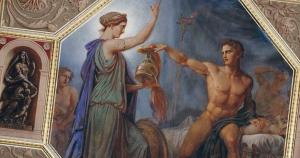
As we saw in our discussion of Homer’s Circe, the gods of the ancient Mediterranean world practiced magic with wand, cup, and herb.* We have also seen that sons and daughters of the gods, like Machaon, Podilares, and Helen, could employ pharmaka in medicine and hospitality. While each of the figures we have studied so far match aspects of the witches of European folklore, and Circe clearly violates Exodus’ prohibition against necromancy, we have yet to see all these characteristics come together in one person. Today’s subject, Medea, may be the one who takes the title of “First Wicked Witch of the West.”**
There are references to Medea in Hesiod’s Theogony, but the first authoritative version we have of her tale is found in Euripides’ play, Medea, performed at Athens in 431 B.C.*** As Euripides tells the tale, Medea had the god Helios as her grandfather.° While this makes her god-blooded, it also places Medea firmly in the mortal realm, even more so than Helen of Troy. Any powers that Medea wields are not innate like Circe’s, but learned. Indeed, Medea’s intelligence and occult knowledge are repeatedly acknowledged in the play.°°
Medea uses these powers to bring destruction on her enemies: evil king Pelias who tormented her husband,°°° or the royal family of Corinth who sought to lure her husband into a political marriage and exile her.§ This brings her into line with the mental concept of a witch held by 17th century Europeans like the magistrates at Salem:
The New England witch was a human being with super-human powers. Foremost among
these was her ability to perform maleficium, that is, to cause harm to others by
supernatural means. The motive most commonly ascribed was malice, stimulated,
ministers argued, by pride, discontent, greed, or envy. Although the witch’s powers could
bring harm to anyone, her victims tended to be her close neighbors or other people who
knew her well enough to anger her.§§
However, merely causing malicious harm is not all that is needed to make a witch a “Witch.” Unlike previous potential witches we have examined, Medea evinces the unique hostility and destructive power towards children in particular that Charles Williams identifies as a hallmark of the European “Witch.”§§§ To effect her revenge on Jason, Medea gruesomely kills King Creon’s adolescent daughter and even her own sons.
The key element, however, that brought together European folklore and the Exodus injunction to create the notion of a “Witch” was a “pact.”⸸ While Euripides had no notion of a devil with which a witch could strike a bargain, he was aware of various powers of Death, Transgression, and the Underworld which could be invoked to grant one unnatural and even baleful powers. Medea has dedicated herself to one of these deities, Hecate:
For, by Queen Hecate, whom above all divinities I venerate, my chosen accomplice, to
whose presence my central hearth is dedicated…⸸⸸
Though the Devil is not present, all the features of the European “Witch” are present (at least in embryo) in Euripides’ Medea. By the end of the play, she ascends, defying gravity, on her snake-drawn chariot as the first “Wicked Witch of the West.”
With Medea, it may seem that our quest for ancient witches, biblical or otherwise, is at an end. The world keeps turning, however. Euripides changed his employer from democratic Athens to the up and coming Macedonian court. Less than a hundred years later, Philip of Macedon and Alexander the Great embarked on a plan of conquest that brought Greece and Greek concepts into contact with far older cultures. In the rich whirl of the Hellenistic world, not only would Exodus and its injunction be translated into Greek, but new vogues in literature would turn Medea from brooding barbarian to tempestuous teenage witch.
*see also Hermes’ use of a pharmakon in the same story, and Demeter’s use of ritual magic in the Homeric Hymn to Demeter, lines 224-274.
**see Shelby Brown, Potions and Poisons: Classical Ancestors of the Wicked Witch. http:blogs.getty.edu/iris/potions-and-poisons-classical-ancestors-of-the-wicked-witch-part-two/, accessed May 30, 2019. Nota bene: Brown and I do not come to quite the same conclusions.
***lines 992-1002, see also Epic Cycle Fragments Nostoi 2 and The Taking of Oechalia 4
°Euripides, Medea. Philip Vellacott, trans. New York: Penguin Books, 1963. p. 29 translating for lines 386-423.
°°Ibid., p. 26 translating for lines 285-321, p. 33 translating for lines 525-562, p. 37 translating for lines 650-677.
°°°Ibid., p. 17. translating for lines 1-16.
§Ibid., p. 53-55. translating for lines 1156-1256.
§§Carol F. Karlsen, The Devil in the Shape of a Woman: Witchcraft in Colonial New England. New York: W.W. Norton and Company, 1998. p 6.
§§§Charles Williams, Witchcraft. Berkley: Apocryphile Press, 2005. pp. 54, 116-117, 134, 153, 184, 212, 214, 256, 276, 281, 305.
⸸Ibid., p. 56-59.
⸸⸸Euripides, p. 29. translating for lines 386-423.
Previous Post
June 1, 2019
Christ Washed The Feet of Judas (George Marion McClellan)
Next Post

June 3, 2019 Ten Books Not For the Summer of 2019, But For Every Summer
Browse Our Archives
Select a Category Apologetics Art Culture Education On Books On Education Philosophy Politics Pop Culture Spiritual Reflections Uncategorized
Select a Month October 2026 September 2026 August 2026 July 2026 July 2025 June 2025 September 2024 July 2024 June 2024 December 2023 June 2023 September 2022 May 2022 April 2022 March 2022 February 2022 July 2021 June 2021 May 2021 April 2021 March 2021 February 2021 January 2021 December 2020 November 2020 October 2020 September 2020 August 2020 July 2020 June 2020 May 2020 April 2020 March 2020 February 2020 January 2020 December 2019 November 2019 October 2019 September 2019 August 2019 July 2019 June 2019 May 2019 April 2019 March 2019 February 2019 January 2019 December 2018 November 2018 October 2018 September 2018 August 2018 July 2018 June 2018 May 2018 April 2018 March 2018 February 2018 January 2018 December 2017 November 2017 October 2017 September 2017 August 2017 July 2017 June 2017 May 2017 April 2017 March 2017 February 2017 January 2017 December 2016 November 2016 October 2016 September 2016 August 2016 July 2016 June 2016 May 2016 April 2016 March 2016 February 2016 January 2016 December 2015 November 2015 October 2015 September 2015 August 2015 July 2015 June 2015 May 2015 April 2015 March 2015 February 2015 January 2015 November 2014 October 2014 September 2014 August 2014 July 2014 June 2014 May 2014 April 2014 March 2014 February 2014 January 2014 December 2013 November 2013 October 2013 September 2013 August 2013 July 2013 June 2013 May 2013 April 2013 March 2013 February 2013 January 2013 December 2012 November 2012 October 2012 September 2012 August 2012 July 2012 June 2012 May 2012
Follow Us!
TAKE THE
Religious Wisdom Quiz
Which Christian group is known for large-scale missionary work headquartered in Salt Lake City, Utah?
Select your answer to see how you score.
United Church of Christ Anglican Latter-day Saints Catholic
Books by This Author John Mark Reynolds
Related posts from Eidos

Classical Education Must Teach Us to Make the...

Yet I Love Her: History and the Church


The Iceberg is There: Verbosity Cannot Defeat Reality
TRENDING AT PATHEOS Evangelical

The REST of Your Life: A Creative Wrestles...
This week I had a conversation with a good friend from church....

How the author of the world's best hymn...
I've been working with John Newton for a while now. This makes...

Long before this Lectio Divina, Psalm 130 - the song - started...

What About the Trees? Another Living Parable
After I finished writing the last article about falling leaves as a...

Why Classical Education Is a Conversation, Not a...
Come and Read: Joy in Classical Education When I was a little...

Cornell University has received a great deal of negative publicity and intense...
view all Evangelical blogs
Ad-Free & Subscriber Log-In Subscription Support
- About Us
- 2026 Calendar
- Videos
- Podcasts
- Library of World Religions
- Faith In Media Tracker
- Advertise With Us
- Write for Us
- Privacy Policy
- Terms of Service
- Do Not Sell My Data
- Contact Us
- Radiant Digital
- Manage Newsletter Subscriptions
- Unsubscribe From Notifications
- Sitemap
Copyright 2008-2026, Patheos. All rights reserved.
Subscription Support Ad-Free & Subscriber Log-In
Follow Patheos