
BuddhistCatholicContemplativeEvangelicalGeneral ChristianHinduJewishLatter-day SaintMuslimNew VisionsProgressive Christian
Beliefs
- Buddhist
- Catholic
- Contemplative
- Evangelical
- General Christian
- Hindu
- Jewish
- Latter-day Saint
- More Voices
- Muslim
- New Visions
- Pagan
- Progressive Christian
Topics
- Religion News
- Food and Religion
- Sports and Religion
- Religious Art
- Religious Music and Entertainment
- Religious Events
- History and Religion
- Style and Religion
- Politics and Religion
- Women in Religion
- Recreation Outdoors and Religion
- Business Finance and Religion
- Careers Workplace and Religion
- Education and Religion
- Family Parenting and Religion
- Health Fitness and Religion
- Home and Religion
- Relationships and Religion
- Technology and Religion
- Travel and Religion
Columnists
- Buddhist Columnists
- Business Finance and Religion Columnists
- Careers Workplace and Religion Columnists
- Catholic Columnists
- Contemplative Columnists
- Education and Religion Columnists
- Evangelists Columnists
- Family Parenting and Religion Columnists
- General Christian Columnists
- Health Fitness and Religion Columnists
- Hindu Columnists
- History and Religion Columnists
- Home and Religion Columnists
- Jewish Columnists
- More Voices Columnists
- Latter Day Columnists
- Muslim Columnists
- New Visions Columnists
- Nonreligious Columnists
- Pagan Columnists
- Politics and Religion Columnists
- Progressive Columnists
- Recreation Outdoors and Religion Columnists
- Relationships and Religion Columnists
- Religion News Columnists
- Religious Art Columnists
- Religious Events Columnists
- Religious Music and Entertainment Columnists
- Sports and Religion Columnists
- Style and Religion Columnists
- Technology and Religion Columnists
- Travel and Religion Columnists
- Women in Religion Columnists
Resource Library
- 2026 Calendar
- Library of World Religions
- The 100 Most Holy Places on Earth
- Patheos Answers
- Podcasts
- Videos
- Faith Leaders Database
- Anglican Episcopalian
- Bahai
- Baptist
- Buddhism
- Christianity
- Confucianism
- Eastern Orthodoxy
- Hinduism
- Holiness and Pentecostal
- ISKCON
- Islam
- Judaism
- Lutheran
- Methodist
- The Church of Jesus Christ of Latter-day Saints
- New Age
- Paganism
- Presbytarian and Reformed
- Protestantism
- Religion Behind the Scenes
- Roman Catholic
- Scientology
- Shia Islam
- Sikhism
- Sufism
- Sunni Islam
- Taoism
- Zen
- See all religions
Research Tools
 Ad-Free & Subscriber Log-In Subscription Support
Ad-Free & Subscriber Log-In Subscription Support
Follow Patheos 

- Trending:
- Forgiveness
- |
- Marriage
- |
- Consciousness
- |
- Death Penalty
- |
- Election
- |
- Halloween

- Home
- Evangelical
- All “Things” Steered Through All (Look for the Design)
All “Things” Steered Through All (Look for the Design)
Last updated on: June 19, 2019 at 4:24 pm by John Mark N. Reynolds
All “Things” Steered Through All (Look for the Design) 2019-06-19T16:24:07-04:00 John Mark N. Reynolds
Patheos Explore the world's faith through different perspectives on religion and spirituality! Patheos has the views of the prevalent religions and spiritualities of the world.
227 The wise is one thing, to be acquainted with true judgement, how all things are steered through all.*
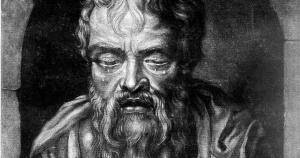 So said Heraclitus: the wisest man to live in Ephesus until Saint John moved there. Saint Basil recommends we begin our studies learning from the noble pagans, particularly in terms of virtue. Says the Saint: “Since the life to come is to be attained through virtue, chief attention must be paid to those passages in which virtue is praised. . . .”
Note how oddly this passage is worded. Heraclitus does not say wisdom is one thing or the wise person does one one thing. Instead this short aphorism says (literally) “one thing is the wise.” In another fragment, Heraclitus refers directly to his one god, Zeus, but not here. This one thing is a principal that if followed unites all the wise making them: being acquainted with true judgment. Judgement is choosing: any fool can choose, but the wise choose truly.
The world is always changing and our data is incomplete so true judgment is hard. God alone will possess true judgment fully so God is fully wise. God is by nature true judgment, because God knows all and is good. He never chooses a falsehood or misunderstands. God has by nature the one thing.
The rest of us as we (constantly) change can hope to participate in the one thing and so become one with the wise! In fact, for Heraclitus this may even be stated more strongly: to have true judgement is to participate in the nature of God. This (may be) an early form of theosis, finding our natures, briefly taken to the one thing that we can share with God.
The true judgment for Heraclitus will show how all things are steered through the all (the whole of the physical cosmos). Things in the cosmos are constantly moving, changing, but there is (for Heraclitus) an eternal Logos that steers the change and is himself unchanging: the word comes from the Word. Partly this is the structure (logos) of the cosmos (sustained by Logos) and might form a reason to think science is possible despite the constant changes in the world. There is an under-arching order that never changes, as Kirk* points out in his commentary on the passage, Heraclitus is not just interested, however, in science. His physical cosmos contains logos and this logos is linked to the great Logos (God). The microcosm and the macrocosm (the smallest view of reality and the broadest view) are linked by similar design.
The Word is found in the word. The things in the word are guided by the word and we can know this work if we judge with truth. Yet the human mind can also find God and the Word that governs the word if only for a moment and can be “the wise.”
Saint John transforms this language at the beginning of his Gospel to express a deeper Truth revealed to the Jewish people. The Logos of Heraclitus is not the Logos of John 1, because the Logos of John has revealed Himself to us in the person of Jesus Christ. We need not seek momentary true judgement, but can see God full of grace and truth. The grace sustains us in the Word.
The logos/Logos of Heraclitus was fire/God/beginning, but lacked the personal nature that God revealed to the Jewish people. Heraclitus (may have) provided a language for the Hebrew message to be put into Greek, but the revelation of God in the person of Jesus Christ is rooted in the deeper, Hebrew, understanding. What Heraclitus saw dimly, the Jewish people experienced. He looked within and also out at the world, but the good God revealed Himself by coming down in the flesh. He came and helped us judge rightly about ideas such as the one and the many, nature and mind.
Glorious truth!
———————————————
*Heraclitus in Presocratic Philosophers (Kirk, Raven, Schofield)
Previous Post

June 17, 2019
Ancient Witches VI (Guest Voice: James Harrington)
Next Post

June 19, 2019 This Juneteenth and all the Summer Days: Unwritten (Tracy K. Smith)
Browse Our Archives
Select a Category Apologetics Art Culture Education On Books On Education Philosophy Politics Pop Culture Spiritual Reflections Uncategorized
Select a Month October 2026 September 2026 August 2026 July 2026 July 2025 June 2025 September 2024 July 2024 June 2024 December 2023 June 2023 September 2022 May 2022 April 2022 March 2022 February 2022 July 2021 June 2021 May 2021 April 2021 March 2021 February 2021 January 2021 December 2020 November 2020 October 2020 September 2020 August 2020 July 2020 June 2020 May 2020 April 2020 March 2020 February 2020 January 2020 December 2019 November 2019 October 2019 September 2019 August 2019 July 2019 June 2019 May 2019 April 2019 March 2019 February 2019 January 2019 December 2018 November 2018 October 2018 September 2018 August 2018 July 2018 June 2018 May 2018 April 2018 March 2018 February 2018 January 2018 December 2017 November 2017 October 2017 September 2017 August 2017 July 2017 June 2017 May 2017 April 2017 March 2017 February 2017 January 2017 December 2016 November 2016 October 2016 September 2016 August 2016 July 2016 June 2016 May 2016 April 2016 March 2016 February 2016 January 2016 December 2015 November 2015 October 2015 September 2015 August 2015 July 2015 June 2015 May 2015 April 2015 March 2015 February 2015 January 2015 November 2014 October 2014 September 2014 August 2014 July 2014 June 2014 May 2014 April 2014 March 2014 February 2014 January 2014 December 2013 November 2013 October 2013 September 2013 August 2013 July 2013 June 2013 May 2013 April 2013 March 2013 February 2013 January 2013 December 2012 November 2012 October 2012 September 2012 August 2012 July 2012 June 2012 May 2012
Follow Us!
TAKE THE
Religious Wisdom Quiz
How many years did Solomon's temple construction take?
Select your answer to see how you score.
6 years 10 years 5 years 7 years
Books by This Author John Mark Reynolds
Related posts from Eidos

Classical Education Must Teach Us to Make the...

The Iceberg is There: Verbosity Cannot Defeat Reality

One Weeping Icon at Christmas is Enough

The Power of Dissenting Societies: A Thought
TRENDING AT PATHEOS Evangelical

The REST of Your Life: A Creative Wrestles...
This week I had a conversation with a good friend from church....

How the author of the world's best hymn...
I've been working with John Newton for a while now. This makes...

Long before this Lectio Divina, Psalm 130 - the song - started...

What About the Trees? Another Living Parable
After I finished writing the last article about falling leaves as a...

Why Classical Education Is a Conversation, Not a...
Come and Read: Joy in Classical Education When I was a little...

Cornell University has received a great deal of negative publicity and intense...
view all Evangelical blogs
Ad-Free & Subscriber Log-In Subscription Support
- About Us
- 2026 Calendar
- Videos
- Podcasts
- Library of World Religions
- Faith In Media Tracker
- Advertise With Us
- Write for Us
- Privacy Policy
- Terms of Service
- Do Not Sell My Data
- Contact Us
- Radiant Digital
- Manage Newsletter Subscriptions
- Unsubscribe From Notifications
- Sitemap
Copyright 2008-2026, Patheos. All rights reserved.
Subscription Support Ad-Free & Subscriber Log-In
Follow Patheos