
BuddhistCatholicContemplativeEvangelicalGeneral ChristianHinduJewishLatter-day SaintMuslimNew VisionsProgressive Christian
Beliefs
- Buddhist
- Catholic
- Contemplative
- Evangelical
- General Christian
- Hindu
- Jewish
- Latter-day Saint
- More Voices
- Muslim
- New Visions
- Pagan
- Progressive Christian
Topics
- Religion News
- Food and Religion
- Sports and Religion
- Religious Art
- Religious Music and Entertainment
- Religious Events
- History and Religion
- Style and Religion
- Politics and Religion
- Women in Religion
- Recreation Outdoors and Religion
- Business Finance and Religion
- Careers Workplace and Religion
- Education and Religion
- Family Parenting and Religion
- Health Fitness and Religion
- Home and Religion
- Relationships and Religion
- Technology and Religion
- Travel and Religion
Columnists
- Buddhist Columnists
- Business Finance and Religion Columnists
- Careers Workplace and Religion Columnists
- Catholic Columnists
- Contemplative Columnists
- Education and Religion Columnists
- Evangelists Columnists
- Family Parenting and Religion Columnists
- General Christian Columnists
- Health Fitness and Religion Columnists
- Hindu Columnists
- History and Religion Columnists
- Home and Religion Columnists
- Jewish Columnists
- More Voices Columnists
- Latter Day Columnists
- Muslim Columnists
- New Visions Columnists
- Nonreligious Columnists
- Pagan Columnists
- Politics and Religion Columnists
- Progressive Columnists
- Recreation Outdoors and Religion Columnists
- Relationships and Religion Columnists
- Religion News Columnists
- Religious Art Columnists
- Religious Events Columnists
- Religious Music and Entertainment Columnists
- Sports and Religion Columnists
- Style and Religion Columnists
- Technology and Religion Columnists
- Travel and Religion Columnists
- Women in Religion Columnists
Resource Library
- 2026 Calendar
- Library of World Religions
- The 100 Most Holy Places on Earth
- Patheos Answers
- Podcasts
- Videos
- Faith Leaders Database
- Anglican Episcopalian
- Bahai
- Baptist
- Buddhism
- Christianity
- Confucianism
- Eastern Orthodoxy
- Hinduism
- Holiness and Pentecostal
- ISKCON
- Islam
- Judaism
- Lutheran
- Methodist
- The Church of Jesus Christ of Latter-day Saints
- New Age
- Paganism
- Presbytarian and Reformed
- Protestantism
- Religion Behind the Scenes
- Roman Catholic
- Scientology
- Shia Islam
- Sikhism
- Sufism
- Sunni Islam
- Taoism
- Zen
- See all religions
Research Tools
 Ad-Free & Subscriber Log-In Subscription Support
Ad-Free & Subscriber Log-In Subscription Support
Follow Patheos 

- Trending:
- Forgiveness
- |
- Marriage
- |
- Consciousness
- |
- Death Penalty
- |
- Election
- |
- Halloween

- Home
- Evangelical
- Not Seeing, but Believing: Saint Thomas (not Epistemology, but not bad Epistemology Either)
Not Seeing, but Believing: Saint Thomas (not Epistemology, but not bad Epistemology Either)
Last updated on: May 7, 2019 at 9:24 am by John Mark N. Reynolds
Not Seeing, but Believing: Saint Thomas (not Epistemology, but not bad Epistemology Either) 2019-05-07T09:24:22-04:00 John Mark N. Reynolds
Patheos Explore the world's faith through different perspectives on religion and spirituality! Patheos has the views of the prevalent religions and spiritualities of the world.
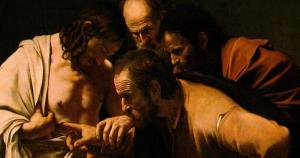 Yesterday was the Sunday of Saint Thomas: the disciple whose account ends any thought that First Century Palestine was stupidly credulous about miracles. After all, one of the most powerful group of Jewish people did not even believe in life after death!
Thomas had scarring experiences we have not had nor will ever have that made reasonableness about a living Jesus hard. He had followed Jesus, Jesus had been crucified, now Thomas found reason hard, almost impossible given his experiences. He wanted to believe that Jesus was alive, but his post-traumatic stress was locking up his mind in gnawing doubts.
Thomas is not a model skeptic. He is so depressed, he can no longer hope. He may (also) be a misogynist, troubled by the testimony of women, but who can be sure? Thomas is (in this story) the last apostle in the old era; he lacks the Holy Spirit, the indwelling divine nature that enables a man to become like God (theosis).
In the context of John’s Gospel, the Divine Son is returning to the Father and sending the Holy Spirit. All humanity will be able to become children of God by having the Holy Spirit dwell within them. We, who have only historical records of Christ’s crucifixion, have the happy advantage of direct access to God. We are, as John points out, in a blessed state. In a beatitude Jesus states:
Thomas, because thou hast seen me, thou hast believed. Blessed (happy) are they that have not seen, and yet have believed.*
Thomas has had his request fulfilled, though as Gregory the Great argued, Thomas has gone beyond the evidence of merely touching the risen Lord when he (rightly) says: “My Lord and my God.” Thomas has seen a risen man, touched Him, and proclaimed His divinity, but this cannot be merely on Christ’s resurrection body. Instead, the encounter with Jesus Christ has taken Thomas further than just saying Jesus is not dead. He sees that Jesus is not dead, but Thomas had seen Lazarus raised. He did not proclaim Lazarus God. The coming of the Holy Spirit (given to the other apostles just a few verses earlier) enabled Thomas to see more than what mere vision would give. If you doubt this, note that Thomas famously touches Jesus, but Jesus says he has “seen.” He does not mention “touch.” Saint Thomas has gone beyond his traumatic doubts to a divine seeing. He had a revelation of God just like that all of us have: Thomas saw a man with scars risen from the dead and by the power of the Holy Ghost experienced God.
He saw and believed: excellent.
Happy, however, are those of us who do not see the risen God-man, but experience God through the Holy Spirit. The writer of John assumed the witness of the Apostles and the other evidences of history combined with a personal experience of the risen God-man through the Holy Spirit would be enough for reasonable belief. After all, if a man were determined to doubt, then Thomas had not “seen” enough to get to Jesus being God. He got there, because Thomas’ experience of Jesus was seeing that was more than seeing. He was blessed, but so are we!
We come to Jesus personally and touch Him in the Church His Body, the Word, and His sacraments.
The Gospel writer is not giving us an epistemology in these verses, though nothing he says is contrary to a sound, reasonable approach to living. Revelation and experience, deep personal experience, is a reason to believe, though not the only one. The direct experience of God in the Holy Spirit is (after Jesus) not just available in the Temple or to a few chosen ones, but to all God’s children.
Thomas saw the risen Lord: he did not need faith in the resurrection. He could not doubt it. Even if Thomas entertained the possibility of a mass delusion, Thomas had seen what he had seen, felt what he had felt. Yet this “seeing” was not enough: Thomas by the Holy Spirit (as Gregory noted) has gone further. He has seen God in the risen Lord and is blessed. We can be blessed too, because we need not see the risen body to experience the Risen Lord.
Oddly, Christian fundamentalists, never seeing a Bible verse they could not misunderstand, and Internet atheists** who never saw a Bible verse they did not understand like a Christian fundamentalist, both try to turn this verse into epistemological advice without understanding the context. One (occasionally) meets a Christian messed up enough to think this verse means they should just believe without evidence and (often) an Internet atheist**agrees.
They can then mic drop and meme forever: ignorance is bliss and they are happy all the time, secure in surety.
Instead, to the extent we have anything epistemological happening in this story, Thomas is healed of his trauma and is enabled to believe. The rest of us, everyone after the first few weeks of Pascha, are reminded we can be happy. We can have a good experience of God. Of course, if we doubt, then we should examine the evidence and it will be sufficient, but only if combined with a revelation of the risen Lord.
We have faith seeking understanding.
—————————-
*John 20: 29 Parenthetical “happy” is my explanation of the Greek term translated “blessed.” I have also used a period to show the beatitude plainly that Jesus is pronouncing on us.
**Internet atheists: no training in relevant fields, but opine as mirror Christian fundamentalists. Often former Christian fundamentalists. Atheism is a serious intellectual tradition. I have a great debt to many serious atheists. Internet atheists are not serious.
Previous Post

May 5, 2019
Shield of Quintas II (Guest Post James Harrington)
Next Post

May 7, 2019 On Being Happy
Browse Our Archives
Select a Category Apologetics Art Culture Education On Books On Education Philosophy Politics Pop Culture Spiritual Reflections Uncategorized
Select a Month October 2026 September 2026 August 2026 July 2026 July 2025 June 2025 September 2024 July 2024 June 2024 December 2023 June 2023 September 2022 May 2022 April 2022 March 2022 February 2022 July 2021 June 2021 May 2021 April 2021 March 2021 February 2021 January 2021 December 2020 November 2020 October 2020 September 2020 August 2020 July 2020 June 2020 May 2020 April 2020 March 2020 February 2020 January 2020 December 2019 November 2019 October 2019 September 2019 August 2019 July 2019 June 2019 May 2019 April 2019 March 2019 February 2019 January 2019 December 2018 November 2018 October 2018 September 2018 August 2018 July 2018 June 2018 May 2018 April 2018 March 2018 February 2018 January 2018 December 2017 November 2017 October 2017 September 2017 August 2017 July 2017 June 2017 May 2017 April 2017 March 2017 February 2017 January 2017 December 2016 November 2016 October 2016 September 2016 August 2016 July 2016 June 2016 May 2016 April 2016 March 2016 February 2016 January 2016 December 2015 November 2015 October 2015 September 2015 August 2015 July 2015 June 2015 May 2015 April 2015 March 2015 February 2015 January 2015 November 2014 October 2014 September 2014 August 2014 July 2014 June 2014 May 2014 April 2014 March 2014 February 2014 January 2014 December 2013 November 2013 October 2013 September 2013 August 2013 July 2013 June 2013 May 2013 April 2013 March 2013 February 2013 January 2013 December 2012 November 2012 October 2012 September 2012 August 2012 July 2012 June 2012 May 2012
Follow Us!
TAKE THE
Religious Wisdom Quiz
According to Romans, what is the gift of God?
Select your answer to see how you score.
Salvation Grace The Holy Spirit Eternal life in Christ Jesus
Books by This Author John Mark Reynolds
Related posts from Eidos

Classical Education Must Teach Us to Make the...

Classical Education and the Art of Dying Well

Golden, Golden, Golden: My Mother's Last Lesson

TRENDING AT PATHEOS Evangelical

The REST of Your Life: A Creative Wrestles...
This week I had a conversation with a good friend from church....

How the author of the world's best hymn...
I've been working with John Newton for a while now. This makes...

Long before this Lectio Divina, Psalm 130 - the song - started...

What About the Trees? Another Living Parable
After I finished writing the last article about falling leaves as a...

Why Classical Education Is a Conversation, Not a...
Come and Read: Joy in Classical Education When I was a little...

Cornell University has received a great deal of negative publicity and intense...
view all Evangelical blogs
Ad-Free & Subscriber Log-In Subscription Support
- About Us
- 2026 Calendar
- Videos
- Podcasts
- Library of World Religions
- Faith In Media Tracker
- Advertise With Us
- Write for Us
- Privacy Policy
- Terms of Service
- Do Not Sell My Data
- Contact Us
- Radiant Digital
- Manage Newsletter Subscriptions
- Unsubscribe From Notifications
- Sitemap
Copyright 2008-2026, Patheos. All rights reserved.
Subscription Support Ad-Free & Subscriber Log-In
Follow Patheos